
Muscle recovery is one of the most important factors beginners often overlook when trying to build muscle. If you’re getting started with resistance training, understanding muscle recovery is important for both progress and long-term consistency. I’ve learned this the hard way through my own experience as a beginner who jumped headfirst into training without enough research, structure, or guidance.
Recovery is not just about making soreness disappear or waiting a certain number of hours before training again. Resistance training provides a stimulus, but it also creates fatigue. Recovery is the process that allows fatigue to fall, adaptation to take place, and you to return ready to train productively again.
These muscle recovery tips for beginners focus on the fundamentals that matter most: a sensible training dose, enough sleep, adequate nutrition and hydration, appropriate rest, and knowing how to recognize when fatigue is becoming a problem. The goal is not to recover as much as possible. It is to recover well enough to keep training effectively, progressing over time, and avoiding unnecessary setbacks.
Note: This guide is for educational purposes and does not replace individualized medical advice. If you have an injury, medical condition, or severe or unusual symptoms, consult an appropriate qualified healthcare professional.
What Does Muscle Recovery Mean and Why It Matters
Muscle recovery is the process your body goes through after training to manage fatigue and adapt to the stress of exercise. If you think recovery is just about fixing sore muscles or waiting until you don’t hurt, that’s missing the bigger picture. The real goal is to help your body return to productive training so you can make progress week after week. Good recovery allows you to perform better over time and avoid unnecessary interruptions, like injury or mental burnout.
For beginners, muscle recovery supports the full cycle of training. You create a stimulus by lifting, your body gets a bit fatigued, you recover, then your muscles adapt, and you return ready for new progress. When recovery lags, you don’t get as much out of your workouts and might even end up stuck or feeling worse.
How Muscles Actually Adapt After Strength Training
Resistance training creates a stimulus that tells your body it needs to adapt. That stimulus triggers a complicated series of cellular signals, protein remodeling, and other adaptations that can eventually make your muscles larger and stronger when training is repeated consistently over time.
You may have heard that lifting works mainly by creating “tiny tears” in your muscles that are repaired and come back bigger. That explanation is too simple.
Muscle damage can happen after resistance training, especially when an exercise is new, the workload suddenly increases, or you return after a long break. But muscle damage is not required for muscle growth, and creating more damage does not automatically create more hypertrophy. Research has shown that muscle growth can occur even when substantial muscle damage is absent (Damas et al., 2018).
That is one reason soreness should not be used as a score for workout quality. A productive workout creates an appropriate training stimulus. The goal is not to damage your muscles as much as possible—it is to provide enough of a stimulus to progress while keeping fatigue manageable enough to train productively again.
Quick Answer: Muscle Recovery Tips for Beginners
- Build workouts with sensible training volume and intensity. Do enough to make progress, not as much as possible.
- Rest days are part of the process, not a sign of weakness.
- Don’t chase soreness; DOMS isn’t proof of muscle growth.
- Focus on adequate sleep and nutrition as daily priorities.
- Use active recovery, stretching, or foam rolling as bonuses, not must-haves.
- Pay attention to pain and energy levels. Don’t ignore sharp or unusual pain.
- Adjust your routine if signs of poor recovery show up over several days.
Understanding Fatigue: Local, Whole Body, and the Recovery Cycle
When you lift, your body gets tired in two main ways. There’s local fatigue, which feels like sore or tired muscles just in the body part you trained. Then there’s systemic or whole body fatigue, which can show up as mental fog, full body tiredness, or decreased energy. Both impact recovery and progress, so it’s worth learning what causes each.
Progress happens in a cycle, often called fitness-fatigue. Each training session creates a balance of fitness (adaptation you want) and fatigue (temporary loss of performance from effort). The goal is to recover enough, especially between sessions, to let fitness gains show up while keeping fatigue manageable. For beginners, this often means spreading training stress through the week, not doing marathon sessions, and giving yourself time to recover both physically and mentally.

How Training Design Affects Recovery
It’s easy to think recovery begins when your workout ends. In reality, one of the best ways to improve recovery is to avoid creating more fatigue than you need in the first place.
Volume and Training Dose
More training can provide more stimulus up to a point, but it also creates more fatigue. The Muscle & Strength Pyramid: Training, 3rd Edition describes different levels of training volume rather than one perfect number for everyone. Its practical long-term hypertrophy range is roughly 10–20 fractional sets per muscle group per week, while lower amounts can still produce progress—especially in newer lifters (Helms, Morgan, & Valdez, 2025).
That does not mean every beginner should immediately perform 10–20 sets per muscle. Start with a manageable amount that allows you to progress, recover, and maintain good training quality. Add more only when you have a reason to, such as a genuine plateau after your sleep, nutrition, exercise execution, effort, and other fundamentals are already in place.
A useful principle is simple: do enough to progress, not as much as possible.
Proximity to Failure
How close a set gets to muscular failure also affects both stimulus and fatigue. You do not have to take every working set to failure to build muscle.
How close you need to train depends partly on the load and rep range. Lighter, higher-repetition sets generally need to be taken closer to failure to provide a strong hypertrophy stimulus, while heavier sets can be effective farther from failure.
For beginners, the main lesson is not to obsess over one universal RIR number. Learn what challenging training feels like, use good technique, and avoid making every set an all-out test. Training to failure can be useful in some situations, but it is not required for muscle or strength gains and can create additional fatigue (American College of Sports Medicine, 2026).
Frequency and Stress Distribution
Training frequency is mainly a tool for organizing your weekly training dose. When weekly volume is equated, simply training a muscle more often does not automatically cause more muscle growth.
If your weekly volume is modest, one or two sessions for a muscle may be perfectly workable. As weekly volume increases, spreading that work over two, three, or more sessions can help maintain session quality and prevent too much work from being crammed into one workout.
Choose a frequency that fits your training volume, recovery, schedule, and preferences instead of assuming every muscle must be trained on one specific schedule.
Exercise Novelty
New exercises, unfamiliar ranges of motion, sudden increases in volume, and movements that place a muscle under unfamiliar stress can produce more soreness and muscle damage. As you repeatedly perform the same movements, the body usually becomes less sore from them—a phenomenon known as the repeated-bout effect.
That is another reason beginners do not need to constantly change exercises just to “shock” their muscles. Keeping core exercises relatively consistent makes it easier to learn them, track progress, and avoid unnecessary soreness.
Life Stress Matters Too
Your recovery capacity is not determined only by what happens in the gym. Sleep, nutrition, work or school demands, other sports and physical activity, psychological stress, illness, travel, and your individual response to training can all change how much training you can productively recover from.
The right training dose is therefore not a permanent number. It can change as your life changes.
Building Your Recovery Hierarchy: What Actually Works
Not every recovery strategy deserves the same amount of attention. Beginners will get far more from improving the fundamentals than from chasing gadgets, supplements, or special recovery techniques.
A useful recovery hierarchy looks like this:
- Appropriate training dose, progression, and fatigue management
- Adequate sleep duration, consistency, and quality
- Enough calories, protein, carbohydrates, micronutrients, and fluids
- Appropriate rest between demanding sessions and management of life stress
- Light activity or active recovery when useful
- Optional comfort tools such as stretching, foam rolling, massage, massage guns, sauna, or cold exposure
The lower you go on this list, the smaller and more situation-dependent the benefits usually become.
In practical terms, do not try to solve a recovery problem with a massage gun, ice bath, supplement, or other recovery tool if the real problem is too much training, too little sleep, inadequate nutrition, or unmanaged fatigue.
Sleep: The Foundation of Recovery
I’ve noticed my energy and mood take a hit when I’m not sleeping enough, and sleep is also one of the most important lifestyle factors supporting productive training.
Sleep helps support physical and mental recovery, training performance, normal physiological function, and the processes involved in adaptation. Severe sleep restriction has even been shown to reduce myofibrillar protein synthesis in healthy young men (Saner et al., 2020).
For healthy adults, regularly getting at least 7 hours of sleep per night is an evidence-based minimum recommendation. Around 7–9 hours is a useful practical range for many people, while some young adults, people recovering from sleep debt, and people with greater individual sleep needs may benefit from more (Watson et al., 2015).
To make good sleep easier:
- Give yourself enough time in bed to actually reach your sleep target.
- Try to keep your sleep and wake times reasonably consistent.
- Keep your bedroom dark, quiet, and comfortably cool.
- Avoid consuming caffeine so late that it interferes with your ability to fall asleep.
- If screens or stimulating activities keep you awake later than intended, create some distance from them before bed.

You do not need perfect sleep to make progress, and one bad night does not ruin your recovery. Look at your sleep as a pattern. If you are consistently sleeping too little, any realistic improvement is a step in the right direction.
Rest Days and Training Frequency: What Beginners Need to Know
There is no universal number of rest days every beginner needs, and there is no rule saying a muscle must always rest for a certain number of hours before it can be trained again.
Recovery depends on the amount of work you performed, how close you trained to failure, exercise selection and novelty, how accustomed you are to the workload, your sleep and nutrition, other physical activity, life stress, and your individual response.
Frequency should therefore be used to distribute your weekly workload rather than treated as a recovery law.
A beginner might train two, three, four, or more days per week depending on the program. A three-day full-body routine naturally creates more non-lifting days than a four-day upper/lower routine, but both can manage recovery very well when their training doses are appropriate.
Even training the same muscle on consecutive days is not automatically wrong if the amount and difficulty of work are low enough. At the same time, most beginners do not need to cram large amounts of hard work into back-to-back sessions.
Instead of counting down a universal recovery clock, look at the bigger picture: how your warm-ups feel, whether your performance is near normal, whether soreness is affecting movement or technique, how much fatigue you are carrying, and whether your program continues to produce progress.

Understanding Soreness (DOMS): Myths, Facts, and Progress
Feeling sore after training (also known as delayed onset muscle soreness, or DOMS) is normal when you try something new, increase intensity, or return after a break. DOMS commonly begins around 12–24 hours after unfamiliar or demanding exercise and may be most noticeable around 24–72 hours later (American College of Sports Medicine, n.d.). But soreness is not a mandatory sign of a good workout. A session that leaves you limping does not guarantee better results. Over time, repeated use of an exercise usually brings less soreness even if progress continues.
Is It Safe to Train When Sore?
Mild soreness is common, especially if you’re new or changing exercises. You can usually train through mild to moderate muscle soreness if you can move well, your warmup feels normal, and performance is steady. Severe or lingering soreness, loss of function, or pain that affects form means it’s usually better to rest or train a different muscle group.
Fueling Recovery: Energy, Protein, Carbs, and Hydration
Calories and Energy Availability
Recovery is harder when your energy intake chronically falls too far below what your body needs for training and normal physiological function.
You do not need to be in a calorie surplus simply to recover, and muscle growth can occur at maintenance or even in a calorie deficit in some situations. However, aggressive or prolonged calorie restriction can make training performance, recovery, and muscle retention more difficult.
Match your calorie intake to your goal, avoid unnecessary crash dieting, and remember that a nutrition plan still needs to support productive training.
Protein
Protein supplies amino acids used to build, repair, and remodel body tissues.
The Muscle & Strength Pyramid: Nutrition, 3rd Edition recommends at least about 1.6 grams of protein per kilogram of total body weight per day at maintenance or in a calorie surplus, or about 2.2 g/kg of lean body mass. Protein needs can be higher for lean lifters dieting in a calorie deficit. The roughly 1.6 g/kg/day figure also aligns with a major meta-analysis in which additional protein above about 1.62 g/kg/day did not produce further resistance-training-related gains in fat-free mass on average (Helms, Morgan, & Valdez, 2025; Morton et al., 2018).
You do not need to obsess over consuming protein within minutes of your final set. The old idea of a tiny post-workout “anabolic window” was overstated. The opportunity to benefit from protein after resistance training is wider than once believed (Helms, Morgan, & Valdez, 2025).
For most beginners who eat normal protein-containing meals throughout the day, simply training between meals and eating another meal afterward is enough. If you train first thing in the morning after an overnight fast, consuming protein reasonably soon after training becomes more useful.
If you want help calculating your intake, see my Beginner’s Guide to Protein.
Carbohydrates and Glycogen
Carbohydrates help fuel demanding resistance training and replenish muscle glycogen after training.
Most beginners do not need to rush to consume high-glycemic carbohydrates the second their workout ends. With an adequate carbohydrate intake, glycogen can normally be replenished well before the next demanding session.
Rapid carbohydrate replacement becomes more relevant if you perform multiple exhausting training sessions in the same day, train the same muscles again soon afterward, combine lifting with a large amount of conditioning or sport, or are dieting with relatively low carbohydrate intake.
For normal beginner lifting, focus first on eating enough carbohydrate across your overall diet to support your training.

Hydration and Electrolytes
Fluid needs differ substantially from person to person because body size, climate, sweat rate, training duration, training intensity, and other factors all matter.
A simple practical check is urine color. Most urinations being pale or light yellow is generally consistent with good hydration. Keep in mind that your first urine after waking is normally darker, and some vitamins or supplements can change urine color.
You also do not need an electrolyte drink for every normal gym workout. Extra sodium and electrolytes become more relevant when you sweat heavily, exercise for long periods, or train in hot and humid conditions.
The goal is not to force as much water as possible. It is to arrive at training adequately hydrated and replace meaningful fluid losses when they occur.
Active Recovery, Stretching, and Recovery Gadgets: What Helps and What’s Optional
Active Recovery
Light walking, easy cycling, gentle mobility work, or other low-effort movement can help some people feel less stiff or sore and can be an enjoyable way to stay active on a rest day.
However, active recovery should not be treated as a technique that magically speeds tissue repair. You do not need a special “recovery workout” on every day you are not lifting. If complete rest feels better, that is also fine.
Stretching
Stretching can be useful for improving or maintaining flexibility, and some people simply enjoy how it feels after training.
What stretching should not be sold as is a reliable way to eliminate DOMS or dramatically accelerate recovery. Research comparing post-exercise stretching with passive recovery has not shown a meaningful improvement in strength recovery or delayed-onset muscle soreness (Afonso et al., 2021).
Stretch because you want the flexibility benefits or because you enjoy it—not because you think it is required for muscle growth or recovery.
Foam Rolling and Massage
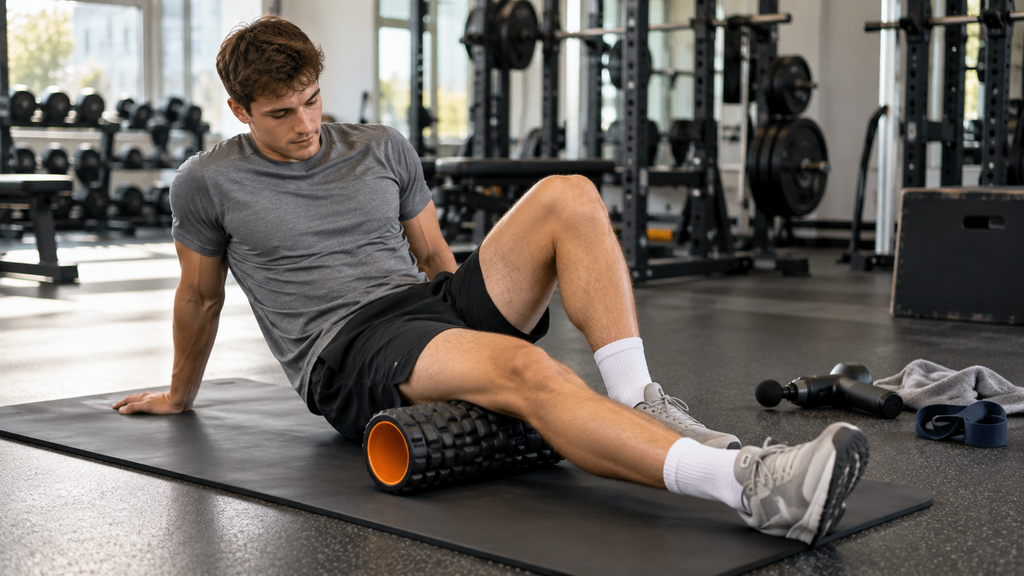
Foam rolling and massage may temporarily reduce perceived soreness or improve range of motion. That can make them useful comfort tools after difficult training, although the overall recovery effects of foam rolling appear relatively small (Wiewelhove et al., 2019).
Their place is still well below the fundamentals. Foam rolling cannot compensate for an excessive training dose, chronic sleep loss, or inadequate nutrition.
Massage Guns
Massage guns may temporarily change how stiff or sore a muscle feels and may improve range of motion in some situations, but the research base is much smaller than the marketing surrounding them (Ferreira et al., 2023).
You can use one if you enjoy it. You do not need one to build muscle or recover properly.
Saunas
Saunas can be relaxing and may have other health or heat-acclimation applications, but evidence that sauna use meaningfully speeds muscle recovery for the average beginner is limited.
Treat sauna use as optional rather than a recovery requirement.
Cold Water Immersion and Ice Baths
Cold-water immersion can reduce perceived soreness and may be useful when short-term recovery is more important than maximizing long-term resistance-training adaptations—for example, certain competitive sport situations.
That creates an important tradeoff for someone lifting primarily to build muscle.
Repeatedly using cold-water immersion immediately after resistance training may modestly reduce muscle-growth adaptations. The evidence is still developing, and the concern mainly applies to regular cold-water immersion used soon after lifting rather than occasional cold exposure at other times (Piñero et al., 2024).
For a beginner whose main goal is building muscle, routine ice baths or cold plunges immediately after lifting are therefore not a recovery habit I would recommend by default.
For a deeper science-based discussion of common recovery methods—from sleep and food to foam rolling, massage guns, sauna, deloads, and cold-water immersion—the video below provides a useful visual breakdown.
How to Know If You’re Recovered: A Simple Green, Yellow, and Red Check
You do not need to wait until you feel 100% fresh before every workout. At the same time, “listen to your body” is not very useful advice if you do not know what signals to look for.
A simple green/yellow/red framework can help you organize those signals. This is a practical decision-making tool, not a validated medical test.

Green: Train as Planned
- No soreness or only mild soreness
- Normal range of motion
- Warm-up sets feel roughly normal
- Strength and repetitions are close to your usual performance
- Energy and motivation are normal
- No concerning pain
If most signs are green, your planned workout can usually continue normally.
Yellow: Adjust if Needed
- Moderate soreness or stiffness
- Worse sleep than normal
- Higher life stress or fatigue
- Warm-up sets feel unusually heavy
- Small drop in strength or repetitions
- Lower-than-normal motivation or energy
A yellow day does not automatically mean you need to skip the gym. Consider reducing a few sets, leaving more repetitions in reserve, avoiding unnecessary failure training, or choosing a less-fatiguing variation if that makes sense.
Red: Do Not Simply Push Through
- Sharp or significant localized pain
- Major loss of range of motion
- Pronounced weakness
- Significant swelling or bruising
- Pain that changes how you move or lift
- Illness or unusually severe whole-body symptoms
Red flags are different from normal training fatigue. Stop or modify the activity that is causing the problem and seek medical evaluation when symptoms are severe, unusual, worsening, or otherwise concerning.
Recovery is best judged from several signals together rather than one isolated feeling.
Signs You May Need More Recovery
Do not diagnose poor recovery from one difficult workout. Everyone has occasional sessions where performance is lower, sleep was poor, motivation is off, or a weight simply feels heavier than expected.
Look for patterns instead.
Possible signs that fatigue is accumulating faster than you are recovering include:
- Repeated decreases in load or repetitions across workouts
- Normal weights consistently feeling harder than they should
- Persistent or unusually severe soreness
- Increasing aches and pains
- Sleep becoming worse than normal
- Feeling run-down or unusually fatigued for several days
- Motivation to train dropping for an extended period
- Life stress increasing while training demands stay the same
- Getting sick more frequently
- Training quality continuing to decline despite appropriate effort
A plateau by itself does not automatically mean you are under-recovered. Lack of progress can also come from too little training stimulus, poor exercise execution, inaccurate effort estimates, nutrition issues, or simply expecting progress faster than your training status allows.
Under-Recovery Is Not the Same as Overtraining Syndrome
The word “overtraining” is often used for almost any period of soreness, fatigue, or bad gym performance, but true Overtraining Syndrome is much more serious and appears to be very rare in people who only perform resistance training. Research in resistance training has also struggled to consistently establish true Overtraining Syndrome because sustained performance decline and appropriate follow-up are required to distinguish it from shorter-term fatigue or overreaching (Grandou et al., 2020).
Most beginners who feel run-down are much more likely to be dealing with normal training fatigue, a temporarily excessive workload, poor sleep, life stress, insufficient food, illness, or some combination of these factors.
That distinction matters because the solution is usually not panic or months away from the gym. It is identifying what is creating too much fatigue and adjusting it.
What to Do When Recovery Slows
Start with the fundamentals:
- Review your recent sleep
- Make sure you are eating enough for your current goal
- Check your protein and carbohydrate intake
- Consider whether life stress or other physical activity has increased
- Review whether training volume or effort recently increased
- Avoid forcing progression when performance is clearly suppressed
- Add rest or temporarily reduce training stress when needed
If your recovery improves after addressing those issues, gradually return to normal training.
Do Beginners Need Deload Weeks?
A deload is a temporary reduction in training stress that can help accumulated fatigue come down while allowing you to keep training.
Beginners do not need to automatically schedule a deload every four, six, or eight weeks. The Muscle & Strength Pyramid: Training, 3rd Edition recommends using deloads when they are actually needed rather than assuming every lifter needs them on a fixed calendar.
Most normal fatigue can often be managed through appropriate training, regular days away from demanding resistance training, enough sleep and food, and sensible stress management.
A deload becomes more reasonable when several signs of under-recovery show up together—such as worsening sleep, decreasing loads or repetitions, greater-than-normal aches and pains, unusually high life stress, or consistently dreading training.
If you are generally feeling beat up and under-recovered, one practical deload approach from The Muscle & Strength Pyramid: Training, 3rd Edition is to reduce the number of working sets by roughly 30–50% for a short period. The exact adjustment should still depend on the situation. If only one body area is struggling, you may only need to reduce or temporarily change the exercises stressing that area instead of cutting the entire program (Helms, Morgan, & Valdez, 2025).
A deload is also different from normal recovery. You need recovery after every training session, but you do not necessarily need a special deload week every few weeks.
For most beginners, the better approach is to start with a manageable training dose, pay attention to recovery trends, and use a deload when accumulated fatigue actually gives you a reason to.
Difference Between Soreness, Injury, and Medical Red Flags
Normal training soreness and pain that may signal an injury are not the same thing, but there is also no perfect sensation-based test that can diagnose an injury.
Normal delayed-onset muscle soreness usually appears after unfamiliar or unusually demanding exercise rather than as a sudden sharp pain during a repetition. DOMS commonly starts around 12–24 hours after exercise and may be most noticeable roughly 24–72 hours later.
Typical muscle soreness may feel like:
- General tenderness across the muscle you trained
- Stiffness or discomfort when the muscle moves
- Temporary reductions in strength or range of motion that improve as recovery progresses
Pain deserves more caution when it is persistent, intense, strongly localized, changes how you move, or appears alongside unusual symptoms.
Warning signs can include:
- Sharp or severe pain
- Pain that consistently returns with a specific movement, load, or range of motion
- Significant swelling or visible bruising
- Major or unexpected weakness
- A substantial loss of normal movement
- Pain that radiates to another area
- Dizziness, nausea, numbness, or other unusual symptoms
Pain is complex, and the amount of pain you feel does not perfectly measure how much tissue damage has occurred. That is another reason not to diagnose yourself solely from how something feels.
If an exercise repeatedly causes significant pain, stop forcing that exact movement. A qualified healthcare or rehabilitation professional can help determine what is going on and whether modifying the exercise, load, or range of motion is appropriate.
If symptoms are severe, unusual, worsening, or interfering substantially with normal movement or daily life, seek appropriate medical evaluation instead of trying to push through them.
When Severe Muscle Pain Needs Immediate Medical Attention
There is one rare but important condition beginners should know about: rhabdomyolysis, often shortened to rhabdo.
Rhabdomyolysis occurs when damaged muscle tissue breaks down and releases its contents into the bloodstream. It can become a medical emergency.
Warning signs can include:
- Muscle pain, cramping, or aching that is much more severe than expected
- Unusual or pronounced muscle weakness
- Dark tea- or cola-colored urine
These symptoms can appear hours or even days after the activity that caused the muscle damage.
If you develop symptoms that could indicate rhabdomyolysis, seek medical attention immediately. It cannot be confirmed simply by looking at your symptoms; healthcare professionals use blood testing to diagnose it (CDC/NIOSH, 2025).
Normal post-workout soreness is common. Severe muscle symptoms combined with unusual weakness or dark urine should not be treated as ordinary DOMS.
Example Beginner Recovery Schedules
There is no single weekly schedule every beginner must follow. These examples simply show two different ways resistance training and recovery can be organized.
3-Day Full-Body Example
Monday: Full-body resistance training
Tuesday: No resistance training / normal daily activity
Wednesday: Full-body resistance training
Thursday: No resistance training / normal daily activity
Friday: Full-body resistance training
Saturday: No resistance training / optional easy activity
Sunday: No resistance training / normal daily activity
This setup distributes three full-body sessions across the week with non-lifting days between them. It can work especially well for beginners who want a simple schedule and relatively frequent practice of the major movement patterns.
4-Day Upper/Lower Example
Monday: Upper body
Tuesday: Lower body
Wednesday: No resistance training / normal daily activity
Thursday: Upper body
Friday: Lower body
Saturday: No resistance training / optional easy activity
Sunday: No resistance training / normal daily activity
This schedule includes back-to-back training days, but the main muscular emphasis changes between upper- and lower-body sessions.
Neither schedule is automatically better for recovery.
The important question is whether the weekly training dose is appropriate, the workload is distributed well enough to maintain training quality, and you are recovering well enough to continue progressing.
A well-designed program should fit your schedule rather than forcing your life to fit an arbitrary recovery rule.
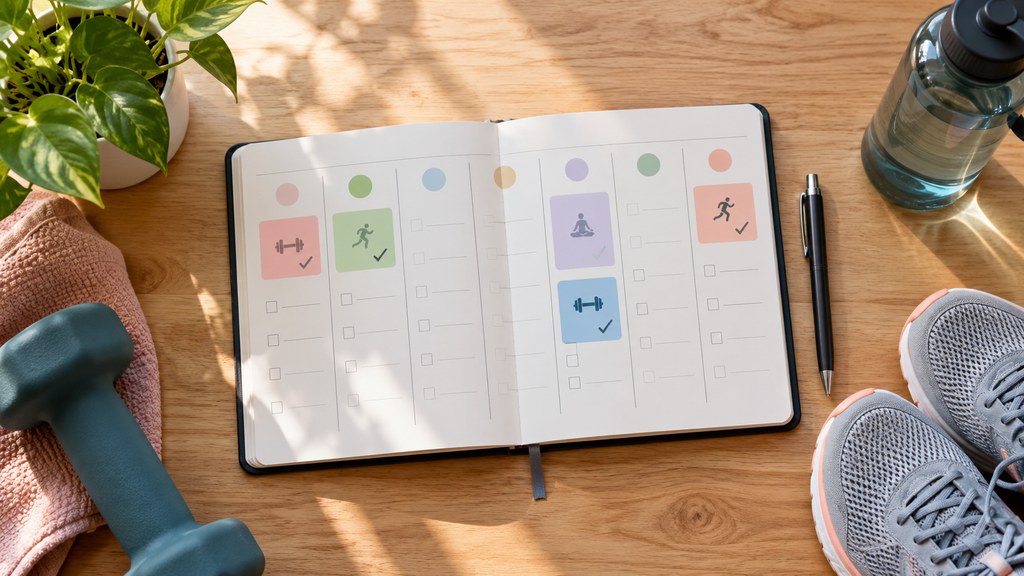
Beginner’s Muscle Recovery Checklist
Use this simple checklist to make sure the major recovery fundamentals are covered:
□ Am I regularly getting enough sleep—at least 7 hours per night, with roughly 7–9 hours being a useful target for many adults?
□ Is my training dose manageable enough that I can maintain good technique, effort, and performance across the week?
□ Am I eating enough calories for my current goal instead of chronically under-fueling my training?
□ Am I getting enough daily protein—around 1.6 g/kg of body weight as a useful baseline at maintenance or in a calorie surplus?
□ Am I eating enough carbohydrates to support my training demands?
□ Am I staying adequately hydrated rather than routinely starting workouts dehydrated?
□ Am I allowing my training schedule to distribute hard work in a way I can recover from?
□ Is my soreness manageable rather than repeatedly interfering with movement, technique, or performance?
□ Are my loads, repetitions, energy, sleep, aches, and motivation reasonably stable or improving over time?
□ Have I accounted for stress outside the gym, including work, school, sports, illness, travel, and other physical activity?
□ Am I treating stretching, foam rolling, massage guns, saunas, and similar recovery methods as optional tools rather than foundations?
□ Am I willing to temporarily reduce training stress when several signs of poor recovery appear together?
If most of these fundamentals are consistently in place, you probably do not need to search for complicated recovery hacks.
Frequently Asked Questions
How long do I need to rest after a workout?
There is no universal number of hours that every muscle needs before it can be trained again. Recovery depends on the amount and difficulty of the training, exercise selection, how accustomed you are to the workload, sleep, nutrition, life stress, and the way your program distributes training across the week.
Instead of following an automatic 24-, 48-, or 72-hour rule, look at your overall recovery and whether you can perform the next planned session productively.
Do I need to get sore for muscles to grow?
No. DOMS is not required for muscle growth and is not a reliable score for workout effectiveness.
Beginners often become less sore as they adapt to an exercise even while continuing to gain strength and muscle. Focus on productive training and long-term progression rather than trying to create as much soreness as possible.
Should I train if I’m a little sore?
Mild soreness does not automatically mean you need to skip training.
If you can move normally, your warm-up feels reasonably normal, your technique is not being altered, and performance is close to what you expect, training may still be appropriate.
If soreness is severe enough to substantially restrict movement, change your technique, or greatly reduce performance, more recovery or an adjustment to the session may make sense.
Does a rest day mean I should do nothing?
No. A rest day usually means taking a break from demanding resistance training, not avoiding all movement.
Walking, normal daily activity, gentle mobility work, or easy recreational activity can be perfectly reasonable if they do not create meaningful additional fatigue.
You also do not need to perform a special active-recovery workout. Complete rest from structured exercise is fine too.
Can I work out every day?
You can be physically active every day, but beginners do not need seven hard resistance-training sessions per week to make excellent progress.
Whether consecutive training days work depends on how your program distributes exercises, muscle groups, volume, and effort. More training days are not automatically better.
Does cardio hurt muscle recovery?
Not necessarily.
Resistance training and cardio can coexist very well. The main concern is the total amount and type of stress you are creating.
Large amounts of exhausting cardio, high-impact work, or demanding conditioning can add fatigue and sometimes interfere with resistance-training performance if they are not organized appropriately. Moderate cardio that you can recover from is a different situation.
Do I need a massage gun or foam roller?
No.
Foam rolling and massage guns may temporarily help with soreness, stiffness, or range of motion in some situations, but they are optional tools.
They are much less important than sensible training, adequate sleep, nutrition, hydration, and appropriate fatigue management.
Are ice baths good after lifting?
Cold-water immersion can reduce perceived soreness in some situations, but routinely using it immediately after resistance training may interfere with some long-term muscle-growth adaptations.
If building muscle is your main goal, you generally do not need to make an immediate post-workout ice bath or cold plunge part of your recovery routine.
Are recovery supplements or powders necessary?
No.
Most beginners should focus first on their overall diet.
Protein powder can be a convenient way to help meet your protein needs, but it is not required if you already get enough protein from food.
Creatine monohydrate is a well-supported supplement for resistance-training performance and muscle gain, but it is better thought of as a useful training supplement than something you must take in order to “recover.”
Special BCAA drinks, recovery powders, or expensive post-workout formulas are not replacements for the fundamentals.
What should I eat for muscle recovery?
Start with your overall diet rather than one magical recovery meal.
Eat enough calories for your current goal, get sufficient daily protein, include enough carbohydrate to support training, consume a generally nutritious diet, and stay adequately hydrated.
There is usually no need to panic about consuming a shake or high-glycemic carbohydrate the minute your workout ends.
How do I know if I need a deload?
Look for multiple recovery problems occurring together rather than one bad workout.
Worsening sleep, falling loads or repetitions, increased aches and pains, unusually high stress, and consistently dreading your workouts can indicate that accumulated fatigue is becoming a problem.
Most beginners do not need automatic deloads on a fixed calendar. Use them when your recovery and performance trends give you a reason to.
Key Takeaways
- Recovery is not something separate from your training plan. Your training volume, effort, frequency, exercise selection, and progression all influence how much fatigue you create and how much recovery you need.
- The goal is not to maximize recovery or wait until you feel perfect. The goal is to manage fatigue well enough that you can return and train productively again.
- Sleep, adequate nutrition, protein, carbohydrates, hydration, sensible training, and appropriate time between demanding sessions form the recovery foundation.
- Muscle damage and soreness are not requirements for muscle growth. A productive workout does not need to leave you extremely sore.
- Rest days are not governed by one universal 24-, 48-, or 72-hour rule. Recovery depends on the person, the workout, the program, and life outside the gym.
- Stretching, foam rolling, massage, massage guns, saunas, active recovery, and cold exposure are optional tools—not substitutes for the fundamentals.
- Judge recovery from trends in performance, soreness, sleep, energy, motivation, stress, and aches rather than one bad workout or one isolated feeling.
- Beginners generally do not need automatically scheduled deloads. Reduce training stress when accumulated fatigue actually gives you a reason to.
- Normal soreness is different from concerning pain. Severe, unusual, persistent, or worsening symptoms deserve caution and, when appropriate, professional medical evaluation.
The simplest principle to remember is this: train hard enough to create a productive stimulus, then manage fatigue well enough to keep progressing.
References
- Helms, E., Morgan, A., & Valdez, A. (2025). The Muscle & Strength Pyramid: Training, 3rd Edition. Muscle and Strength Pyramids, LLC.
- Helms, E., Morgan, A., & Valdez, A. (2025). The Muscle & Strength Pyramid: Nutrition, 3rd Edition. Muscle and Strength Pyramids, LLC.
- Nippard, J. (2024). The Muscle Ladder. Victory Belt Publishing.
- Nippard, J., & Barakat, C. (2020). The Ultimate Guide to Body Recomposition.
- Damas, F., Libardi, C. A., & Ugrinowitsch, C. (2018). The development of skeletal muscle hypertrophy through resistance training: the role of muscle damage and muscle protein synthesis. European Journal of Applied Physiology, 118(3), 485–500.
- Morton, R. W., et al. (2018). A systematic review, meta-analysis and meta-regression of the effect of protein supplementation on resistance training-induced gains in muscle mass and strength in healthy adults. British Journal of Sports Medicine, 52(6), 376–384.
- Watson, N. F., et al. (2015). Recommended Amount of Sleep for a Healthy Adult: A Joint Consensus Statement of the American Academy of Sleep Medicine and Sleep Research Society. Journal of Clinical Sleep Medicine, 11(6), 591–592.
- Saner, N. J., et al. (2020). The effect of sleep restriction, with or without high-intensity interval exercise, on myofibrillar protein synthesis in healthy young men. The Journal of Physiology, 598(8), 1523–1536.
- Afonso, J., et al. (2021). The Effectiveness of Post-exercise Stretching in Short-Term and Delayed Recovery of Strength, Range of Motion and Delayed Onset Muscle Soreness: A Systematic Review and Meta-Analysis of Randomized Controlled Trials. Frontiers in Physiology, 12, 677581.
- Wiewelhove, T., et al. (2019). A Meta-Analysis of the Effects of Foam Rolling on Performance and Recovery. Frontiers in Physiology, 10, 376.
- Ferreira, R. M., et al. (2023). The Effects of Massage Guns on Performance and Recovery: A Systematic Review. Journal of Functional Morphology and Kinesiology, 8(3), 138.
- Piñero, A., et al. (2024). Throwing cold water on muscle growth: A systematic review with meta-analysis of the effects of postexercise cold water immersion on resistance training-induced hypertrophy. European Journal of Sport Science, 24(2), 177–189.
- Grandou, C., Wallace, L., Impellizzeri, F. M., Allen, N. G., & Coutts, A. J. (2020). Overtraining in Resistance Exercise: An Exploratory Systematic Review and Methodological Appraisal of the Literature. Sports Medicine, 50(4), 815–828.
- American College of Sports Medicine. (2026). Resistance Training Prescription for Muscle Function, Hypertrophy, and Physical Performance in Healthy Adults: An Overview of Reviews. Medicine & Science in Sports & Exercise.
- American College of Sports Medicine. Delayed Onset Muscle Soreness (DOMS).
- Centers for Disease Control and Prevention / National Institute for Occupational Safety and Health. (2025). Signs and Symptoms of Rhabdomyolysis.
About the Author
My name is Angel Carcamo. I’m 19 and still consider myself a beginner when it comes to lifting. I started resistance training when I was pretty young, but I did way too much without really knowing what was backed by research. After pushing myself too hard, I developed lower body problems and had to stop for a while, going through some physical therapy. During the two years away, I started reading about evidence-based training and nutrition. My biggest hope with this guide is to help other beginners avoid the same mistakes and build good recovery habits for sustainable progress and fewer setbacks.
Want more beginner resources? Check out the Beginner’s Guide to Progressive Overload or the 12-Week Beginner Plan for step-by-step programming tips.
This is really helpful and makes a lot of sense. Without giving your body that break that it needs, your muscles cannot build themselves or repair themselves, and that is probably why you also feel lousy if you don’t take the break.
I was surprised to read that you could still do light exercise during your recover period like walking or stretching. How much stretching is permissible, as some stretches border on strength training?
Thanks for reading the article and sharing your thoughts, Michel — I’m glad it was helpful!
You’re absolutely right that recovery is essential for muscle growth. A lot of beginners focus only on the workout itself, but the rebuilding process actually happens during rest. Without giving your muscles enough time to repair, it becomes much harder to gain strength and progress consistently.
Light activity during recovery days can actually support that repair process. Gentle movement like walking, easy cycling, or light stretching helps increase blood flow, which brings nutrients and oxygen to the muscles. That can reduce stiffness and help you feel better before your next workout.
When it comes to stretching specifically, the key is to keep it light and controlled, especially on recovery days. A good rule is to hold each stretch for about 15–30 seconds and avoid pushing into pain. The goal is to relax the muscles and improve mobility, not to turn stretching into another intense workout.
For most beginners, 5–10 minutes of light stretching is plenty. Focus on the major muscle groups you trained recently (legs, hips, chest, back, shoulders). If the stretch feels gentle and relieving rather than tiring, you’re probably doing it right.
Thanks again for the thoughtful question, and feel free to share what types of stretching or recovery methods have worked best for you so far!
This is a really solid breakdown, especially the way you emphasized that recovery is where the real progress happens. A lot of beginners (myself included at one point) tend to overlook that and just focus on training harder.
The sleep and rest day sections really stood out—simple, but probably the most important part.
Do you find most beginners struggle more with getting enough rest, or with nutrition when it comes to recovery?
Thank you, Jason — I’m glad that stood out to you.
A lot of beginners really do focus almost entirely on training harder, while recovery gets treated like an afterthought, so I’m happy that part of the article resonated with you. Sleep and rest days really are some of the biggest factors in long-term progress.
To your question, I think most beginners usually struggle more with recovery habits as a whole, but if I had to separate the two, I would say sleep and rest are often the most overlooked. Many people understand that nutrition matters, even if they do not always apply it perfectly, but a lot of beginners still underestimate how much poor sleep, too little rest, and always trying to “push through” can slow recovery.
That said, nutrition is still a very common problem too. Not eating enough total calories, not getting enough protein, and staying under-fueled can definitely make recovery worse. In practice, the two usually overlap. Someone who is sleeping poorly often is not recovering well overall, and someone who is under-eating may also feel more fatigued and sore between sessions.
If I had to prioritize for most beginners, I’d look first at sleep quality, total training frequency, and whether they are actually giving themselves enough time to recover between hard sessions. Then I’d check protein, calories, hydration, and meal quality.
Recovery usually improves the most when all of those basics work together.
Thanks again for the great comment.