The Push Pull Legs Workout For Beginners is one of those routines you are almost guaranteed to come across once you start learning about bodybuilding.
It sounds simple:
Train your pushing muscles.
Train your pulling muscles.
Train your legs.
Then repeat.
That simple structure is one reason the push/pull/legs split—usually shortened to PPL—has become so popular.
But there is an important question that often gets skipped:
Is push pull legs actually a good way for a beginner to organize their training?
The answer is more nuanced than either “yes” or “no.”
A properly designed PPL routine can absolutely build muscle and strength in a beginner. There is nothing about organizing your training into push, pull, and legs days that suddenly makes a program “advanced.”
At the same time, PPL creates some scheduling tradeoffs that are especially important when you are new.
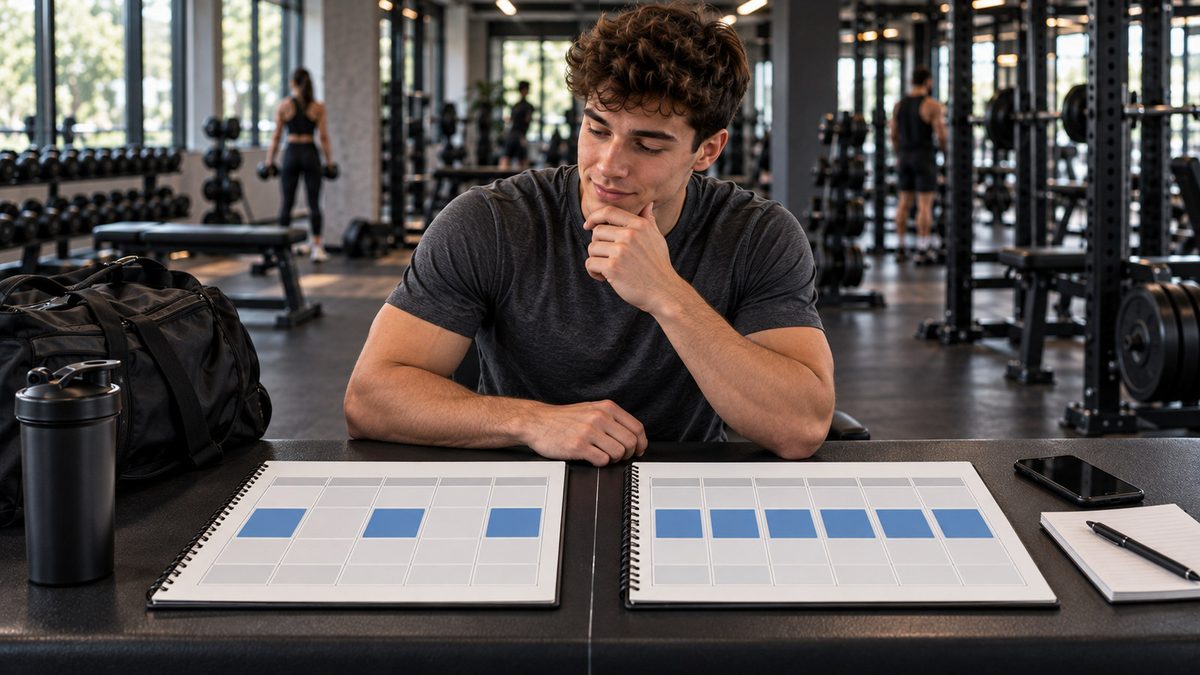
A traditional 3-day PPL routine gives you one push, one pull, and one leg workout each week. That is simple, but it usually means directly training each major muscle group only once per week.
A traditional 6-day PPL routine solves that problem by repeating the cycle twice, but now you are committing to six resistance-training sessions every week—more gym days than most beginners need to make excellent progress.
That is why a full-body routine three days per week or an upper/lower routine four days per week will often be more practical for a beginner.
But “more practical” does not mean PPL cannot work.
This guide will explain the difference so you can make that decision for yourself.
One important note about where I am coming from before we continue:
I am not writing this as someone who has personally followed a perfectly structured push/pull/legs program for years.
I am 19 years old and still consider myself a beginner. My earlier training was not organized around the structured, science-based principles I later began learning about. I have also been away from consistent training for about two years.
During that time away from the gym, I started studying evidence-based bodybuilding more seriously and learning from researchers, educators, and science-based lifters such as Jeff Nippard.
I have not yet returned to consistent training and applied all of those methods myself.
So I am not going to tell you:
“I used this exact PPL routine for years, so trust me.”
Instead, Lift & Nurture is built around something more honest:
learning the evidence, organizing it clearly, and making it understandable for other beginners who are trying to figure this out too.
That means this guide separates what research supports from what is simply preference or programming choice.
No pretending.
No secret split.
No magic exercises.
Just a clear look at how push/pull/legs works and whether it actually fits your situation.
Quick Answer: Is Push Pull Legs Good for Beginners?
Yes.
A push/pull/legs split can work for beginners.
However, it is not automatically the best beginner workout split simply because it is popular.
The most important issue is how many days you can realistically train.
If you train PPL only three days per week, your week might look like:
Monday — Push
Wednesday — Pull
Friday — Legs
That gives each major area one main training session per week.
You can still build muscle this way.
Research comparing different training splits suggests that the split itself does not appear to determine muscle growth when important variables such as weekly training volume are comparable.
The drawback is mainly how the work is distributed.
If you have three training days, a full-body routine can spread your chest, back, shoulders, and leg training across all three sessions instead of concentrating most of it into one day.
A six-day PPL solves the once-weekly frequency issue:
Monday — Push
Tuesday — Pull
Wednesday — Legs
Thursday — Push
Friday — Pull
Saturday — Legs
Sunday — Rest
Now each major muscle group receives roughly two direct training opportunities each week.
That can work extremely well.
The question is whether a beginner actually needs to train six days per week to get there.
Usually, no.
A beginner can make excellent progress with fewer training days when the program includes appropriate exercises, enough challenging sets, good technique, progressive overload, and sufficient recovery.
The simplest decision
If you can realistically train:
2–3 days per week: a full-body routine is usually the most convenient starting structure.
4 days per week: upper/lower is an excellent option.
5–6 days per week: PPL becomes much easier to organize at a higher frequency.
3 days per week but you strongly prefer PPL: you can still use it. Just understand that your weekly training is distributed differently.
The best split is not the one that looks most advanced.
It is the one that lets you perform enough productive training, recover from it, and repeat it consistently.
Table of Contents
- What Is a Push Pull Legs Workout?
- What Muscles Do You Train on Push, Pull, and Legs Days?
- Why Your Training Split Is Not the Main Driver of Muscle Growth
- 3-Day vs. 6-Day Push Pull Legs
- The Main Tradeoff With a 3-Day PPL
- Is a 6-Day PPL Too Advanced for Beginners?
- Benefits of Push Pull Legs for Beginners
- Drawbacks of Push Pull Legs for Beginners
- Who Should Use a PPL Split?
- Complete 3-Day Push Pull Legs Workout for Beginners
- How to Read the Workout Tables
- Warm-Up Before Each PPL Workout
- Push Workout
- Pull Workout
- Legs Workout
- Why These Exercises Were Chosen
- How Hard Should You Train? RIR Explained
- How Much Weight Should You Use?
- How to Progress the Program
- How Long Should You Rest Between Sets?
- Technique and Range of Motion
- Exercise Substitutions
- How Much Weekly Volume Do Beginners Need?
- What If You Miss a PPL Workout?
- How Long Should You Follow the Program?
- When Should You Add More Training?
- Recovery, Sleep, and Nutrition
- Push Pull Legs vs. Full Body vs. Upper/Lower
- Common Beginner PPL Mistakes
- How to Know If the Program Is Working
- Frequently Asked Questions
- Key Takeaways
- Beginner Bodybuilding Guides on Lift & Nurture
- References
- Final Thoughts
- About the Author
What Is a Push Pull Legs Workout?
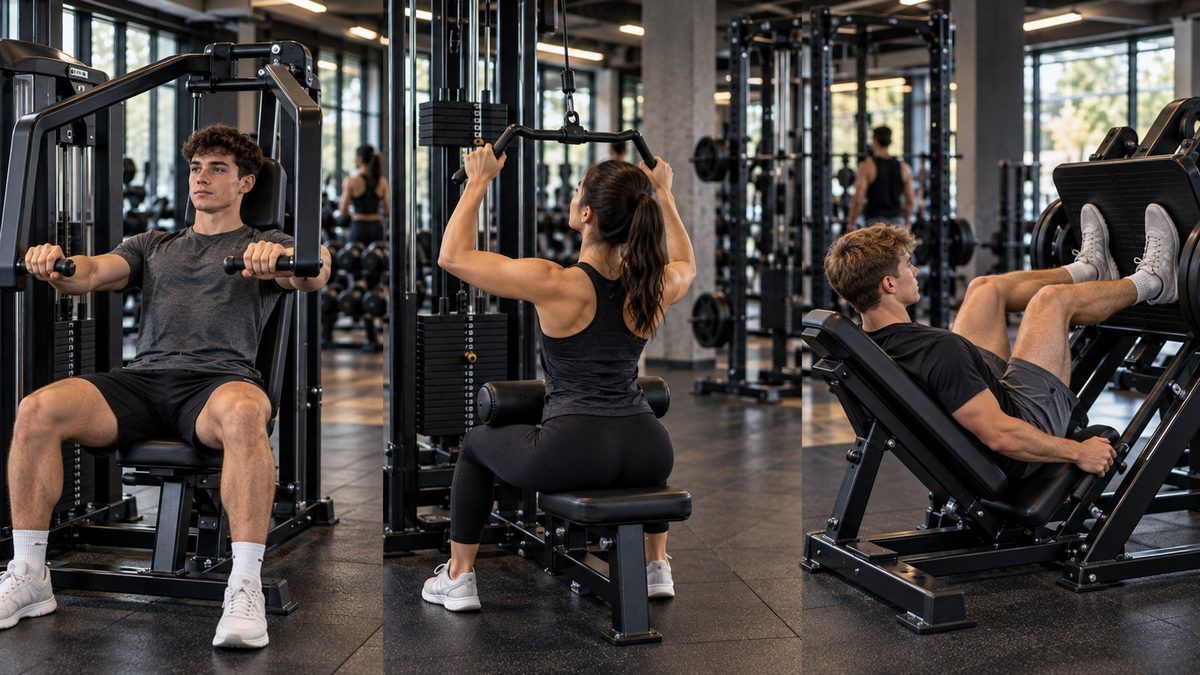
A push/pull/legs split organizes resistance training according to groups of muscles that tend to work together.
Instead of training your entire body in one session, you divide your workouts into three categories:
Push
Pull
Legs
That is all the name really means.
PPL is not a special muscle-building mechanism.
It is a training split—a way of deciding which muscles and exercises you perform on different days.
Push Day
A push workout primarily trains:
- Chest
- Front delts
- Side delts
- Triceps
Pressing exercises make up much of the workout because the chest, shoulders, and triceps cooperate during movements where you push resistance away from you.
Common examples include:
- Bench press variations
- Machine chest presses
- Dumbbell presses
- Overhead presses
- Push-ups
- Dips
- Lateral raises
- Triceps extensions
Not every exercise literally involves pushing something.
A lateral raise, for example, is usually placed on push day because it directly trains the deltoids and fits naturally with shoulder training.
Pull Day
A pull workout primarily trains:
- Latissimus dorsi
- Trapezius
- Rhomboids and other upper-back muscles
- Rear delts
- Biceps
- Brachialis and other elbow flexors
Common exercises include:
- Pull-ups
- Lat pulldowns
- Rows
- Cable pullover variations
- Reverse flyes
- Face pulls
- Biceps curls
You will sometimes see deadlifts programmed on pull day because the back works hard during the exercise.
That is not wrong.
But the glutes and other lower-body muscles play such a major role in many deadlift variations that they can also fit naturally on leg day.
Exercise categories are organizational tools, not laws.
Leg Day
Leg day generally trains:
- Quadriceps
- Hamstrings
- Glutes
- Calves
- Sometimes adductors
- Often abs or other core muscles
Common exercises include:
- Squats
- Leg presses
- Hack squats
- Split squats
- Romanian deadlifts
- Leg curls
- Leg extensions
- Hip thrusts
- Calf raises
This is an important improvement over thinking of “legs” as simply doing squats and calling it a day.
The quadriceps and hamstrings do not perform the exact same jobs.
For example, the hamstrings contribute to hip extension and knee flexion. That is why a balanced leg workout will usually benefit from including a hip-hinge movement such as a Romanian deadlift and/or a knee-flexion exercise such as a leg curl rather than relying entirely on squatting movements.
What About Abs?
Abs do not fit perfectly into push, pull, or legs.
That is fine.
You can put abdominal training at the end of whichever workout is shortest, add it to leg day, or divide a small amount of core training across the week.
Do not overcomplicate it.
Why Your Training Split Is Not the Main Driver of Muscle Growth
It is easy to spend far too much time asking:
“What is the best split?”
That question matters.
But it probably matters less than beginners often assume.
A training split mainly determines how your weekly work is organized.
Your muscles still need the same basic things regardless of whether your program says:
Full Body
Upper/Lower
or
Push/Pull/Legs
A productive muscle-building program needs you to:
- Choose exercises that effectively train the intended muscles
- Use repeatable technique
- Perform enough challenging working sets
- Train with sufficient effort
- Gradually improve over time
- Recover from the work
- Follow the program consistently
A 2024 systematic review and meta-analysis comparing split routines with full-body resistance training found similar changes in muscle growth and strength when weekly training volume was equated.
That is an important point.
It means we should not turn workout splits into competing teams.
Full body is not automatically superior to PPL.
PPL is not automatically superior to upper/lower.
The split is the container.
What you put inside the container matters much more.
More recent research examining resistance-training volume and frequency also reinforces the importance of this distinction. Weekly training volume shows a relationship with hypertrophy, although the additional benefit becomes smaller as volume increases. Training frequency appears to have much less of an independent effect on hypertrophy when volume is accounted for.
In practical terms:
Frequency is useful partly because it helps you distribute your weekly training.
Suppose you wanted to perform six challenging sets for your chest each week.
You could theoretically do:
6 sets on Monday
or:
3 sets Monday + 3 sets Thursday
or:
2 sets Monday + 2 sets Wednesday + 2 sets Friday
The muscle does not care what those days are called.
What changes is how the work feels, how fatigued you become during each session, how often you practice the movements, and how well that structure fits your schedule.
That is the real reason the choice of workout split matters.
3-Day vs. 6-Day Push Pull Legs
The two most recognizable PPL structures look very different in practice.
| Factor | 3-Day PPL | 6-Day PPL |
|---|---|---|
| Weekly lifting sessions | 3 | 6 |
| Push workouts | 1 | 2 |
| Pull workouts | 1 | 2 |
| Leg workouts | 1 | 2 |
| Typical direct muscle frequency | About 1× weekly | About 2× weekly |
| Schedule commitment | Moderate | High |
| Rest days available | Plenty | Usually 1 |
| Volume distribution | More concentrated | More spread out |
| Beginner practicality | Simple, but lower frequency | Effective, but large time commitment |
Example 3-Day PPL
Monday — Push
Tuesday — Rest
Wednesday — Pull
Thursday — Rest
Friday — Legs
Saturday — Rest
Sunday — Rest
This structure is easy to remember and gives you plenty of recovery days.
However, your chest may not receive another direct training session until the following Monday.
Your back may wait until the following Wednesday.
Your legs may wait until the following Friday.
Again, that does not make the program ineffective.
It simply creates a different volume distribution.
Example 6-Day PPL
Monday — Push 1
Tuesday — Pull 1
Wednesday — Legs 1
Thursday — Push 2
Friday — Pull 2
Saturday — Legs 2
Sunday — Rest
Now the same muscles are trained twice per week.
You can also vary the emphasis.
For example:
Push 1 might give slightly more attention to chest.
Push 2 could give slightly more attention to shoulders.
Pull 1 could emphasize vertical pulling and the lats.
Pull 2 could emphasize rowing and the upper back.
Legs 1 could emphasize the quadriceps.
Legs 2 could shift a little more work toward hamstrings and glutes.
That flexibility is one reason PPL is so popular with bodybuilding-focused lifters.
But there is a cost:
you have to show up six times per week.
For someone who is still learning how to make resistance training a regular part of life, that can be unnecessary.
The Main Tradeoff With a 3-Day PPL
The biggest issue with a three-day PPL routine is not recovery.
If anything, you have a lot of recovery time.
The main tradeoff is that your weekly training for each muscle becomes concentrated into one session.
Imagine you wanted to perform around eight challenging back sets each week.
On 3-day PPL, most of those sets probably happen on Pull Day.
That could look like:
Lat pulldown — 3 sets
Chest-supported row — 3 sets
Straight-arm pulldown — 2 sets
That is perfectly manageable.
But imagine your future training eventually required considerably more weekly volume.
Trying to squeeze everything into one pull workout becomes less appealing.
That is where additional frequency can help.
Instead of performing twelve back sets in one session, you could divide them into six sets on two different days.
This can help keep more sets productive because you are less fatigued deep into each workout.
For a complete beginner, however, there is another side to the story:
you probably do not need an enormous amount of volume yet.
That is why a three-day PPL can still work reasonably well as a simple introduction to the split.
It just may not use three available training days as efficiently as a well-designed three-day full-body routine.
Is a 6-Day PPL Too Advanced for Beginners?
Not automatically.
This is one idea I would be careful with.
A six-day workout schedule is not biologically “advanced” just because it contains six days.
You could technically create six very short, low-volume beginner workouts.
Likewise, you could create a brutally difficult three-day program that is completely inappropriate for a beginner.
Training days do not tell you the whole training dose.
The more useful question is:
Does a beginner need six weekly lifting sessions to make good progress?
Usually not.
A beginner has a major advantage: resistance training is still a relatively new stimulus.
You can build strength, improve technique, and gain muscle without needing the volume or specialization that a highly trained bodybuilder may eventually use.
Six days may still make sense if you:
- Truly enjoy training that often
- Have a reliable schedule
- Recover well
- Keep the total workload appropriate
- Prefer shorter but more frequent sessions
- Understand that more days do not automatically equal more gains
But if training six days makes you constantly miss workouts, cut sleep short, rush recovery, or dread going to the gym, the theoretical advantages disappear quickly.
A sustainable four-day routine will beat an unsustainable six-day routine.
Benefits of Push Pull Legs for Beginners
PPL has several genuine advantages.
The Structure Is Easy to Understand
The categories make intuitive sense.
Push.
Pull.
Legs.
You know what the main focus is as soon as you walk into the gym.
Workouts Feel Focused
Instead of moving from legs to chest to back and back to legs within the same session, you concentrate on related muscles.
Some people simply enjoy that style more.
Enjoyment matters because a technically excellent program does little for you if you hate it enough to stop following it.
It Works Well for Bodybuilding
PPL makes it easy to include a mix of compound and isolation movements.
For example, Push Day can include a chest press, shoulder exercise, lateral raise, and triceps work without having to fit lower-body movements into the same workout.
It Scales Well
As your training needs change, PPL is easy to expand.
You can use different exercises or emphases on the second rotation of the week without completely changing the structure.
It Makes Exercise Selection Organized
Instead of randomly deciding what to train each day, every exercise has a logical home.
That can reduce some of the confusion new lifters experience when building a routine.
Drawbacks of Push Pull Legs for Beginners
PPL also has disadvantages that are worth understanding before you choose it.
Three-Day PPL Usually Trains Each Area Once Per Week
Again, once-weekly training can build muscle.
But if you only have three training days, full-body training gives you more opportunities to distribute your weekly work and practice important exercises.
Six-Day PPL Requires Six Gym Visits
That is a large weekly commitment.
It may work perfectly for someone who loves going to the gym.
For someone balancing school, work, family, sleep, and other responsibilities, it might be much less realistic.
Missing One Session Can Matter More on 3-Day PPL
Imagine you follow:
Monday — Push
Wednesday — Pull
Friday — Legs
Then you miss Friday.
Unless you move the workout, you have skipped virtually all of your planned direct lower-body training for that week.
With a full-body routine, missing one workout usually still leaves some training for every major muscle during the other sessions.
Sessions Can Become Volume-Heavy
If you try to hit an aggressive weekly volume target in one workout, PPL sessions can become unnecessarily long.
This is especially noticeable on leg day because the lower body includes several large muscle groups with different functions.
It Can Encourage “More Is Better” Programming
Online PPL routines sometimes contain a huge number of exercises.
A beginner sees:
Bench press.
Incline press.
Dips.
Machine press.
Flyes.
Shoulder press.
Three lateral raises.
Three triceps exercises.
…and assumes all of it must be necessary because the workout is called “Push Day.”
It is not.
Your workout does not need to destroy the target muscles.
It needs to stimulate them with recoverable training.
Who Should Use a PPL Split?
PPL may be a good fit if you genuinely enjoy bodybuilding-style sessions and like giving related muscle groups their own workout.
It can also make sense if you eventually want to train five or six days per week and prefer shorter, more focused sessions.
A three-day PPL may still be reasonable if you simply enjoy the format far more than full-body training.
That preference matters.
A program you look forward to performing consistently may outperform a theoretically cleaner structure that you constantly avoid.
PPL may be less convenient if you:
- Can only train two or three days and want to distribute each muscle’s training across the week
- Frequently miss scheduled gym days
- Want the simplest possible beginner routine
- Are returning after a long layoff and need to rebuild training tolerance slowly
- Do not enjoy having a whole workout centered around one category of muscles
- Find six training days unrealistic
If you are still deciding between workout structures, read my How To Choose A Workout Split For Beginners guide.
Complete 3-Day Push Pull Legs Workout For Beginners
If you understand the tradeoffs and still want to use PPL, here is an original beginner-friendly three-day routine.
I intentionally kept the program moderate.
It is not designed to cram every possible hypertrophy set into three workouts.
That would defeat the purpose of making this approachable.
Instead, the goal is to give you:
- Balanced movement coverage
- Straightforward exercises
- A mixture of machines, cables, and free weights
- Clear rep ranges
- Clear RIR targets
- Enough recovery
- Simple substitutions
- A repeatable progression system
Weekly Schedule
Monday — Push
Tuesday — Rest
Wednesday — Pull
Thursday — Rest
Friday — Legs
Saturday — Rest or light activity
Sunday — Rest
The exact days are flexible.
Tuesday / Thursday / Saturday works too.
What matters is that you can follow the schedule consistently.
If you are returning after a long training layoff, consider using only 1–2 working sets per exercise during your first one or two weeks, staying around 3–4 RIR while you relearn the movements.
Then gradually move toward the full prescription.
How to Read the Workout Tables
Before using the routine, understand what each column means.
Exercise
This is the main movement programmed.
Sets
These are working sets.
Warm-up sets do not count.
Reps
A range such as 8–12 means any result between 8 and 12 can be appropriate.
You do not have to hit the same number on every set.
Warm-Up Sets
These are lighter preparation sets before your working weight.
The number is a starting point rather than an absolute requirement.
Early-Set RIR
This is how many good repetitions you should approximately have left during your earlier working sets.
Last-Set RIR
The final working set can usually be pushed slightly harder.
Rest
This tells you roughly how long to recover before performing the next set.
Substitutions
These are alternatives.
You do not perform both the main exercise and every substitution.
Choose one.
Exercise Video Demonstrations
Each exercise or substitution marked with ▶ links to a visual demonstration showing how to perform the movement.
If an exercise is unfamiliar to you, watch the demonstration before your warm-up sets so you can review the setup, movement path, range of motion, and basic execution.
Use these videos as visual references alongside the coaching guidance in this program. The sets, reps, RIR targets, rest periods, warm-up recommendations, and progression guidelines in this article are still the instructions for the routine.
Keep in mind that equipment designs and individual anatomy can vary. Adjust machine settings, stance, grip, body position, and range of motion as needed to find a controlled and comfortable setup.
If a demonstration uses slightly different programming—such as different sets, reps, rest periods, or training intensity—follow the programming provided in this article instead.
Warm-Up Before Each PPL Workout
A warm-up should make you more prepared to train.
It should not tire you out before the real workout begins.
General Warm-Up
Start with around 5–10 minutes of easy activity.
Examples include:
- Treadmill walking
- Stationary cycling
- Elliptical
- Rowing
- Brisk walking
You do not need to turn this into hard cardio.
The goal is simply to feel warmer and more prepared.
You can then use a few dynamic movements if they help the areas you are about to train.
For example:
Before Push or Pull
Arm circles ▶ — 10 reps per side
Arm swings ▶— 10 reps per side
Light band pull-aparts ▶— 15 reps (optional)
Very light cable external rotations if useful ▶— 15 reps per side (optional)
Before Legs
Front-to-back leg swings ▶— 10 reps per side
Side-to-side leg swings ▶— 10 reps per side
Bodyweight squats ▶— 10 reps
A few easy hip-hinge repetitions ▶ — 10 reps
These movements are optional tools, not mandatory rituals.
Exercise-Specific Warm-Up Sets
The more important part comes when you approach a demanding exercise.
Gradually work toward your working weight.
For example, imagine your chest-press working weight is 100 pounds.
You might do:
50 pounds × 8
75 pounds × 4–5
90 pounds × 2–3
Then:
100 pounds × working set
Notice that the repetitions decrease as the load rises.
Warm-up sets are supposed to prepare, not create fatigue.
As a general starting point:
Heavy or demanding compound exercise: 2–3+ ramp-up sets
Moderate compound exercise: 1–2 ramp-up sets
Isolation exercise: 0–1 ramp-up set
If you are completely unfamiliar with an exercise, your first few sessions may require more practice.
If you want a deeper warm-up guide, read How To Warm Up Before Lifting For Beginners.
Push Workout
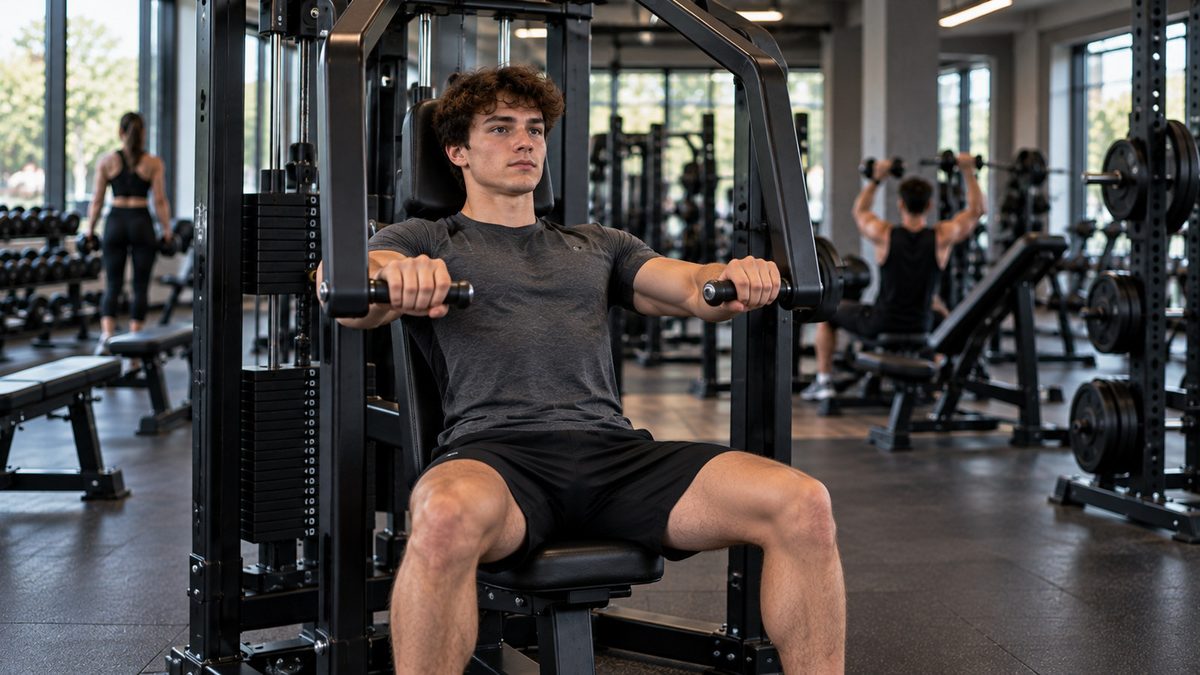
| Exercise | Sets | Reps | Warm-Up Sets | Early RIR | Last-Set RIR | Rest | Substitutions |
|---|---|---|---|---|---|---|---|
| Machine Chest Press ▶ | 3 | 6–10 | 2–3 | 2–3 | 1–2 | 2–3 min | Dumbbell Bench Press ▶ / Barbell Bench Press ▶ |
| Incline Dumbbell Press ▶ | 2 | 8–12 | 1–2 | 2 | 1–2 | 2–3 min | Incline Machine Press ▶ / Low-Incline Smith Press ▶ |
| Machine Shoulder Press ▶ | 2 | 8–12 | 1 | 2 | 1–2 | 2–3 min | Dumbbell Shoulder Press ▶ / Seated Barbell Press ▶ |
| Cable Lateral Raise ▶ | 3 | 12–20 | 0–1 | 2 | 1 | 1–2 min | Dumbbell Lateral Raise ▶ / Lateral-Raise Machine ▶ |
| Cable Triceps Pressdown ▶ | 2 | 10–15 | 0–1 | 2 | 0–1 | 1–2 min | Machine Triceps Extension ▶ / Dumbbell Skull Crusher ▶ |
Why the Push Workout Is Structured This Way
The machine chest press comes first because it allows you to train the chest, front delts, and triceps while you are fresh.
Machines are not automatically superior to free weights for muscle growth.
Research comparing machines and free weights generally finds similar hypertrophy outcomes.
But machines can be useful for beginners because they tend to offer more external stability and require less balance and setup.
That makes it easier to focus on learning how a hard working set feels.
The incline dumbbell press provides another chest movement from a slightly different angle.
Next comes the shoulder press.
Your front delts already contribute to the chest presses, so they do not require endless additional pressing volume.
The lateral raise is included because pressing alone is not an especially complete way to develop the side delts.
Finally, the triceps pressdown provides direct elbow-extension work after the triceps have already contributed to your pressing movements.
Notice what is not here:
Seven chest exercises.
Four shoulder presses.
Three triceps movements.
A beginner does not need to turn Push Day into a two-hour marathon.
Pull Workout
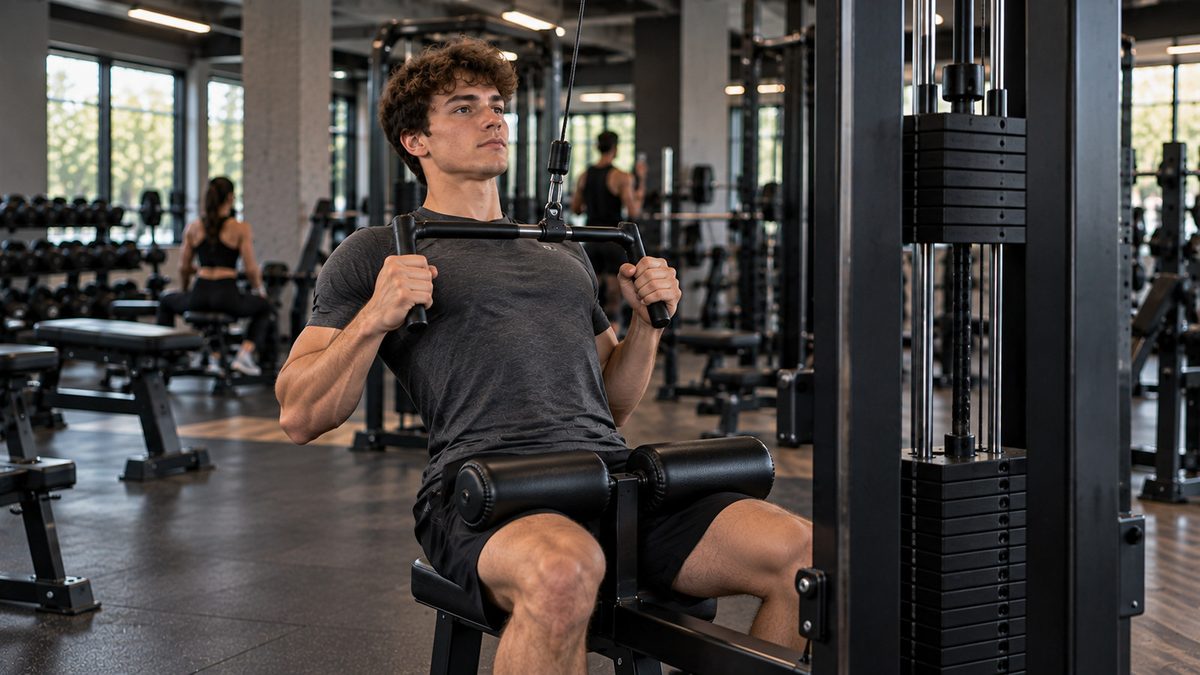
| Exercise | Sets | Reps | Warm-Up Sets | Early RIR | Last-Set RIR | Rest | Substitutions |
|---|---|---|---|---|---|---|---|
| Neutral-Grip Lat Pulldown ▶ | 3 | 6–10 | 2 | 2–3 | 1–2 | 2–3 min | Assisted Pull-Up ▶ / Standard Lat Pulldown ▶ |
| Chest-Supported Row ▶ | 3 | 8–12 | 1–2 | 2 | 1 | 2–3 min | Seated Cable Row ▶ / One-Arm Machine Row ▶ |
| Straight-Arm Cable Pulldown ▶ | 2 | 10–15 | 0–1 | 2 | 1 | 1–2 min | Lying CablePullover ▶ / Machine Pullover ▶ |
| Reverse Pec Deck ▶ | 2 | 12–20 | 0–1 | 2 | 0–1 | 1–2 min | Cable Reverse Fly ▶ / Bent-Over Reverse Fly ▶ |
| Cable Curl ▶ or EZ-Bar Curl ▶ | 2 | 8–12 | 0–1 | 2 | 0–1 | 1–2 min | Dumbbell Curl ▶ / Machine Preacher Curl ▶ |
Why the Pull Workout Is Structured This Way
The first two exercises cover the main pulling directions.
The pulldown provides a vertical pull.
The chest-supported row provides a horizontal pull.
Together they give the back a much more complete stimulus than simply performing five versions of the same row.
The straight-arm pulldown adds direct shoulder-extension work for the lats without requiring much elbow flexion.
The reverse pec deck trains the rear delts and upper-back musculature.
Finally, curls provide direct biceps work after the biceps have already contributed during your rows and pulldowns.
Beginners usually do not need enormous arm-isolation volume because compound pulling and pressing exercises already involve the elbow flexors and extensors.
That indirect work counts for something.
Legs Workout
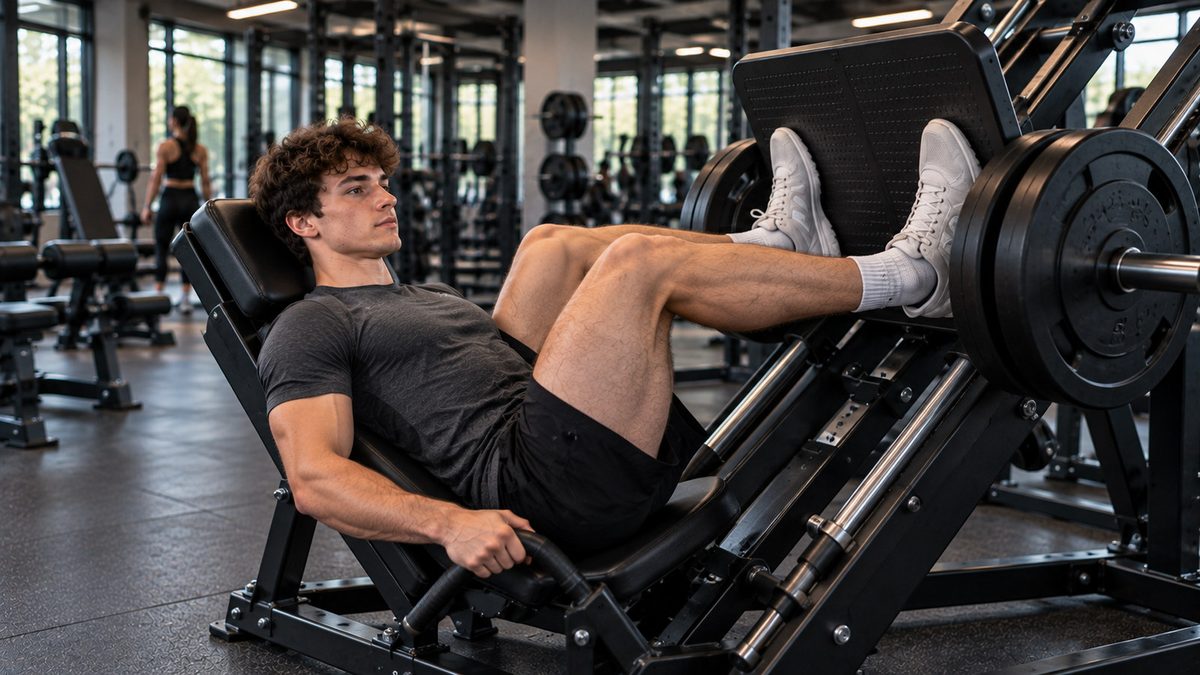
| Exercise | Sets | Reps | Warm-Up Sets | Early RIR | Last-Set RIR | Rest | Substitutions |
|---|---|---|---|---|---|---|---|
| Leg Press ▶ | 3 | 6–10 | 2–3 | 2–3 | 1–2 | 2–3 min | Hack Squat ▶ / Goblet Squat ▶ |
| Romanian Deadlift ▶ | 3 | 6–10 | 2–3 | 3 | 2 | 2–4 min | Dumbbell RDL ▶ / 45° Back Extension ▶ |
| Leg Extension ▶ | 2 | 10–15 | 0–1 | 2 | 0–1 | 1–2 min | Split Squat ▶ / Supported Reverse Lunge ▶ |
| Seated Leg Curl ▶ | 2 | 10–15 | 0–1 | 2 | 0–1 | 1–2 min | Lying Leg Curl ▶ / Sliding Leg Curl ▶ |
| Standing Calf Raise ▶ or Seated Calf Raise ▶ | 3 | 8–15 | 0–1 | 2 | 0–1 | 1–2 min | Leg-Press Calf Raise ▶ |
| Cable Crunch ▶ | 2 | 10–15 | 0–1 | 2 | 0–1 | 1–2 min | Reverse Crunch ▶ / Hanging Knee Raise ▶ |
Why the Leg Workout Is Structured This Way
The leg press provides a stable knee-dominant movement for the quadriceps and glutes.
You can absolutely use squats instead if you prefer them and perform them comfortably.
But barbell squats are not mandatory for building muscular legs.
The Romanian deadlift adds a hip-hinge pattern and directly trains the hamstrings and glutes.
This is an important difference from the old version of this article, which paired goblet squats with leg presses but did not include a meaningful hip-hinge or leg-curl movement.
The leg extension provides additional direct quadriceps training.
The seated leg curl trains knee flexion, giving the hamstrings something the Romanian deadlift alone does not fully provide.
Calf raises directly train the calves.
Cable crunches finish the session with abdominal work.
That gives the lower body much more complete movement coverage without turning Leg Day into an exercise encyclopedia.
If you want a dedicated breakdown, read my Simple Leg Day Workout Plan.
Why These Exercises Were Chosen
There is no single perfect bodybuilding exercise list.
That is important.
If someone tells you that you cannot grow your chest without a barbell bench press, your quads without a back squat, or your back without conventional deadlifts, the claim is too strong.
Muscle-building exercises need to satisfy much more practical requirements.
A useful exercise should generally let you:
Train the intended muscle effectively.
Use a comfortable and repeatable range of motion.
Maintain stable technique.
Progress the exercise over time.
Perform it without persistent pain.
Recover from it well enough to repeat your training.
This program uses several machines because their stability can make those goals easier for beginners.
But dumbbells, barbells, cables, bodyweight movements, and machines can all be valuable.
The tool matters less than whether you can use it productively.
For help learning common equipment, see my Guide To Gym Machines For Beginners.
How Hard Should You Train? RIR Explained
Sets and reps do not tell the entire story.
Imagine two people both perform:
10 reps
Person A finishes and could easily have done 10 more.
Person B finishes and could probably have done only 2 more.
Those were very different sets.
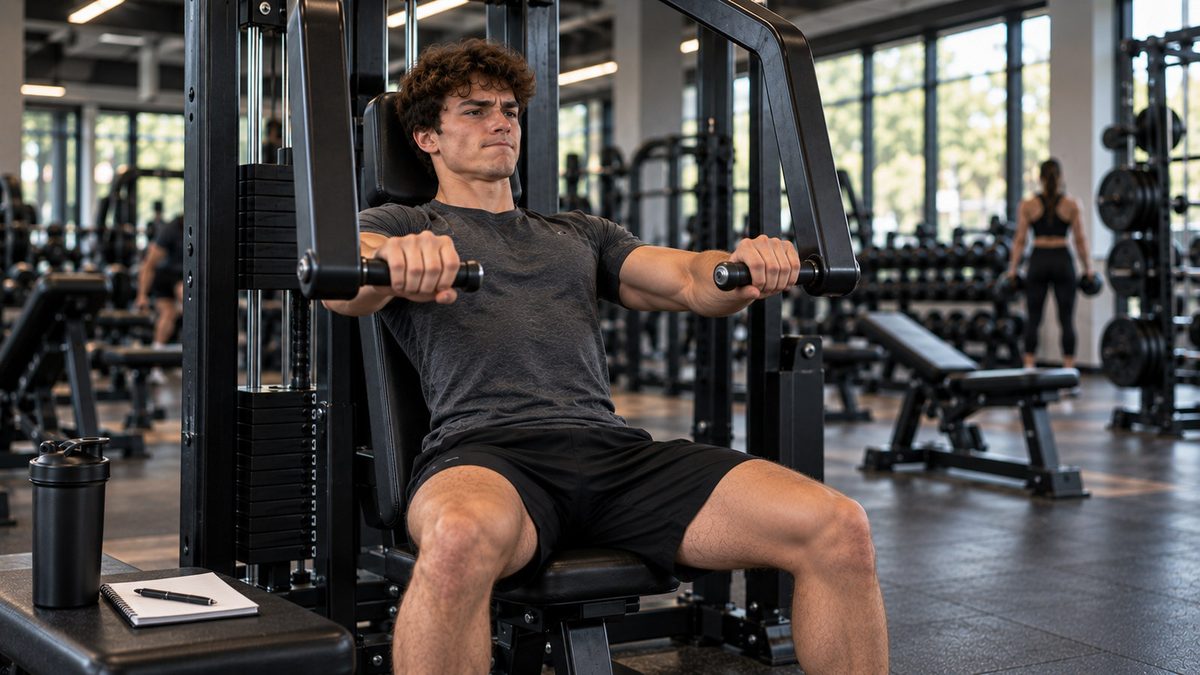
That is why this program uses Reps in Reserve, or RIR.
RIR estimates how many additional good repetitions you could have completed before muscular failure.
| RIR | What It Means |
|---|---|
| 4 RIR | About four good reps remained |
| 3 RIR | About three remained |
| 2 RIR | About two remained |
| 1 RIR | About one remained |
| 0 RIR | No additional complete rep was available |
You may also see the term RPE, or Rating of Perceived Exertion.
A rough relationship is:
3 RIR ≈ RPE 7
2 RIR ≈ RPE 8
1 RIR ≈ RPE 9
0 RIR ≈ RPE 10
Research indicates that muscle growth generally tends to improve as working sets are performed closer to failure.
But that does not mean every set must reach absolute muscular failure.
Failure can also create additional fatigue, especially during demanding compound exercises.
For this beginner program, the default is therefore:
Main Compound Exercises
Most early sets:
2–3 RIR
Last set:
1–2 RIR
Isolation Exercises
Most early sets:
1–2 RIR
Last set:
0–1 RIR, once you are confident with the exercise and can maintain technique
If you are brand new or returning after a long layoff, begin farther from failure.
There is no prize for reaching 0 RIR during your first week.
Your first job is learning what 3 RIR, 2 RIR, and 1 RIR actually feel like.
That takes practice.
For a deeper explanation, read How Hard Should Beginners Train For Muscle Growth?.
How Much Weight Should You Use?
Do not choose your starting weights based on what another person lifts.
Your first working load should let you:
- Reach the prescribed rep range
- Maintain good technique
- Use the intended range of motion
- Finish near the listed RIR
Suppose the machine chest press calls for:
3 sets of 6–10 reps at 2–3 RIR
If you choose 100 pounds and only manage 4 shaky repetitions, it is too heavy for the prescription.
If you perform 10 repetitions and could easily do another 10, it is too light for the intended working set.
If you reach 8 controlled reps and believe you could have done about 2 more, you are probably in a useful starting range.
Do not worry about choosing the mathematically perfect load on Day 1.
Your workout log will help you refine it.
How to Progress the Program
Progressive overload is one of the most important concepts in resistance training.
But it is also commonly misunderstood.
Progressive overload does not mean forcing yourself to put more weight on every exercise every week no matter what happens to your form.
It means your training capacity gradually improves over time.
For this program, the simplest progression method is double progression.
Example: Machine Chest Press
Prescription:
3 sets × 6–10 reps
Imagine Week 1 looks like:
100 lb × 8
100 lb × 7
100 lb × 7
The following week, you might get:
100 lb × 9
100 lb × 8
100 lb × 7
Then:
100 lb × 10
100 lb × 9
100 lb × 8
Eventually:
100 lb × 10
100 lb × 10
100 lb × 10
If those sets also meet your technique and RIR targets, increase the weight slightly.
Maybe you move to 105 pounds.
Your repetitions might fall back to:
105 lb × 8
105 lb × 7
105 lb × 6
That is normal.
Now you climb the range again.
Add reps → reach the top → add a small amount of weight → build the reps back up.

Technique Can Improve Too
Suppose the number on your workout log does not change.
But this week you:
Used a larger comfortable range of motion.
Controlled the load better.
Reduced unnecessary momentum.
Maintained a more stable position.
Matched last week’s reps with less perceived effort.
That can still represent meaningful improvement.
Do not turn progressive overload into progressive cheating.
If your curl goes from 20 pounds to 30 pounds only because your torso starts swinging like a pendulum, the extra load does not necessarily mean your biceps received more useful tension.
Keep your execution reasonably consistent so your numbers mean something.
For a full guide, read How To Implement Progressive Overload For Beginners.
How Long Should You Rest Between Sets?
Do not rush your next set simply because a stopwatch reached 60 seconds.
The purpose of rest is to recover enough to make the next working set productive.
Research comparing rest intervals suggests very short rest periods can reduce performance, while somewhat longer rest intervals may provide a small hypertrophy advantage by allowing you to maintain training quality.
A useful starting point is:
Isolation Exercises
1–2 minutes
Examples:
Lateral raises
Curls
Triceps pressdowns
Leg extensions
Leg curls
Moderate or Machine-Based Compound Exercises
2–3 minutes
Examples:
Machine chest press
Lat pulldown
Chest-supported row
Leg press
More Demanding Compound Exercises
2–4+ minutes as needed
Examples:
Romanian deadlifts
Heavy squats
Heavy free-weight presses
The exact number is not sacred.
Ask yourself:
Has my breathing settled enough?
Can I focus again?
Does the target muscle feel capable of producing another strong set?
Am I about to lose several repetitions just because I rushed the rest period?
If the answer to the last question is yes, rest longer.
You are bodybuilding—not racing the clock.
For more detail, read How To Structure Workout Rest Periods.
Technique and Range of Motion
More weight is useful only if you can control it.
For most exercises in this program, aim to use a comfortable, controlled range of motion that you can repeat consistently.
That generally means:
Avoid bouncing the weight.
Avoid throwing your entire body into isolation movements.
Control the lowering portion rather than simply letting the weight fall.
Reach a meaningful stretch where your anatomy and the exercise comfortably allow it.
Drive the weight up with intent while keeping the target movement under control.
You do not need to deliberately move every repetition extremely slowly.
You also do not need to turn every rep into an explosive competition.
Think:
controlled down, purposeful up.
The exact technique will differ by exercise.
Your body proportions, mobility, machine design, and comfort all matter.
If an exercise produces persistent joint pain, do not interpret pain as evidence that the exercise is “working.”
Reassess your setup, technique, range of motion, or exercise selection.
Exercise Substitutions
A workout plan should give you structure without making you believe one specific exercise is mandatory.
Good reasons to use a substitution include:
- Your gym does not have the equipment
- An exercise consistently causes pain despite reasonable technique adjustments
- The movement simply does not fit your anatomy well
- You cannot perform it productively after giving yourself time to learn it
- You strongly dislike it and an equally appropriate alternative improves adherence
Less useful reasons include changing an exercise every week because you are bored after two sessions or because social media showed you a new variation.
Beginners benefit from repetition.
You need enough exposure to an exercise to:
Learn the technique.
Estimate RIR accurately.
Track your performance.
Build confidence.
See whether you are actually progressing.
Constant exercise rotation makes that much harder.
Keep productive exercises stable for at least several weeks.
Change them when there is a reason—not because you think your muscles need to be “confused.”
How Much Weekly Volume Do Beginners Need?
Training volume describes how much work you perform.
For hypertrophy, a practical way to estimate it is the number of challenging working sets performed for a muscle over the week.
Research generally shows a dose-response relationship:
More productive weekly sets can produce more muscle growth, but the additional return becomes smaller as volume rises.
That last part matters.
More is not infinitely better.
The 2026 ACSM resistance-training position stand highlights roughly 10 weekly sets per muscle group as a useful hypertrophy-oriented reference point.
Do not interpret that as:
“If I only perform seven sets, I will not grow.”
That is not how the evidence works.
Growth can occur at lower volumes.
Beginners also vary considerably in:
- Training history
- Genetics
- Exercise selection
- Effort
- Recovery
- Sleep
- Nutrition
- Muscle group
- Tolerance to training
That is why this PPL routine does not force exactly ten direct isolation-quality sets onto every muscle.
For example, your triceps receive direct work from pressdowns, but they also contribute to the machine chest press, incline press, and shoulder press.
Your biceps receive curls, but they also assist in rows and pulldowns.
Trying to count every compound exercise as one perfect set for every muscle involved becomes messy quickly.
Use volume as a useful programming tool, not as an accounting obsession.
Start With the Program Before Adding More
Do not perform the routine for one week and immediately add five exercises because you did not feel destroyed.
Run it consistently.
Track your numbers.
Watch your recovery.
Then make changes based on evidence from your training, not impatience.
If you want a complete volume explanation, read Muscle Group Sets Per Week For Beginners.
What If You Miss a PPL Workout?
Do not panic.
And do not try to punish yourself with two workouts in one day.
If you miss Pull Day on Wednesday, you have two straightforward options.
Option 1: Move the Workout
Wednesday — Missed Pull
Thursday — Pull
Saturday — Legs
Then return to your usual schedule the following week.
Option 2: Continue the Rotation
Instead of thinking that Monday must always be Push Day, simply perform the next workout the next time you can train.
Push → Pull → Legs → Push → Pull → Legs
This turns the program into a rolling rotation.
That approach is especially useful if your weekly schedule changes frequently.
The important thing is not to repeatedly skip the same session.
If every busy week causes Leg Day to disappear, your program will eventually become unbalanced.
How Long Should You Follow the Program?
Do not switch routines just because you have completed exactly four weeks.
A beginner often benefits from keeping the same core exercises long enough to become skilled at them and build a meaningful performance history.
A reasonable initial commitment is around 8–12 weeks.
During that time, focus on:
- Technique
- Consistency
- RIR accuracy
- Gradual rep progression
- Gradual load progression
- Workout logging
- Recovery
After 8–12 weeks, ask whether something actually needs to change.
If you are:
Enjoying the routine.
Still progressing.
Recovering well.
Training consistently.
Not experiencing persistent pain.
…there is no rule saying you must abandon it.
You can continue.
Change the program when the change solves a problem or serves a new goal.
Do Beginners Need a Scheduled Deload?
Not necessarily.
A deload is a temporary reduction in training stress.
It can be useful when fatigue has accumulated enough that normal training is becoming less productive.
But a complete beginner does not automatically need to schedule a deload every fourth or sixth week because a calendar says so.
Watch for patterns such as:
Persistent decline in performance.
Unusually poor motivation across multiple sessions.
Lingering joint discomfort.
Poor recovery.
Repeatedly feeling run down.
Soreness that is not resolving normally.
One bad workout is not enough to diagnose a recovery problem.
If fatigue is clearly accumulating, an easier week may help.
For example, you could temporarily:
Perform one fewer working set per exercise.
Stay farther from failure.
Use slightly lighter loads.
Then resume normal progression once you feel recovered.
When Should You Add More Training?
Not when you become impatient.
Add volume when there is a reason.
Suppose you have followed the program consistently for several months.
Your technique is good.
Your sleep and nutrition are in place.
You are recovering comfortably.
But one muscle has clearly stopped progressing despite good effort and progression elsewhere.
Then adding a small amount of targeted weekly work may make sense.
That could mean one additional set.
Not six new exercises.
Make small adjustments so you can tell whether they actually help.
This is another reason beginners should resist copying advanced bodybuilding routines.
Advanced lifters often use higher volumes because years of adaptation have made continued progress harder.
A beginner and an advanced bodybuilder may have the same goal—muscle growth—but they do not necessarily require the same training dose.
Recovery, Sleep, and Nutrition
Your workout creates the training stimulus.
Your ability to adapt to that stimulus depends partly on what happens outside the gym.
You do not need a perfect bodybuilding lifestyle before you are allowed to train.
But several fundamentals matter.
Sleep
Aim for enough consistent sleep that you can recover and perform well.
For adults, around 7–9 hours per night is a common general recommendation, although individual sleep needs vary.
If you regularly sacrifice sleep to squeeze in a sixth workout, moving to a lower-frequency program may actually improve the overall quality of your training.
Protein
Protein provides the amino acids your body uses to repair and build tissue.
A useful evidence-based range for people resistance training is roughly:
1.6–2.2 grams per kilogram of bodyweight per day
or approximately:
0.7–1.0 gram per pound per day
You do not need to hit the exact same gram every day.
Think of the range as a practical target.
For more detail, read How Much Protein Do Beginners Need To Build Muscle?.
Calories
Your calorie intake should reflect your goal.
If your main priority is maximizing muscle gain, a modest calorie surplus may help.
If fat loss is the main goal, a calorie deficit is necessary for long-term weight loss.
Beginners and people returning after a period of detraining can sometimes build muscle while losing fat, especially when resistance training and protein intake are properly structured.
You do not need to turn this PPL article into a full nutrition course.
That is why I have a separate Muscle Building Nutrition Guide For Beginners and guide on How Many Calories Should Beginners Eat To Build Muscle?.
Hydration and Food Quality
Stay adequately hydrated and build most of your diet around nutritious foods that help you meet your calorie, protein, carbohydrate, fat, fiber, vitamin, and mineral needs.
Supplements should come after the foundation.
A workout split cannot compensate for consistently poor recovery.
What About Cardio?
Cardio and bodybuilding can coexist.
You do not need to avoid cardiovascular exercise because you follow PPL.
Walking, cycling, incline treadmill work, and other forms of cardio can improve cardiovascular fitness and overall health.
The main consideration is fatigue.
If hard cardio repeatedly leaves your legs exhausted before Leg Day, adjust the timing, intensity, or amount.
Try to avoid turning every form of exercise into another maximum-effort session.
Strength training has its job.
Cardio has its job.
Recovery has a job too.
Push Pull Legs vs. Full Body vs. Upper/Lower
Instead of ranking these splits with stars, it is more useful to compare what they actually do.
| Factor | 3-Day Full Body | 4-Day Upper/Lower | 3-Day PPL | 6-Day PPL |
|---|---|---|---|---|
| Weekly workouts | 3 | 4 | 3 | 6 |
| Typical major-muscle exposure | ~3× weekly | ~2× weekly | ~1× weekly | ~2× weekly |
| Session focus | Whole body | Half body | Push/Pull/Legs | Push/Pull/Legs |
| Volume distribution | Very spread out | Spread out | More concentrated | Spread out |
| Weekly time commitment | Low–moderate | Moderate | Low–moderate | High |
| Different workout categories | Low–moderate | 2–4 | 3 | 3–6 |
| Effect of one missed workout | Usually smaller | Moderate | Larger for that category | Moderate |
| Beginner practicality | Excellent for many | Excellent for many | Completely viable | Viable but often unnecessary |
| Best fit | 2–3 training days | 4 training days | 3 days + strong PPL preference | 5–6 days + strong PPL preference |
PPL vs. Full Body
If you only have three days available, full-body training often makes the most sense.
You can train each major muscle multiple times across the week without adding more gym visits.
That can also give a beginner more frequent opportunities to practice important movement patterns.
However, full-body sessions can feel less focused.
Some people simply prefer walking into the gym knowing:
“Today is back and biceps.”
If that enjoyment makes PPL significantly easier for you to follow, that matters.
For a full three-day alternative, see my 3 Day Workout Schedule For Beginners.
PPL vs. Upper/Lower
Upper/lower is often the natural middle ground.
A four-day schedule commonly looks like:
Monday — Upper
Tuesday — Lower
Wednesday — Rest
Thursday — Upper
Friday — Lower
Weekend — Rest
That lets most major muscles receive two weekly training opportunities while requiring four rather than six sessions.
For many beginners who want more gym time than a three-day full-body plan, this is extremely convenient.
See my 4 Day Workout Routine For Beginners for a complete upper/lower example.
There Is No Universal Progression Ladder
Do not think:
Full Body = Beginner
Upper/Lower = Intermediate
PPL = Advanced
That is not how workout splits work.
An advanced lifter can use full-body training.
A beginner can use PPL.
The split should change because your schedule, preferences, goals, training volume, or recovery needs change—not because you “unlocked” the next level.
A Simple Beginner Decision Rule
Ask yourself one question first:
How many resistance-training sessions can I realistically maintain most weeks?
If the answer is:
Two Days
Use full body.
Three Days
Full body is usually the most efficient general recommendation.
But 3-day PPL remains a valid option if you strongly prefer focused sessions.
Four Days
Upper/lower fits extremely well.
You could also use other hybrid structures.
Five or Six Days
PPL becomes much easier to use while spreading your training volume across multiple exposures.
Then ask:
Which structure do I actually enjoy enough to follow?
Those two questions will usually get you much closer to the right answer than asking which split is “best.”
Common Beginner PPL Mistakes
1. Copying an Advanced Lifter’s Volume
You do not need thirty working sets because your favorite bodybuilder does them.
Training requirements change with experience.
Start with enough work to progress.
Add only when needed.
2. Training to Failure on Every Set
Hard training matters.
Absolute failure on every set is not necessary.
Use RIR so your early sets remain productive and your technique stays controlled.
3. Doing Too Many Similar Exercises
Three chest presses that all perform nearly the same job do not automatically create three times the growth.
Choose exercises that complement each other.
4. Neglecting Hamstrings on Leg Day
Squats and leg presses are excellent exercises, but a complete lower-body routine should account for knee flexion and hip extension as well.
That is why this plan includes Romanian deadlifts and leg curls.
5. Treating Soreness as the Goal
You do not need to be unable to walk after Leg Day.
Soreness can occur when training is new, but it is not a scorecard for muscle growth.
6. Changing Exercises Constantly
If you replace every exercise before you learn it, you make progression difficult to measure.
Give good exercises time.
7. Adding Weight at the Expense of Technique
Do not shorten the range of motion, bounce, swing, or completely change the movement just to claim a personal record.
Progress needs context.
8. Rushing Rest Periods
Being out of breath is not the same thing as your target muscle being fully challenged.
Rest enough to perform the next set well.
9. Skipping Legs Whenever Life Gets Busy
If PPL repeatedly turns into:
Push.
Pull.
Push.
Pull.
…you are no longer running a balanced PPL routine.
10. Believing More Training Days Automatically Means Faster Progress
Six days provides more opportunities to train.
It does not guarantee a better result.
More training only helps when the work is productive and recoverable.
For more beginner errors, read Workout Mistakes For Beginners.
How to Know If the Program Is Working
Do not judge your program by one workout.
Look for trends.
Your Workout Log
Track:
- Exercise
- Weight
- Repetitions
- Working sets
- Approximate RIR
- Any important technique notes
Over time, you want to see evidence that your training capacity is improving.
For example:
More repetitions with the same weight.
More weight for the same repetitions.
Better technique with the same performance.
The same workload at a lower perceived effort.
Your Technique
A beginner becoming more skilled at an exercise is progress.
You may notice:
More stability.
Better control.
A more consistent range of motion.
Less uncertainty during setup.
Those improvements create a stronger foundation for future overload.
Body Measurements and Photos
If muscle growth is your goal, progress photos and occasional measurements can provide useful long-term information.
Use similar:
Lighting.
Pose.
Distance.
Camera height.
Time of day.
Do not expect visible physique changes every morning.
Muscle growth is a slow process.
Bodyweight
Bodyweight can help, but the meaning depends on your nutrition goal.
Gaining weight does not automatically mean you gained muscle.
Losing weight does not automatically mean you lost muscle.
Look at multiple indicators together.
How Long Until You See Results?
There is no exact universal timeline.
Genetics, nutrition, training history, body composition, sleep, adherence, and program quality all affect the rate of progress.
Instead of promising a dramatic transformation by a particular date, focus on whether the inputs are improving.
For more detail, see How Long Does It Take To Build Muscle For Beginners?.
Frequently Asked Questions
Is Push Pull Legs good for complete beginners?
Yes, it can be.
There is nothing inherently advanced about dividing workouts into push, pull, and legs.
However, if a complete beginner only has three weekly training days, full-body training usually distributes training and exercise practice more conveniently.
PPL becomes especially convenient when someone wants to train more frequently.
Can I build muscle doing PPL three days a week?
Yes.
A 3-day PPL can build muscle as long as your workouts provide enough productive training, your sets are performed with sufficient effort, you progressively improve, and you recover properly.
Its main tradeoff is that each major muscle group is usually trained directly only once per week.
Is training each muscle once per week bad?
No.
Once-weekly training can produce hypertrophy.
Frequency is not an on/off switch for muscle growth.
However, spreading weekly volume over multiple sessions can make training easier to organize and help maintain set quality.
That is one reason higher-frequency full-body or upper/lower structures can be attractive.
Do I need to train each muscle twice per week?
Not absolutely.
Current general resistance-training guidance often recommends training major muscle groups at least twice per week, and that frequency is a practical way to distribute training.
However, evidence suggests frequency itself has a relatively small independent effect on hypertrophy when weekly training volume is taken into account.
Think of twice-weekly training as a useful default rather than a magical requirement.
Is 6-day PPL too much for a beginner?
It can be, but not simply because the number six is “advanced.”
The issue is the total workload, recovery demand, and schedule commitment.
A beginner usually does not need six resistance-training days to make excellent progress.
If you genuinely enjoy six-day training and the volume is appropriate, it can still work.
What is better for beginners: PPL or full body?
Neither is inherently more muscle-building simply because of the split name.
If you have three available days, full body usually makes the weekly distribution easier and gives you more opportunities to practice each movement pattern.
If you strongly prefer separate push, pull, and leg sessions, PPL can still be effective.
What is better: PPL or upper/lower?
For four weekly workouts, upper/lower is often easier to organize because you can train the upper and lower body twice each week.
PPL fits especially naturally when you have enough weekly sessions to repeat the three-day cycle.
Choose based on schedule, preferences, volume distribution, and recovery.
Should beginners train to failure?
Not on every set.
Working reasonably close to failure is useful for hypertrophy, but absolute failure is not required for every working set.
A beginner can use approximately 1–3 RIR for most training, staying farther from failure during early sessions while learning technique.
How many exercises should a PPL workout have?
There is no universal number.
This plan uses around five exercises on Push and Pull days and six on Leg Day, including direct calf and abdominal work.
Your goal is not to collect exercises.
Your goal is to cover the important muscles with enough high-quality working sets.
How long should a PPL workout take?
It depends on exercise selection, warm-ups, number of working sets, and rest intervals.
A beginner session may commonly take around 45–75 minutes.
Do not deliberately shorten your rest periods just to finish within an arbitrary deadline.
Should I do Push, Pull, Legs in that exact order?
No.
Push → Pull → Legs is easy to understand and works well.
Some lifters prefer Pull → Push → Legs, particularly when performing consecutive training days, because it places a push workout between back training and a leg workout that requires substantial back stabilization.
The exact order matters less when your three-day program already includes rest days between sessions.
Where should deadlifts go in PPL?
They can technically fit on Pull or Legs depending on the variation and programming goal.
For a beginner hypertrophy-focused routine, I prefer placing Romanian deadlifts on Leg Day because the hamstrings and glutes are major target muscles.
The category is less important than the total program.
Can women use this Push Pull Legs Workout For Beginners?
Absolutely.
The basic principles of resistance-training programming apply to both men and women.
Exercise selection and training volume can then be adjusted according to goals, preferences, recovery, and individual development priorities.
Can I use machines instead of barbells?
Yes.
Both can build muscle.
Machines may be particularly convenient for beginners because they provide external stability and often have a simpler setup.
Free weights also offer valuable advantages and are perfectly effective.
Use the tool that allows you to train the target muscles productively and progress over time.
What should I do if an exercise hurts?
Do not treat persistent pain as something you have to “push through.”
Review your setup, technique, load, and range of motion.
Try an appropriate substitution if necessary.
If pain is significant, persistent, worsening, associated with an injury, or otherwise concerning, seek guidance from an appropriately qualified healthcare professional.
Key Takeaways
If you only remember the most important points from this guide, remember these:
PPL is a training organization system—not a special muscle-building method.
A beginner can build muscle with push/pull/legs.
Three-day PPL normally trains each major area directly around once per week.
Six-day PPL normally increases that to around twice per week but requires far more weekly gym visits.
Full-body and split routines can produce similar hypertrophy when important training variables are comparable.
Frequency is useful largely because it helps distribute weekly training volume and practice.
More weekly volume can support more hypertrophy, but the returns diminish and more is not automatically better.
Train most working sets reasonably close to failure without believing every set must reach 0 RIR.
Use consistent technique.
Add repetitions before forcing load increases.
Rest long enough to make your next set productive.
Keep effective exercises stable long enough to learn and progress them.
Eat enough protein and calories for your goal.
Recover between sessions.
And most importantly:
Choose the workout structure you can realistically follow.
Beginner Bodybuilding Guides on Lift & Nurture
If you want to build your training knowledge step by step, these guides go deeper into each part of the process:
Beginner Bodybuilding Workout Plan: 12-Week Foundation Blueprint — A complete foundation for beginner training, progression, recovery, and nutrition.
3 Day Workout Schedule For Beginners — A full-body alternative if you can train three days per week.
Full Body Workout Plan For Beginners — Learn the basic structure behind full-body training.
4 Day Workout Routine For Beginners — A complete upper/lower option for four training days.
How To Choose A Workout Split For Beginners — Compare training structures according to schedule, recovery, and preferences.
Beginner Bodybuilder Exercises — Learn how to choose useful beginner muscle-building movements.
Guide To Gym Machines For Beginners — Learn how to use common gym machines confidently.
Beginner Upper Body Workout At The Gym — A dedicated chest, back, shoulder, and arm guide.
Simple Leg Day Workout Plan — A detailed lower-body training guide.
How To Warm Up Before Lifting For Beginners — Build a useful warm-up without wasting energy.
How Hard Should Beginners Train For Muscle Growth? — Understand RIR, RPE, and proximity to failure.
Beginner Weight Training Sets And Reps — Understand practical rep ranges and working sets.
Muscle Group Sets Per Week For Beginners — Learn how weekly training volume works.
How To Structure Workout Rest Periods — Learn when shorter and longer rests make sense.
How To Implement Progressive Overload For Beginners — Learn how to progress reps, load, and execution over time.
Muscle Recovery Tips For Beginners — Understand sleep, soreness, fatigue, and rest days.
Muscle Building Nutrition Guide For Beginners — Build the nutrition foundation that supports training.
How Much Protein Do Beginners Need To Build Muscle? — Understand practical daily protein targets.
Beginner Fitness Plans After A Break — A useful starting point if you are returning after time away from training.
References
The recommendations in this article were built around current resistance-training research and evidence-based educational material. The most important sources include:
American College of Sports Medicine. (2026). Resistance Training Prescription for Muscle Function, Hypertrophy, and Physical Performance in Healthy Adults: An Overview of Reviews. Medicine & Science in Sports & Exercise.
This updated position stand synthesizes a large body of resistance-training research and emphasizes consistency, adequate weekly training, individualized programming, and the relatively small importance of many unnecessarily complicated programming details.
Ramos-Campo, D. J., et al. (2024). Efficacy of Split Versus Full-Body Resistance Training on Strength and Muscle Growth: A Systematic Review With Meta-Analysis. Journal of Strength and Conditioning Research.
This review found no meaningful difference in strength or hypertrophy between split and full-body routines when training volume was equated.
Pelland, J. C., et al. (2026). The Resistance Training Dose-Response: Meta-Regressions Exploring the Effects of Weekly Volume and Frequency on Muscle Hypertrophy and Strength Gain. Sports Medicine. DOI: 10.1007/s40279-025-02344-w.
This analysis supports a dose-response relationship between weekly training volume and hypertrophy with diminishing returns, while the independent relationship between training frequency and hypertrophy appeared comparatively small.
Robinson, Z. P., et al. (2024). Exploring the Dose-Response Relationship Between Estimated Resistance Training Proximity to Failure, Strength Gain, and Muscle Hypertrophy. Sports Medicine.
This meta-regression found that hypertrophy tended to improve as sets were terminated closer to failure, while the relationship with strength was less clear.
Singer, A., et al. (2024). Give It a Rest: A Systematic Review With Bayesian Meta-Analysis on the Effect of Inter-Set Rest Interval Duration on Muscle Hypertrophy. Frontiers in Sports and Active Living.
This review found evidence favoring rest intervals longer than very short rests for hypertrophy, supporting the practical goal of resting long enough to preserve productive set performance.
Refalo, M. C., et al. (2021). Influence of Resistance Training Load on Measures of Skeletal Muscle Hypertrophy and Improvements in Maximal Strength and Neuromuscular Task Performance: A Systematic Review and Meta-Analysis. Journal of Sports Sciences.
This review supports the idea that a wide range of resistance-training loads can stimulate hypertrophy when effort is sufficient, while heavier loads tend to have a stronger advantage for maximal-strength development.
Heidel, K. A., et al. (2022). Machines and Free Weight Exercises: A Systematic Review and Meta-Analysis Comparing Changes in Muscle Size, Strength, and Power.
The available evidence generally supports similar hypertrophy outcomes between machines and free weights, with strength adaptations showing greater specificity to the training mode used.
Morton, R. W., et al. (2018). A Systematic Review, Meta-Analysis and Meta-Regression of the Effect of Protein Supplementation on Resistance Training-Induced Gains in Muscle Mass and Strength in Healthy Adults. British Journal of Sports Medicine. DOI: 10.1136/bjsports-2017-097608.
This review supports sufficient daily protein intake for resistance-training adaptations and found little average additional lean-mass benefit beyond approximately 1.6 g/kg/day, although somewhat higher practical targets can provide a reasonable buffer.
Additional Educational Sources Reviewed
Nippard, Jeff. (2024). The Muscle Ladder. Victory Belt Publishing.
Useful concepts reviewed included training sustainability, technique, exercise selection, effort, progressive overload, volume, training splits and frequency, rep ranges, and rest periods.
Nippard, Jeff. Fundamentals Hypertrophy Program.
Relevant programming concepts reviewed included exercise consistency, warm-up structure, RPE/RIR, progressive overload, volume, frequency, rest periods, and substitutions.
Nippard, Jeff. The Hypertrophy Handbook.
Relevant concepts reviewed included technique, training effort, double progression, stable exercise selection, machines and free weights, and exercise substitutions.
Nippard, Jeff & Barakat, Chris. The Ultimate Guide to Body Recomposition.
Relevant concepts reviewed included progressive overload, volume, recovery, protein intake, and considerations for beginners and detrained lifters.
These educational resources were used to understand and organize relevant training principles. The PPL routine in this article is an original Lift & Nurture example rather than a reproduction of any copyrighted training program.
Final Thoughts
So, should a beginner start with push/pull/legs?
You can.
But you do not have to.
That distinction is what I wish more beginner workout discussions made clear.
There is nothing magical about PPL.
And there is nothing wrong with it either.
If you have three training days and simply want the most straightforward way to spread your full-body training across the week, a 3 Day Workout Schedule For Beginners is probably the option I would look at first.
If you have four days, an upper/lower routine is extremely practical.
If you enjoy PPL far more than either option, you can run the three-day version in this guide.
And if your schedule, enjoyment, recovery, and training needs eventually make five or six weekly workouts realistic, a higher-frequency PPL can become an excellent bodybuilding structure.
You do not need to “graduate” into it.
You just need a reason for using it.
That is the bigger lesson.
A workout split does not build muscle by itself.
The progress comes from what you repeatedly do inside that split:
Learn your exercises.
Train with good technique.
Put real effort into your working sets.
Progress gradually.
Perform enough volume.
Eat appropriately for your goal.
Recover.
Then keep doing those things long enough for small improvements to accumulate.
If you are completely new and want the entire training process laid out from the beginning, start with my Beginner Bodybuilding Workout Plan: 12-Week Foundation Blueprint.
And if you are still deciding which weekly structure fits you, use the How To Choose A Workout Split For Beginners guide next.
The goal is not to find the most impressive-looking routine.
The goal is to find a good program you can actually train, recover from, improve on, and sustain.
About the Author
I’m Angel Carcamo, founder of Lift & Nurture.
I created this website to make beginner bodybuilding easier to understand through evidence-backed training principles, practical structure, and an honest beginner perspective.
I am not a certified personal trainer, healthcare professional, or veteran bodybuilder.
I am 19 years old and still consider myself a beginner. My earlier time training was not based on the structured, science-based approach I later began studying, and I have currently been away from consistent training for around two years.
It was during that time away that I began learning more seriously from evidence-based bodybuilding research and educators such as Jeff Nippard and others in the science-based lifting community.
I have not yet personally applied all of those methods in a properly structured long-term program, so I do not present my articles as proof based on years of personal success.
Instead, my goal with Lift & Nurture is to research the fundamentals carefully, separate evidence from hype, explain what I am learning in beginner-friendly language, and document the process honestly as I continue learning and eventually return to consistent training myself.
Thanks for reading this guide.
If you are at the beginning too, I hope it helps you make your next training decision with a little more clarity and a lot less confusion.
Lift with intention. Nurture long-term growth.
This was a very clear and balanced guide for beginners. I liked that you did not simply present push pull legs as the perfect plan for everyone, but explained when it works and when full body or upper/lower training may be better. The 3-day version feels especially realistic, with enough recovery time and simple exercises. I also appreciated the focus on progressive overload, proper form, and avoiding too much volume too soon. When would you personally suggest a beginner move from full body to PPL?
Thank you so much, Hanna! I really appreciate your thoughtful comment.
After looking more closely at the research and updating this article, I would frame this a little differently than I used to.
I do not think a beginner has to “graduate” from full-body training to upper/lower and then eventually to push/pull/legs. Those are different ways of organizing weekly training rather than strict beginner, intermediate, and advanced levels.
A beginner can start with PPL from the beginning if they genuinely prefer that structure and the overall program is appropriate for them. The bigger question is usually how many days they can realistically train and how they want their weekly volume distributed.
If someone only has three training days available, I would usually lean toward a full-body routine because it lets them spread chest, back, shoulder, and leg training across all three sessions. It also gives a newer lifter more frequent opportunities to practice the main movement patterns.
A 3-day PPL can still work, though. The main tradeoff is that Push, Pull, and Legs are each usually trained directly only once per week, so more of the weekly work for each area is concentrated into a single session.
If someone can realistically train four days per week, an upper/lower split is often very convenient because it spreads upper- and lower-body training across two sessions each. But I would not consider upper/lower a required stepping stone before PPL.
And if someone enjoys training five or six days per week, PPL becomes especially easy to organize because the Push, Pull, and Legs cycle can be repeated while spreading the weekly workload across more sessions.
I also would not say that a beginner needs to spend exactly 8–12 weeks on full body before changing. Keeping a routine for several weeks can absolutely be useful for learning technique, tracking progress, and building consistency, but there is no universal week where someone suddenly becomes “ready” for PPL.
I would consider changing from full body to PPL when there is an actual reason to change—for example:
They enjoy focused Push, Pull, and Legs sessions more.
Their schedule allows enough training days for the structure they want.
They want to distribute more weekly training volume across separate sessions.
Their current full-body workouts are becoming longer than they prefer.
They are recovering well and can maintain the new schedule consistently.
Just as importantly, someone does not need to switch if their full-body routine is still enjoyable, productive, and fits their schedule.
So my updated answer would be: there is no required point when a beginner should move from full body to PPL. Use the split that best fits your available training days, preferences, recovery, and ability to progress consistently.
Full body is often a very practical choice for 2–3 training days, upper/lower fits naturally around four days, and PPL becomes especially convenient with more weekly sessions—but none of those splits has to be “unlocked” through experience first.
Thanks again for asking this because it is an important distinction, and it is something I wanted the updated version of this guide to make much clearer.
The part of your article about recovery and keeping volume lower at the start makes a lot of sense. Do you think beginners should stay with a 3-day PPL for a certain amount of months before adding more training days? Also, how do you know when recovery is actually becoming a problem and not just normal soreness? And for someone training at home with dumbbells only, would you still recommend PPL over full body?
Thank you, Bob. I’m glad that section helped because recovery management is one of the biggest things beginners underestimate when starting a PPL routine.
In most cases, I think beginners should stay with a lower-frequency version first, such as a 3-day PPL schedule or even a full-body routine, before jumping into 5–6 training days per week. That gives the body time to adapt to resistance training, improve technique, and build recovery capacity without accumulating excessive fatigue too quickly.
As for recovery problems versus normal soreness, some soreness after training is completely normal, especially early on. The bigger concern is when fatigue starts carrying over into future workouts. Signs of poor recovery usually include persistent soreness, declining performance, joint aches, low motivation, poor sleep, or feeling constantly tired and run down. If multiple signs show up together, it’s usually a good idea to reduce training volume or take a lighter week before pushing harder again.
For someone training at home with dumbbells only, I would usually still lean toward full-body workouts first unless they already have some training experience. Full-body routines tend to work especially well with limited equipment because you can train movement patterns more frequently while keeping weekly volume manageable. That said, a dumbbell-only PPL split can absolutely work if the person enjoys it, can recover from it properly, and progressively overloads over time.
At the end of the day, the “best” split is usually the one that allows a beginner to train consistently, recover properly, and continue progressing long term rather than the one that simply looks the most advanced.