
Many beginners find themselves tangled in the web of workout splits. The sheer variety of options can seem overwhelming, making it tough to pick a starting point. The good news is that the split you choose isn’t as crucial as sticking to a routine that’s consistent and progressively challenging.
If you’re wondering how to choose a workout split for beginners, the best place to start is your weekly schedule. This guide is written for beginners who want a simple way to choose a workout split without getting overwhelmed by advanced programming advice.
Workout splits are essentially just a way to divide your training sessions. While you might worry about the details, it’s key to remember that regular training, appropriate volume, sufficient effort, and progressive overload are what truly drive muscle growth. If you’re new to structured training, it helps to follow a clear plan like this Beginner Bodybuilding Workout Plan (12-Week Foundation Blueprint) to understand how these principles work together.
By understanding that a split is simply a tool to help organize your workouts, you can focus on more important elements like making sure you’re regularly challenging your muscles and allowing them to recover properly. Approaching your workout plan with this mindset can simplify decisions and help set you on a path to success.
Important Note: This article is for educational purposes only and is not a substitute for medical advice or personalized coaching. If you have injuries or health concerns, speak with a qualified professional before starting a new workout routine.

Table of Contents
1. Quick Answer: What Workout Split Should Beginners Use?
2. What Is a Workout Split?
3. What Is a Full BodyWorkout?
4. What is an Upper/Lower Split?
5. Full Body vs Upper Lower: Key Differences
6. What Actually Builds Muscle?
7. How Many Days Can You Train per
8. Common Beginner Mistakes
9. Frequently Asked Questions
10. Key Takeaways
11. Final Thoughts
12. Beginner Bodybuilding Guides on Lift & Nurture
13. References
14. About the Author
Quick Answer: What Workout Split Should Beginners Use?
For those starting out, simplicity is your best friend. If you’re able to train 2 to 3 times a week, a full body workout is recommended. A structured example of this approach can be found in this 3 Day Workout Schedule For Beginners, which shows how to organize full body training effectively. When you’re hitting the gym 4 days a week, consider an upper/lower split. Both options are great for building muscle as long as they’re part of a consistent routine.
Full body workouts keep things straightforward by targeting all major muscle groups in a single session. This approach ensures that you’re frequently stimulating your muscles, which is key for beginners learning proper form and building a solid foundation.
An upper/lower split divides your workouts into upper body and lower body days. This setup provides a bit more focus on certain areas on any given day and is perfectly suited for those with a bit more time to spend in the gym during the week.
Ultimately, it’s not about which split is “better,” but which fits seamlessly into your lifestyle. The most effective split is the one you can stick to, because consistency breeds progress.
What Is a Workout Split?
A workout split is essentially a way to organize your training sessions by dividing them into different muscle groups or movement patterns. This helps structure your workouts and ensures that each session has a specific focus, maximizing efficiency and effectiveness.
Beginners often encounter various types of splits, ranging from full body and upper/lower to more complex ones like push/pull/legs. For example, a Push Pull Legs Workout For Beginners explains how this more advanced split works and why most beginners should build a foundation with full body or upper/lower training first. Each has its unique benefits, catering to different needs and schedules.
For beginners, the split serves as a roadmap, guiding which muscle groups are worked on specific days. By following a structured plan, you can better manage your energy and recovery, preventing burnout and overtraining.
What Is a Full Body Workout?
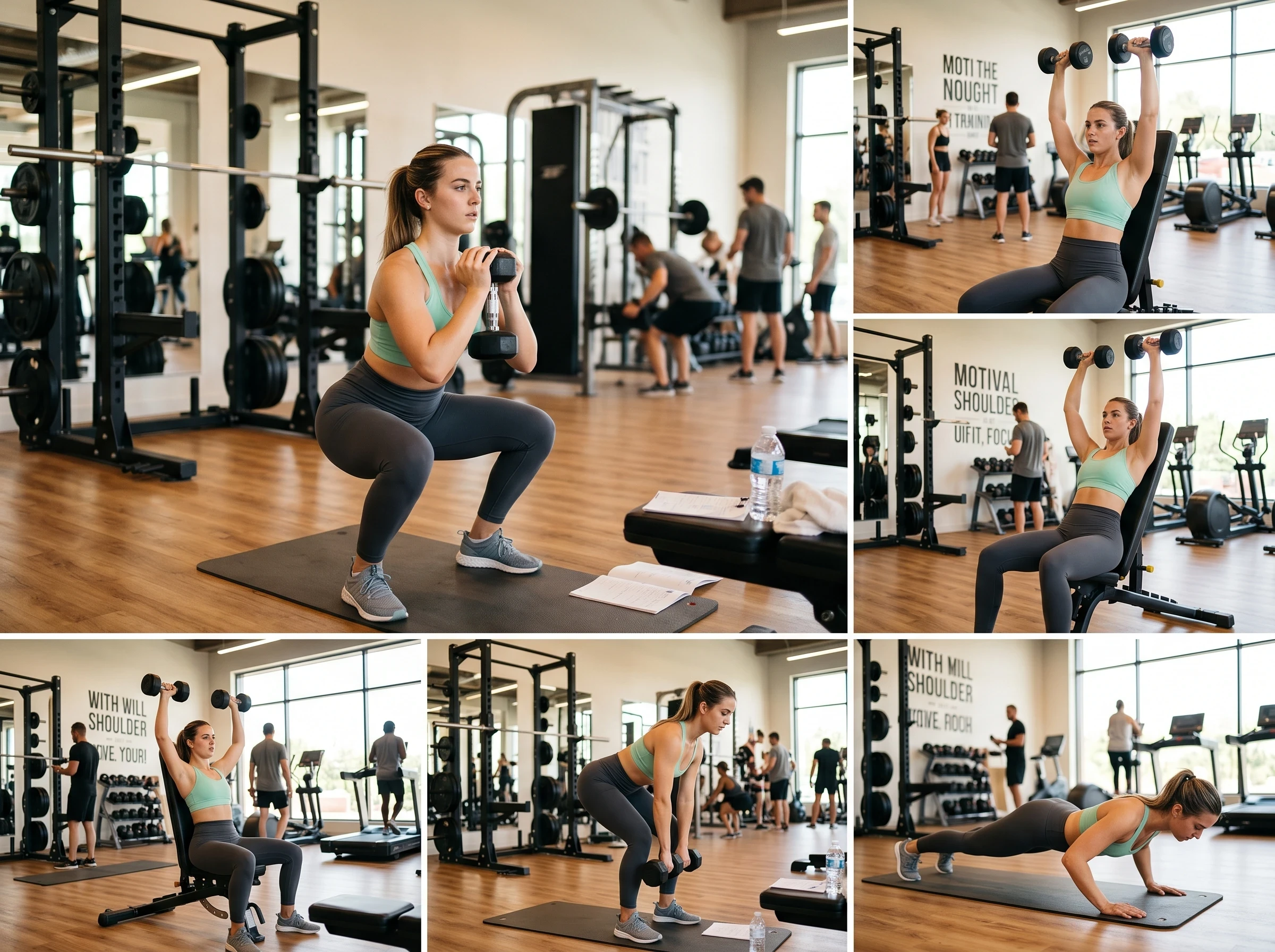
Full body workouts bring a practical and effective approach to training. They involve exercises that target all major muscle groups within a single session, making them a staple for beginners. If you want a simple step-by-step example, this full body workout plan for beginners shows how to structure exercises, sets, reps, rest, and progression in one beginner-friendly routine.
If you prefer training at home or do not have access to a gym yet, this Beginner Bodyweight Workout Plan To Build Muscle At Home explains how to structure beginner-friendly full-body bodyweight workouts using progressive overload, recovery, and consistent training principles.
If you want a more structured weekly home workout schedule built around full-body bodyweight training, this 3 Day At Home Workout Routine For Beginners explains how to organize three weekly workouts, recovery days, and progression using simple beginner-friendly exercises at home.
If you want the simplest possible starting point before following a more structured workout schedule, this No Equipment Full Body Workout For Beginners At Home explains how beginners can build strength and consistency using simple full-body bodyweight exercises without gym equipment.
If you want a simple lower-body example from a full-body style routine, this Simple Leg Day Workout Plan shows how beginners can structure leg exercises, warm-ups, sets, reps, rest periods, and progression without overcomplicating training.
The simplicity of full body workouts is one of their biggest strengths. Beginners benefit from this straightforward format, which not only reduces time spent planning but also ensures balanced muscle development.
Another key advantage is increased frequency—a powerful tool in refining skills and techniques. By working on similar movements multiple times a week, beginners can improve their form faster, aiding in the safe and effective execution of exercises, which is important when learning exercises like the barbell squat step-by-step tutorial.
These workouts usually prevent the fatigue associated with longer, more intense sessions focused on specific body parts. The manageable duration and balanced recovery periods help keep beginners motivated and consistent in their fitness journey.
What Is an Upper/Lower Split?
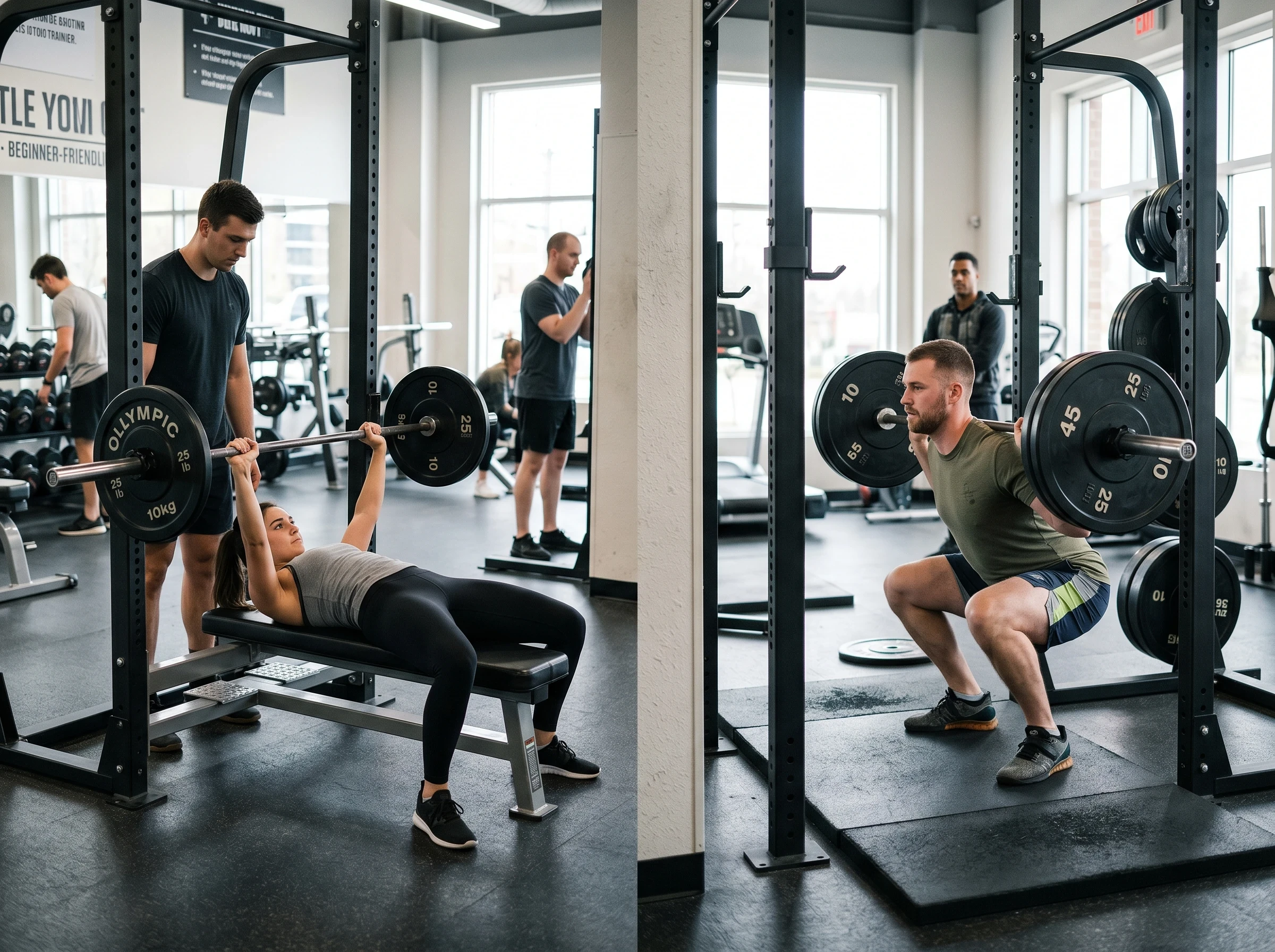
Upper/lower splits introduce the idea of focusing on either the upper or lower half of the body during a workout, usually spread across four weekly sessions. This division allows for more targeted attention, letting you focus intently on major muscle groups.
With this setup, you’ll dedicate two sessions to upper body exercises and two to lower body exercises. This way, each area can be worked intensively, increasing the volume within each session. If you want to see what a simple upper-body session can look like, this beginner upper body workout at the gym guide shows how to organize chest, back, shoulders, and arm exercises with beginner-friendly sets and reps. It’s a great next step for those ready to delve a little deeper into their routine than what full body workouts offer.
Many beginner upper/lower programs also use gym machines like the leg press, machine chest press, lat pulldown, and seated row because they are easier to learn and help build confidence early on. If you’re unfamiliar with how gym machines work or how to adjust them properly, this Guide To Gym Machines For Beginners explains how beginners can use common machines safely and effectively.
The increased volume within sessions allows for slightly more specialization, making it a practical choice for individuals with specific strength or hypertrophy goals. Dividing workouts this way can also reduce the fatigue faced during full body sessions, helping you maintain energy and form throughout your workout.
While it asks for a bit more time commitment than a full body plan, this split can still fit into a busy schedule, often providing a balanced mix of recovery and intensity. As always, the goal is to pick an approach that synchronizes well with your lifestyle and keeps you consistent.
If you decide to follow this structure, this 4 day upper/lower workout routine for beginners shows how to apply it in a simple weekly plan.
Full Body vs Upper Lower: Key Differences
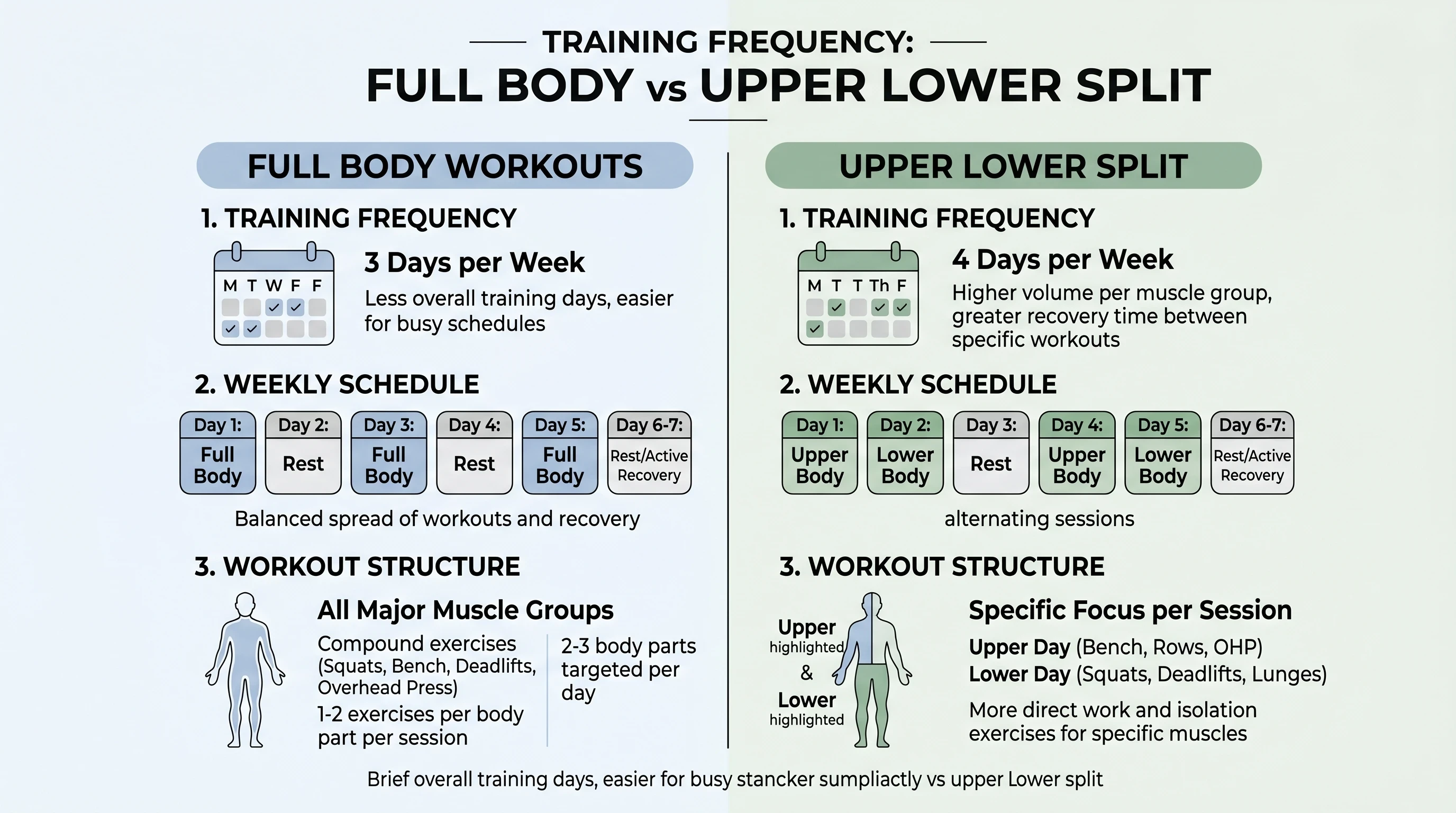
When comparing full body workouts to the upper/lower split, several key differences emerge, each offering unique benefits depending on your fitness goals and schedule.
Training frequency is a major point of distinction. Full body workouts typically promote higher frequency for each muscle group, as they’re worked every session. In contrast, upper/lower splits allow more focused attention per session but distribute workouts over more days.
Another factor is weekly volume distribution. Full body routines provide more evenly spread volume across sessions, which can be less daunting for beginners. Upper/lower splits, however, tend to pack more volume into each session, thus requiring more focus and energy per workout.
Recovery demands also differ between the two. Full body workouts emphasize shorter, more frequent recovery periods, helping maintain momentum and motivation. Upper/lower splits generally offer a bit more recovery time for specific muscle groups, as each is trained less frequently but with greater intensity.
Session length and complexity can influence your choice too. Full body workouts generally have shorter sessions with less complexity, making them manageable for beginners. Upper/lower sessions might be longer and involve more exercises, necessitating a bit more planning and endurance.
In deciding between these splits, consider what fits best with your lifestyle and how each aligns with your personal goals. Both can be incredibly effective, so focus on consistency and how well the routine integrates into your life.
What Actually Builds Muscle?
Understanding what truly builds muscle is more important than getting hung up on the specifics of each workout split. Key principles that govern muscle growth include progressive overload, sufficient weekly volume, proper recovery, adequate training effort, and most importantly, consistency. Training results also depend heavily on nutrition, including proper calorie intake as explained in how many calories beginners should eat to build muscle.
Progressive overload means gradually increasing the resistance or intensity of your workouts, pushing your muscles to adapt and grow. Without it, gains can quickly plateau, regardless of the split you’re following. If you’re unsure how to apply this, this guide on How To implement Progressive Overload For Beginners breaks it down step by step.
Effort is one of the most overlooked factors for beginners. In simple terms, effort means how close you train to muscular failure—how hard your sets actually are. Many beginner programs recommend finishing most sets with about 1 to 3 reps in reserve (RIR), meaning you could only perform a few more reps before failure. If your sets are too easy, your muscles don’t receive enough stimulus to grow, regardless of the workout split you choose.
It’s essential to ensure that you’re hitting the right amount of weekly volume—meaning enough sets and reps to stimulate muscle growth without overtraining. If you’re unsure how many sets and reps to use, this guide on Beginner Weight Training Sets And Reps explains the basics. Both full body and upper/lower splits can provide this volume when planned correctly. Understanding how much training volume you need is easier with this guide on Muscle Group Sets Per Week For Beginners.
Recovery is another vital piece of the puzzle. Muscles need time to repair and strengthen after being stressed during exercise. Strategic rest days are crucial in any workout schedule, preventing burnout and injury. Learn how to improve this with these Muscle Recovery Tips for Beginners.
Finally, consistency cannot be overstressed. Stick with whichever split aligns with your life and stick to it—it’s the consistent application of these principles that leads to progress over time. Both splits are merely organizational tools and should not be the focus. Instead, emphasize how they help apply these muscle-building fundamentals effectively. Research on resistance training frequency suggests that how often a muscle is trained can influence hypertrophy, but this is most useful when combined with enough weekly volume, effort, recovery, and consistency.
How Many Days Can You Train Per Week?
Finding the right frequency depends largely on your personal schedule and what you can maintain consistently. Your available training days play a big role in shaping your decision between full body and upper/lower splits.
If committing to 2 or 3 workouts per week fits best into your schedule, full body workouts offer simplicity and efficient use of your time. They allow you to work all major muscle groups every session, making the most of limited gym days without compromising on progress.
On the other hand, if you can comfortably train 4 times a week, the upper/lower split opens up more opportunities for targeted work with increased session volume. This approach can provide a bit more detail to your routine, allowing focus on specific areas over multiple days.
Consistency is your lodestar here; the best split is the one that you won’t dread and can stick to week after week. By choosing a frequency that aligns with your lifestyle, you set yourself up for long-term success and sustainable progress in your fitness journey.
Simple Beginner Decision Rule
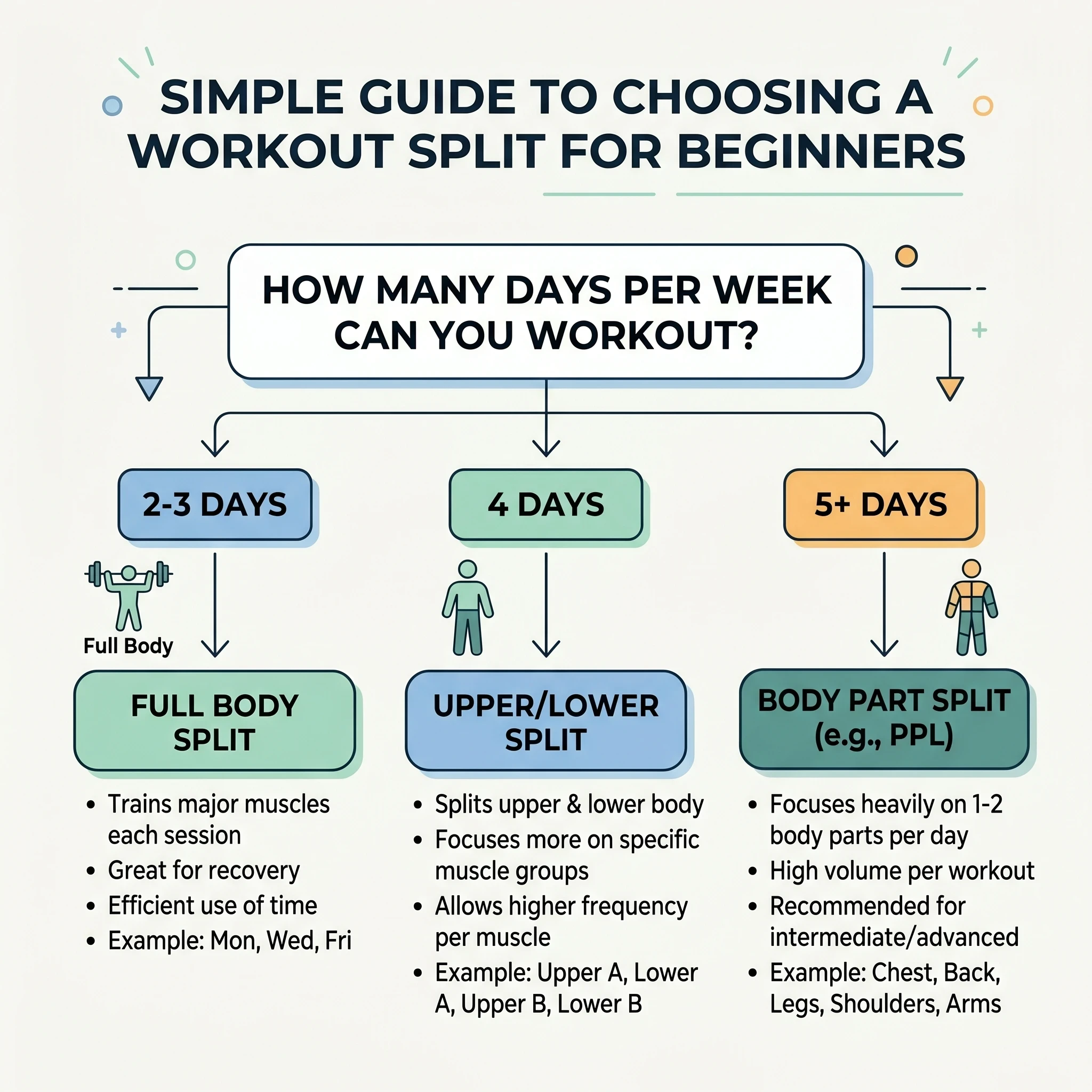
- If you can train 2–3 days per week, choose full body.
- If you can train 4 days per week, choose upper/lower.
- If you are completely new, start with full body for 8–12 weeks before moving to a 4-day split. If you are restarting after time off, this guide on Beginner Fitness Plans After A Break explains how to ease back in with lower volume, lighter weights, and safer progression before choosing a higher-frequency split. More advanced splits like push/pull/legs can be effective later on, but they are typically not necessary for beginners who are still building strength, consistency, and recovery habits.
- If you feel overly sore, tired, or inconsistent, reduce training frequency before adding more days.
Common Beginner Workout Split Mistakes
Starting a fitness journey can be daunting, but by avoiding a few common pitfalls, beginners can set themselves on a more secure path to success. Many beginners make avoidable errors—this guide on Workout Mistakes For Beginners explains what to watch out for. One frequent mistake is the temptation to switch workout splits too often. Sticking with a plan for at least 8-12 weeks allows your body the time it needs to adapt and grow.
Another error is jumping into advanced splits too soon. While they’re appealing, without a solid foundation, they can lead to overtraining and burnout. For beginners, mastering basic exercises and building on them is a better approach.
Focus should always be on progression, not merely the division of your workouts. Overly complex routines may distract from the essential goal of increasing weight and improving form gradually.
Additionally, training too many days without adequate recovery is a common setback. Ensuring rest is built into your routine is crucial. Muscles need downtime to repair, which is when growth truly occurs.
In crafting your fitness path, start simple and keep sustainability at the forefront of your planning. Align your training with your life to maintain consistency, making sure that your workout plan is built for the long haul.
Frequently Asked Questions
Is full body or upper/lower better for beginners?
Both are effective. Full body is best for beginners training 2–3 days per week, while upper/lower works well for those training 4 days per week.
How do I choose the right workout split?
Choose based on how many days you can train consistently. The best split is the one you can stick to long-term.
Can beginners build muscle with full body workouts?
Yes. Full body workouts are one of the most effective ways for beginners to build muscle due to higher training frequency.
How many days a week should beginners train?
Most beginners see great results with 2–4 workouts per week, depending on recovery and schedule.
Do workout splits really matter for muscle growth?
Workout splits matter less than consistency, effort, progressive overload, and recovery.
Key Takeaways
• The best workout split is the one you can stay consistent with
• Full body is ideal for 2–3 training days per week
• Upper/lower works well for 4 days per week
• Muscle growth depends more on effort, volume, and progression than split choice
• Avoid overcomplicating your training as a beginner
Final Thoughts
Choosing between full body and upper/lower training doesn’t have to be complicated. Both approaches can build muscle effectively when applied with the right principles.
Instead of searching for the “perfect” split, focus on building a routine you can follow consistently, train with enough effort, and progressively challenge over time.
Learning how to choose a workout split for beginners comes down to matching your routine to your schedule, recovery, and consistency.
For beginners, simple and structured always beats complex and inconsistent.
Beginner Bodybuilding Guides on Lift & Nurture
If you’re building your beginner training plan step by step, these guides will help you structure your workouts, recovery, and nutrition more effectively:
• Beginner Bodybuilding Workout Plan (12-Week Foundation Blueprint)
• 3 Day Workout Schedule For Beginners
• Push Pull Legs Workout For Beginners – Learn how this popular split compares to full body and upper/lower training, and when it makes sense to use it.
• How To Implement Progressive Overload For Beginners
• Beginner Weight Training Sets And Reps
• Muscle Recovery Tips for Beginners
• Workout Mistakes For Beginners
• How Many Calories Should Beginners Eat To Build Muscle?
• Beginner Upper Body Workout At The Gym – See how a simple upper-body gym session can be structured with chest, back, shoulders, arms, sets, reps, and progression.
References
Schoenfeld BJ, Ogborn D, Krieger JW. Effects of Resistance Training Frequency on Measures of Muscle Hypertrophy: A Systematic Review and Meta-Analysis. Sports Medicine. 2016.
https://pubmed.ncbi.nlm.nih.gov/27102172/
About the Author
Angel Carcamo is the founder of Lift & Nurture, a beginner bodybuilding platform focused on structured training, muscle growth fundamentals, and long-term progress.
As someone building Lift & Nurture around beginner-friendly research and structured training principles, Angel creates guides that simplify widely accepted strength training concepts into clear, practical steps.
His guides focus on key fundamentals like progressive overload, recovery, and nutrition — helping beginners build muscle without confusion, shortcuts, or unrealistic expectations.
Start here: Beginner Bodybuilding Roadmap
Foundation guide: Beginner Bodybuilding Workout Plan (12-Week Foundation Blueprint)
Thank you for sharing this helpful article about choosing the right workout split for beginners. I liked how the article explained that different workout splits can suit different fitness goals, schedules, and recovery abilities. The discussion about starting with a manageable routine instead of jumping into overly intense programs was especially useful for beginners.
I do have a few questions after reading the article. How can beginners determine which workout split is best for their body type, fitness level, and personal goals? Also, how long should someone stick with one workout split before deciding whether it is effective or needs to be changed?
Another question I had is whether full-body workout splits are generally better for beginners compared to push-pull-legs or upper/lower splits. Do you think recovery time and consistency are more important than workout intensity during the early stages of training?
Overall, the article provides practical guidance for beginners trying to build a sustainable fitness routine without feeling overwhelmed. Thank you again for sharing these valuable workout tips and insights.
Hi IYERE,
Thank you for reading the article and for the thoughtful questions. I’m glad the comparison between full body and upper/lower splits helped make the topic feel less overwhelming for beginners.
For most beginners, the “best” workout split usually depends less on body type and more on three things: schedule, recovery ability, and consistency. A beginner should choose the split they can realistically follow every week while still recovering well between workouts.
For example:
A beginner with only 2–3 available training days per week will usually do very well with a full body routine.
Someone who enjoys training 4 days per week and wants slightly more exercise variety may prefer an upper/lower split.
A beginner with poor recovery, inconsistent sleep, or a busy schedule is often better off starting simpler rather than jumping into very high-volume programs too early.
In general, I think beginners should stay with one split for at least 8–12 weeks before deciding whether it is effective. Many people switch programs too quickly before giving themselves enough time to improve technique, build consistency, and apply progressive overload properly. Usually, if strength is gradually improving, recovery is manageable, and workouts remain sustainable, the split is working.
As for whether full body routines are generally better for beginners, I would say they are often the easiest and most practical starting point — especially for new lifters still learning exercise form and recovery management. Full body training allows beginners to practice the main movement patterns multiple times per week without needing extremely high training volume in each session.
That does not mean upper/lower splits are bad for beginners, though. A 4-day upper/lower routine can also work very well when someone has the schedule and recovery capacity for it. The important thing is matching the split to the person rather than assuming one split is automatically superior for everyone.
And yes, I do believe recovery time and consistency are usually more important than extreme workout intensity during the early stages of training. Many beginners think they need to train as hard as possible every workout, but long-term progress usually comes from:
learning proper technique
training consistently
recovering properly
gradually increasing performance over time
A beginner who trains moderately but consistently for months will usually make better progress than someone who trains with maximum intensity for two weeks and burns out.
One of the biggest ideas I wanted to emphasize in the article is that there is rarely one “perfect” split. Full body, upper/lower, and even push/pull/legs routines can all build muscle when the fundamentals are in place. The best split is usually the one that allows a beginner to recover well, stay motivated, and train consistently over the long term.
Thanks again for the excellent questions and for taking the time to leave such a thoughtful comment!
– Angel
I agree that consistency and recovery matter more than trying to train hard every single day. A lot of beginners probably quit because they copy advanced routines from experienced lifters too early.
Do you think some beginners recover better with upper/lower splits even if they only train 3 days per week? Also, how can someone tell the difference between normal soreness and doing too much volume too soon? And for beginners over 35 or 40, would you still recommend starting with full body workouts first?
Thanks, Bob. I completely agree. A lot of beginners run into recovery problems because they copy high-volume routines from advanced lifters before building a solid foundation first.
Yes, I do think some beginners can recover very well with an upper/lower split even if they only train 3 days per week. In that situation, they can simply rotate the workouts across the week instead of forcing all 4 sessions every week. Upper/lower splits are flexible, which is one reason they work well for many people.
For most beginners, though, full-body training 2–3 times per week is usually easier to recover from while still providing enough frequency and practice with the main exercises. That’s one reason many evidence-based coaches recommend it early on.
As for soreness versus too much volume, normal soreness usually improves within a couple of days and doesn’t significantly reduce performance. Recovery becomes a concern when soreness is extreme or persistent, strength keeps dropping, motivation falls, joints start aching, sleep quality worsens, or the person constantly feels exhausted and run down. Those are usually signs the total workload is too high relative to recovery.
For beginners over 35 or 40, I would still often recommend starting with full-body workouts first, especially after a long break from training. The main difference is that recovery usually needs to be managed more carefully. That can mean fewer total sets, slower progression, longer warm-ups, controlled reps, and slightly more rest between sessions. The goal is still consistency and sustainable progress, not trying to recover from advanced-level training too early.