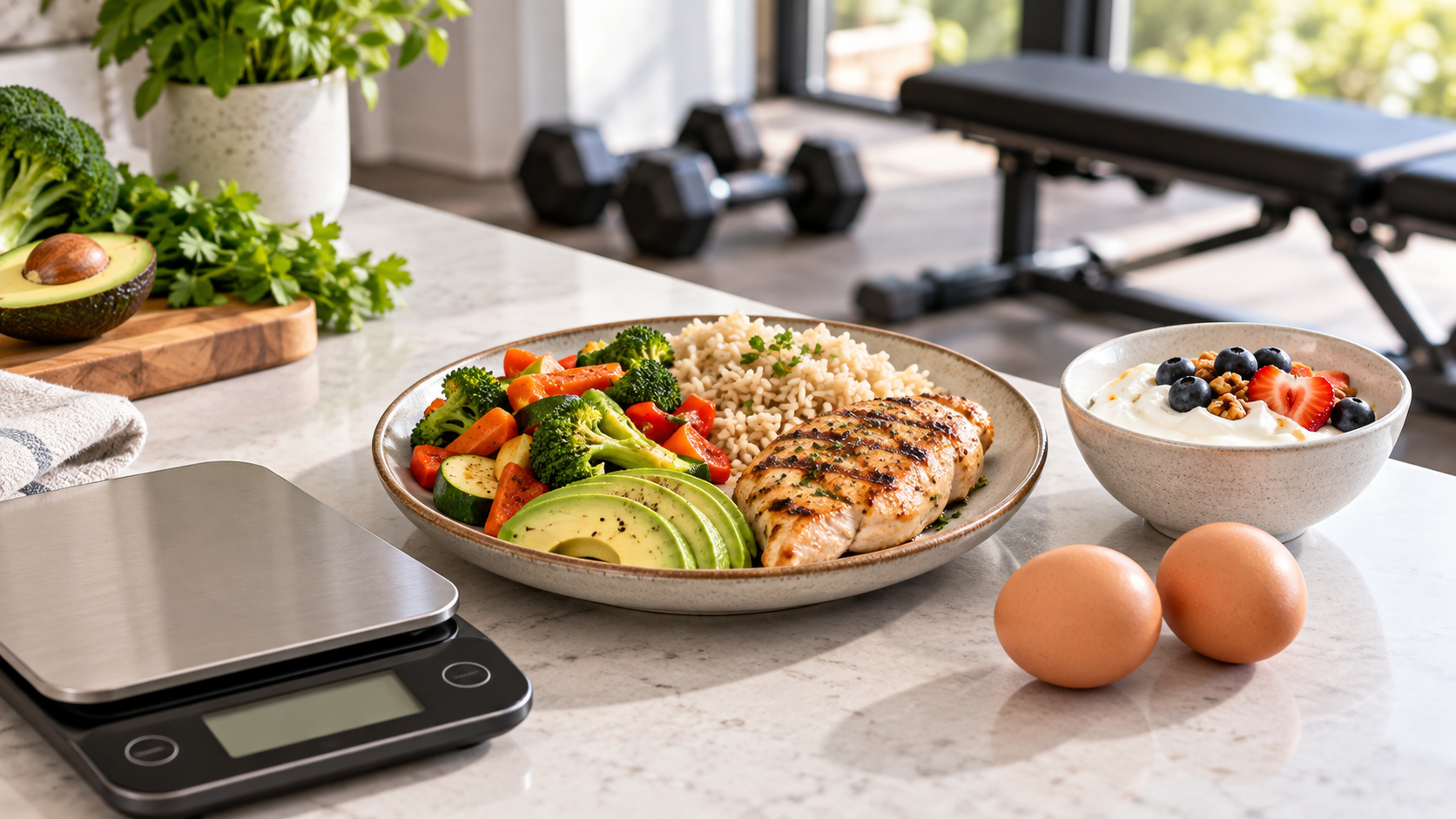
Protein can become surprisingly confusing once you start trying to build muscle.
One person says you need exactly 1 gram per pound of bodyweight. Someone else says 0.8 grams per kilogram is enough. Another lifter tells you that anything over 30 grams in one meal is wasted. Then you hear that you need a protein shake immediately after training or you have somehow missed your opportunity to grow.
Fortunately, the practical answer is much simpler than all of that.
For most healthy adults who are resistance training and trying to build muscle, around 1.6 grams of protein per kilogram of bodyweight per day—or about 0.7 to 0.75 grams per pound—is an excellent evidence-based target. Eating somewhat more can also be perfectly reasonable, but more protein does not automatically mean more muscle.
A major 2018 meta-analysis involving 49 resistance-training studies found that additional protein helped improve muscle and strength gains, but the estimated benefit for fat-free mass leveled off around 1.62 g/kg/day. The uncertainty around that estimate extended higher, which is one reason ranges up to roughly 2.2 g/kg/day are commonly used in sports nutrition.
That gives beginners a much more useful starting point than simply being told to “eat as much protein as possible.”
This guide will show you how to calculate your own target, how much to eat at each meal, which foods make reaching it easier, whether protein timing matters, whether protein powder is necessary, what changes when you are cutting or gaining, and which common protein rules are more myth than reality.
Important: This guide is written for generally healthy adults. Anyone with kidney disease, impaired kidney function, another condition requiring a prescribed protein intake, pregnancy-related nutritional needs, or other medical concerns should use individualized guidance from a qualified healthcare professional or registered dietitian instead of relying on general bodybuilding recommendations.
Quick Answer: How Much Protein for Beginners?
If you want the simplest useful answer:
Aim for about 1.6 grams of protein per kilogram of bodyweight per day, or roughly 0.7–0.75 grams per pound.
For most beginners who resistance train, that is a strong evidence-based starting point. A broader 1.6–2.2 g/kg/day, or about 0.7–1.0 g/lb/day, range can also work well, but the upper end is not required for excellent progress.
For example:
- 120 lb: about 87 g/day
- 150 lb: about 109 g/day
- 180 lb: about 131 g/day
- 200 lb: about 145 g/day
Round your target to a practical number rather than chasing perfect precision. Spreading protein across roughly 3–5 meals or snacks can make the target easier to reach, but productive resistance training, adequate overall nutrition, sleep and recovery remain essential.
Beginner Tip: Treat your target as a useful range, not a daily pass-or-fail test. Being close consistently matters much more than hitting the exact same number every day.
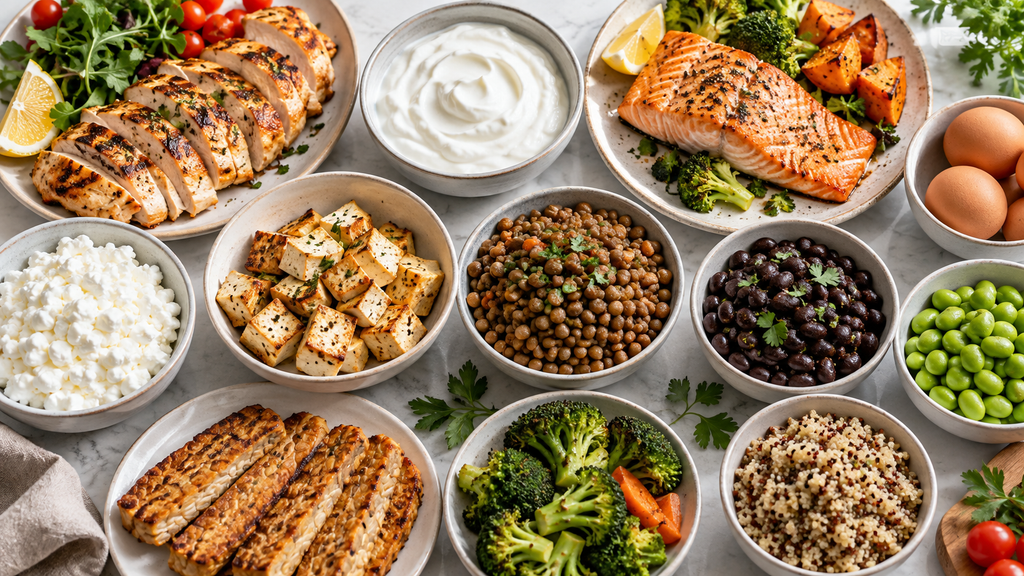
Table of Contents
- Why Protein Matters for Building Muscle
- Why 0.8 g/kg and 1.6 g/kg Are Both Protein Recommendations
- How Much Protein Should a Beginner Eat?
- How to Calculate Your Personal Protein Target
- Protein Targets by Bodyweight
- Does Protein Change When Bulking, Cutting, or Recomping?
- What If You Are Returning After a Long Training Break?
- How Much Protein Should You Eat Per Meal?
- Can Your Body Absorb More Than 20–30 Grams at Once?
- How Many Protein Meals Should You Eat?
- Does Protein Timing Matter?
- Should You Eat Protein Before Bed?
- Should You Eat the Same Protein on Rest Days?
- Protein Quality, Amino Acids, and Leucine
- Animal vs. Plant Protein
- Best High-Protein Foods for Beginners
- Do Beginners Need Protein Powder?
- What About BCAAs, EAAs, and Collagen?
- Realistic Beginner Protein Meal Examples
- How to Hit Your Protein Target Without Tracking Forever
- Common Beginner Protein Mistakes
- How Protein Fits With Calories, Carbs, Fats, and Training
- Is a High-Protein Diet Safe?
- How Long Until You See Results?
- Beginner Protein Action Plan
- Protein FAQ
- Key Takeaways
- Final Thoughts
- References
- About the Author
Why Protein Matters for Building Muscle
Your muscles are constantly going through protein turnover: old or damaged proteins are being broken down while new proteins are being built.
Resistance training changes that environment. A productive workout provides a stimulus telling muscle tissue that it needs to adapt to the challenge. Dietary protein supplies amino acids—the raw materials needed to support the remodeling process.
One important process involved is muscle protein synthesis, usually shortened to MPS. Resistance exercise stimulates MPS, and eating protein provides essential amino acids that can further stimulate the process. Repeated over many weeks and months, alongside progressive resistance training, that remodeling helps contribute to muscle hypertrophy.
This is a better way to understand muscle growth than the familiar explanation that lifting simply “tears your muscles and protein repairs the tears.” Exercise-induced muscle damage can occur, especially when training is new or unfamiliar, but muscle damage itself is not the goal or the primary explanation for hypertrophy.
Think of resistance training as providing the reason to adapt, while nutrition provides much of the material and energy needed to support that adaptation.
Protein is important, but it cannot compensate for ineffective training.
Someone eating 200 grams of protein while barely challenging their muscles is not automatically in a better muscle-building position than someone eating an appropriate protein amount while following a well-designed program and progressively improving.
For the training side of the equation, see Beginner Bodybuilding Workout Plan: 12-Week Foundation Blueprint and How to Implement Progressive Overload for Beginners.
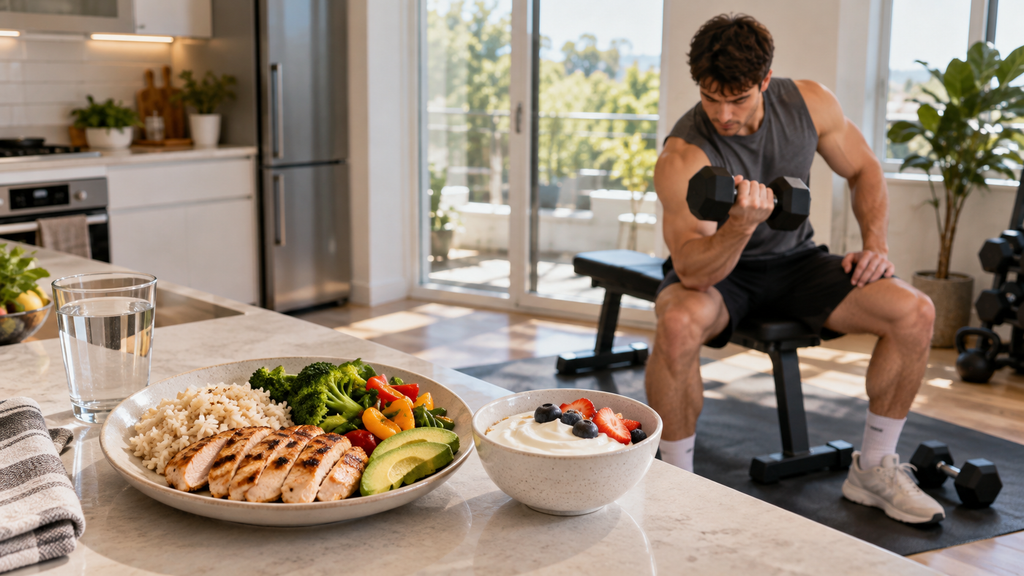
Why Do You Hear Both 0.8 g/kg and 1.6 g/kg?
This is one of the biggest sources of beginner confusion.
The adult Recommended Dietary Allowance, or RDA, is approximately 0.8 grams of protein per kilogram of bodyweight per day.
So why would someone trying to build muscle eat roughly twice that amount?
Because the two numbers are answering different questions.
The RDA is designed as a population-level recommendation intended to meet the protein requirements of nearly all healthy adults. It is not a specific bodybuilding target designed to maximize adaptations from resistance training.
Muscle-building research asks a different question:
How much protein appears useful when someone is repeatedly challenging muscle with resistance exercise and wants to support muscle and strength development?
That is where higher intakes become relevant.
The ISSN position stand concluded that roughly 1.4–2.0 g/kg/day is sufficient for most exercising individuals, while the well-known Morton meta-analysis estimated that the relationship between protein intake and additional fat-free-mass gains during resistance training leveled off around 1.62 g/kg/day.
So:
0.8 g/kg is not “wrong.”
It is simply not the same type of recommendation as a protein target intended to support resistance-training adaptations.
How Much Protein Should a Beginner Eat to Build Muscle?
For a generally healthy adult beginner who is resistance training, a very strong practical target is:
About 1.6 g/kg per day
That equals approximately:
0.73 grams per pound of bodyweight per day.
You can simplify that to 0.7–0.75 g/lb.
For someone who enjoys a higher-protein diet, is dieting, prefers the added fullness protein provides, or simply wants additional margin for individual variation, intake can reasonably move higher.
About 1.6–2.2 g/kg is a useful practical range
That converts to approximately:
0.7–1.0 g/lb per day.
The important distinction is that this is a range, not a prescription telling everyone to hit the highest number.
A 180-pound beginner does not automatically need 180 grams merely because 1 gram per pound is easy to remember.
At 180 pounds, 1.6 g/kg works out to approximately 131 grams per day.
That is already a substantial protein intake.
If that person prefers 150 grams or even 175–180 grams and the rest of their diet remains balanced, that can be reasonable too. It just should not be presented as though the extra 50 grams are guaranteed to produce more muscle.
Is 1 gram per pound a bad rule?
No.
It is actually a convenient rule because it lands near the upper end of commonly used muscle-building ranges.
It is easy to calculate:
180 pounds = about 180 grams.
But there is an important difference between:
“1 gram per pound is a simple, reasonable high-end target”
and
“You must eat 1 gram per pound or you will leave muscle gains behind.”
The second statement is not supported well by the research.
For most beginners, getting reliably close to an evidence-based intake matters much more than chasing an unnecessarily high number.
How to Calculate Your Personal Protein Target
You can calculate your protein target in either kilograms or pounds.
Method 1: Kilograms
Take your bodyweight in kilograms and multiply it by 1.6.
Bodyweight in kg × 1.6 = daily protein target
Example:
A beginner weighs 68 kg.
68 × 1.6 = 108.8 grams
Round that to approximately 110 grams of protein per day.
Method 2: Pounds
Multiply your bodyweight in pounds by about 0.73.
Bodyweight in pounds × 0.73 = approximately 1.6 g/kg
Example:
150 × 0.73 = 109.5 grams
Again, approximately 110 grams per day.
For an even easier calculation, multiply your weight by somewhere between 0.7 and 0.75.
There is no need to obsess over decimal points. Protein recommendations are estimates, not laboratory prescriptions.
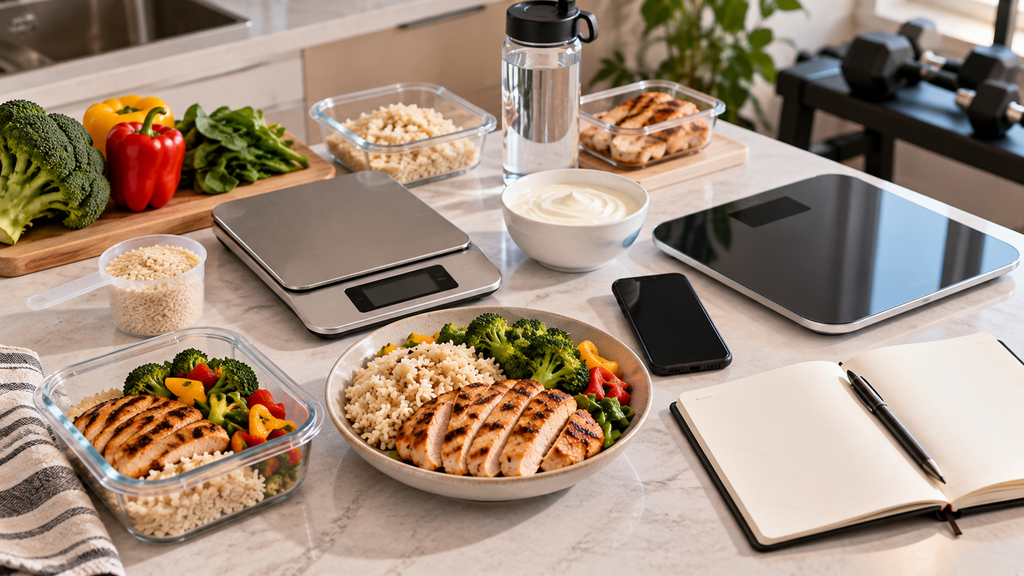
Daily Protein Targets by Bodyweight
Here is what approximately 1.6 g/kg looks like across common bodyweights.
| Bodyweight | Strong Starting Target (~1.6 g/kg) | High-End Reference (~2.2 g/kg) |
|---|---|---|
| 100 lb | 73 g | 100 g |
| 120 lb | 87 g | 120 g |
| 140 lb | 102 g | 140 g |
| 150 lb | 109 g | 150 g |
| 160 lb | 116 g | 160 g |
| 180 lb | 131 g | 180 g |
| 200 lb | 145 g | 200 g |
| 220 lb | 160 g | 220 g |
| 250 lb | 181 g | 249 g |
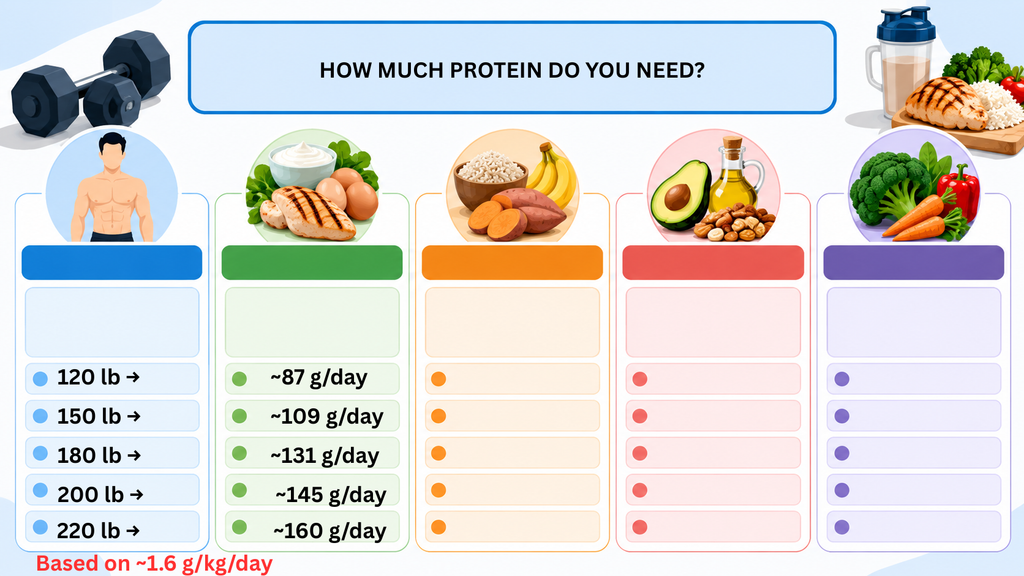
The final column is not a minimum and should not be read as the amount you need to maximize growth.
It is simply a high-end reference.
What if you carry a lot of body fat?
This is one situation where blindly multiplying total bodyweight can become less useful.
Protein requirements for muscle are related more closely to metabolically active and lean tissues than to body fat. Someone at a substantially higher body-fat level can therefore end up with an unnecessarily large number if they multiply every pound of current bodyweight by 0.7–1.0.
One practical approach is to calculate using a reasonable goal bodyweight rather than automatically using current bodyweight. Jeff Nippard’s more recent nutrition material similarly suggests using goal weight for people at a high body-fat percentage.
This is a practical approximation rather than a universally validated clinical formula, so people with obesity or medical nutrition concerns may benefit from individualized guidance.
Want a video explanation? Jeff Nippard’s The Smartest Way To Use Protein To Build Muscle (Science Explained) goes deeper into daily protein intake, protein distribution, protein quality and timing. The recommendations in this guide are based on the broader body of research rather than relying on any single creator or video.
Does Your Protein Target Change When Bulking, Cutting, or Recomping?
Yes—but usually not as dramatically as social media makes it sound.
When gaining muscle in a calorie surplus
A target around 1.6 g/kg/day is an excellent place to start.
You can eat more if you prefer, but there is little reason for a beginner to force extremely high protein while gaining.
A small calorie surplus already gives the body plenty of dietary energy, so once protein is sufficient, additional calories can be allocated to carbohydrates and fats.
Carbohydrates can be especially useful because they help support resistance-training performance.
For a complete calorie setup, see How Many Calories Should Beginners Eat to Build Muscle?
At maintenance or during body recomposition
A similar ~1.6 g/kg/day target works well as a starting point.
A broader 1.6–2.2 g/kg range can be used depending on preference, appetite, body composition, and whether the person is technically spending some days in a slight deficit.
Beginners, people returning from a layoff, and people beginning effective resistance training for the first time can be particularly good candidates for body recomposition, although individual results vary considerably.
During a calorie deficit
Protein becomes more valuable when calories are restricted because the goal is not only to lose weight but also to retain as much muscle as possible.
Reviews of athletic weight loss commonly recommend higher protein intakes during energy restriction, with approximately 1.6–2.4 g/kg/day being a useful general reference and some literature on lean, resistance-trained athletes extending higher depending on leanness and deficit severity.
That does not mean an ordinary beginner carrying moderate body fat needs 2.7 g/kg every day.
The highest recommendations are particularly relevant to lean, resistance-trained athletes going through demanding calorie deficits.
For an everyday beginner cutting at a sensible pace, staying around 1.6–2.2 g/kg will often be a much more reasonable starting point.
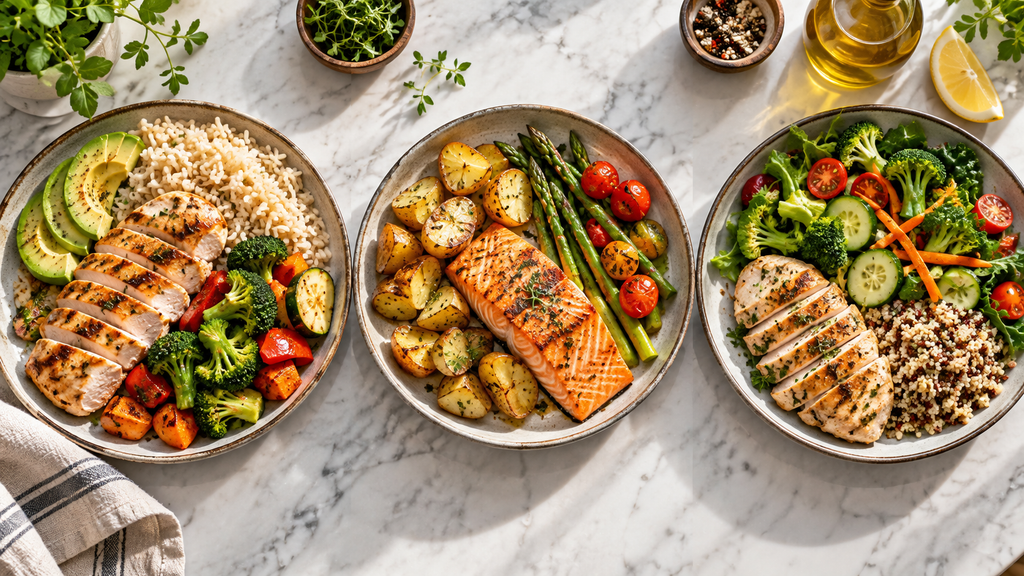
What If You Are Returning After a Long Training Break?
You do not need a completely different protein rule just because you have been away from training.
A long break changes your training status and potentially your body composition, but it does not create a magical requirement for enormous protein intake.
Once resistance training resumes, the same basic process applies:
- Choose an appropriate calorie intake for your current goal.
- Eat enough daily protein.
- Return to training progressively instead of trying to regain everything immediately.
- Give sleep and recovery enough attention.
- Track what actually happens and adjust gradually.
The useful takeaway for this guide is simple:
A training break is not a reason to panic-eat protein.
Start with the evidence-based fundamentals and let your training and recovery do their jobs.
How Much Protein Should You Eat Per Meal?
Once your daily protein target is covered, protein distribution becomes worth considering.
A commonly used evidence-based starting point is approximately:
0.4 g of protein per kilogram of bodyweight per meal
when protein is spread over roughly four meals.
A review by Schoenfeld and Aragon proposed about 0.4 g/kg per meal across four meals as a practical way to reach approximately 1.6 g/kg/day, with around 0.55 g/kg per meal corresponding to 2.2 g/kg/day across four meals.
For example, a 180-pound person weighs about 82 kg.
82 × 0.4 = approximately 33 grams per meal.
Four meals containing about 33 grams each would provide roughly:
132 grams per day.
That almost perfectly matches a 1.6 g/kg daily target for that person.
But this is not a hard threshold.
You do not suddenly stop using protein if one meal contains 45 or 60 grams.
Think of 0.4 g/kg as a useful meal-planning target, not a biological speed limit.
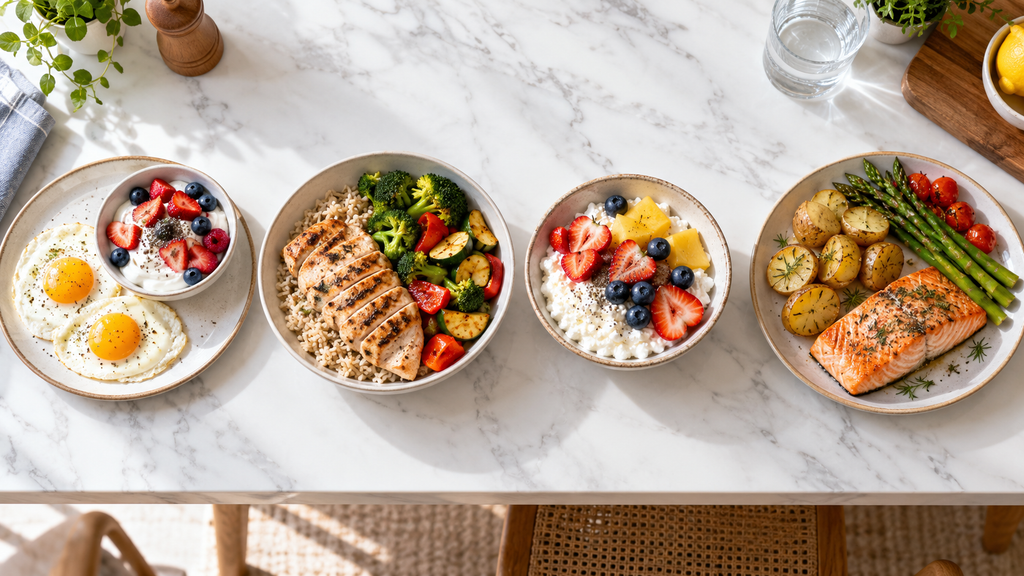
Can Your Body Absorb More Than 20–30 Grams of Protein in One Meal?
Yes.
This is one of the most persistent protein myths.
Your body can absorb far more than 20 or 30 grams of protein from a meal.
Absorption refers to amino acids moving from the digestive tract into circulation. The real question people usually mean is:
How much protein from one meal can contribute to muscle-building processes?
That answer is much more complicated.
Earlier acute studies found that relatively modest protein servings could strongly stimulate muscle protein synthesis, which helped create the idea that anything over 20–30 grams was “wasted.”
But later work has shown that larger meals can produce larger or more prolonged anabolic responses depending on the situation.
A 2023 study compared 25 grams with 100 grams of protein after resistance exercise. The 100-gram dose produced a larger and substantially longer anabolic response, lasting beyond 12 hours.
That does not prove everyone should start eating 100 grams of protein in one meal.
It tells us something more useful:
The human body does not simply throw away every gram above 20, 30, or 40 grams.
Your protein can also be used for enzymes, hormones, structural proteins, other tissues, and many metabolic functions outside of building biceps.
So if dinner contains 55 grams instead of 35, there is no reason to panic.
How Many Protein Meals Should Beginners Eat?
For most beginners, 3–5 protein-containing meals or snacks per day is an easy structure.
For example:
- Breakfast
- Lunch
- Afternoon snack
- Dinner
Or:
- Breakfast
- Lunch
- Pre- or post-workout snack
- Dinner
- Evening snack
You do not need six bodybuilding meals.
You also do not ruin your progress by eating only three times per day.
Daily protein intake remains the larger priority.
A person consistently consuming enough protein across three sensible meals is likely in a much better position than someone obsessing over six perfectly timed feedings while routinely missing their daily target.
Once your total is reliable, spreading protein reasonably across the day may help provide repeated opportunities for muscle protein synthesis and makes large daily totals easier to eat comfortably.
Does Protein Timing Matter?
Yes—but much less than your total daily intake.
The old bodybuilding idea was that you had roughly 30 minutes after your final set to drink a protein shake or the workout would somehow be wasted.
That is not supported by current evidence.
A 2025 meta-analysis specifically compared studies where protein was consumed before versus after resistance training. Timing did not meaningfully change lean-body-mass gains, although the strength findings were less certain.
This means you do not need to sprint from the last machine to your shaker bottle.
A much better approach is:
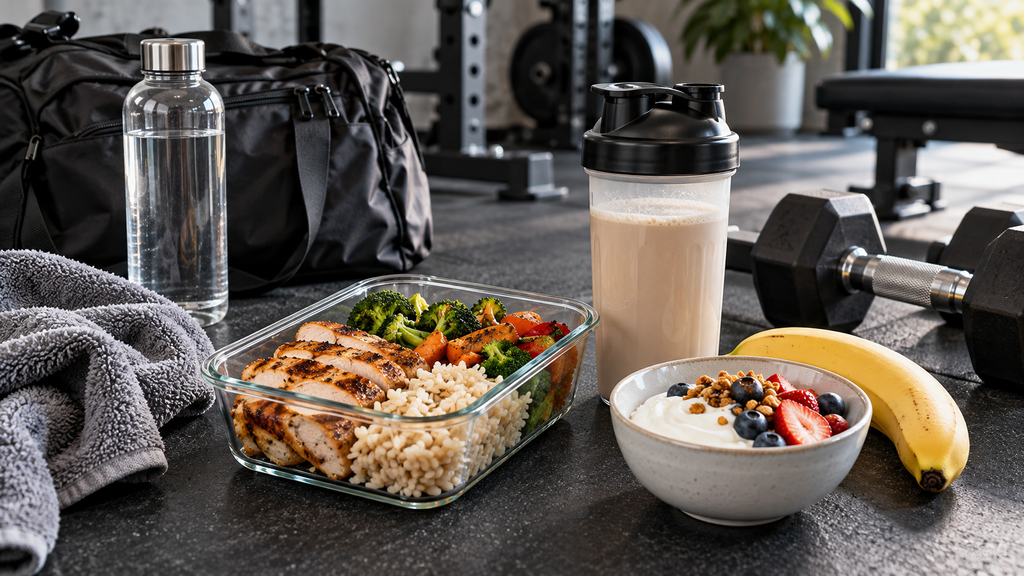
Eat a normal protein-rich meal within a reasonable period before training, after training, or both depending on your schedule.
If lunch contained plenty of protein and you train two hours later, your muscles are not suddenly starving for amino acids the instant your workout ends.
If you train first thing in the morning after an overnight fast, eating protein reasonably soon afterward makes more sense because your last protein-containing meal was much longer ago.
The key word is reasonably.
You do not need a stopwatch.
For more detail about workout nutrition, see What to Eat Before a Workout for Muscle Growth and What to Eat After a Workout to Build Muscle.
Should You Eat Protein Before Bed?
Protein before bed can be useful, but it is an optimization—not a requirement.
Research has shown that protein consumed before sleep can be digested and absorbed overnight and can increase overnight muscle protein synthesis. A systematic review found acute benefits from roughly 20–40 grams of pre-sleep casein, while noting that evidence for additional long-term muscle gains was less certain because some studies did not perfectly match total protein between groups.
So instead of thinking:
“I need casein at 10:17 p.m.”
think:
“Do I still need some protein today, and would an evening meal or snack fit comfortably?”
If yes, foods such as Greek yogurt, cottage cheese, milk, soy foods, or a protein shake can work.
If you already hit your target and do not want to eat before bed, you do not need to force another meal.
Should You Eat the Same Amount of Protein on Rest Days?
Generally, yes.
Muscle adaptation does not switch off when you leave the gym.
Recovery and tissue remodeling continue between training sessions, so beginners do not need dramatically different protein targets for training days and rest days.
Keeping roughly the same daily protein target also makes eating habits simpler.
You can change carbohydrate or total calorie intake slightly between days if that is part of your chosen nutrition plan, but protein usually does not need to swing wildly.
Consistency makes more sense.
Protein Quality: What Does It Actually Mean?
Not every protein source has the exact same amino-acid profile or digestibility.
Protein is made from amino acids. Nine amino acids are considered essential amino acids, or EAAs, because the body cannot manufacture enough of them on its own and therefore needs to obtain them through food.
Among them, leucine plays an important signaling role in stimulating muscle protein synthesis.
This is why proteins such as whey, dairy, eggs, meat, fish, and soy are often considered especially useful for muscle building: they provide substantial amounts of essential amino acids and leucine.
But this topic can become unnecessarily complicated.
A beginner does not need to calculate the leucine content of breakfast, measure every essential amino acid, or rank every meal using a protein-quality scoring system.
The bigger lesson is:
Hit an appropriate daily protein total and get much of it from protein-rich foods with good essential-amino-acid profiles.
If you do that consistently, the smaller differences in individual protein sources become much less important.
That fundamental-first approach also matches the hierarchy in the source material you supplied: daily intake carries more practical importance than micromanaging amino acids and timing.
Animal Protein vs. Plant Protein
You can absolutely build muscle on a plant-based diet.
However, plant and animal proteins are not always nutritionally identical gram for gram.
Many animal proteins naturally contain high concentrations of essential amino acids and leucine and are highly digestible. Some individual plant proteins contain less of one or more essential amino acids or provide less leucine per gram.
That does not make plant protein “bad.”
It means plant-based lifters may benefit from being a little more deliberate about:
- Eating enough total protein.
- Using a variety of protein sources.
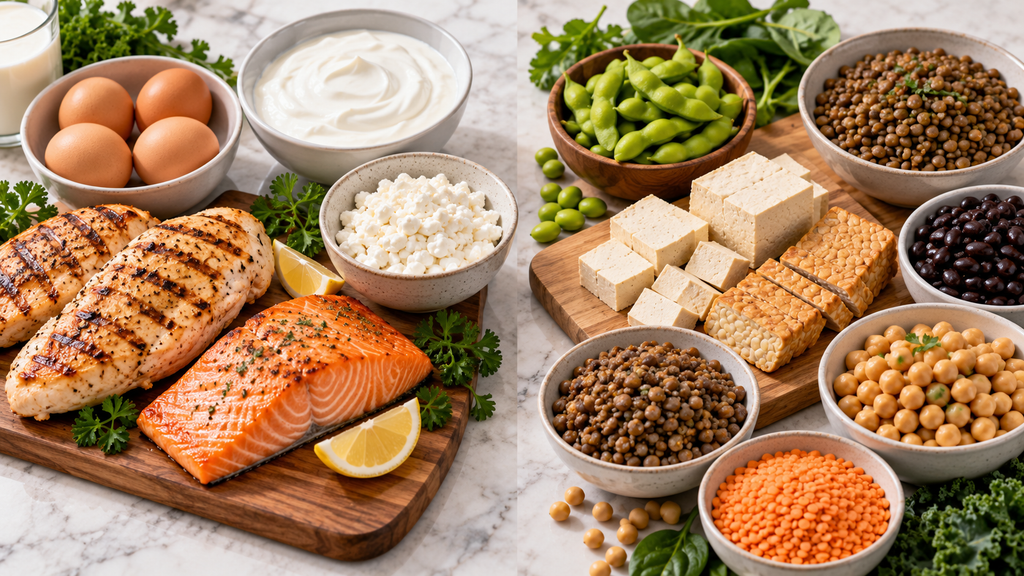
- Including protein-dense foods such as soy, tofu, tempeh, seitan, legumes, and higher-protein grains.
- Using soy, pea, rice, or blended plant protein powder if convenience helps.
- Potentially aiming somewhat higher within their protein range if much of their diet comes from lower-quality protein sources.
A 2025 meta-analysis found a small overall advantage for animal protein on muscle-mass outcomes, particularly compared with non-soy plant sources, but found no pooled difference between soy and milk protein and no significant overall difference in muscle strength.
Newer long-term evidence published in 2026 also found no significant differences between plant and animal protein supplementation across lean mass or strength when sufficient protein was consumed, although research remains heterogeneous.
The practical message is not:
“Animal protein builds muscle and plant protein does not.”
It is:
Protein source can matter somewhat, especially gram for gram, but an adequately planned plant-based diet can still support excellent resistance-training progress.
Best High-Protein Foods for Beginners
You do not need bodybuilding-specific foods.
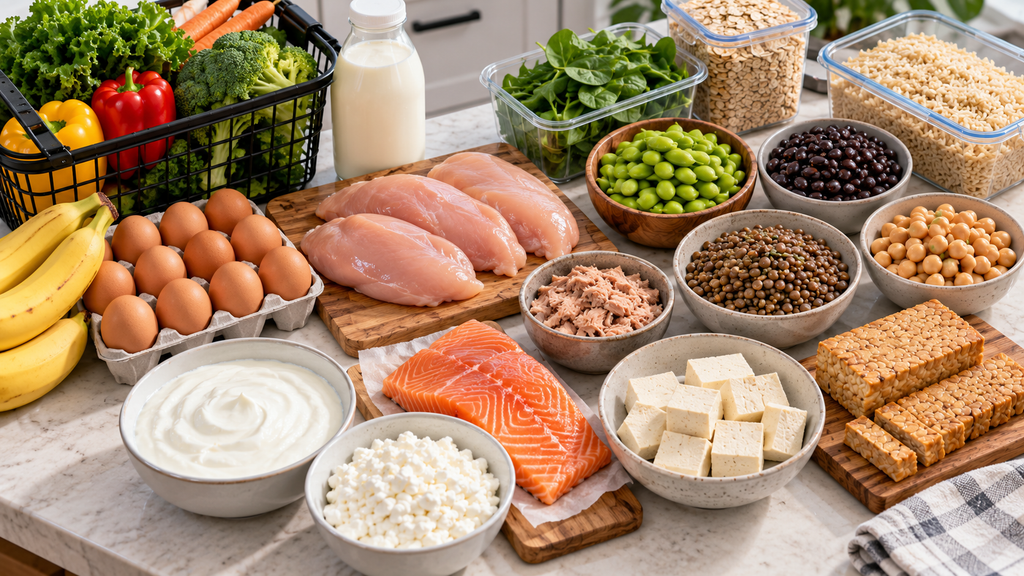
You need foods that make your protein target practical while fitting your calories, budget, preferences, digestion, and overall nutrition.
Protein amounts below are approximate because brands, cooking methods, serving sizes, and individual foods vary.
| Food | Example Serving | Approximate Protein |
|---|---|---|
| Chicken breast | 4 oz cooked | 30–35 g |
| Turkey | 4 oz cooked | 25–30 g |
| Lean beef | 4 oz cooked | 25–30 g |
| Salmon | 4 oz cooked | 23–25 g |
| Canned tuna | 5 oz drained | 25–30 g |
| Whole eggs | 2 large | 12–13 g |
| Greek yogurt | 1 cup | 18–23 g |
| Cottage cheese | 1 cup | 24–28 g |
| Milk | 1 cup | ~8 g |
| Firm tofu | ~150 g | 15–20 g |
| Tempeh | 100 g | ~19–20 g |
| Edamame | 1 cup cooked | ~18 g |
| Lentils | 1 cup cooked | ~18 g |
| Beans | 1 cup cooked | ~14–16 g |
| Seitan | 3 oz | ~20–25 g |
| Whey protein | 1 typical scoop | ~20–25 g |
| Plant protein powder | 1 typical scoop | ~20–25 g |
These foods do not have to be eaten plain.
Chicken can become a burrito bowl. Greek yogurt can be mixed with fruit and oats. Tofu can go into a stir-fry. Lentils can go into chili. Cottage cheese can be blended into sauces. A protein shake can include milk, fruit, oats, or peanut butter depending on calorie needs.
Protein nutrition becomes much easier when the meals are foods you actually enjoy.
For more food ideas, see Best Foods for Building Muscle for Beginners and Muscle Building Grocery List for Beginners on a Budget.
Do Beginners Need Protein Powder?
No.
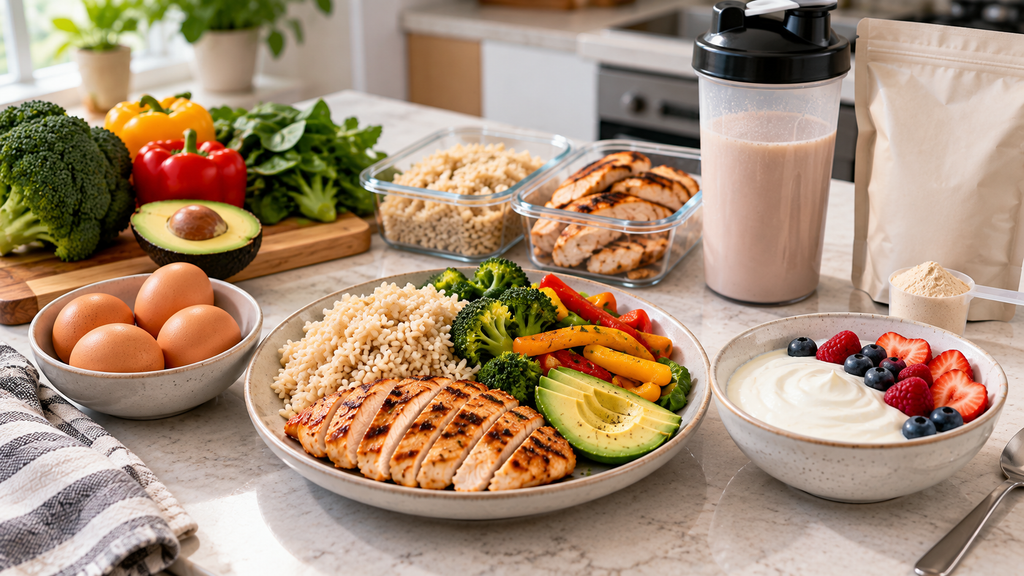
Protein powder is optional.
Think of it as a convenient protein food rather than a muscle-building drug.
If you can comfortably hit your target with foods you enjoy, there is no physiological requirement to add whey or another powder.
Protein powder becomes useful when:
- You are short on protein at the end of the day.
- You need something quick before work or school.
- Your appetite makes solid food difficult.
- You want an easy post-workout option.
- Getting enough protein from food alone becomes expensive or inconvenient.
- You follow a vegetarian or vegan diet and want an easy high-quality protein source.
Whey concentrate
Usually the most affordable dairy-based option. It contains some lactose, carbohydrate, and fat along with protein.
Whey isolate
More heavily filtered and usually higher in protein by weight, with less lactose, carbohydrate, and fat. It can be useful for people who prefer it or tolerate it better, but it does not automatically build more muscle than a good whey concentrate when total protein is matched.
Casein
A slower-digesting milk protein. It can work at any time of day and is commonly used in evening meals or snacks, but it is not mandatory before bed.
Plant protein
Soy protein is a strong standalone option. Pea, rice, or blended plant formulas can also work very well.
When buying protein powder, focus on boring but useful things:
Does it provide a meaningful amount of protein? Do you tolerate it? Do you like the taste? Does it fit your budget? Does the company clearly disclose what is in it?
For athletes who undergo drug testing or anyone especially concerned about supplement contamination, reputable third-party testing can provide additional reassurance.
You do not need the most expensive tub on the shelf.
What About BCAAs, EAAs, and Collagen?
BCAAs
BCAAs—leucine, isoleucine, and valine—are real amino acids with important physiological roles.
That does not mean buying them separately is necessary.
Complete protein foods already contain BCAAs along with the other essential amino acids needed to build new proteins.
A 2022 systematic review found that although BCAA supplementation can affect some biochemical markers and may sometimes reduce soreness, benefits for body composition and athletic performance were negligible or inconsistent.
If you already eat enough high-quality protein, BCAAs would be very low on the priority list.
EAAs
Essential amino acid supplements make more biological sense than isolated BCAAs because muscle protein synthesis requires the complete set of essential amino acids.
Still, for most beginners, a normal serving of complete protein accomplishes the same nutritional goal while also providing more total protein.
Collagen
Collagen is protein, but it has a very different amino-acid profile from proteins such as whey, dairy, eggs, soy, meat, or fish.
It should therefore not be treated as a gram-for-gram replacement for your main muscle-building protein sources.
A direct 10-week trial in young adults found whey protein produced greater increases in muscle thickness than leucine-matched collagen peptides, although strength improvements were similar.
Collagen research for connective tissue, bone, and resistance training continues to develop, so it would also be inaccurate to call collagen worthless.
A sensible approach is:
If you use collagen for another reason, it can contribute to your total dietary protein—but still build most of your muscle-building protein intake around complete, essential-amino-acid-rich sources.
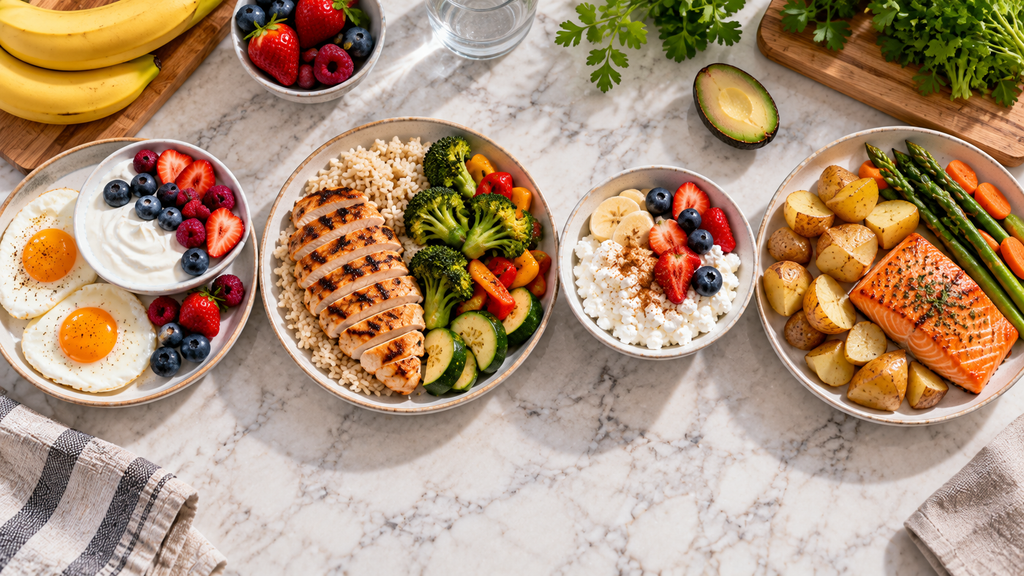
What Does a High-Protein Day Actually Look Like?
Numbers become much easier once you turn them into meals.
These examples are not required meal plans. They simply show how ordinary foods can add up.
Example 1: About 130 Grams
Breakfast:
2 eggs + 1 cup Greek yogurt
Approximately 30–32 g
Lunch:
4 oz chicken breast in a rice bowl
Approximately 35 g
Running total: about 65–67 g
Snack:
1 cup cottage cheese
Approximately 25–27 g
Running total: about 90–94 g
Dinner:
5 oz salmon with potatoes and vegetables
Approximately 30–32 g
Daily total: roughly 120–126 g
Add a glass of milk, beans with dinner, or a little additional yogurt and the day easily lands around 130 grams.
Example 2: About 160 Grams
Breakfast:
3 eggs + Greek yogurt
~38 g
Lunch:
5 oz chicken breast
~40–45 g
Running total: ~80 g
Snack:
Protein shake with milk
~30–33 g
Running total: ~110–115 g
Dinner:
5 oz lean beef + ½ cup beans
~45 g
Daily total: approximately 155–160 g.
Example 3: Plant-Based Day Around 150 Grams
Breakfast:
Tofu scramble + soy milk
~35–40 g
Lunch:
Tempeh bowl with rice and vegetables
~30–35 g
Running total: ~65–75 g
Snack:
Plant protein shake with soy milk
~30–35 g
Running total: ~95–110 g
Dinner:
Seitan, lentils, potatoes or grains, and vegetables
~40–45 g
Daily total: roughly 140–155 g.
The exact total will depend on serving sizes and brands.
The point is that you do not need five protein shakes or endless chicken breast.
How to Hit Your Protein Goal Without Tracking Forever
Tracking food can be educational, but it does not have to become a permanent lifestyle.
A useful beginner strategy is to track for a short learning period.
Step 1: Learn what you currently eat
Track several normal days without trying to create a “perfect” diet.
You might discover that breakfast contains 8 grams, lunch 20 grams, dinner 35 grams, and snacks almost none.
Now you know where the gap actually is.
Step 2: Build a protein anchor into each main meal
Instead of thinking about your entire 130-gram target at once, ask:
“What is the main protein source in this meal?”
Examples:
Eggs + Greek yogurt at breakfast.
Chicken, turkey, tuna, tofu, or lentils at lunch.
Greek yogurt, cottage cheese, milk, edamame, or a shake as a snack.
Fish, meat, tofu, tempeh, seitan, or legumes at dinner.
Step 3: Learn your repeat meals
Most people eat many of the same foods repeatedly.
Once you know your usual breakfast gives you about 30 grams and your normal lunch gives you 35, you do not need to recalculate them every day.
Step 4: Stop chasing perfect accuracy
Food labels, databases, serving sizes, and your own measurements all contain some error.
If your target is 130 grams, landing somewhere around it consistently matters far more than proving you consumed exactly 130.0 grams.
Common Beginner Mistakes With Protein
Mistake 1: Thinking more is always better
Protein has diminishing returns.
Going from an inadequate intake to an appropriate one can matter.
Going from appropriate to extremely high does not automatically keep increasing muscle growth.
Do not take a useful nutrient and turn it into a competition.
Mistake 2: Treating 1 gram per pound as a minimum
For many lifters, it is closer to a convenient high-end target than a biological minimum.
Around 0.7–0.75 g/lb is already approximately 1.6 g/kg.
Mistake 3: Ignoring calories
Protein does not operate in isolation.
You can hit your protein perfectly while eating far too few calories to perform and recover well—or consume far more total calories than your goal requires.
See How Many Calories Should Beginners Eat to Build Muscle? for the larger energy-balance picture.
Mistake 4: Believing 30 grams is the absorption limit
It is not.
You can digest and absorb substantially more protein than that, and newer acute research has shown a prolonged anabolic response to much larger doses.
Mistake 5: Obsessing over the anabolic window
Your muscles do not become nutrition-resistant 31 minutes after training.
Daily protein and overall meal structure matter more than racing a clock.
Mistake 6: Buying supplements before fixing meals
Protein powder is useful.
BCAAs are optional at best for most people.
A complicated supplement stack cannot compensate for consistently missing your protein and calorie needs.
Mistake 7: Forgetting breakfast
Many beginners accidentally eat most of their daily protein at dinner because breakfast is cereal, toast, or a pastry and lunch is relatively small.
Adding 20–30 grams earlier in the day can make the entire target dramatically easier.
Mistake 8: Counting foods as “high protein” when they are primarily something else
Peanut butter, nuts, quinoa, oats, and many other foods contain protein.
That does not necessarily make them efficient protein sources.
Peanut butter, for example, is primarily a fat-rich food that happens to contain some protein.
Count the protein—but do not expect a spoonful of peanut butter to replace a substantial serving of Greek yogurt, tofu, chicken, fish, or another protein-dense food.
Mistake 9: Neglecting the rest of the diet
Protein is important.
So are fruits, vegetables, whole grains, healthy fats, fiber, micronutrients, and sufficient dietary variety.
A muscle-building diet should also be a diet that supports your long-term health.
Protein Does Not Replace Calories, Carbohydrates, Fats, Training, or Recovery
One of the easiest mistakes in bodybuilding nutrition is to find one important variable and treat it like the entire system.
Protein is not the entire system.
For muscle growth, think of the big picture like this:
Resistance training provides the stimulus.
Protein supplies amino acids.
Total calories influence whether enough energy is available and whether bodyweight is trending up, down, or remaining stable.
Carbohydrates help fuel productive training.
Dietary fat supports health and makes the diet practical and enjoyable.
Sleep and recovery give adaptation time to occur.
None of these need to be perfect.
They need to work together consistently.
Is a High-Protein Diet Safe?
For generally healthy adults without chronic kidney disease, the available controlled research is reassuring about protein intakes commonly used in fitness.
However, “healthy people can eat unlimited protein forever with zero concern” would be much stronger than the evidence actually supports.
A 2026 systematic review and meta-analysis examined 22 randomized trials of high-protein diets in adults without chronic kidney disease. Higher protein increased estimated glomerular filtration rate, but there was no consistent biochemical evidence suggesting kidney injury. The researchers also emphasized that many studies were relatively short and that the long-term renal implications remain uncertain.
That gives us a much more responsible conclusion:
The usual muscle-building protein ranges appear well tolerated in healthy adults, but more is not automatically healthier and long-term extremes are unnecessary.
People with chronic kidney disease, reduced kidney function, or other medical conditions affecting protein metabolism should not use general bodybuilding recommendations as individualized medical guidance.
The same applies to anyone who has been specifically told by a healthcare professional to restrict or modify protein intake.
How Long Until More Protein Builds Visible Muscle?
There is no protein-specific countdown.
Eating 1.6 g/kg today does not mean visible muscle appears in eight weeks.
Protein supports the adaptation created by your training, but the actual rate of muscle development depends on:
- Training quality.
- Training experience.
- Genetics.
- Calorie intake.
- Protein intake.
- Sleep.
- Recovery.
- Exercise selection.
- Effort and progression.
- Starting muscle mass.
- Starting body composition.
- Consistency over time.
Beginners can often make faster progress than advanced lifters because resistance training is a newer stimulus, but even beginner muscle growth should be viewed in months and years, not just individual workouts.
Short-term changes in your appearance can also come from glycogen, water, food volume, lighting, pumps, and body-fat changes rather than new muscle tissue.
For a full explanation, see How Long Does It Take to Build Muscle for Beginners?
The Beginner Protein Action Plan
If the entire guide feels like a lot of information, use these steps:
Step 1: Start with resistance training
Protein supports muscle growth, but training provides the stimulus that gives your body a reason to adapt.
Step 2: Calculate your starting target
Aim for roughly 1.6 g/kg/day, or about 0.7–0.75 g/lb/day.
Step 3: Divide it into manageable meals
Around 3–5 protein-containing meals or snacks works well for many people. About 0.4 g/kg per meal can be a useful planning reference if you want more structure.
Step 4: Give each main meal a protein anchor
Build meals around foods such as chicken, fish, eggs, Greek yogurt, cottage cheese, tofu, tempeh, legumes or another protein-rich food you enjoy.
Step 5: Use protein powder only when it makes life easier
A shake can be convenient, but it does not replace a balanced diet and is not required for muscle growth.
Step 6: Adjust for your goal
Keep protein fairly consistent on training and rest days. A somewhat higher intake can become more useful during a calorie deficit, while extremely high intakes are usually unnecessary when gaining or maintaining.
Step 7: Track long enough to learn, then focus on consistency
Logging your food for a short period can teach you what your usual meals provide. Once your protein intake is reliably covered, put your attention back on productive training, enough total nutrition, sleep and recovery.
Beginner FAQ: Protein and Muscle Building
| Question | Answer |
|---|---|
| How much protein should beginners eat to build muscle? | Around 1.6 g/kg/day, or 0.7–0.75 g/lb/day, is an excellent starting target for most healthy adults who resistance train. A broader 1.6–2.2 g/kg range can also work. |
| Is 100 grams of protein enough? | It depends on bodyweight. For someone around 135–140 pounds, 100 grams is close to 1.6 g/kg. A much heavier person would generally need more to reach the same relative intake. |
| Is 150 grams enough to build muscle? | For many people, yes. A 200-pound person eating 150 grams gets roughly 1.65 g/kg/day. |
| Do beginners need 1 gram of protein per pound? | No. It is a convenient high-end target, not a requirement. |
| Can your body absorb more than 30 grams of protein? | Yes. There is no 30-gram absorption limit. |
| Is more than 40 grams in one meal wasted? | No. Larger protein meals are still digested and used by the body, although that does not mean extremely large servings are necessary. |
| Should beginners eat protein immediately after lifting? | No. Total daily protein matters more than hitting an exact 30-minute window. Eat protein reasonably around training based on your schedule. |
| What if I train fasted? | If several hours have passed since your last protein-containing meal, eating protein reasonably soon after training makes sense. |
| Do I need protein on rest days? | Generally, yes. Keep roughly the same target because recovery and remodeling continue between workouts. |
| Do women need less protein than men? | The same general g/kg framework can be used. Total grams may differ because bodyweight differs. |
| Can vegans build muscle? | Yes. Prioritize enough total protein, varied protein-rich plant foods and good-quality sources such as soy when useful. |
| Do I need whey protein? | No. Whey is convenient, not required. |
| Are BCAAs necessary? | Usually not when you already consume enough complete protein. |
| Should collagen count toward my protein goal? | It contributes protein, but it should not replace most of your complete, essential-amino-acid-rich protein sources when muscle growth is the goal. |
| Does protein make you bulky? | No. Significant muscle gain requires resistance training, adequate nutrition and time. |
| Can too much protein make you gain fat? | Protein contains calories, so bodyweight can increase when total calorie intake consistently exceeds expenditure. |
| Should beginners track protein every day? | Not necessarily. Tracking temporarily can help you learn your portions; you may not need to log forever. |
Key Takeaways
- About 1.6 g/kg/day—or 0.7–0.75 g/lb—is an excellent starting protein target for most healthy adult beginners who resistance train.
- A broader 1.6–2.2 g/kg/day range can work, but 1 g/lb is not mandatory.
- Daily protein intake matters more than perfect timing, although spreading protein across several meals can be useful.
- There is no 20-, 30- or 40-gram hard absorption limit per meal.
- Whole foods can provide all the protein you need; protein powder is optional convenience.
- Well-planned plant-based diets can support muscle growth too.
- Protein needs can rise during calorie restriction, especially in leaner, resistance-trained people.
- Protein works alongside resistance training, adequate calories, sleep and recovery—not instead of them.
Final Thoughts
If you came here wondering how much protein for beginners is actually needed, start with roughly 1.6 grams per kilogram of bodyweight per day, or about 0.7–0.75 grams per pound.
Build most of that intake around protein-rich foods you enjoy, distribute it through the day in a way that fits your schedule, and use protein powder only when convenience makes it useful. You do not need to force 1 gram per pound, race a 30-minute anabolic window, or make every meal mathematically perfect.
Protein is only one part of building muscle. Long-term results come from combining enough protein with productive resistance training, appropriate calories, progressive improvement, sleep and recovery. The best nutrition plan is not the most complicated one—it is one you can follow consistently.
For the complete nutrition picture beyond protein, continue with Muscle Building Nutrition Guide for Beginners. For calorie setup, see How Many Calories Should Beginners Eat to Build Muscle? And when you are ready to connect nutrition with training, start with the Beginner Bodybuilding Workout Plan: 12-Week Foundation Blueprint.
References
Morton RW, Murphy KT, McKellar SR, et al. A systematic review, meta-analysis and meta-regression of the effect of protein supplementation on resistance training-induced gains in muscle mass and strength in healthy adults. British Journal of Sports Medicine. 2018. The analysis included 49 studies and identified an estimated protein-intake breakpoint around 1.62 g/kg/day for additional fat-free-mass gains.
Jäger R, Kerksick CM, Campbell BI, et al. International Society of Sports Nutrition Position Stand: protein and exercise. Journal of the International Society of Sports Nutrition. 2017.
Schoenfeld BJ, Aragon AA. How much protein can the body use in a single meal for muscle-building? Implications for daily protein distribution. Journal of the International Society of Sports Nutrition. 2018.
Tagawa R, Watanabe D, Ito K, et al. Synergistic Effect of Increased Total Protein Intake and Strength Training on Muscle Strength: A Dose-Response Meta-analysis of Randomized Controlled Trials. Sports Medicine Open. 2022.
Trommelen J, et al. The anabolic response to protein ingestion during recovery from exercise has no upper limit in magnitude and duration in vivo in humans. Cell Reports Medicine. 2023.
Casuso RA, Goossens L. Does Protein Ingestion Timing Affect Exercise-Induced Adaptations? A Systematic Review with Meta-Analysis. Nutrients. 2025.
Reid-McCann RJ, Brennan SF, Ward NA, et al. Effect of Plant Versus Animal Protein on Muscle Mass, Strength, Physical Performance, and Sarcopenia: A Systematic Review and Meta-analysis of Randomized Controlled Trials. Nutrition Reviews. 2025.
Martinho DV, Nobari H, Faria A, et al. Oral Branched-Chain Amino Acids Supplementation in Athletes: A Systematic Review. Nutrients. 2022.
Silva PRT, Santos P, Nogueira PAM, et al. Effects of High-Protein Diets on Renal Function and Body Composition in Adults Without Chronic Kidney Disease: A Systematic Review and Meta-Analysis of Randomised Trials. Diabetes, Obesity and Metabolism. 2026.
Hector AJ, Phillips SM. Protein Recommendations for Weight Loss in Elite Athletes: A Focus on Body Composition and Performance. International Journal of Sport Nutrition and Exercise Metabolism. 2018.
Helms ER, Zinn C, Rowlands DS, Brown SR. A systematic review of dietary protein during caloric restriction in resistance trained lean athletes: a case for higher intakes. International Journal of Sport Nutrition and Exercise Metabolism. 2014.
Reis CEG, Loureiro LMR, Roschel H, da Costa THM. Effects of pre-sleep protein consumption on muscle-related outcomes – A systematic review. Journal of Science and Medicine in Sport. 2021;24(2):177–182.
Yimam MA, Roberts J, O’Callaghan A, et al. Long-term effects of plant vs. animal protein supplementation on body composition, muscle strength, physical performance, and cardiometabolic risk factors in adults: a systematic review and meta-analysis of randomized controlled trials. Frontiers in Nutrition. 2026;13:1813846.
Jacinto JL, Nunes JP, Gorissen SHM, et al. Whey Protein Supplementation Is Superior to Leucine-Matched Collagen Peptides to Increase Muscle Thickness During a 10-Week Resistance Training Program in Untrained Young Adults. International Journal of Sport Nutrition and Exercise Metabolism. 2022;32(3):133–143.
Institute of Medicine (US), Food and Nutrition Board. Dietary Reference Intakes for Energy, Carbohydrate, Fiber, Fat, Fatty Acids, Cholesterol, Protein, and Amino Acids. Washington, DC: The National Academies Press. 2005. Adult protein RDA: approximately 0.8 g/kg/day.
About the Author
Angel Carcamo is the founder of Lift & Nurture, a beginner bodybuilding website focused on making muscle-building fundamentals easier to understand and apply.
I am not a personal trainer, registered dietitian, or veteran bodybuilder, and I do not want Lift & Nurture to pretend otherwise.
I started trying to train when I was much younger, but I did not have a structured understanding of programming, nutrition, recovery, or evidence-based bodybuilding. After stepping away from training for an extended period, I began spending much more time studying science-based training and nutrition so that when I eventually return to structured lifting, I can approach it with a much better foundation.
I am still learning and preparing for that return, so the recommendations in this guide are not presented as methods I have personally coached or successfully used for years.
Instead, Lift & Nurture is built around a different goal: research the evidence, separate the fundamentals from the noise, explain what the research actually supports, acknowledge uncertainty where it exists, and turn the information into practical guidance for other beginners who are trying to learn too.
This article is educational and is not a substitute for individualized medical or nutrition advice.
Hello Angel,
Thank you for this article, it was such a clear and practical read. I’ve always thought protein was one of those things that should be simple, but there’s so much confusing info out there that it ends up feeling overwhelming instead. You broke it down in a way that feels actually doable for someone just starting out, and that’s so appreciated.
I especially liked how you explained that it’s not one-size-fits-all and that protein needs shift based on goals and activity levels. That part really stood out because I think a lot of beginners hear a number and assume that’s the magic rule, instead of thinking about what works best for their own body and lifestyle.
Do you find most people tend to under-eat protein or overestimate how much they need when they first start paying attention to it? I’d love to hear what you see most often.
Angela M 🙂
Thanks so much, Angela — I really appreciate that. I’m glad the breakdown made it feel less overwhelming.
From what I’ve seen most often, beginners usually under-eat protein at first (especially if they’re not tracking). A lot of people think they’re getting “plenty,” but when they add it up, they’re closer to 50–90g/day than the amount that supports muscle-building.
That said, some people go the other direction and overestimate what they need because they hear huge numbers online. The sweet spot is keeping it simple: use the bodyweight range (0.7–1.0g per pound) and aim to hit it consistently, not perfectly.
A super easy way to tell which camp you’re in: track for 3–5 days and see what your average is. Most people get a “wow, I didn’t realize” moment either way.
If you want, tell me your bodyweight and whether you’re trying to lean out, maintain, or gain, and I can help you pick a realistic daily target.
(Also, if you’re pairing protein with training, my beginner guide on progressive overload can help you turn that nutrition into steady muscle/strength progress.)
This is such a solid guide for beginners—honestly the kind of post I wish more people would read before diving into random fitness advice online. What stood out to me most is how you kept things realistic and practical. The protein range based on bodyweight is explained in a way that actually makes sense, instead of throwing out one fixed number and expecting everyone to follow it. That alone clears up a lot of confusion for beginners.
I also really liked how you emphasized habits over perfection. A lot of people get stuck trying to hit exact numbers every day, and when they miss, they feel like they’ve failed. Your approach of staying within a range and focusing on consistency makes the whole process feel much more doable long term. The section on common mistakes was especially helpful too. I think a lot of beginners don’t realize they’re under-eating protein until they actually track it, and your point about spreading intake throughout the day is something that often gets overlooked but makes a big difference.
And I appreciate that you didn’t push supplements as a must-have. It’s refreshing to see someone remind beginners that real food can absolutely get the job done, with supplements just being a convenience—not a requirement. Overall, this feels like a very balanced and honest guide. It doesn’t overcomplicate things, but it also doesn’t oversimplify them either. Definitely a great resource for anyone starting their muscle-building journey and trying to build a routine that actually lasts.
Thank you so much, Shafna — I really appreciate you taking the time to write such a thoughtful comment. That’s exactly the kind of clarity I hoped this guide would give beginners before they get overwhelmed by conflicting advice online.
You made a great point about habits over perfection. Many beginners assume they need to hit an exact number every single day, and when they don’t, it feels like failure — when in reality, consistency within a reasonable range is what drives progress over time. Muscle building is much more about repeatable habits than perfect days.
I’m also glad the bodyweight-based protein range helped. Fixed “one-size-fits-all” numbers rarely work because activity level, body size, and goals vary so much from person to person. Giving people a practical range makes it easier to apply in real life, not just on paper.
You’re absolutely right about under-eating protein too — a lot of beginners don’t realize how easy it is to fall short until they track for a short period. And spreading intake throughout the day often makes hitting the target feel much more manageable.
I’m especially happy you mentioned the supplement part. Whole foods can absolutely get the job done, and supplements are best viewed as convenience tools, not requirements. Building a sustainable routine always comes first.
Thanks again for your kind words — I’m really glad the guide felt balanced and practical. That was the goal: to help beginners build a routine that actually lasts, not just something that works for a week or two.