
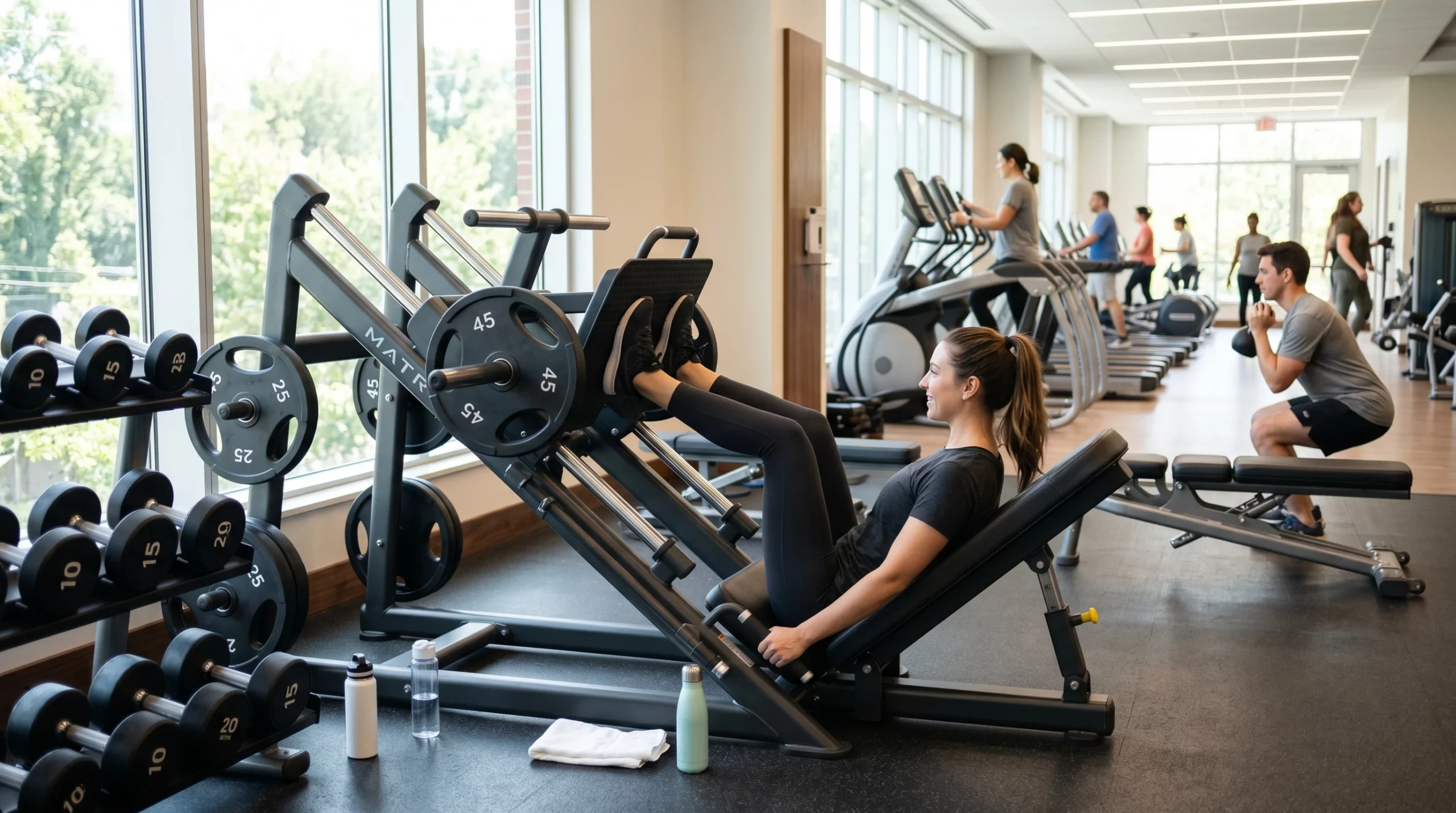
A simple leg day workout plan should help beginners train the quads, hamstrings, glutes, and calves without excessive volume or complicated exercises. This guide breaks down a beginner-friendly gym leg workout using simple exercises, clear sets and reps, warm-up guidance, rest periods, and progression tips.
If you are new to lifting or returning after time away from training, this plan is designed to reduce confusion and give you a simple starting point.
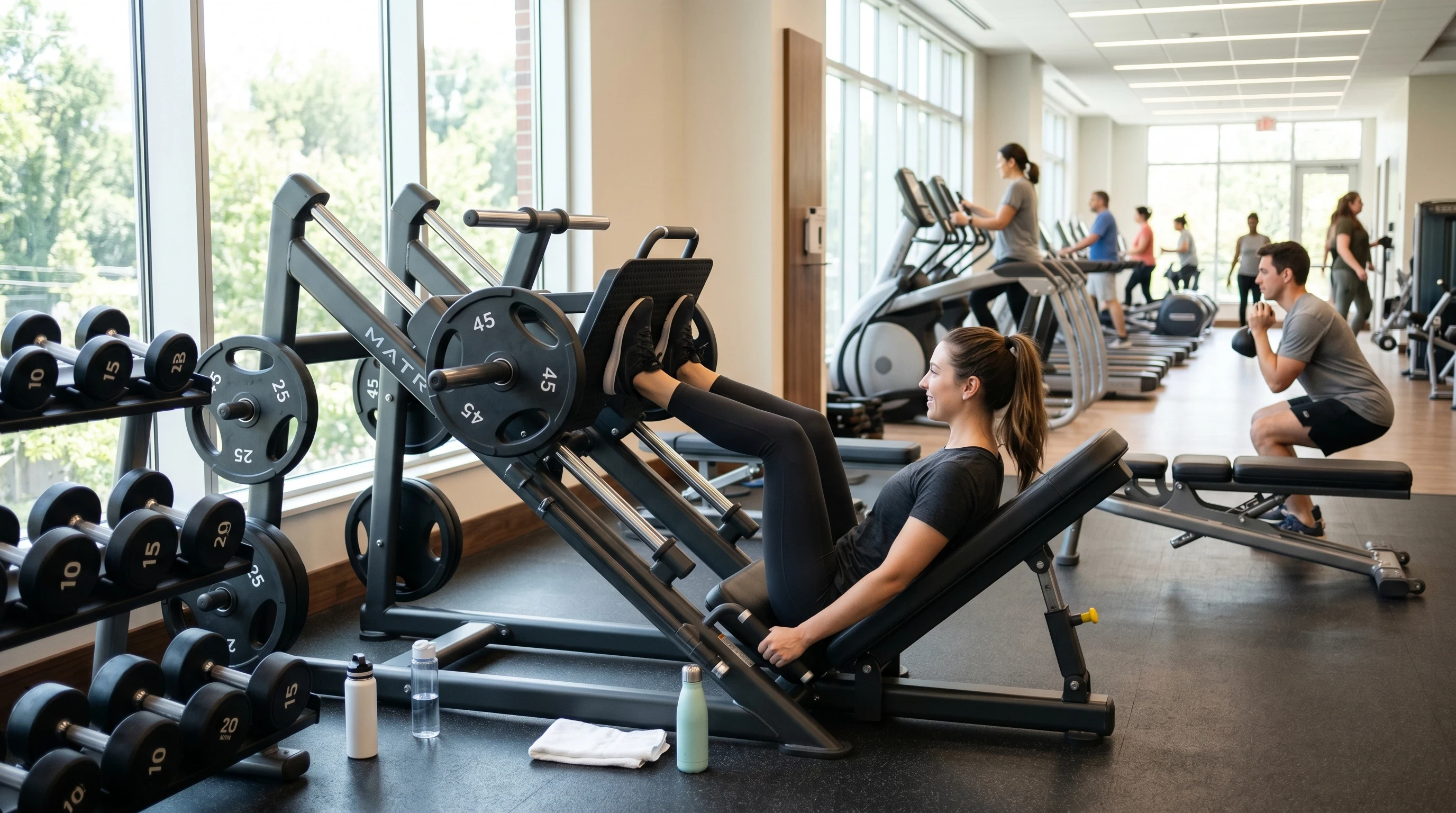
Quick Answers: Beginner Leg Day Workout
- How often? 1–2 times per week is enough for most beginners.
- What exercises? Leg Press or Goblet Squat, Romanian Deadlift, Walking Lunges or Split Squats, Leg Curl, Leg Extension, Calf Raise.
- How many sets? Usually 2–3 sets of each exercise works well.
- How many reps? 8–15 reps is a solid range for most machine and free weight lifts.
- What about failure? You don’t need to train to failure on every set. Stopping with a few reps left helps you recover and keeps you safer as a beginner.
- How much rest? Use 1–2 minutes for isolation lifts, 2–3 minutes for lighter compound lifts, 3–5 minutes for heavy compound lifts.
- How do I warm up? Start with 5–10 minutes of light cardio, dynamic movements like leg swings, then perform 1–2 lighter warm up sets before your first heavy exercise.
Table of Contents
- Key Takeaways for Simple Leg Day Success
- Why Train Legs: Benefits for Beginners
- How to Warm Up for Leg Day (With Easy Example)
- Compound vs Isolation Leg Exercises
- Free Weights vs Machines: What’s Better for Beginners?
- How to Choose Weight and RIR for Leg Day
- Beginner Training Volume and Rest Periods
- Beginner Friendly Leg Day Workout Plan (Step by Step)
- How to Progress With Progressive Overload Basics
- Beginner Recovery Basics
- Common Beginner Leg Day Mistakes
- Frequently Asked Questions (FAQ)
- Final Thoughts
- Beginner Bodybuilding Guides on Lift & Nurture
- References
- About the Author
Key Takeaways for Simple Leg Day Success
- Machines and free weights both build muscle effectively.
- Many beginners can make progress with around 10 challenging sets per muscle group per week.
- Warming up is super important for safety and performance.
- Learn exercise form first. Don’t rush into heavy weights or advanced routines.
- 1–3 reps in reserve (RIR) on most sets is usually just right for building muscle as a beginner.
- Sticking to the basics pays off more than chasing advanced influencer routines.
Why Train Legs: Benefits for Beginners
Strong legs help make everyday life easier, let you move better in sports, reduce injury risk, and support your whole body strength. Muscle mass in your lower body also has real health benefits, including healthier joints, better balance, and support for healthy weight. Having a leg day each week helps you build stamina and confidence for more demanding gym routines later on. Stair climbing, walking, and daily activities feel easier when your legs are strong and conditioned. Plus, lower body training sparks muscle growth throughout your whole body thanks to major muscle recruitment and hormone response during big moves such as squats and deadlifts.
How to Warm Up for Leg Day (With Easy Example)
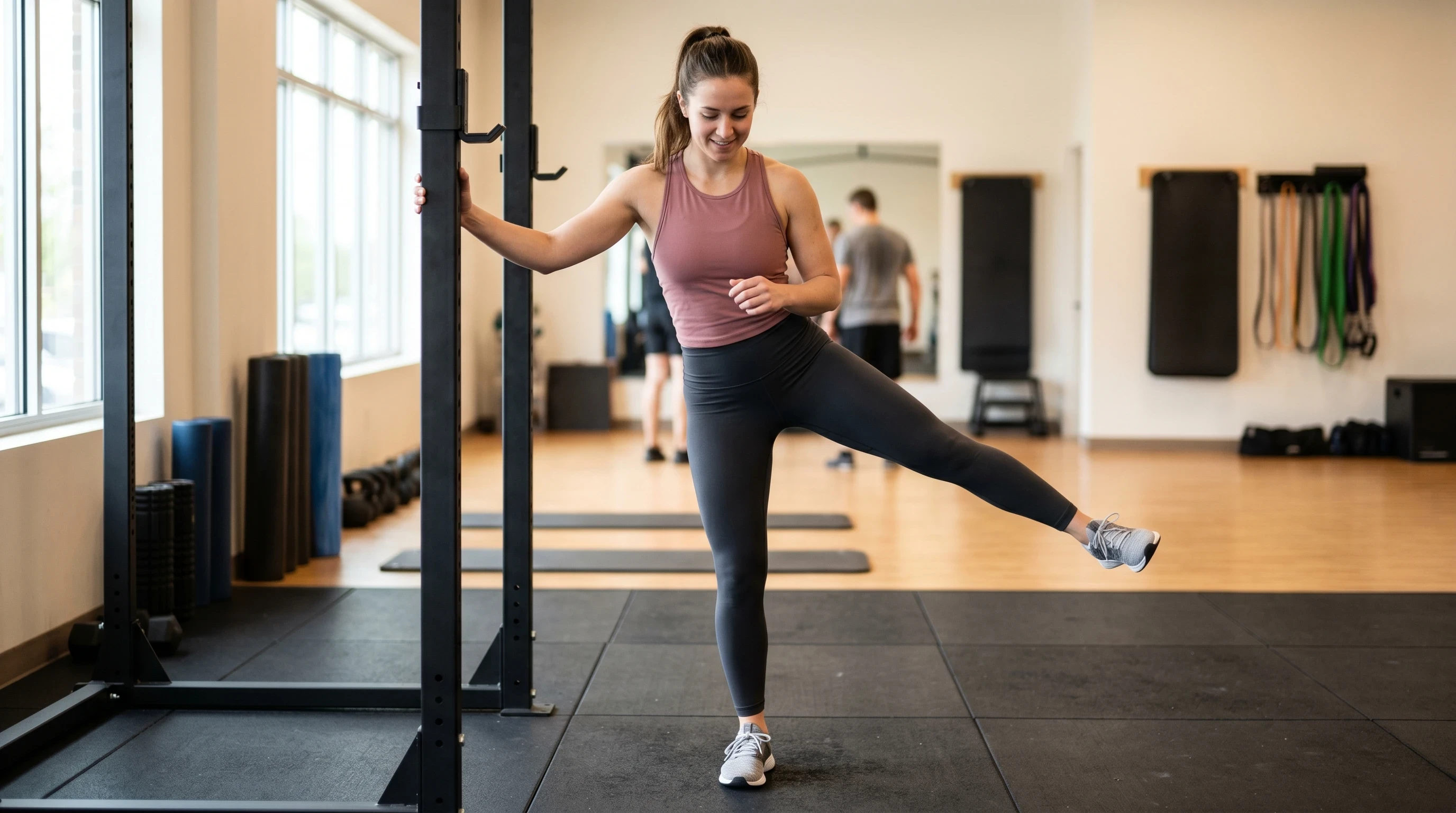
Warming up gets your body and mind ready to train. A proper warm up reduces injury chances and helps you get better results from each workout. Spend a little time getting your muscles and joints moving and you’ll feel stronger on your first set every time.
- 5–10 min light cardio: Think brisk walking, easy cycling, or gentle rowing. This gets your heart rate up and muscles moving.
- Dynamic leg swings: Standing straight, lightly swing one leg forward and back, 10–15 reps per leg. Then swing side to side for 10–15 reps.
- Arm circles: Even for leg day, it helps to get your upper body warmed up so your whole body feels ready. Do 10–20 circles in each direction.
- Exercise specific warm up sets: Before your first heavy compound exercise (like leg press, goblet squat, or Romanian deadlift), do 1–2 lighter warm up sets to prepare your joints, muscles, and movement pattern.
For beginners, a simple approach works well:
- Warm up set #1: Use about 50–60% of the weight you plan to use for your working sets and perform about 6–10 controlled reps.
- Warm up set #2 (optional for heavier lifts): Use about 65–75% of your planned working weight for about 4–6 reps.
These warm up sets should feel easy and controlled — not exhausting. The goal is to practice technique, increase blood flow, and feel mentally ready before your harder working sets begin.
All of this only takes about 10–15 minutes, but makes a big difference in how good your workout feels. As you advance, you might include foam rolling, ankle and hip mobility moves, or glute activation to give your warm up a bigger boost.
Compound vs Isolation Leg Exercises
Basic gym routines for beginners tend to focus on both compound exercises and isolation exercises. Each has a different purpose.
- Compound Exercises: These moves involve more than one joint and work several muscles at once. Squats, leg press, Romanian deadlifts, and lunges are examples. They are great for building strength and working your legs efficiently. These big movements tap into your glutes, quads, hamstrings, and core all at once, giving you the most bang for your buck each session.
- Isolation Exercises: These moves use a single joint and focus on just one muscle group. Leg extensions and leg curls target your quads or hamstrings by themselves. Calf raises target the calves specifically. These exercises help round out your routine, bring up weak areas, and develop mind muscle connection. They are especially good for targeting muscles that need a little extra attention, which keeps your legs balanced and healthy.
Most beginners will want to focus on 1–2 compound lifts and finish with a couple of isolation moves. You don’t need a huge list of exercises; consistency and good form matter more.
Free Weights vs Machines: What’s Better for Beginners?
It’s common to wonder if using free weights (like barbells and dumbbells) or machines is better when starting out. Both build muscle and strength effectively. Machines offer more stability and make it easy to learn good technique, especially if balance is a challenge.
Free weights build coordination and use more stabilizer muscles. They also allow for more natural movement patterns. Some beginners like starting with machines and gradually mixing in free weight versions as they build confidence and stability. Many beginner programs recommend a combination of both. Neither is “better” or “worse”; choosing what feels right for your body is more productive in the long run.
If you prefer training at home or do not have access to gym equipment yet, this Beginner Bodyweight Workout Plan To Build Muscle At Home shows how beginners can build muscle using structured bodyweight exercises, progressive overload, and full-body training principles.
If you want a more structured weekly home workout schedule built around bodyweight exercises, this 3 Day At Home Workout Routine For Beginners explains how to organize three weekly full-body workouts, recovery days, and progression using simple beginner-friendly exercises at home.
If you want the simplest possible beginner starting point before using gym equipment or following a larger workout plan, this No Equipment Full Body Workout For Beginners At Home explains how to build strength and consistency using basic beginner-friendly bodyweight exercises at home.
If you have a previous injury or trouble with joints, machines can offer a safer and more comfortable entry point, but don’t be afraid to try both as your balance and strength improve.
How to Choose Weight and RIR for Leg Day
Knowing how heavy to lift can feel confusing at first. These simple guidelines can help beginners challenge themselves safely:
- Use RIR to control effort: Most beginners should stop compound lifts with about 1–3 reps left in reserve. Your early sets can stay easier, while your final set can be more challenging.
- 1–3 Reps in Reserve (RIR) Works Well: This means you finish each set with the ability to do 1–3 more reps if you had to.
- Isolation exercises (like leg extension): These can often be pushed a little closer to failure because they are safer and less fatiguing. Going to the point where one more rep is a struggle is fine for these; just don’t let your form get sloppy.
Beginners do not need to “go to failure” on every set. Training this way every session can wear you out and make it harder to recover, especially as you’re learning technique. If you finish a set and think, “I could have done one or two more reps,” you’re right where you should be. When in doubt, always choose a weight you feel confident you can control for good reps, even when you’re tired near the end of the set.
Beginner Training Volume and Rest Periods
Many beginners can see great muscle-building results with around 10 challenging sets per muscle group per week. The updated American College of Sports Medicine resistance training guidelines also emphasize that consistency matters more than complexity, which fits the beginner goal of using a simple plan you can repeat and recover from. That can mean 2–3 sets of 3–4 different leg exercises each workout. More sets are not always better, especially early on. Form, recovery, and consistency matter more than sheer volume. Remember, building a training habit and learning technique will take you further than piling on extra sets or going to the gym every single day.
Recommended rest breaks:
- Isolation exercises (leg extension, leg curl, calf raise): Rest 1–2 minutes between sets.
- Lighter compound lifts (goblet squat, walking lunges): Take 2–3 minutes between sets.
- Heavy compound lifts (leg press with challenging weight): Take 3–5 minutes if you need it.
Don’t rush your rest breaks. Longer rest helps you get the most out of each set, especially for your main compound exercises. If you need an extra 30 seconds to catch your breath and keep your form crisp, take it—quality trumps speed every time.
Beginner Friendly Leg Day Workout Plan (Step by Step)
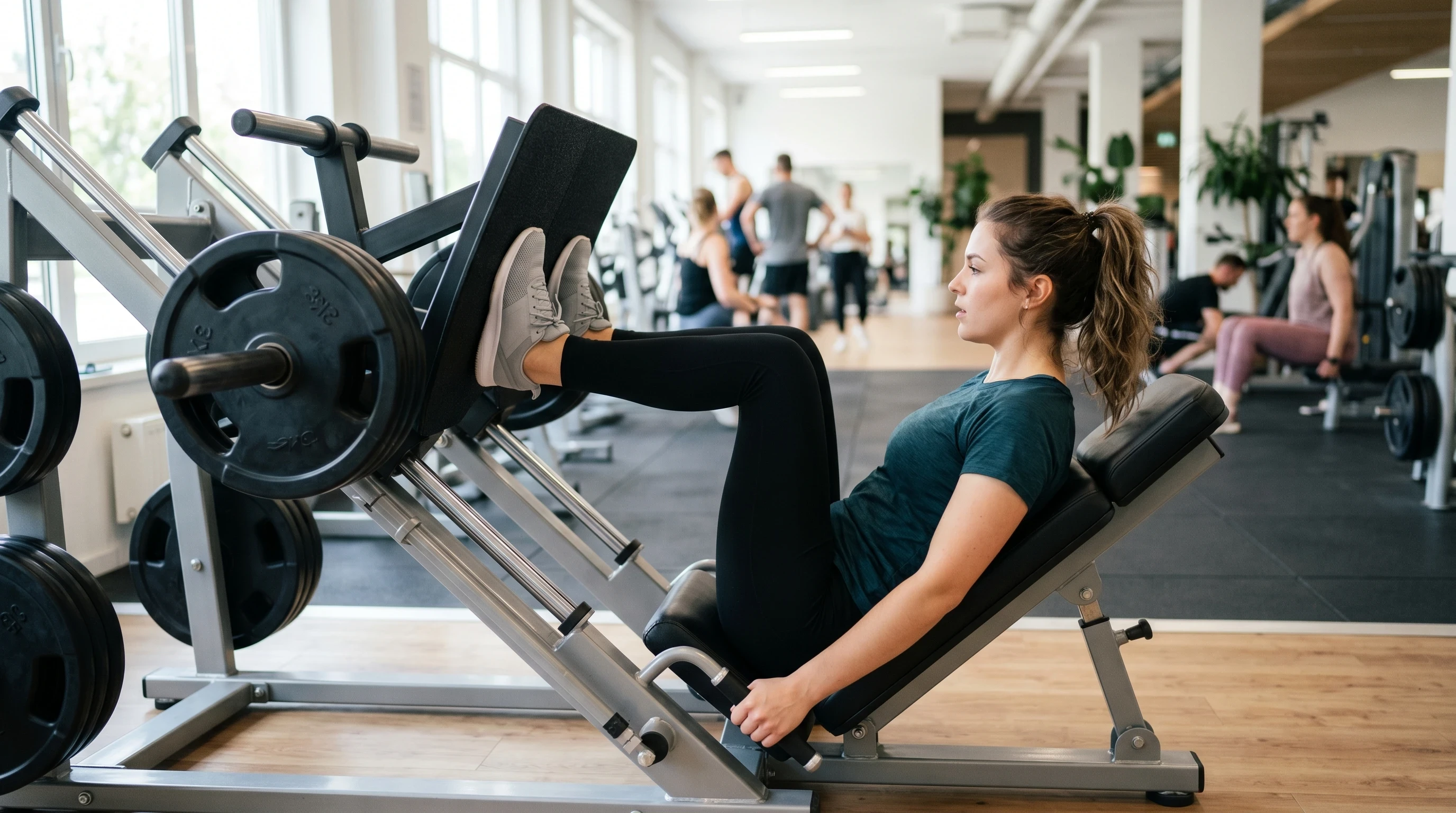
This plan uses mostly machines and simple free weight moves. If you want a matching upper-body session to pair with this leg day, this beginner upper body workout at the gym guide shows how to train chest, back, shoulders, biceps, and triceps with beginner-friendly sets, reps, rest periods, and progression. Choose weights you can lift with good form, leaving 1–3 reps in reserve for each set. Adjust reps and weight as needed so you finish each set feeling challenged, but not maxed out.
Safety note: If you have injuries, pain, or medical concerns, speak with a qualified healthcare professional before starting a new workout routine. Start lighter than you think you need, and stop any exercise that causes sharp pain.
Simple Workout Table
Use this table as the quick version of the plan. The detailed exercise notes below explain how to perform each movement safely.
| Exercise | Category | Sets | Reps | Warm-Up Sets | Early Sets RIR | Last Set RIR | Rest |
|---|---|---|---|---|---|---|---|
| Leg Press or Goblet Squat | Primary (Squat Pattern) | 3 | 8–12 | 2–3 | 3 | 1–2 | 2–3 min |
| Romanian Deadlift | Primary (Hip Hinge) | 2 | 10–15 | 1–2 | 3 | 1–2 | 2–3 min |
| Walking Lunges or Split Squats | Secondary (Unilateral) | 2 | 10–12/leg | 1 | 2 | 1 | 1–2 min |
| Leg Curl | Accessory (Hamstrings) | 2 | 12–15 | 0–1 | 2 | 0–1 | 1–2 min |
| Leg Extension | Accessory (Quads) | 2 | 12–15 | 0–1 | 2 | 0–1 | 1–2 min |
| Seated or Standing Calf Raise | Accessory (Calves) | 2–3 | 10–15 | 0–1 | 2 | 0–1 | 1–2 min |
Early sets should feel controlled and technically clean, while the final set can be pushed slightly harder with safe form. For example, 3 RIR means you could do about 3 more reps, 1–2 RIR means you are close to failure but still controlled, and 0–1 RIR means you are very close to failure.
- Leg Press or Goblet Squat
- Sets/Reps: 3 sets of 8–12 reps
- Rest: 2–3 minutes
- Effort: Start around 3 RIR on early sets and finish around 1–2 RIR on the final set.
- How to: Both moves work your quads, glutes, and hamstrings. On the leg press, set your feet hip width apart and drive through your whole foot. For the goblet squat, hold a dumbbell at your chest, squat to comfortable depth, and stand tall. Focus on keeping your chest lifted and pushing your knees slightly outward—not letting them collapse inward.
- Romanian Deadlift
- Sets/Reps: 2 sets of 10–15 reps
- Rest: 2–3 minutes
- Effort: Keep about 3 RIR early and 1–2 RIR on the final set.
- How to: Stand holding a pair of dumbbells (or barbell) in front of your thighs. Hinge at the hips, keeping a slight knee bend and a flat back, lowering weight until you feel a stretch in your hamstrings. Return to standing. Keep your movements controlled—don’t let your back round at any point.
- Walking Lunges or Split Squats
- Sets/Reps: 2 sets of 10–12 reps per leg
- Rest: 1–2 minutes
- Effort: Keep about 2 RIR early and about 1 RIR on the final set.
- How to: Lunge forward (or use a stationary split squat), keeping your torso tall and your knee just behind your toes. Switch legs after each rep (or after completion if doing stationary). Use a strong push through your front foot to return to standing. If balance is tough, hold onto a rail or bench for extra support.
- Leg Curl
- Sets/Reps: 2 sets of 12–15 reps
- Rest: 1–2 minutes
- Effort: Keep about 2 RIR early and 0–1 RIR on the final set if your form stays controlled.
- How to: Adjust the machine to fit your legs comfortably. Curl the weight up with control, feeling your hamstrings contract. Don’t rush your reps—slow lowering builds even more muscle.
- Leg Extension
- Sets/Reps: 2 sets of 12–15 reps
- Rest: 1–2 minutes
- Effort: Keep about 2 RIR early and 0–1 RIR on the final set if your form stays controlled.
- How to: Sit comfortably, align your knees with the machine’s pivot, and extend your legs to straighten. Lower slowly. Focus on squeezing your quads at the top of each rep.
- Seated or Standing Calf Raise
- Sets/Reps: 2–3 sets of 10–15 reps
- Rest: 1–2 minutes
- Effort: Keep about 2 RIR early and 0–1 RIR on the final set if your form stays controlled.
- How to: Use a calf raise machine or a step. Push through the balls of your feet, lifting your heels up high, then lower back down with control. Pause for a moment at the top of each rep for extra benefit.
If you’re short on time, choose any three of these exercises and stick to 2 sets each. Anything is better than nothing when you’re building a consistent routine. When you get busier, quick sessions still make real progress! As you grow more comfortable, feel free to swap in reverse lunges, step ups, or glute bridges to mix in some variety and target new muscles.
Related reading: Beginner Bodybuilding Workout Plan | Beginner Weight Training Sets And Reps
How to Progress. Progressive Overload Basics
Progressive overload means you try to do a little more over time, whether that’s slightly more weight, a few more reps, or better technique. This gradual approach helps you gain muscle and strength safely. Over months, small improvements lead to bigger muscles and more strength without burning out or getting hurt.
- When a weight becomes easy for the prescribed reps (for example, 3 sets of 12 reps feels like you could do 15), add a small amount of weight the next session.
- If increasing weight is tough, aim to add 1–2 reps instead, then try for a heavier dumbbell once you max out the rep range.
- Form always comes first. It’s better to add reps or improve technique before adding weight.
Extra tip: Write down your weights and reps each week in your phone or notebook. Progress adds up faster than it seems when you track it. You’ll be surprised how quickly your numbers rise!
Related: Progressive Overload For Beginners
Beginner Recovery Basics
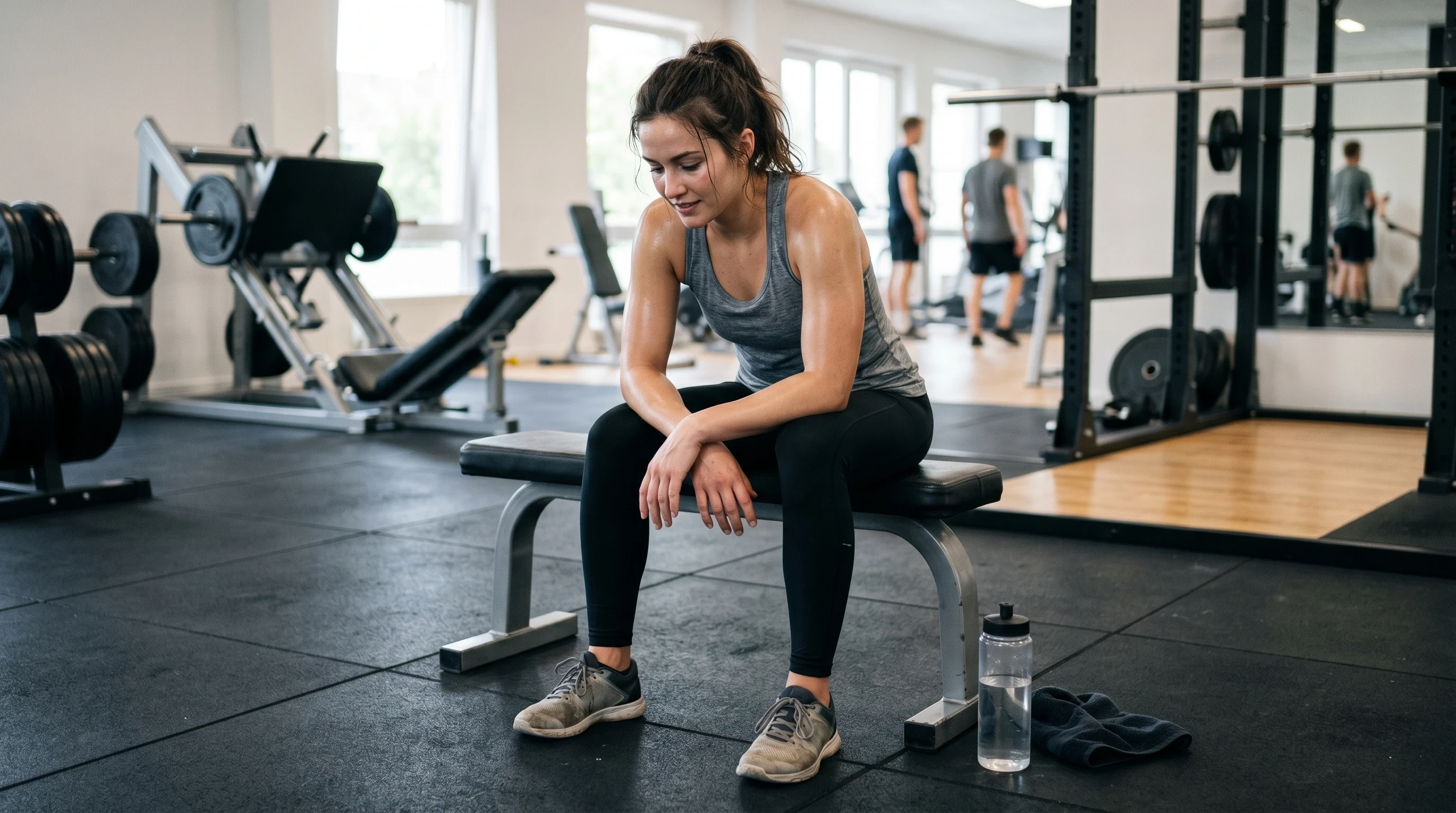
Recovery is just as important as your actual workout. Beginners often see muscle growth even with two short workouts per week. These recovery habits can help beginners recover more effectively:
- Eat enough protein (about 0.7–1 gram per pound of goal body weight is a simple guideline)
- Get at least 7 hours of sleep each night
- Practice good form and listen to your body
- Take at least 48 hours between tough leg workouts
- Gentle walking, stretching, or yoga on off days helps soreness fade faster
- Stay hydrated by drinking water throughout the day to keep muscles working well
Rest days let muscles rebuild stronger. If you feel low on energy, tweak your schedule or check out more Muscle Recovery Tips for Beginners. Remember, more is not always better—instead, focus on consistently putting in solid effort and letting your body recover in between sessions. Taking rest days seriously sets you up for more gains, less soreness, and fewer injuries.
Common Beginner Leg Day Mistakes
- Skipping warm ups: Jumping into heavy lifts cold is a recipe for aches, or worse, injury.
- Lifting too much weight too soon: This makes it hard to control the movement. Start lighter, master good form, and build up slowly.
- Training to failure every set: Feeling worn out after every set is not a shortcut. Most sets do best with 1–3 reps left in your tank.
- Poor technique: Quality reps are better than quantity. If you’re not sure, ask a coach, staff member, or seasoned lifter to check your form.
- Copying advanced influencer workouts: Most influencer routines aren’t built for beginners and can encourage risky habits and too much volume.
- Not getting enough rest between sets: Rushing your next set means less muscle growth and more sloppy reps.
- Doing way too many sets or exercises: Extra volume often leads to burnout as a beginner. Stick to about 10 sets per muscle group each week, which really works.
- “Ego lifting”: Choosing heavier weight just to impress someone. Stick with weights that you can control the whole way.
Checking in with these reminders every few weeks keeps your progress real and sustainable. Learning to listen to your body and adjust as needed is one of the most valuable skills you’ll gain early on. If something hurts or feels off, back off, ask for help, or check in with a professional. Remember, solid progress is a marathon, not a sprint.
Related resource: Workout Rest Periods For Beginners
Frequently Asked Questions (FAQ)
Should beginners use only machines on leg day?
Both machines and free weights build muscle. Machines are a great choice for safety and learning form, but some simple free weight moves (like goblet squats or Romanian deadlifts) are very beginner friendly too.
How many leg workouts per week is enough?
Most new lifters do well with 1–2 dedicated leg days per week. Consistency is more important than cramming all your sets into one session or trying to lift every day. Choose a routine you can stick to and slowly add challenge.
Do you need to feel sore after every leg day?
Soreness doesn’t define a good workout. You might feel mild discomfort or tightness when you try new movements, but you should not feel pain or struggle to walk for days. When your form is good and weights get a little heavier over time, you’ll know progress is happening. If soreness lingers more than 3 days, take an extra rest day and tone down your next session a bit.
What’s the best way to add weight?
Add a small amount (5–10 lbs) when your current weight feels too easy for the target reps. If you can’t add weight easily, try adding reps instead for a week or so. Keep notes to help you spot patterns in your progress.
Do beginners need special shoes or gear?
Flat soled shoes or even gym socks are fine for most beginners, especially on lifts where stability is important. No pricey shoes needed unless you want them. Regular athletic shoes work for most moves—just pick shoes that don’t slip easily. Weightlifting belts, knee sleeves, and other gear aren’t necessary for most people early on, but can be explored down the road if you enjoy training and want a little extra support for heavy main lifts.
Is this simple leg day workout plan enough to build muscle?
Yes, beginners can build muscle with a simple leg day workout plan if they train consistently, use good form, recover well, and gradually progress over time.
Still have questions? More detailed answers can be found in Beginner Bodybuilding Workout Plan, Beginner Bodybuilder Exercises, and Muscle Recovery Tips for Beginners.
Final Thoughts
Sticking to a simple, practical leg day routine helps you get stronger, build confidence in the gym, and set yourself up for bigger goals down the road. Machines and free weights both work. If you have injuries, pain, or medical concerns, it’s smart to speak with a qualified healthcare professional before starting a new workout routine. Most of your results will come from showing up, using good form, warming up, and adding a little more effort over time. Sustainable routines always beat hype, and learning good habits early saves you a lot of frustration later. One of the best things beginners can do is stay patient, focus on learning, and have fun with the process—results will come over time as you put in consistent effort.
If you want to learn more about getting the most from your workouts, I recommend checking out more guides on progressive overload and basic sets and reps for beginners so you can keep building muscle safely and confidently. There are lots of resources and communities out there ready to support your fitness adventure too, so don’t hesitate to reach out if you need extra motivation or if something feels confusing along the way.
Beginner Bodybuilding Guides on Lift & Nurture
If you want to keep building your beginner muscle-building foundation, these guides can help you connect leg day with the bigger picture of training, recovery, and progression.
- Beginner Bodybuilding Workout Plan (12-Week Foundation Blueprint)
Start here if you want a complete beginner bodybuilding structure that explains full-body training, progressive overload, recovery, nutrition basics, and realistic expectations. - Full Body Workout Plan For Beginners: Simple Step-by-Step Guide
Use this if you want a simple full-body routine that shows how to organize exercises, sets, reps, and progression across your training week. - 3 Day Workout Schedule For Beginners: A Complete Full Body Plan
This guide helps beginners structure three weekly workouts while balancing training, recovery, and consistency. - 4 Day Workout Routine For Beginners: Simple Upper/Lower Plan For Muscle Growth
Read this when you are ready to move from full-body training into a simple upper/lower structure with more weekly training days. - Guide To Gym Machines For Beginners: Best Machines To Build Muscle
This guide explains how to use beginner-friendly gym machines, set them up properly, and train with more confidence. - Beginner Bodybuilder Exercises: The Best Starter List For Muscle Growth
Use this exercise guide to learn the main movements beginners can use to train each muscle group safely and effectively. - How To Implement Progressive Overload For Beginners
This guide explains how to add reps, weight, or better technique over time so your workouts continue driving strength and muscle growth. - Beginner Weight Training Sets And Reps
Read this if you want a clearer understanding of how many sets and reps beginners should use for muscle growth, strength, and consistency. - Muscle Recovery Tips for Beginners
This recovery guide explains how sleep, rest days, nutrition, and smart training habits help your muscles repair and grow. - Workout Mistakes For Beginners: 10 That Slow Muscle Growth
Use this guide to avoid common beginner mistakes like doing too much volume, changing workouts too often, or ignoring recovery.
References
- American College of Sports Medicine. “ACSM Unveils Landmark 2026 Resistance Training Guidelines — First Update in 17 Years.”
- Schoenfeld BJ, et al. “Resistance training volume enhances muscle hypertrophy.” Medicine & Science in Sports & Exercise. 2019.
- Gentil P, Fisher J, Steele J. “A review of the acute effects and long-term adaptations of single- and multi-joint exercises.” European Journal of Sport Science. 2017.
About the Author
Angel Carcamo is the founder of Lift & Nurture, a beginner bodybuilding platform focused on structured training, muscle growth fundamentals, and long-term progress.
As a beginner himself, Angel creates research-based beginner bodybuilding guides that simplify widely accepted strength training principles into clear, practical steps.
His guides focus on key fundamentals like progressive overload, recovery, and nutrition — helping beginners build muscle without confusion, shortcuts, or unrealistic expectations.
Start here: Beginner Bodybuilding Roadmap
Foundation guide: Beginner Bodybuilding Workout Plan (12-Week Foundation Blueprint)