
If you’re just starting out with strength training, figuring out how many sets to do for each muscle group can feel overwhelming. Many beginner workout routines give different recommendations on weekly training volume, which can make it hard to know how much work is actually enough for muscle growth. The right answer depends on your experience level, recovery, and goals. Understanding the basics about muscle group sets per week for beginners can help you get started the smart way and avoid common mistakes.
Muscle growth for beginners depends on three key factors: structured training, proper nutrition, and consistent recovery
Quick Answer
Most beginners build muscle well with about 8–10 hard sets per week for large muscle groups like the chest, back, quads, and glutes, and about 3–8 direct sets per week for smaller muscle groups like the biceps, triceps, calves, and abs. A good starting point is to stay near the lower end, spread those sets across 2–3 weekly workouts, and only add more volume if recovery and progress are both going well. As some beginners progress, a 4 day workout routine for beginners can also help distribute weekly volume across a simple upper/lower split.
Table of Contents
- Quick Answer
- What Are Muscle Group Sets Per Week?
- How Many Sets Per Muscle Group Per Week Do Beginners Need?
- Why Beginners Need Less Volume Than Advanced Lifters
- How Training Volume Impacts Muscle Growth
- Breaking Down the Weekly Set Recommendations
- How To Distribute Weekly Sets Across a 3-Day Full-Body Routine
- What Counts as a Hard Set?
- How Much Weekly Training Volume Is Too Much for Beginners?
- How To Tell If Weekly Volume Is Too Low
- Common Beginner Mistakes with Sets Per Muscle Group Per Week
- Supporting Factors: Recovery and Progress
- Frequently Asked Questions About Muscle Group Sets Per Week For Beginners
- Approaching Muscle Growth as a Beginner
- Key Takeaways
- Final Thoughts
- Beginner Bodybuilding Guides on Lift & Nurture
- References
- About the Author
What Are Muscle Group Sets Per Week?
The term “muscle group sets per week” means the number of hard sets performed for each body part over seven days. A ‘hard set’ is a set where you perform an exercise for a certain muscle group with enough effort that it feels challenging, typically with good form and just a few repetitions left in the tank. Most programs count only these tough sets because easy “warm-up” sets or sets with very little effort do not stimulate muscle growth in the same way.
For beginners, knowing how many hard sets to do is really important. Too few, and you may see little progress. Too many, and you could risk soreness or burning out. Research suggests that beginners usually build muscle well on moderate volume, without needing marathon workouts or lots of fancy exercises. Focusing on the number of hard sets each week is a simple way to track and manage training volume.
How Many Sets Per Muscle Group Per Week Do Beginners Need?
Evidence-based guidelines on weekly training volume for beginners generally fall in these ranges:
| Muscle Group | Beginner Weekly Hard Sets |
|---|---|
| Chest | 8–10 |
| Back | 8–10 |
| Quads | 8–10 |
| Glutes | 8–10 |
| Hamstrings | 6–10 |
| Shoulders | 6–10 |
| Biceps | 3–6 direct sets |
| Triceps | 3–6 direct sets |
| Calves | 3–8 |
| Abs | 3–8 |
These ranges refer to hard working sets performed with good effort, not warm-up or low-effort sets. These are general beginner-friendly starting ranges, not rigid rules. Most beginners do best starting near the lower end and only increasing volume when recovery and progress are both going well.
Most beginner programs recommend staying near the lower end at first (e.g., 8 sets for most muscle groups), especially if training full-body three times per week. This general range also aligns with the updated ACSM resistance training guidelines, which note that muscle growth often benefits from roughly 10 weekly sets per muscle group. As you gain experience, you might try the higher end of these ranges. As you gain experience, you can make small changes based on your recovery, performance, and consistency.
Why Beginners Need Less Volume Than Advanced Lifters
Muscle growth responds best to a certain level of weekly training volume, but more is not always better. Beginners can grow muscle on fewer sets per week compared to those with years of training experience. The main reasons are:
- Beginners respond quickly: Your muscles are very sensitive to training if you have little previous strength training. Smaller training volumes provide enough stimulus for muscle growth.
- Practicing the basics: When learning form, too much volume can harm technique or worsen soreness.
- Recovery needs: Lifting weights is new for beginners, so your muscles and nervous system need more time to recover between sessions. Lower volume helps your body adjust and lowers the risk of feeling worn down or sore in a way that slows progress. If you’re returning after time off, this guide on Beginner Fitness Plans After A Break explains how to restart with fewer sets, lighter effort, and safer week-to-week progression.
Research shows that advanced lifters sometimes need higher volumes to keep growing, but for beginners, moderate sets per muscle group per week work very well. It’s also valuable because beginners can focus more on learning good movement patterns and building strength without risking setbacks from excessive fatigue.
How Training Volume Impacts Muscle Growth
Weekly training volume (sets per week for muscle growth beginners) is the total number of challenging sets you do for each muscle group. Here’s what happens:
- More sets stimulate growth up to a certain level. For complete beginners, anything in the suggested ranges often works well.
- There are diminishing returns. After a point, increasing sets adds very little muscle growth, and can actually interfere with recovery.
- Too much weekly volume can lead to sore muscles, bad workout performance, poor motivation, and more risk of injury or stalling out entirely.
So, beginners usually get great results with 8–10 sets per week for big muscle groups. Doing double that, thinking faster results will come, often backfires. You may simply slow your progress by jumping into high volume before you’re ready.
Breaking Down the Weekly Set Recommendations
Beginner workout volume should focus on hitting each muscle group with a moderate number of sets spread over multiple days. Here’s a brief look at each muscle group and why its weekly set range matters:
- Chest, Quads, Glutes: These are large muscle groups and often get trained through compound lifts like squats, leg presses, pushups, and bench press. 8–10 sets give enough work without crowding workouts.
- Back: The back muscles (upper, middle, and lower) work in pulling movements such as rows and pulldowns. Around 10 sets keeps these complex muscles strongly challenged.
- Hamstrings: These are targeted with deadlifts, hip thrusts, and leg curls. Beginners often achieve good growth at 6–10 sets since the hamstrings work hard in other leg movements too.
- Shoulders: Presses and lateral raises target the shoulders. 6–10 sets combine well with pushing movements that already work these muscles.
- Biceps & Triceps: These smaller muscles help with presses and pulls, but research shows that adding a few direct arm sets (3–6 per week) supports balanced growth. Biceps and triceps usually need fewer direct sets because compound pulling and pressing exercises already train them indirectly.
- Calves & Abs: These areas can be stubborn for some people. 3–8 sets per week, split across a few days, is enough for most beginners while learning good form and building a base of strength.
It’s essential to remember that all muscle groups benefit from steady, consistent stimulus each week. Splitting the sets—not piling them all into a marathon session—allows your body to grow, supports stronger habits, and builds confidence as you refine technique.
How To Distribute Weekly Sets Across a 3-Day Full-Body Routine
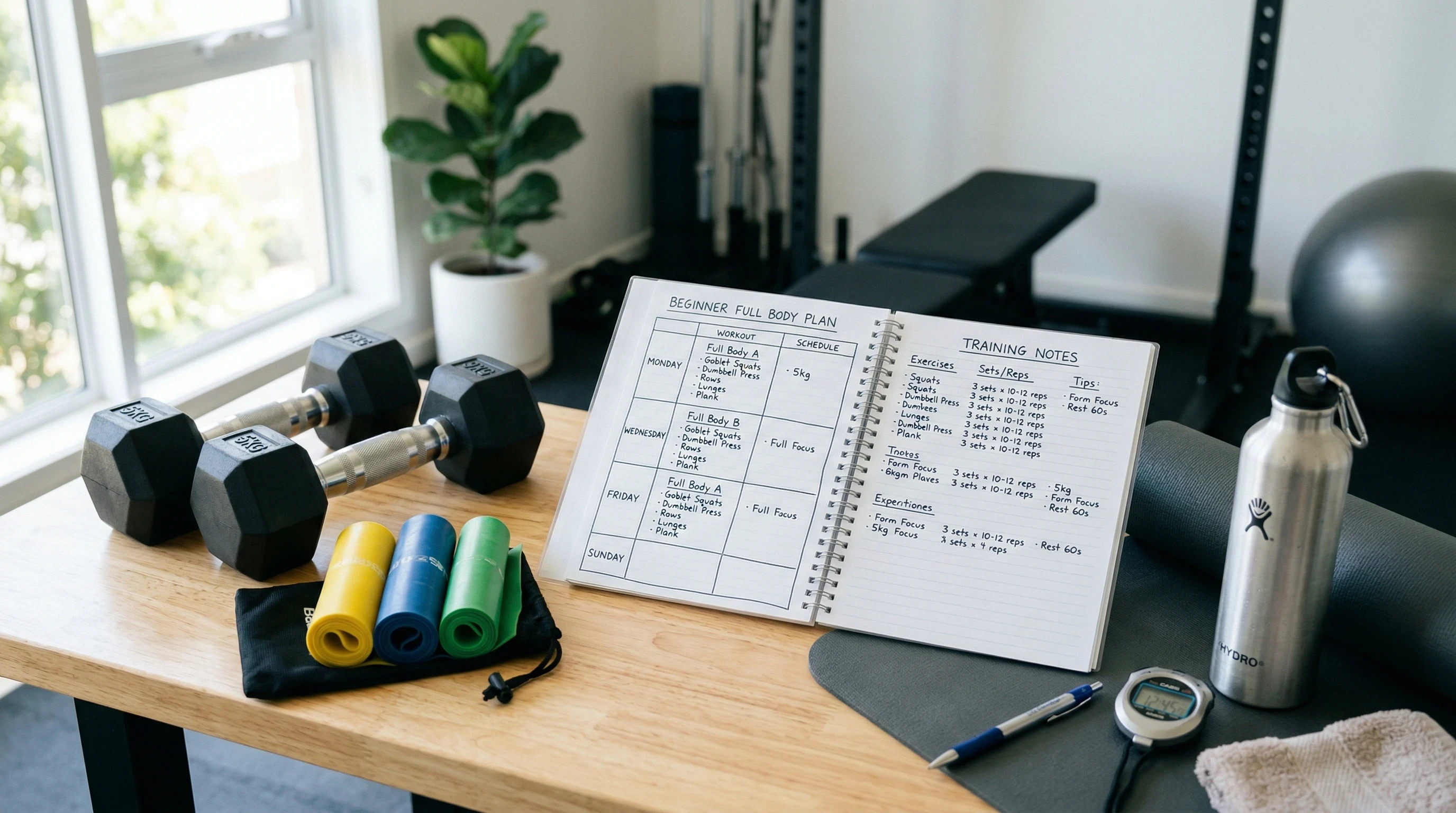
Spreading sets across several workouts each week is usually more effective than doing all sets for a muscle group in one day.
If you prefer training at home instead of using gym equipment, this Beginner Bodyweight Workout Plan To Build Muscle At Home shows how to organize weekly training volume, full-body workouts, and progressive overload using simple bodyweight exercises.
If you want a more structured weekly home training schedule built around beginner-friendly bodyweight workouts, this 3 Day At Home Workout Routine For Beginners explains how to organize three weekly workouts, weekly training volume, recovery days, and progression using simple full-body exercises at home.
If you want the simplest possible beginner-friendly starting point, this No Equipment Full Body Workout For Beginners At Home shows how beginners can organize simple full-body workouts, recovery days, and weekly training volume using only bodyweight exercises and no gym equipment.
While many beginners start with full-body training, a 4 day workout routine for beginners is another effective way to spread weekly volume across the week using an upper/lower split.
A push pull legs workout for beginners can also distribute volume across separate push, pull, and leg days, but it is usually better used after a beginner has built consistency with simpler full-body or upper/lower training.
If you’re unsure which structure fits your recovery and schedule best, this guide on how to choose a workout split for beginners explains when full body or upper/lower training makes more sense. Muscles recover faster, and most people find they can give their best effort each session.
Here is a basic 3-day full-body beginner example. If you want a simpler step-by-step breakdown of how to build this kind of routine from scratch, this full body workout plan for beginners explains how to combine exercises, sets, reps, rest, and progression into one beginner-friendly structure. If you also want a dedicated upper-body-focused session, this beginner upper body workout at the gym guide shows how to organize chest, back, shoulders, and arm training with beginner-friendly sets, reps, and progression.
If you want to see how lower-body weekly volume can be organized into a dedicated beginner leg session, this Simple Leg Day Workout Plan shows how to structure squats, leg press variations, Romanian deadlifts, split squats, calf raises, sets, reps, and progression inside one complete lower-body workout.
If you’re unfamiliar with beginner machine exercises like the leg press, seated row, or lat pulldown used in many full-body programs, this Guide To Gym Machines For Beginners explains how to use machines safely, adjust them properly, and structure beginner-friendly machine workouts.
This meets weekly set goals for all major muscle groups:
- Monday (Full-body):
Squat – 3 sets (quads, glutes)
Pushups or Bench Press – 3 sets (chest, shoulders, triceps)
Barbell Row or Dumbbell Row – 3 sets (back, biceps)
Leg Curl – 2 sets (hamstrings)
Standing Calf Raise – 2 sets (calves)
Plank or Crunch – 2 sets (abs) - Wednesday (Full-body):
Lunges – 3 sets (quads, glutes, hamstrings)
Overhead Press – 3 sets (shoulders, triceps)
Lat Pulldown or Pullups – 3 sets (back, biceps)
Seated Calf Raise – 2 sets (calves)
Leg Raise or Cable Crunch – 2 sets (abs) - Friday (Full-body):
Leg Press – 2 sets (quads, glutes)
Incline Dumbbell Press – 2 sets (chest, shoulders, triceps)
Cable Row – 2 sets (back, biceps)
Romanian Deadlift – 2 sets (hamstrings, glutes)
Bicep Curl – 2 sets (biceps)
Triceps Pressdown – 2 sets (triceps)
Russian Twist – 2 sets (abs)
This routine covers 8–10 sets for each major muscle group over the week, fitting the recommendations for beginner muscle group sets per week. It also avoids overloading any muscle group in one session, supporting consistent recovery. Remember, you can swap exercises for ones you prefer or have access to, as long as you keep working the same muscle groups with similar effort.
What Counts as a Hard Set?
A ‘hard set’ is a set of an exercise that feels challenging by the last few repetitions, but doesn’t require all-out exhaustion. Typically, it means you could do one or two more reps with good form if you had to, but the set still makes you work. Training this way gives enough tension to the muscle to drive change without risking poor form or burnout, especially when your sets and reps are structured appropriately. For example, if you do a set of 10 dumbbell presses for your chest, and the last two reps feel tough, that’s one hard set.
You do not need to push every set until failure, especially when your main goal is applying progressive overload consistently over time. Quality sets with good technique, where you finish with a couple of reps in reserve, are ideal for most beginners. This protects joints and makes it easier to recover for your next workout. The concept of “reps in reserve” is widely used by top coaches. It helps you build muscle effectively while reducing the chance of fatigue that lingers for days.
How Much Weekly Training Volume Is Too Much for Beginners?
It might feel tempting to copy the training volumes you see in bodybuilder programs online. But research shows that beginner muscle growth happens quickly with moderate sets. Here are signs your training volume might be too high:
- Workouts leave you constantly exhausted instead of energized
- You always feel sore, especially for days after training
- Progress on lifts stalls, or performance goes down
- Your motivation to go to the gym drops
- You find it hard to keep up with your routine week to week
If you notice these issues, consider reducing your sets per week for each muscle group. Making progress with fewer, high-quality sets is more effective and easier to stick with, especially when starting out. Remember, the most popular fitness plans for new lifters focus on doing just enough to see meaningful and consistent results without the burnout.
How to Tell If Weekly Volume Is Too Low
On the flip side, training volume might be too low if:
- Your workout feels much too easy, with little effort required
- You do not notice any visible or performance progress after several weeks
- You are not getting stronger, adding reps, or seeing noticeable improvement over time
For most beginners, the ranges listed earlier (8–10 sets for big muscles, 3–6 for small ones) are enough. Gradually adjust if you notice low progress, but focus first on good effort, form, and consistency over adding more sets right away. Sometimes, simply concentrating on improving your exercise execution each week will give better results than piling on extra volume.
Common Beginner Mistakes with Sets Per Muscle Group Per Week
Getting beginner workout volume right is important, but there are some easy pitfalls that can delay results or risk injury:
- Doing too much volume too soon: Trying to match “advanced” routines from magazines or online. This can quickly become unsustainable.
- Copying advanced programs: These are often designed for experienced lifters who can recover from high training volume. Beginners see better progress working with fewer sets and focusing on main movements.
- Ignoring recovery and nutrition: Training hard without supporting your body with rest, sleep, and enough protein makes muscle growth much harder.
- Adding more sets instead of improving effort and form: Some assume more is always better, but great results come from pushing each set effectively and learning good technique first. Only add sets once you’ve built a solid routine and recovered well.
- Switching workouts too often: Beginners sometimes get tempted by new trending workouts, but hopping from routine to routine does not give your muscles time to respond. Stick with your plan for several weeks before making changes.
- Skipping warmups and cooldowns: Building a habit of warming up preworkout and spending a few minutes cooling down afterward supports joint health and may help prevent soreness.
Supporting Factors: Recovery and Progress
While sets per week for muscle growth beginners provide a foundation, supporting your workouts with proper recovery, sleep, and nutrition is just as important. Make sure to:
- Get enough sleep to support muscle recovery and help your body repair between workouts
- Eat enough protein to support recovery and muscle repair
- Take rest days and schedule lighter weeks if you start feeling run down
- Stretch regularly and take short walks between workouts to support circulation and recovery
You also need enough calories overall if you want your weekly training volume to support muscle gain effectively.
Tracking your progress, resting well, and making small, consistent increases in effort will help you get the most out of your training volume. You don’t need high-volume or complicated strategies to get stronger and build muscle as a beginner. Many new lifters get the best results by focusing on the basics and letting gradual changes lead the way.
Frequently Asked Questions About Muscle Group Sets Per Week For Beginners
How many sets per muscle group per week do I need to build muscle as a beginner?
Most research-backed beginner routines recommend 8–10 hard sets per week for major muscle groups like chest, back, quads, and glutes; and 3–6 sets for smaller muscles like arms and calves. This range is enough to trigger muscle growth without overtaxing your body.
Can I do more than 10 sets per week if I feel good?
It is usually best to start on the lower end and only increase sets if your recovery, schedule, and motivation allow. Increasing too quickly can hurt progress and recovery. Quality is more important than quantity for beginners.
Is it better to do all sets for one muscle group in a single workout, or spread them out?
Beginners benefit more by spreading sets throughout the week, for example, doing 3–4 sets for each body part over three days instead of 10 sets all in a row. This gives muscles more chances to grow without unnecessary soreness or burnout.
How fast should I add more sets or increase workout volume?
Stick with the recommended ranges for at least 1–2 months. Increase sets gradually only if you are recovering well, making progress, and ready for a bigger challenge. Jumping to higher volume before you’re ready can lead to stalled results or injury. Notes and workout journals can help you spot your progress and track down when to add sets responsibly.
Approaching Muscle Growth as a Beginner
Finding the best sets per muscle group per week for beginners comes down to balancing effort, recovery, and consistency, whether you apply that volume through full-body training or a 4 day workout routine for beginners. This beginner workout split guide can also help you choose the structure that lets you distribute your weekly sets without doing too much too soon. Starting with moderate volume gives your muscles the best chance to grow without getting overwhelmed. Focusing on hard sets, improving technique, and letting your body recover builds a strong foundation. With patience, good habits, and attention to your body’s feedback, you are more likely to enjoy steady progress week after week. For most beginners, steady training, solid recovery, and realistic weekly volume are what drive the best long-term results.
Key Takeaways
- Most beginners grow well on moderate weekly volume, not extreme volume.
- A practical starting point is 8–10 hard sets per week for larger muscle groups.
- Smaller muscle groups often need less direct volume, especially because compound lifts already train them.
- Weekly sets should usually be spread across multiple workouts, not done all at once.
- More volume helps only up to a point. After that, diminishing returns and recovery problems can reduce progress.
- If your performance is dropping, soreness stays high, or motivation crashes, your volume may be too high.
- If workouts feel too easy and progress is absent after several weeks, your volume may be too low.
- Beginners should improve effort, technique, sleep, nutrition, and consistency before adding lots of extra sets.
Your Simple Action Plan:
- Start with the lower end of the recommended weekly set ranges.
- Spread your sets across 3 full-body workouts or another simple beginner split, such as a 4 day workout routine for beginners.
- Track your lifts, recovery, and energy for several weeks before making changes.
- Only add volume when progress is slowing and recovery is still strong.
Final Thoughts
Getting your weekly set volume right is one of the simplest ways to make beginner training more effective.
When your volume is structured properly, you give your muscles enough work to grow without creating so much fatigue that recovery becomes the problem.
For most beginners, the goal is not to chase the highest possible volume. The goal is to build momentum with:
– hard, high-quality sets
– good technique
– realistic weekly structure
– consistent recovery
– enough protein and calories
That approach is what creates long-term muscle growth.
Instead of copying advanced routines or assuming more work always means more progress, focus on doing a recoverable amount of work well each week. For beginners, that is usually where the best results happen.
Beginner Bodybuilding Guides on Lift & Nurture
If you’re building your beginner training plan step by step, these guides will help you structure your workouts, recovery, and nutrition more effectively:
- Beginner Bodybuilding Workout Plan (12-Week Foundation Blueprint) – Learn how to organize beginner training around full-body structure, progressive overload, and recovery.
- 3 Day Workout Schedule For Beginners – See how to spread your weekly training volume across a realistic full-body routine.
- 4 Day Workout Routine For Beginners – Learn how to distribute your weekly training volume across a simple upper/lower split for steady muscle growth.
- Push Pull Legs Workout For Beginners – Learn how a push, pull, legs split organizes weekly training volume and why most beginners should usually start with simpler routines first.
- How To Implement Progressive Overload For Beginners – Learn how to progress your sets, reps, and weights safely over time.
- Beginner Weight Training Sets And Reps – Understand how weekly set volume works together with rep ranges for muscle growth.
- How To Structure Workout Rest Periods For Beginners – Learn how rest between sets affects performance, recovery, and training quality.
- Muscle Recovery Tips for Beginners – Improve sleep, rest day structure, and overall recovery so your weekly volume stays productive.
- Workout Mistakes For Beginners – Avoid common training errors that reduce muscle growth and make volume harder to recover from.
- How Many Calories Should Beginners Eat To Build Muscle? – Make sure your training volume is supported by enough energy intake.
- How Much Protein For Beginners To Build Muscle? – Learn how protein supports recovery and muscle growth from your weekly workouts.
- Muscle Building Nutrition Guide For Beginners – Build a nutrition foundation that supports training consistency and muscle gain.
- Beginner Upper Body Workout At The Gym – A beginner-friendly upper-body workout plan showing how to organize chest, back, shoulders, and arm exercises with proper sets, reps, and progression.
References
American College of Sports Medicine. Updated resistance training guidelines for healthy adults. The 2026 ACSM update highlights that consistency matters most, recommends training major muscle groups at least twice weekly, and notes that hypertrophy often benefits from roughly 10 weekly sets per muscle group.
Schoenfeld BJ, Ogborn D, Krieger JW. Dose-response relationship between weekly resistance training volume and increases in muscle mass: a systematic review and meta-analysis. This review found a graded relationship between weekly resistance training volume and hypertrophy, supporting the idea that more weekly sets can help up to a point.
About the Author
Angel Carcamo is the founder of Lift & Nurture, a beginner bodybuilding platform focused on structured training, muscle growth fundamentals, and long-term progress.
As a beginner himself, Angel creates content based on evidence-backed principles commonly recommended in strength training, breaking them down into clear, simple steps for new lifters.
His guides focus on key fundamentals like progressive overload, recovery, and nutrition — helping beginners build muscle without confusion, shortcuts, or unrealistic expectations.
Start here: Beginner Bodybuilding Roadmap
Foundation guide: Beginner Bodybuilding Workout Plan (12-Week Foundation Blueprint)
Wow, ten weekly sets per muscle group sounds like a lot, but I suppose not if you break it down into separate days and workout sessions. They also say that form is better than the amount of reps you do, and in order to maintain good form, one shouldn’t be too tired so I also try and do the reps until I feel a burn, but not so much that I can’t perform the exercise properly anymore.
I think this is where a lot of beginners go wrong, trying to do too many reps in one session and risking injury. What do you find the most common mistake for beginners is?
Hi Michel,
Thank you for the thoughtful comment.
Yes, that is exactly the idea. Ten weekly sets can sound like a lot at first, but once you spread them across multiple workouts, it becomes much more manageable and usually much easier to recover from. And you’re also right that good form should come before pushing reps too far. Feeling the muscle work is useful, but once your range of motion shortens, momentum takes over, or technique starts to break down, the set has probably gone far enough.
In my view, one of the most common beginner mistakes is trying to do too much too soon. That can mean too many sets, too many exercises, too much weight, or pushing every set too close to failure before building a solid foundation. A lot of beginners assume more always means better, when in reality better progress usually comes from controlled effort, good form, and recoverable weekly volume.
That is why I think starting with moderate volume and repeating the basics consistently works so well. It gives beginners enough stimulus to grow, without turning every workout into something they cannot recover from.
Thank you again for reading and for adding such a thoughtful point to the discussion.
Angel
Wow, I am overwhelmed just by reading, lol!
I’m 65 and I have not delved on muscle strength exercises. Stretch routines and walking only for me.
Do you suggest that I should start with a trainer for proper guidance?
Especially since I am hypertensive and diabetic, I know I need to start these strength exercises if I plan to live a better healthier life on retirement.
Thanks,
Marita
Thank you for your comment, Marita — I really appreciate you sharing your situation.
And first, don’t worry — feeling overwhelmed at the beginning is completely normal. There’s a lot of information out there, and the goal is not to understand everything at once, but to start simple and build from there.
It’s great that you’ve already been staying active with walking and stretching. That’s a strong foundation to build on.
To answer your question: starting with a trainer can be a very good idea, especially in your case.
Since you mentioned hypertension and diabetes, having a qualified professional guide you through proper form, exercise selection, and safe intensity can help you feel more confident and reduce the risk of doing too much too soon. Even just a few sessions can make a big difference in learning the basics.
That said, strength training for beginners does not need to be complicated.
A simple and safe starting point would look like this:
• 2–3 days per week
• 4–6 basic exercises
• 1–2 sets per exercise to start
• Slow, controlled movement
• Stop each set while it still feels manageable, not at exhaustion
The goal in the beginning is not to push hard — it’s to build the habit, learn the movements, and stay consistent.
Also, since you mentioned your health conditions, it would be a good idea to make sure your doctor is aware that you’re starting strength training, just so everything is aligned with your overall care plan.
You’re already thinking in the right direction by wanting to include strength training. If you keep things simple and consistent, you’re on a very good path.
— Angel