
Starting a fitness plan after taking a few months off can feel tough, both mentally and physically. If you’re trying to restart fitness after a break or getting back into the gym after time off, you might worry about losing progress, feeling sore faster, or simply not knowing where to begin. Many beginners (and those returning after a break) feel this way. By following a few simple steps, you can make it much easier and safer to regain your strength while building muscle again.
This guide takes a simple, science-backed approach to help you safely ease back into training, avoid injury, and build the consistency you need for real results. The focus is on what works best for beginners and those coming back after 1–3 months off. For even more structure, see the Beginner Bodybuilding Workout Plan (12-Week Foundation Blueprint). Whether your break was planned or accidental, this roadmap puts you on track to return stronger. This guide is based on widely accepted beginner strength training principles used in evidence-based programs.
Table of Contents
- Quick Answer: How to Restart Fitness After a Break
- Simple Restart Plan (Do This First Week)
- Why Restarting Fitness After a Break Feels Hard
- Key Principles For Getting Back Into Training
- Beginner-Friendly Full-Body Workout Plan (After a Break)
- What Is Reps In Reserve (RIR)?
- Why Beginners Regain Muscle Quickly (Muscle Memory)
- How To Progress Over Time (Week-to-Week Plan)
- Common Mistakes To Avoid When Returning
- Key Takeaways
- Simple Troubleshooting for Beginners
- Practical Next Steps & Final Thoughts
- Beginner Bodybuilding Guides on Lift & Nurture
- References
- About the Author
Quick Answer: How to Restart Fitness After a Break
Ease in slowly. Pick a simple full-body workout plan 2–3 days per week (like this 3 Day Workout Schedule For Beginners), start with lighter weights and fewer sets, and focus on good form before pushing the weight higher. Give your body time to adjust by reducing training volume and intensity, using the “reps in reserve” approach (keep 1–3 reps left in the tank). Increase your effort only as your technique improves and soreness gets lighter. Most people regain strength and muscle faster the second time thanks to muscle memory.
Simple Restart Plan (Do This First Week)
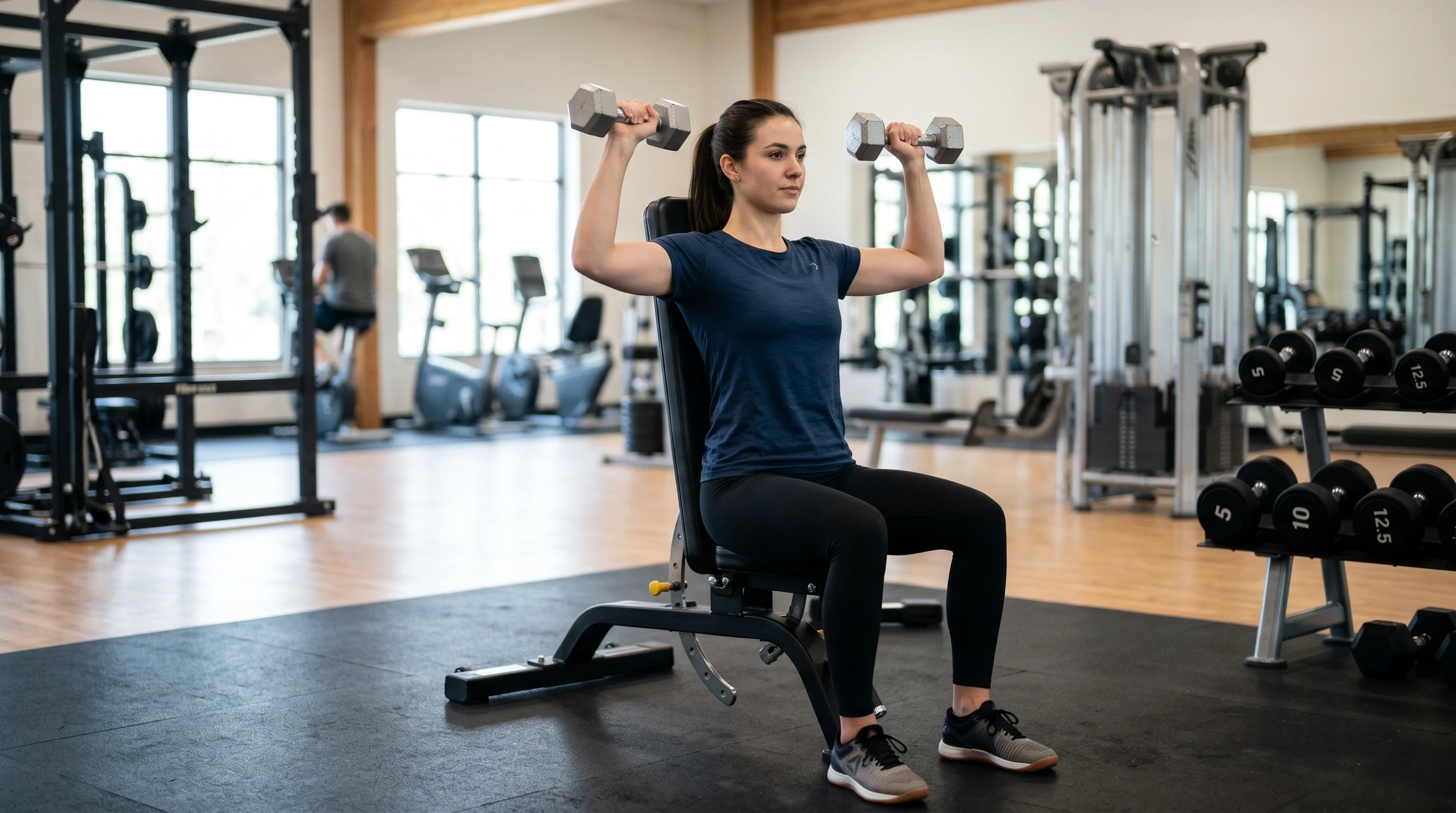
If you’re unsure how to restart training after time off, follow this simple plan for your first week back:
- Train 3 days this week
- Use 2 sets per exercise
- Stay in the 8–12 rep range
- Stop with 2–3 reps in reserve
- Focus on finishing each workout feeling strong—not exhausted
Why Restarting Fitness After a Break Feels Hard

It’s common to feel like you’ve lost all your progress—even after just a month or two off—but your muscles and nervous system remember more than you think. Many returning lifters notice their first few workouts feel harder than expected—even if they were previously consistent. After a break, your body’s tolerance for exercise drops, so what used to feel easy may feel much harder or cause more soreness. Hormonal changes, less conditioning, and a weaker mind-muscle connection are all normal experiences.
Soreness can feel more intense, especially in the first 1–2 weeks. Even your motivation and confidence might be lower. By starting with easier workouts and focusing on movement patterns, you’ll help your body “re-learn” safe and effective training much faster. Want to know why beginners and returning lifters often regain lost muscle fast? Check out the section below on muscle memory, where we dig into the science and give you a clearer picture.
It’s also important to remember that starting again is a mental challenge—expect some swings in motivation. Try rewarding yourself for small wins to keep your spirits up. Even making it to the gym the first week is a positive step. Expect the first 1–2 weeks to feel harder than usual. This is normal and improves quickly as your body readapts.
Key Principles For Getting Back Into Training
Most people coming back after a break worry about doing too little. In reality, doing too much too soon is the most common mistake and can result in overuse injuries, extreme soreness, and burnout. Following these general guidelines helps you progress safely and build momentum:
- Start with lower volume and intensity. Choose 2–3 sets per exercise and keep 2–3 reps left in the tank (see RIR explanation below). If you’re unsure how much total volume beginners should use, this guide on muscle group sets per week for beginners explains how to structure weekly training volume safely.
- Limit workouts to 3 nonconsecutive days per week. This gives your muscles time to recover and adapt between sessions. A 3 day workout schedule works well for most beginners.
- Emphasize good technique first. Use a weight that allows you to move with control. Don’t rush to heavier weights. If you feel sharp pain or unusual discomfort, stop and adjust the movement or consult a qualified professional.
- Progress slowly, instead of forcing every session to be harder. Use small increases in weight, reps, or sets only when you feel comfortable.
Why Less is More Early On
Your muscles, tendons, and joints need time to readjust. Small steps now mean less soreness and lower risk of injury, which helps you stick with your plan longer. Early on, make your goal to finish every workout feeling like you could have done a little more. This approach keeps you motivated and helps avoid setbacks.
Beginner-Friendly Full-Body Workout Plan (After a Break)

This plan focuses on key movement patterns, efficiency, and safety. Once you rebuild consistency with full-body training, this beginner upper body workout at the gym guide can help you transition into a more focused upper-body session for chest, back, shoulders, and arms. If you want a more general breakdown of how to build this type of routine from scratch, see this full body workout plan for beginners.
If you prefer restarting at home before returning to the gym, this Beginner Bodyweight Workout Plan To Build Muscle At Home explains how to rebuild strength and muscle using simple bodyweight exercises, structured full-body workouts, progressive overload, and recovery-focused training.
If you want a more structured weekly home workout schedule while rebuilding consistency after time away from training, this 3 Day At Home Workout Routine For Beginners explains how to organize three weekly full-body bodyweight workouts, recovery days, and progression using simple beginner-friendly exercises at home.
If you want the simplest possible way to restart training at home before returning to more structured programs, this No Equipment Full Body Workout For Beginners At Home explains how to rebuild consistency, strength, and confidence using basic beginner-friendly bodyweight exercises without gym equipment.
You’ll train your whole body with a mix of push, pull, and lower body exercises, three days a week. Adjust exercises for what you have access to (at home or in the gym). If you’re unsure which movements to choose, this guide on best beginner exercises for muscle growth covers safe and effective options. For more structure, check out the Beginner Bodybuilding Workout Plan.
If lower-body training feels especially difficult after time away from the gym, this Simple Leg Day Workout Plan shows how to structure beginner-friendly leg workouts with manageable exercises, sets, reps, and progression.
If you feel unsure using machines after time away from the gym, this Guide To Gym Machines For Beginners explains how to adjust common beginner machines safely and train with more confidence while rebuilding your strength.
This plan fits anyone looking to rebuild the habit and get back on track without overdoing it your first few weeks.
Workout Frequency:
- 3 days per week (e.g., Monday, Wednesday, Friday)
- At least 1 day of rest between workouts
How Many Sets & Reps?
- 2–3 sets per exercise
- 8–12 reps per set
- Move with good control—focus on form over weight
- Stop each set with 1–3 reps left in reserve (RIR)
What’s “Reps In Reserve (RIR)”?
RIR means ending every set with 1–3 repetitions left before you would fail. For example, if you could do 12 reps, you stop at 9–11 reps. This trains your muscles without overdoing it, especially after a layoff, and reduces the risk of soreness or injury.
Sample 3-Day Full-Body Program
- Squat or Leg Press
2–3 sets of 8–12 reps - Push-Up or Chest Press
2–3 sets of 8–12 reps - Bent-Over Row or Seated Row
2–3 sets of 8–12 reps - Step-Up or Split Squat
2–3 sets of 8–12 reps - Shoulder Press (Dumbbell or Machine)
2 sets of 8–12 reps - Plank or Dead Bug
2 sets, 20–30 seconds (core work)
Rest about 1–2 minutes between sets. This plan covers all the basic movement patterns without overwhelming your body. If you need an alternative exercise for comfort or access, swap with a similar movement. If motivation is an issue, try a quick playlist or gym partner to make it more fun; consistency is what counts here.
Why Beginners Regain Muscle Quickly After a Break (Muscle Memory)
Studies suggest that people who once built muscle or strength, then stopped training, can often regain their abilities faster than complete beginners. This is often referred to as muscle memory, where previous training experience allows you to regain strength and muscle faster than when you first started. This concept is supported by research on muscle memory in resistance training, which suggests that prior training can create long-lasting adaptations at the muscle cell level. This concept has been widely discussed in resistance training research and supported by physiological studies on muscle cell adaptation. In simple terms, your body may “remember” some of the training adaptations you built before, which can make rebuilding lost muscle and strength easier than starting from zero.
This fast return is reliable and has been shown in many research studies. Don’t panic if you lost size or strength—you can rebuild it much quicker than the first time. Focus on consistency and safe progression. The good news: progress in the beginning can feel almost as fast as your first few months ever in the gym, making it a great time to reset your habits.
If you want to dig into the details, many studies have tested just how effective muscle memory is for people getting back into fitness. Across age groups, your body remembers prior training and adapts very quickly. This means your “comeback” can be smoother with dedication.
How To Progress Over Time (Week-to-Week Plan)
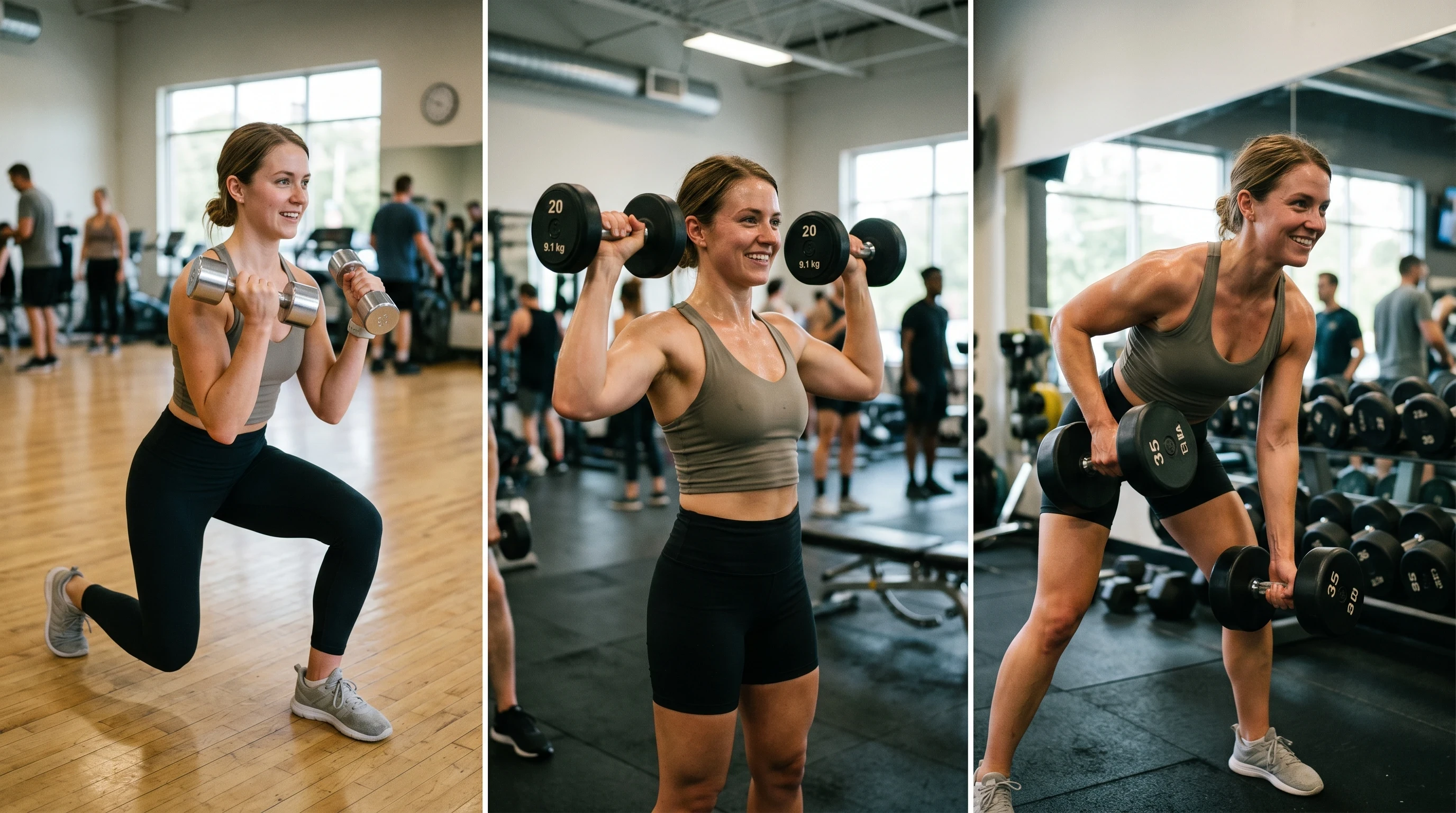
After you complete your first week or two and feel less sore, you’re ready to increase the challenge gradually. Use these simple strategies for week-to-week progress:
- Add weight only if you finished all sets with 2–3 reps left in reserve and your form was solid.
- Add a set per exercise if your soreness is minimal and you’re recovering well.
- Add reps within your range (work toward 12 before increasing weight). If you want a clearer breakdown of sets and reps for beginners, this guide explains how to structure rep ranges and volume for muscle growth.
Small, steady steps help your body adjust and avoid setbacks. There’s no rush to reach a certain weight. Each increase, even if small, builds strength over time. If you want more detail about how to structure your increases, read How To Implement Progressive Overload For Beginners.
Simple Week-to-Week Progression Example
- Weeks 1–2: 2 sets per exercise, light to moderate weight, 2–3 reps left in reserve
- Weeks 3–4: Increase to 3 sets if comfortable, or add a few reps each set (aiming for 12)
- Weeks 5+: Add a small amount of weight once you do 3 sets of 12 reps with good form
If you ever feel more soreness, dial back slightly and wait another week. Listen to your body, especially in the first month back. If necessary, add extra rest days or reduce the workload, then rebuild your momentum again slowly.
Common Mistakes To Avoid When Returning
- Doing too much, too soon. If you want a deeper breakdown of common beginner workout mistakes, this guide explains what to avoid and how to fix them early. It’s tempting to try to “make up for lost time,” but this often causes excessive soreness or injury. Patience pays off in the long run.
- Neglecting warmups and cooldowns. Take 5–10 minutes for dynamic stretches and joint circles before lifting. Cool down with gentle stretching or walking.
- Using poor form. Rushing to heavy weights before your body relearns good technique is risky, especially if you’re coming back from months off.
- Skipping rest days. You get stronger when you recover, not just in the gym. Three nonconsecutive days of training is enough for most beginners.
- Ignoring aches and pains. Slight soreness is normal, but sharp pain is not. Adjust or rest as needed to avoid long-term injuries.
Key Takeaways: Building Fitness Again After a Break
- Start slow; fewer sets and lighter weights help your body readapt
- Train full body 2–3 times per week, with rest between sessions
- Keep 1–3 reps “in reserve” every set to avoid overdoing it
- Technique matters more than the weight you lift in the first month
- Progress comes quickest when you consistently complete each workout feeling strong, not exhausted
- Muscle memory helps you regain strength faster than you think
- Add weight, sets, or reps only when you’re ready; small steps beat big jumps
Use these principles as your roadmap. For more structured programs and beginner friendly guides, see the Beginner Bodybuilding Workout Plan (12-Week Foundation Blueprint) and our 3 Day Workout Schedule For Beginners. Remember, a steady approach always beats burnout from doing too much at once.
Simple Troubleshooting for Beginners Returning After a Break
What if I feel extra sore after the first week?
This happens to almost everyone returning after a break. Take an extra day off if needed, keep moving gently (like walking), and ease back into workouts. Soreness fades as your body readapts each week.
What if I can’t do as many reps or sets as before?
This is normal! Use the lower end of the rep/set ranges to start. Each week, try to add a rep or stick with your plan until strength returns. Muscle memory makes the comeback go much faster than starting fresh.
Should I diet when starting again?
Focus on eating enough protein and a balanced diet. Extreme calorie cutting makes it harder to build muscle and recover. See our nutrition basics for more tips for beginners. Getting enough sleep also plays a key role in your recovery and progress.
Can I do more than three workouts per week?
Three sessions weekly is enough for great results and gives plenty of recovery for most. Once you rebuild your base fitness, you can add more (see our intermediate guides). Beginners, however, benefit most from consistency rather than high frequency.
Practical Next Steps & Final Thoughts
- Pick your three weekly workout days and schedule them in your calendar
- Choose weights and exercises that allow you to train with good form, leaving 1–3 reps in reserve
- Track your sets, reps, and weights so you can see progress (use a simple notebook or app)
- Focus on finishing each workout feeling strong, not wiped out
- If you want detailed guidance, check out our Beginner Bodybuilding Workout Plan (12-Week Foundation Blueprint) or our article on How To Implement Progressive Overload For Beginners
Use this approach to stay consistent, avoid burnout, and regain your fitness with confidence. Every week back is a step forward—even a small step beats none at all. Stay patient, monitor your progress, and celebrate your return to movement. The strength and energy you build now will set you up for bigger things ahead! If you’ve trained before, you’re not starting from zero—you’re rebuilding. And that process is faster, smoother, and more predictable than you think.
Beginner Bodybuilding Guides on Lift & Nurture
If you want to continue building your training structure after getting back into the gym, these beginner guides will help you progress safely and effectively:
- Beginner Bodybuilding Workout Plan (12-Week Foundation Blueprint) – Learn how to follow a structured program built around progressive overload, recovery, and long-term muscle growth.
- 3 Day Workout Schedule For Beginners – See how to organize your weekly training into a simple, realistic full-body routine.
- How To Implement Progressive Overload For Beginners – Understand how to safely increase weight, reps, and sets over time without stalling progress.
- Beginner Weight Training Sets And Reps – Learn how to choose the right rep ranges and set volume for muscle growth.
- Muscle Recovery Tips for Beginners – Improve recovery with better sleep, rest days, and training balance.
- Muscle Building Nutrition Guide For Beginners – Learn how calories, protein, and meal structure support muscle growth and recovery.
- Beginner Upper Body Workout At The Gym – Learn how to structure a simple upper-body gym workout once you are ready for more focused chest, back, shoulders, and arm training.
References
American College of Sports Medicine (ACSM). Progression Models in Resistance Training for Healthy Adults.
Schoenfeld, B. J. (2010). The Mechanisms of Muscle Hypertrophy and Their Application to Resistance Training. Journal of Strength and Conditioning Research.
Centers for Disease Control and Prevention (CDC). Physical Activity Guidelines for Americans.
Damas, F., Phillips, S. M., Vechin, F. C., & Ugrinowitsch, C. (2018). A Review of Resistance Training-Induced Changes in Skeletal Muscle. Sports Medicine.
Gundersen, K. (2016). Muscle memory and a new cellular model for muscle atrophy and hypertrophy. Experimental Physiology. Available via PubMed: https://pubmed.ncbi.nlm.nih.gov/26792335/
About the Author
Angel Carcamo is the founder of Lift & Nurture, a beginner bodybuilding platform focused on structured training, muscle growth fundamentals, and long-term progress.
As a beginner himself, Angel creates research-based beginner bodybuilding guides that simplify widely accepted strength training principles into clear, practical steps.
His guides focus on key fundamentals like progressive overload, recovery, and nutrition — helping beginners build muscle without confusion, shortcuts, or unrealistic expectations.
Start here: Beginner Bodybuilding Roadmap
Foundation guide: Beginner Bodybuilding Workout Plan (12-Week Foundation Blueprint)
This is such a timely and encouraging article! Coming back to fitness after a long break can be incredibly intimidating, both physically and mentally. I really appreciate how you focused on the “nurture” aspect of the process; it’s so easy to fall into the trap of trying to pick up exactly where we left off, which usually leads to burnout or injury.
I have a few questions regarding the transition period: For someone who has been away for several months, do you recommend starting with a full-body routine to “wake up” the muscles, or is it better to focus on just one or two muscle groups at a time to manage soreness? Also, how do you suggest balancing the “push” to get back into a routine with the need to listen to the body’s recovery signals? Sometimes it’s hard to tell the difference between normal post-workout fatigue and a sign that we’re overdoing it too soon.
Thank you so much for sharing these practical tips and for helping make the journey back to health feel much more manageable!
Thank you for the thoughtful comment, IYERE.
I’m really glad the “nurture” side of the article stood out to you, because that’s one of the most important parts of returning to fitness after time away. A lot of people try to jump back in exactly where they left off, but recovery capacity, coordination, soreness tolerance, and work capacity usually need time to rebuild first.
For someone who has been away from training for several months, I’d generally recommend starting with a simpler full-body routine first rather than immediately returning to a very high-volume split. Full-body training 2–3 days per week works well because it helps rebuild movement patterns, improve consistency, and keep soreness more manageable while your body readjusts to training again.
A gradual “bridge” phase of about 2–4 weeks is usually a smart approach. During that time, keeping the weights lighter, leaving several reps in reserve, and focusing on controlled technique tends to work much better than pushing hard too early. The goal is to rebuild momentum and recovery capacity — not to test your limits right away.
The Jeff Nippard comeback articles discuss a very similar idea: after a training break, it’s usually better to balance stimulus and recovery carefully instead of trying to “make up” for lost time. They also emphasize that excessive soreness can actually slow recovery and make consistency harder early on.
For balancing the “push yourself” mindset with listening to your body, I think patterns matter most.
Normal post-workout fatigue usually looks like:
– mild soreness for a day or two
– muscles feeling worked but functional
– temporary tiredness while performance still gradually improves
Signs you may be doing too much too soon can include:
– soreness lasting several days
– declining workout performance
– joint pain instead of muscle fatigue
– poor sleep or low motivation
– constantly feeling run down before workouts
A simple beginner rule is: finish workouts feeling challenged, but not destroyed. In most cases, that approach leads to faster long-term progress because it improves consistency and recovery instead of creating burnout early on.
Thank you again for reading the article and for asking such practical questions.
— Angel
This was such a helpful and realistic guide. I really liked the reminder that after a break, the goal is not to punish yourself or “make up for lost time,” but to rebuild slowly and safely. The idea of finishing workouts feeling strong instead of exhausted is especially useful for beginners. I also liked the simple 3-day full-body plan because it feels doable without being overwhelming. Do you think it is better to restart at home first or go straight back to the gym?
Thank you so much, Hanna. I really appreciate the thoughtful comment, and I’m glad the guide helped make the process feel more realistic and less overwhelming.
I honestly think the “best” place to restart depends more on consistency, comfort, and confidence than on whether someone trains at home or in a gym.
For some people, starting at home first can be a great option because it removes pressure and makes it easier to rebuild the habit gradually. Simple bodyweight workouts, lighter resistance, and shorter sessions can help your body readapt while keeping soreness and fatigue manageable. It can also help you regain confidence before returning to a busier gym environment.
On the other hand, going straight back to the gym can work really well too — especially if you enjoy the environment, feel motivated there, and keep your training controlled instead of trying to “make up for lost time.” The biggest mistake most people make after a break is jumping back into their old training volume and intensity too quickly.
In general, I think the safest and most sustainable approach is:
start lighter than you think you need to, focus on good technique, leave a few reps in reserve, and gradually rebuild over the first few weeks instead of rushing.
The good news is that muscle memory works strongly in your favor, so strength and coordination usually come back much faster than people expect as long as they stay consistent and recover properly.
Thanks again for the great question and for taking the time to read the article!