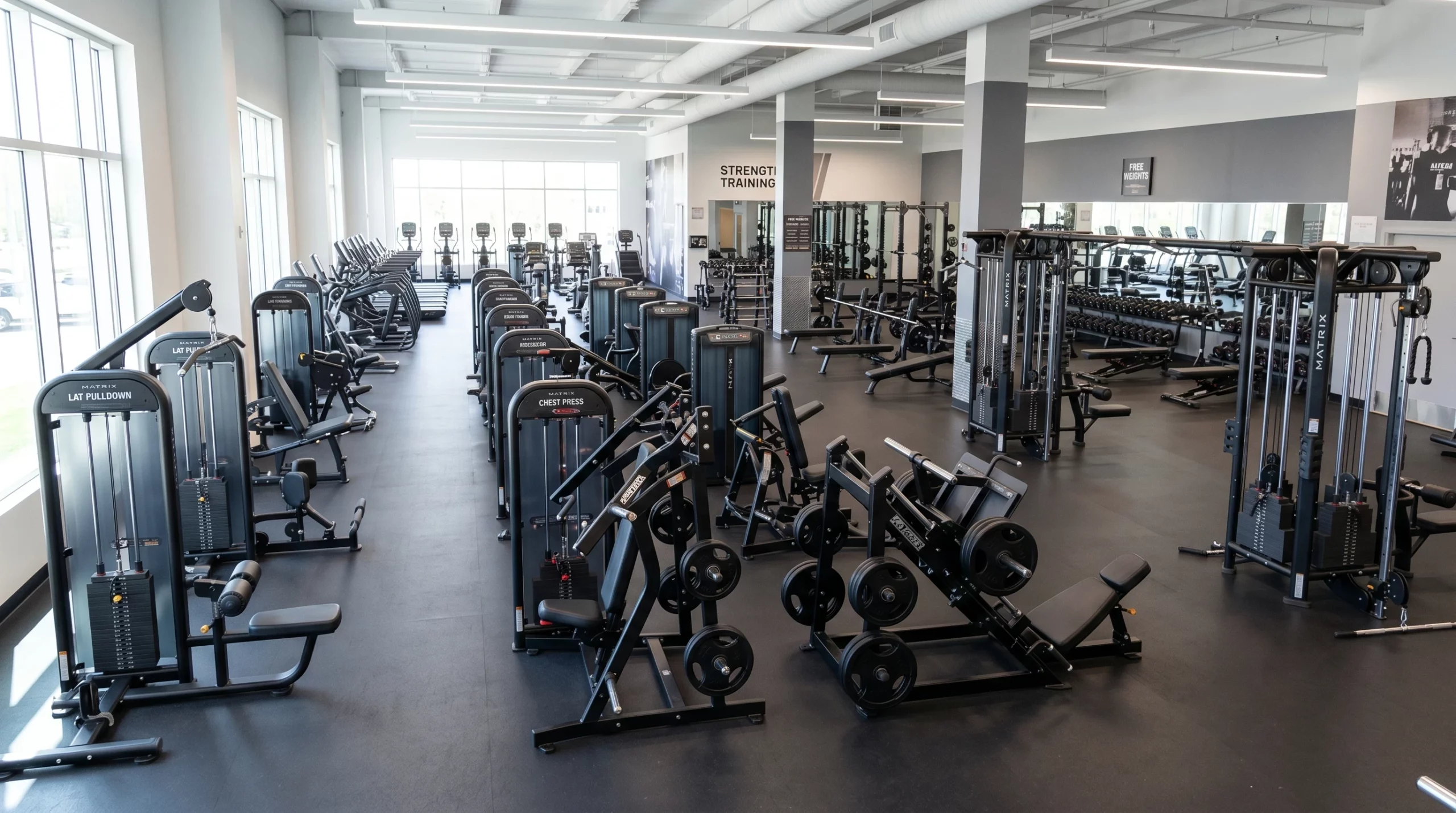
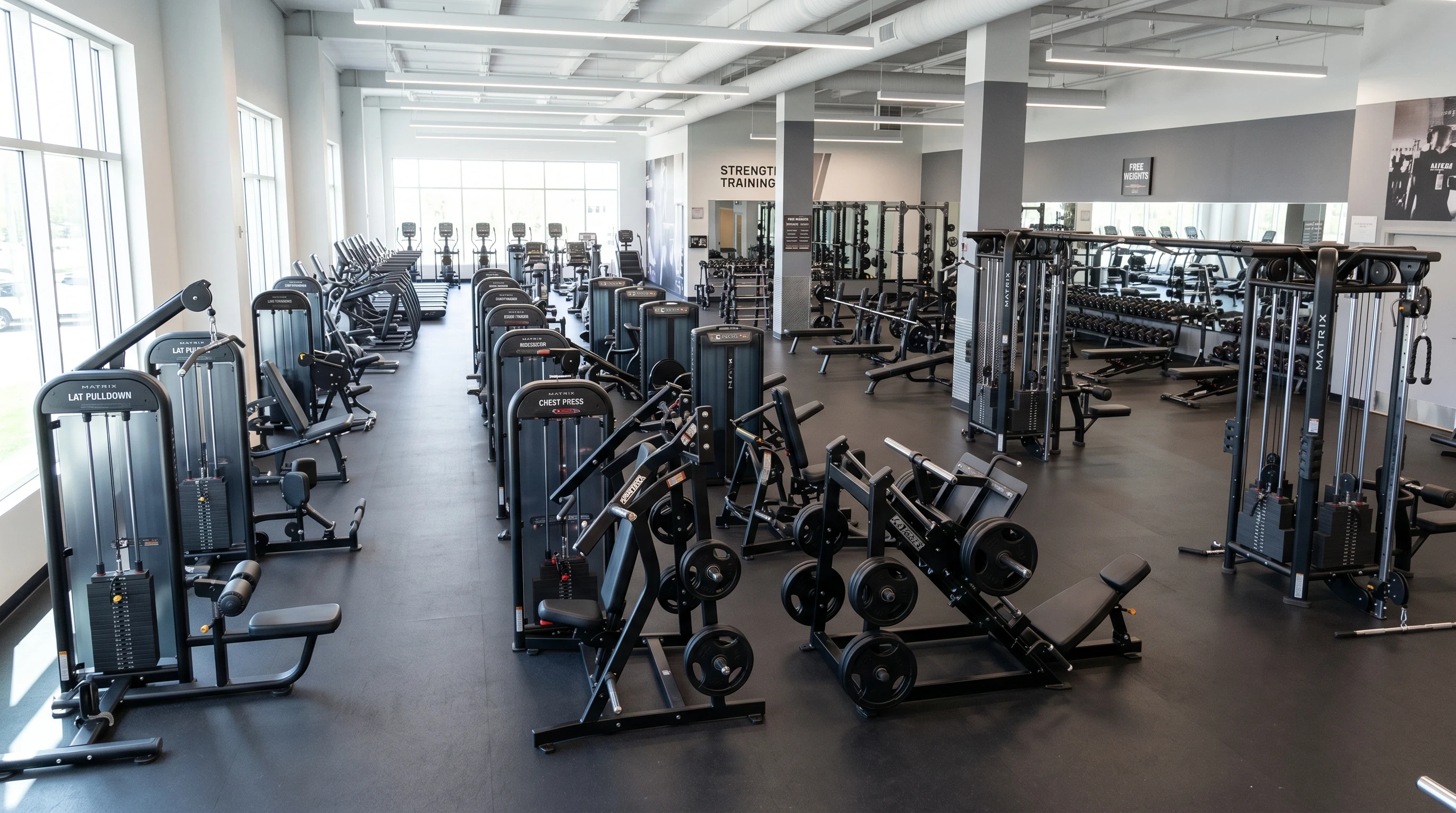
Many people feel overwhelmed when setting foot in the gym for the first time, especially when rows of machines and complicated setups make it hard to know where to begin. Most beginner programs recommend starting out on gym machines because they make it easier to learn good technique, target different muscle groups, and build basic strength without needing advanced gym knowledge.
This guide is designed to help beginners understand the basics of gym machines, how to use them safely, and how to structure an effective machine-based workout for building muscle and confidence. By following these straightforward ideas, anyone can start their muscle-building journey with clarity and less anxiety about doing things wrong. The goal is to take the first steps in your fitness journey without unnecessary stress and confusion.
If you feel unsure about where to start, machines can give you a more controlled way to learn the gym before moving into more complex exercises.
Table of Contents
- Quick Answer: How Should Beginners Use Gym Machines?
- What Gym Machines Are and Why Beginners Should Use Them
- Are Gym Machines Good for Building Muscle?
- How Beginners Should Use Gym Machines Properly
- Simple Beginner Decision Rule
- Best Gym Machines For Each Muscle Group
- Simple Beginner Machine Workout Example
- Common Gym Machine Mistakes Beginners Make
- How To Progress With Gym Machines
- Machines vs Free Weights: Simple Explanation
- Frequently Asked Questions About Gym Machines for Beginners
- Key Takeaways
- Beginner Bodybuilding Guides on Lift & Nurture
- Final Thoughts + Action Plan
- References
- About the Author
Quick Answer: How Should Beginners Use Gym Machines?
Most beginner guides recommend focusing on simple gym machines that target major muscle groups. Adjust the machine for your body and use a weight you can lift for 8–12 slow, controlled reps with good form. Aim for one or two exercises per muscle group, two to three sets each, and train each muscle group two to three times per week. Increase the reps or weight slowly as you improve. This approach helps build muscle, confidence, and familiarity with the gym environment in a safe way.
What Gym Machines Are and Why Beginners Should Use Them
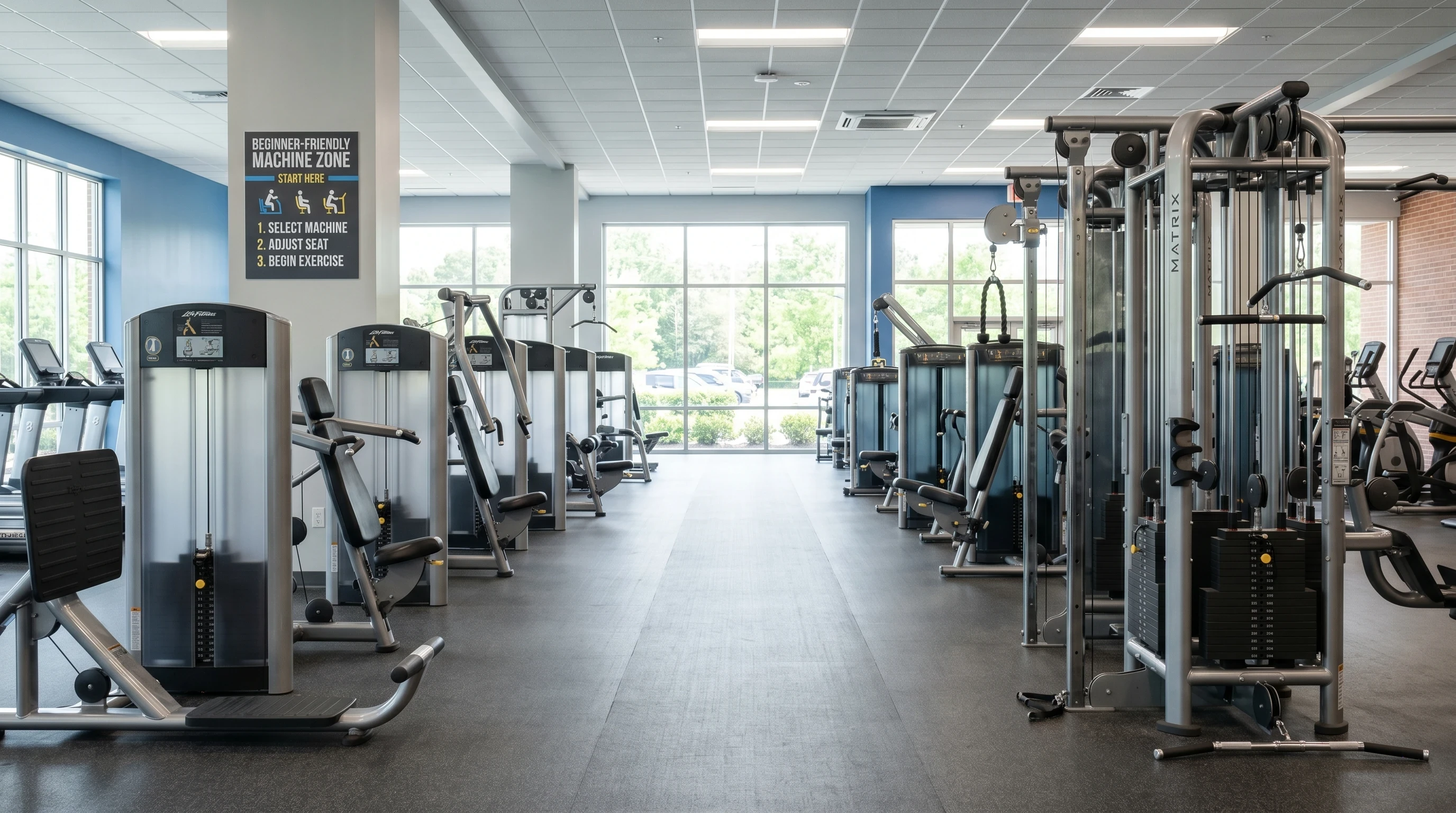
Gym machines are pieces of equipment meant to guide your movement safely through specific patterns. Unlike free weights where you control every angle, machines have fixed paths. This means your body stays in the right position, making it easier to learn the basics without needing much experience or coordination. Machines make it easier to build a beginner strength foundation.
Stability and Ease of Learning
Most beginner programs recommend machines because they support your body and keep you stable. You don’t have to worry about balancing a heavy barbell or keeping your core super tight during every movement. This gives you a chance to focus fully on working the muscle and practicing proper technique, which helps beginners learn faster.
Reduced Coordination Compared to Free Weights
Machines make lifting less complicated for beginners. Free weights like dumbbells or barbells demand more balance and coordination since every rep relies on you to control the movement path. Machines limit the room for error, which helps new gym-goers stay safe and feel more confident early on. This support helps beginners train with more control and confidence.
Safer Introduction to Resistance Training
Resistance training has many health benefits, including stronger muscles and bones, better posture, and improved mood. For new lifters, gym machines offer a safer introduction since they help prevent accidental slips or dropped weights and allow you to adjust the load to your ability level. Building good habits from the start lays the groundwork for later progress.
Focus on Proper Form and Muscle Activation
Learning good form is really important in lifting. Since machines guide your movement path, you can practice the basics and learn to feel the muscle working before worrying about balance or advanced technique. This can help beginners build confidence before adding more challenging free-weight movements later.
Are Gym Machines Good for Building Muscle?
Gym machines can build muscle for beginners when paired with steady progression and enough effort. Most muscle-building programs (also called hypertrophy programs) use both machines and free weights. Many studies show that consistent effort and challenging your muscles over time matter more than the equipment used. Both approaches can build muscle, especially for newcomers.
The most important thing for muscle growth is to challenge your body. This usually means lifting moderate to heavy weights for 8–12 reps and trying to do a bit more as you get stronger. This can be done using machines or free weights as long as you push close to your limit (while keeping good form). Sticking to your routine, focusing on steady progress, and putting in enough effort in each workout all play a bigger role than the specific tools you use. Muscle-building success comes from the process, not just the equipment.
How Beginners Should Use Gym Machines Properly
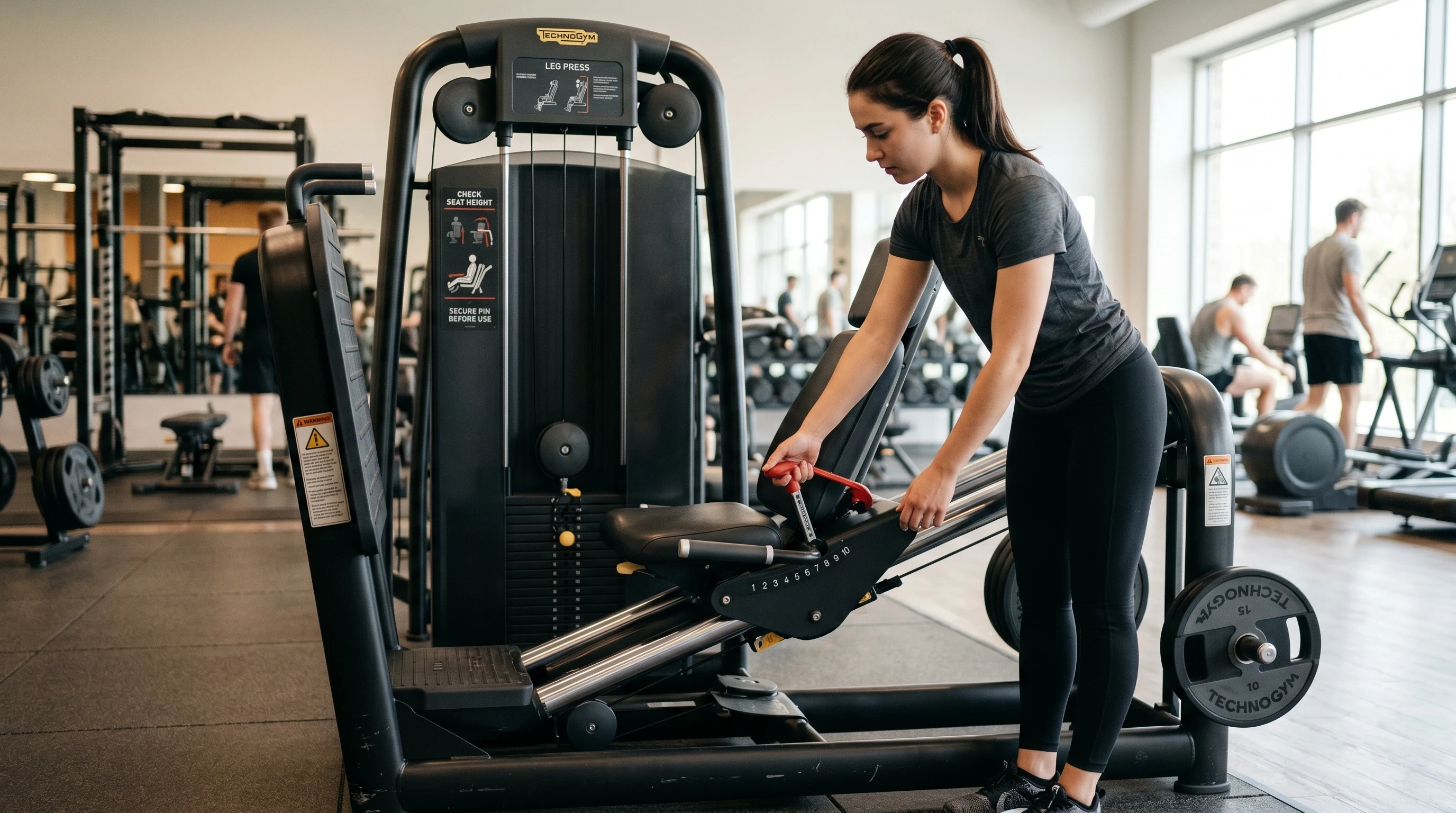
Using gym machines is pretty straightforward, but using them with good technique and setup makes your workouts safer and much more effective. Here are the main things to stay aware of as a beginner:
Adjusting Seat Height and Setup
Before you start your set, adjust the seat so your limbs and joints line up with the moving parts. Most machines have diagrams to show proper body position, and most gyms have staff who can show you how to set them up. Lining up your joints with the machine’s axis of movement keeps you comfortable and helps target the right muscles. Proper setup also minimizes unnecessary strain so you can focus on your workout.
Controlled Reps (No Momentum)
Move the weight in a slow and controlled manner. Avoid jerking or swinging the weight, as this reduces muscle activation and can increase the chance of discomfort or injury. A controlled movement, about two to three seconds to lift and two to three seconds to lower, helps keep the target muscle working. Focusing on control lets your body get used to resistance training safely.
Full Range of Motion
Try to move through the full allowed range on each machine, unless it feels uncomfortable. A bigger movement range works the muscle more completely. Use a light weight at first to make sure you can complete each rep comfortably and safely. Full range reps allow you to develop flexibility and all-around strength.
Basic Rep Ranges (8–12 Reps For Hypertrophy)
Many beginner routines recommend 8–12 repetitions per set for building muscle size (hypertrophy) because this range balances muscle tension and fatigue. Aim for a weight that is tough to complete by the final reps, but does not force you to “cheat” on your form. This zone is ideal for building a base of muscle.
Training Close to Failure (1–3 Reps in Reserve)
For best results, try to finish each set when you feel you could do one to three more good reps before your form breaks down. This is called “keeping reps in reserve” and helps challenge the muscle enough to grow while avoiding burnout or injury.
Simple Beginner Decision Rule
If you’re unsure what to do in the gym, follow this:
- Choose 6–9 total machine exercises
- Do 2–3 sets per exercise
- Stay in the 8–12 rep range
- Stop with 1–3 reps left in the tank
- If you hit 12 reps easily → increase weight next workout
This keeps your training simple, structured, and effective.
Best Gym Machines For Each Muscle Group
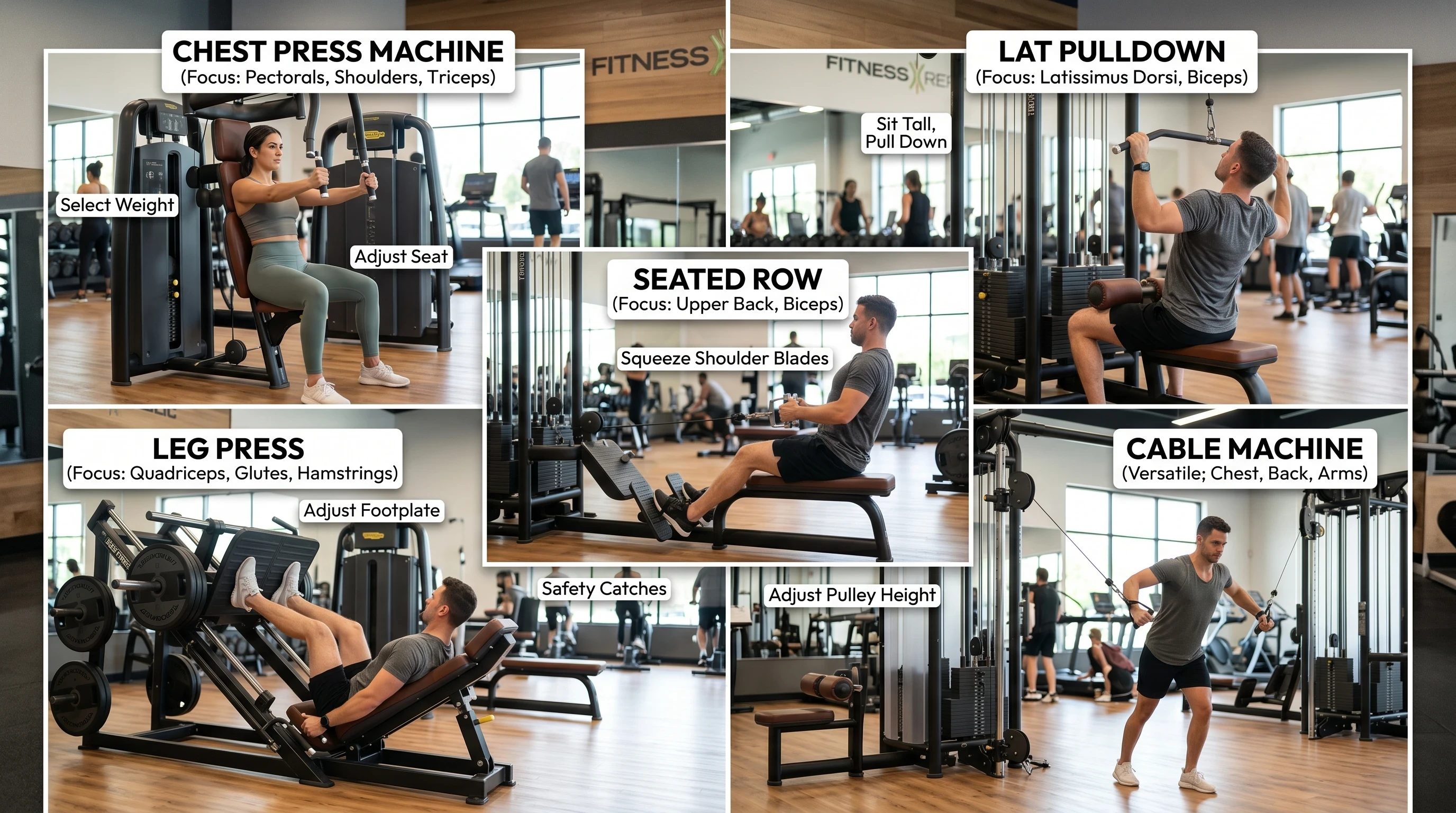
Most beginners do best starting with one or two user-friendly machine exercises per major muscle group. Here are the top choices, what they work, why they’re user-friendly, and a simple cue to focus on for good technique:
Chest
- Machine Chest Press
Targets: Chest (pectorals), front shoulders, triceps.
User-friendly because the back support and fixed path help you push with your chest rather than the shoulders.
Cue: Keep your shoulders back and press the handles out without letting your elbows flare too wide. - Pec Deck Machine
Targets: Chest (pectorals), especially inner chest.
User-friendly because you stay seated and only move your arms.
Cue: Squeeze the handles together like you’re hugging a big tree, keeping your chest high.
Shoulders
- Machine Shoulder Press
Targets: Shoulders (deltoids), triceps.
Easy to learn because the movement is guided and supported from behind.
Cue: Press handles upward above your head, keeping your lower back against the seat. - Cable Lateral Raise
Targets: Side shoulders (side deltoids).
User-friendly because using a cable limits cheating and swinging.
Cue: Stand tall, lift your arm directly out to the side, lifting only to shoulder height.
Back
- Lat Pulldown
Targets: Upper back (latissimus dorsi), biceps.
Stable seat and easy to set up.
Cue: Pull the bar down in front of your chest, leading the pull with your elbows. - Seated Cable Row
Targets: Middle and upper back (rhomboids, lats), biceps.
Feet braced, simple to control. Cue: Sit tall, pull the handles toward your belly button, and squeeze the shoulder blades together. - Chest Supported Machine Row
Targets: Upper/mid back, rear shoulders, biceps.
Chest pad support makes it easier to avoid swinging or using your lower back. Cue: Pull handles toward the ribcage, focusing on your back squeezing, not just your arms pulling.
Arms
- Cable Biceps Curl
Targets: Biceps.
Standing or seated, cable keeps tension on the muscle. Cue: Keep elbows close to your sides and curl the handle up toward your shoulder. - Cable Triceps Pushdown/Overhead Extension
Targets: Triceps (back of upper arm). User-friendly, cable lets you work arms with good control.
Cue: Keep elbows close, push rope or bar downward (pushdown), or overhead and fully extend the arms (overhead extension).
Legs
- Leg Press Machine
Targets: Quads, glutes, hamstrings.
Safer than barbell squats for new lifters. Large, supportive back pad. Cue: Keep feet shoulder width, lower the weight until your knees bend to about 90 degrees, and press through your heels.
If you want a complete beginner-friendly lower-body routine using exercises like the leg press, hack squat, leg curl, split squat variations, calf raises, and progressive overload principles, this Simple Leg Day Workout Plan shows how to structure an effective beginner leg workout step by step.
- Hack Squat Machine
Targets: Quads, glutes, hamstrings.
Stable, upright path makes it easier to learn squat depth and knee position. Cue: Lower yourself smoothly, don’t let knees cave in, stand up by pushing evenly through your feet.
- Leg Extension Machine
Targets: Quads (front thigh). Simple to set up, isolates thigh muscles.
Cue: Sit tall, lift the lower leg up to straighten your knee, don’t swing or kick. - Leg Curl Machine
Targets: Hamstrings (back thigh). Lying or seated design supports the rest of your body. Cue: Curl your feet down and back, squeezing the back of your thigh.
Calves
- Standing or Seated Calf Raise Machine
Targets: Calf muscles (gastrocnemius and soleus). User-friendly with support for your back and legs. Cue: Push through the balls of your feet and rise up slowly onto your toes, then lower with control.
Abs
- Cable Crunch Machine
Targets: Rectus abdominis (front abs). Fixed movement, easy to control resistance.
Cue: Round your back slightly and crunch down, squeezing your abs, not pulling with your arms or hips.
Simple Beginner Machine Workout Example
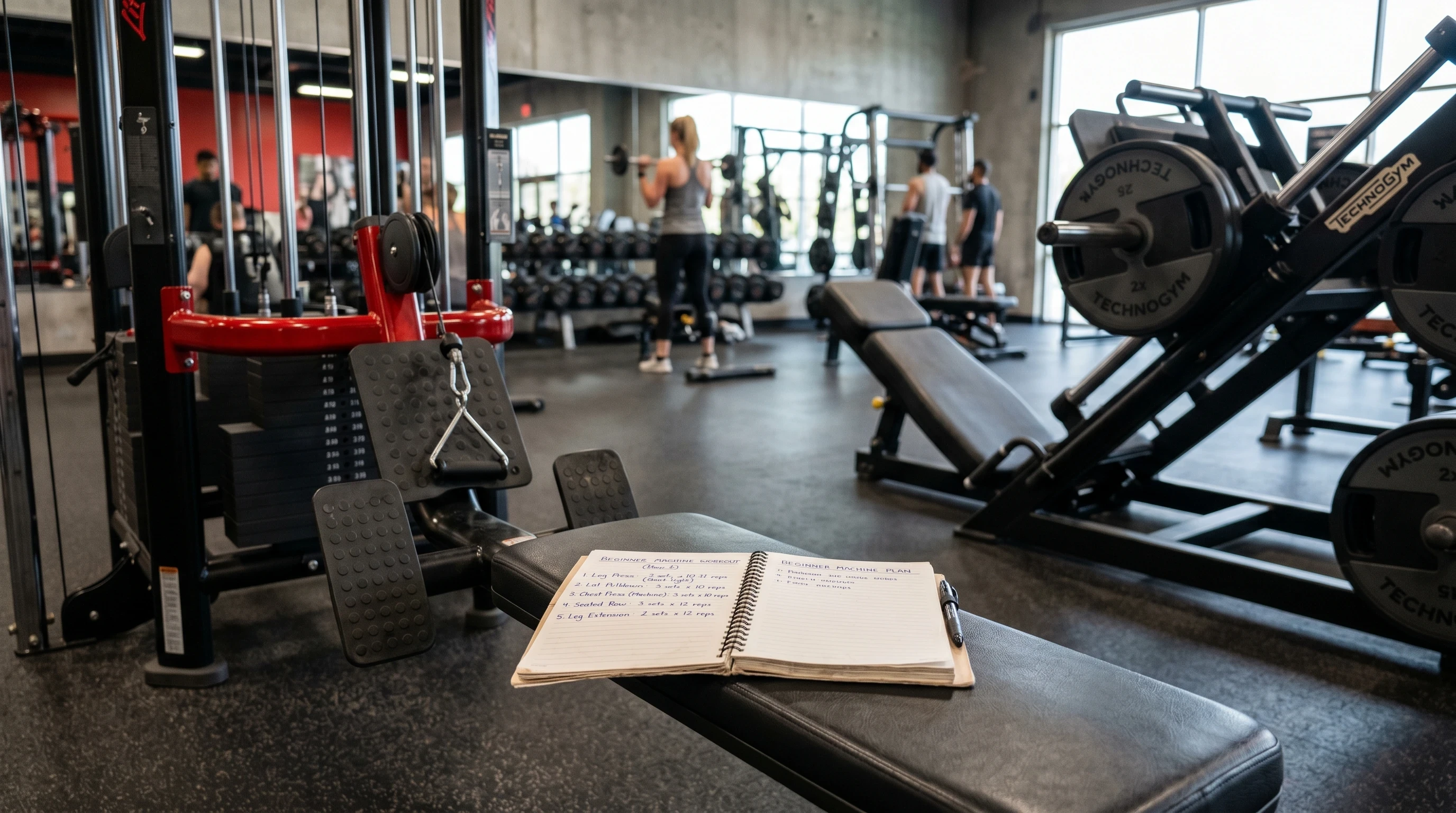
A full-body machine workout is a popular beginner approach because it targets all major muscle groups, gives enough recovery between sessions, and keeps things structured. If you want a more focused upper-body version, this beginner upper body workout at the gym guide shows how to structure chest, back, shoulders, biceps, and triceps using beginner-friendly machines, cables, and dumbbells. Here’s a sample you can do two or three times per week:
- Machine Chest Press – 2 sets x 8–12 reps
- Lat Pulldown – 2 sets x 8–12 reps
- Machine Shoulder Press – 2 sets x 8–12 reps
- Leg Press – 2 sets x 8–12 reps
- Leg Curl – 2 sets x 8–12 reps
- Cable Bicep Curl – 2 sets x 8–12 reps
- Cable Triceps Pushdown – 2 sets x 8–12 reps
- Seated Calf Raise – 2 sets x 10–15 reps
- Cable Crunch Machine – 2 sets x 12–15 reps
Rest for 60 to 90 seconds between each set. Stick with the same movements for at least four to six weeks so you can see your strength and confidence grow. Starting with two sessions per week and working up to three can feel more manageable for beginners. Recovery is a crucial part of muscle gains, so listen to your body as you increase workout frequency over time.
Common Gym Machine Mistakes Beginners Make
- Using Too Much Weight Too Soon: Many lifters want to lift as much as possible, but it’s better to lift lighter with great form when starting out. This helps avoid soreness and lets you develop better movement skills.
- Rushing Through Reps: Moving too fast or using momentum makes the exercise less effective and may cause joint discomfort. Slow and steady reps build better results.
- Not Adjusting Machines for Your Body: Setting up a seat too high or too low can make some machines uncomfortable or even risky for joints. Always adjust machines for your height and limb length before adding weight.
- Ignoring Progression: Doing the same weight and reps every week will not keep your body improving. Tracking your workouts and aiming to add a bit more over time is super important for muscle growth.
- Doing Random Exercises Without Structure: Picking machines randomly can mean missing important muscles or overloading others. Following a balanced plan keeps your training more complete and easier to repeat.
How To Progress With Gym Machines
Progress in the gym means challenging your muscles a little more over time so they have a reason to grow stronger and bigger. Beginners often use double progression: add more reps first, then raise the weight once the rep range gets easier.
Add Reps First, Then Weight
If you’re lifting a weight for eight reps and it gets to twelve or more with good form, increase the weight slightly and return to eight reps. Gradually build back up. This slow progression works well for getting steady results.
Track Your Workouts
Write down your sets, reps, and weights each workout, whether in a phone note, simple notebook, or app. This helps you remember what to do next time.
Stay Consistent Week to Week
Muscle growth relies on routine and steady effort. Visible progress often becomes easier to notice after six to twelve weeks of consistent training. Skipping sessions or changing the plan each week can slow things down. Staying consistent is key for both physical changes and building self-confidence in the gym setting.
Machines vs Free Weights: Simple Explanation
Machines and free weights both work for building muscle. Most beginner programs recommend machines at first because they’re easier to control, safer to learn, and make focusing on good technique simpler. Free weights use more muscle groups at once and need more balance and coordination.
If you do not have access to gym equipment yet, this Beginner Bodyweight Workout Plan To Build Muscle At Home shows how beginners can build muscle using structured bodyweight workouts, progressive overload, and full-body training principles without needing machines or free weights.
If you want a more structured weekly home workout schedule using bodyweight exercises, this 3 Day At Home Workout Routine For Beginners explains how to organize three weekly full-body workouts, recovery days, and progression using simple beginner-friendly exercises without needing gym machines.
If you want the simplest possible beginner starting point before using gym machines or equipment, this No Equipment Full Body Workout For Beginners At Home explains how to build strength, consistency, and confidence using basic full-body bodyweight exercises at home.
After building some basic strength and experience, combining both machines and free weights gives a well-rounded training approach. Over time, combining both methods can make training more balanced and flexible.
Frequently Asked Questions About Gym Machines for Beginners
Are gym machines good for beginners?
Yes. Gym machines are one of the easiest ways for beginners to start strength training because they provide stability, guide your movement, and reduce the need for balance and coordination. This makes it easier to learn proper form and build confidence in the gym.
Should beginners use machines or free weights first?
Most beginners start with machines because they are simpler and safer to learn. After building basic strength and confidence, you can gradually add free weights to develop more coordination and overall muscle control.
How much weight should I use on gym machines?
Start with a weight that allows you to complete about 8–12 reps with good form while still feeling challenging near the end of the set. If you can easily go beyond 12 reps, increase the weight slightly next workout.
How often should beginners use gym machines?
Most beginners train 2–3 times per week using a full-body approach. This allows enough practice for each muscle group while still giving your body time to recover between workouts.
Can you build muscle using only machines?
Yes. Beginners can build muscle effectively using only machines as long as they train consistently, use proper form, and gradually increase reps or weight over time. Machines and free weights can both support muscle growth.
How long should a machine workout take?
Most beginner machine workouts take about 45–75 minutes depending on the number of exercises, rest time, and experience level. Focus on quality sets rather than rushing through the workout.
Key Takeaways
- Most beginner guides recommend starting with gym machines because they’re stable, safe, and easy to set up.
- The best muscle-building results come from training consistently, using the right form, and making small progressions over time.
- Choose one or two user-friendly machine exercises for each muscle group and stick to them for a few months.
- Aim for slow, controlled reps in the 8–12 range, adjusting weights only when you can complete all the reps comfortably.
- Tracking your progress week to week is really important for steady improvement and confidence.
Beginner Bodybuilding Guides on Lift & Nurture
If you want to go beyond gym machines and build a complete beginner program, these guides will help:
- Beginner Bodybuilding Workout Plan (12-Week Foundation Blueprint)
→ Your full step-by-step system for building muscle with structured training, recovery, and progression. - How To Implement Progressive Overload For Beginners
→ Learn exactly how to increase reps and weight over time without stalling. - Beginner Bodybuilder Exercises: The Best Starter List For Muscle Growth
→ A complete list of beginner-friendly exercises using both machines and free weights. - Full Body Workout Plan For Beginners: Simple Step-by-Step Guide
→ A practical 3-day routine you can follow in the gym right away. - How To Structure Workout Rest Periods For Beginners
→ Learn how long to rest between machine exercises, compound lifts, and isolation movements so your sets stay strong and productive. - Gym Etiquette Tips For Beginners
→ Learn how to feel confident using machines and training around others. - Beginner Upper Body Workout At The Gym
→ Learn how to structure a simple upper-body gym workout using beginner-friendly machines, cables, dumbbells, sets, reps, rest periods, and progression.
Final Thoughts
Many lifters feel nervous or lost when starting out in a gym full of complicated equipment, but gym machines help make the learning process smoother. Focusing on basic machine exercises for each muscle group and training with consistency means beginners can build muscle, gain strength, and feel more comfortable in the gym. Over time, as you grow more confident, you can try new machines, increase the weight, or add free weight movements for variety. That confidence can help beginners stay consistent long enough to see long-term results.
Your Action Plan:
- Pick two to three days each week for gym sessions and use the beginner machine workout plan above.
- Set up each machine for your body and use a moderate weight you can control.
- Focus on slow reps, staying in the 8–12 rep range, and good form every time.
- Write down your workouts and aim to do a little more each week.
- Be patient, trust the process, and don’t worry about perfection; the results come from steady effort.
If you want more help with building your own plan or have questions about progressing with machines, check out related articles like Beginner Bodybuilding Workout Plan (12-Week Foundation Blueprint) or How To Implement Progressive Overload For Beginners. These resources will build on what you’ve learned here and help you continue progressing.
References
- American College of Sports Medicine. Progression Models in Resistance Training for Healthy Adults.
- Schoenfeld BJ. The mechanisms of muscle hypertrophy and their application to resistance training.
- CDC. Benefits of Physical Activity.
About the Author
Angel Carcamo is the founder of Lift & Nurture, a beginner bodybuilding platform focused on structured training, muscle growth fundamentals, and long-term progress.
As a beginner himself, Angel creates research-based beginner bodybuilding guides that simplify widely accepted strength training principles into clear, practical steps.
His guides focus on key fundamentals like progressive overload, recovery, and nutrition — helping beginners build muscle without confusion, shortcuts, or unrealistic expectations.
Start here: Beginner Bodybuilding Roadmap
Foundation guide: Beginner Bodybuilding Workout Plan (12-Week Foundation Blueprint)
Hi Angel,
As someone who avoided gym machines for a long time because they looked confusing, I actually found this guide really useful. The part about adjusting the machines properly before starting is something most beginners don’t think about, but it probably prevents a lot of bad form and discomfort.
I also liked that you explained the purpose of different machines instead of just listing them. It makes the gym feel less intimidating for people starting out. One thing I’m still curious about though: for complete beginners, do you think it’s better to focus mostly on machines first, or mix in some free weights right away?
Thank you, Bob! I really appreciate your thoughtful comment.
That is a great question. For complete beginners, I think machines are often the best starting point because they are more stable, easier to set up, and less intimidating while you are still learning basic movement patterns. They let you focus on controlled reps, proper setup, and feeling the target muscle work without also having to manage balance and coordination.
That said, I do not think beginners need to avoid free weights completely. A good approach is to start mostly with machines, then gradually add simple free-weight movements once confidence and form improve. For example, a beginner might use the machine chest press, lat pulldown, leg press, and seated row, but also include beginner-friendly free-weight exercises like dumbbell curls, goblet squats, or dumbbell presses.
So the best answer is usually a mix, but with machines doing more of the early heavy lifting. Machines help build confidence and consistency first, while free weights can be added slowly to improve coordination, control, and overall strength. The goal is not to prove that one is better than the other, but to use the option that helps you train safely, consistently, and progressively.
It is very overwhelming when you walk into a gym and see all the machines, that also keep getting updated and more complicated to use. I never know where to start and usually have to ask for help.
You have highlighted the most important ones to start off with here, for the major muscle groups and I like that you emphasize doing enough reps with good form for maximum results.
I would just like to know what the best machine is to work out core and abs?
Thank you, Michel. I completely understand what you mean. Walking into a gym full of machines can feel confusing at first, especially when every machine has different seats, handles, pins, and adjustment points.
For core and abs, my favorite beginner-friendly machine option is the cable crunch or cable crunch machine. It is one of the best choices because it lets you train the abs with resistance, control the movement, and gradually add weight or reps over time, just like you would with any other muscle group.
The main thing is to use the abs to crunch down, not the arms or hips. I would start light, use slow controlled reps, round the upper body slightly as you crunch, and aim for about 2–3 sets of 10–15 reps.
A good backup option would be a weighted crunch, reverse crunch, or hanging knee raise if the cable setup feels uncomfortable. Planks are also useful for general core stability, but for directly building the “six-pack” muscles, loaded crunch-style movements are usually more effective.
So for most beginners, I would start with the cable crunch machine first, keep the weight manageable, focus on control, and slowly progress from there.