
If you are looking for a Beginner Bodybuilding Workout Plan that tells you exactly what to do in the gym — while also explaining why you are doing it — this 12-week blueprint is designed to give you that foundation.
Bodybuilding can look unnecessarily complicated from the outside.
You may see experienced lifters training five or six days per week, using specialized exercises, intensity techniques, precise nutrition strategies, and routines built around individual weak points.
That does not mean a beginner needs to start there.
Your first job is much simpler:
- Learn how to perform a small group of exercises consistently
- Train your major muscle groups with enough weekly volume
- Take your working sets reasonably close to muscular failure
- Gradually improve your reps, weight, technique, or control
- Eat enough protein and calories for your goal
- Recover between workouts
- Repeat the process long enough for those small improvements to accumulate
That is what this plan is built around.
One important note before we begin: I am not presenting this as a routine I have personally followed perfectly for years, and I am not pretending to have decades of bodybuilding experience.
I created Lift & Nurture from the perspective of a beginner who wants to understand the process properly. My earlier training was not built around the structured, science-based principles I later began learning during my time away from consistent training. Since then, I have spent time studying evidence-based bodybuilding principles and learning from researchers and educators in the strength-training space.
So this guide is not a veteran bodybuilder saying, “Do exactly what I did.”
It is a beginner-focused guide that takes evidence-backed training principles, organizes them into a practical system, and explains them in a way that someone new to bodybuilding can actually use.
And that is exactly what I want Lift & Nurture to be about:
No pretending. No shortcuts. No unnecessary complexity. Just a clear foundation for long-term progress.
Quick Answer: What Should a Beginner Bodybuilding Workout Plan Look Like?
For most healthy beginners who can consistently train three days per week, a strong starting structure is:
- 3 full-body resistance-training sessions per week
- Around 2–3 working sets per exercise
- Mostly moderate rep ranges such as 6–15 reps, with higher reps also useful for some isolation exercises
- Most working sets ending around 1–3 reps in reserve (RIR)
- Longer rest periods for demanding compound exercises and shorter rests for smaller isolation exercises
- Consistent exercise selection for several weeks
- Progressive overload through additional reps, load, or improved execution
- Enough weekly training volume to stimulate muscle growth without overwhelming your recovery
- Adequate calories and roughly 0.7–1.0 grams of protein per pound of bodyweight per day
- Sufficient sleep, hydration, and rest between workouts
Current evidence shows that resistance training reliably increases muscle size, and hypertrophy tends to benefit from sufficient weekly volume. At the same time, variables such as machine versus free-weight training, complicated set structures, training to absolute failure, and elaborate periodization are far less important than many beginners assume.
This 12-week plan puts those priorities in the order that matters most.
Who This Beginner Bodybuilding Workout Plan Is For
This plan is designed primarily for:
- People beginning structured resistance training
- Beginners who have exercised before but have never followed a well-organized bodybuilding program
- Returning lifters rebuilding their training after a long break
- People who want to build muscle while becoming stronger and more comfortable in the gym
- Beginners who can consistently train around three days per week
- People who want a sustainable alternative to immediately jumping into a five- or six-day bodybuilding split
If you are specifically returning after a long period away from training, you may also want to read my Beginner Fitness Plans After A Break guide.
This plan is not intended to replace individualized programming for:
- Competitive bodybuilders
- Advanced lifters with highly specific weak points
- Athletes preparing for a particular sport
- People with significant injuries, unexplained pain, or medical restrictions
- Anyone who has been told by a healthcare professional to modify or avoid resistance training
If you have an injury, medical condition, or uncertainty about whether resistance training is appropriate for you, speak with a qualified healthcare professional before beginning.
Why Beginners Should Focus on Foundations Before Optimization
One of the easiest traps in bodybuilding is worrying about advanced details before the fundamentals are consistent.
A beginner may wonder:
- Should I use a push/pull/legs split?
- Should I train every muscle exactly twice per week?
- Should I use lengthened partials?
- Should I do drop sets?
- Which curl variation maximizes the long head of the biceps?
- Is a machine 3% better than a dumbbell?
- Should every final set reach failure?
Those can eventually become useful questions.
But they are not the first questions.
A better order is:
- Can you perform the exercise consistently and safely?
- Does the exercise train the muscle you intend to train?
- Are your working sets difficult enough to stimulate adaptation?
- Are you gradually improving over time?
- Are you doing enough weekly training without doing more than you can recover from?
- Can you sustain the program?
Only after those pieces are working does it make sense to obsess over smaller optimizations.
That foundation-first approach is one of the most useful ideas in the science-based bodybuilding material I have studied: the lower-level principles support everything that comes later.
For a beginner, mastering the basics is not “beginner stuff” you rush through.
The basics are the system.
The Five Training Principles Behind This Plan
Before looking at the workout tables, it helps to understand what they are designed to accomplish.
1. Technique
Muscle growth requires your muscles to produce force against resistance.
Your technique determines where much of that tension goes.
Good bodybuilding technique does not mean every repetition must look mechanically identical for every person. Bodies differ in limb lengths, mobility, joint structure, equipment, and comfort.
Instead, aim for technique that is:
- Stable
- Controlled
- Repeatable
- Appropriate for your anatomy
- Comfortable through the joints
- Capable of loading the target muscle effectively
Avoid turning every exercise into a competition to move the most weight possible.
If adding 20 pounds requires dramatically shortening your range of motion, bouncing the weight, swinging your torso, or using completely different mechanics, the extra load may represent fake progression rather than meaningful progression.
Technique comes before ego.
2. Exercise Selection
There is no single mandatory list of bodybuilding exercises.
Barbells work.
Dumbbells work.
Machines work.
Cables work.
Research comparing machine-based and free-weight resistance training has generally found similar muscle-growth outcomes. Strength gains tend to be specific to what you practice: if you train a machine, you become better at that machine; if you train a barbell lift, you become better at that barbell lift.
For that reason, this beginner program intentionally uses several stable machine-based exercises, while providing free-weight alternatives.
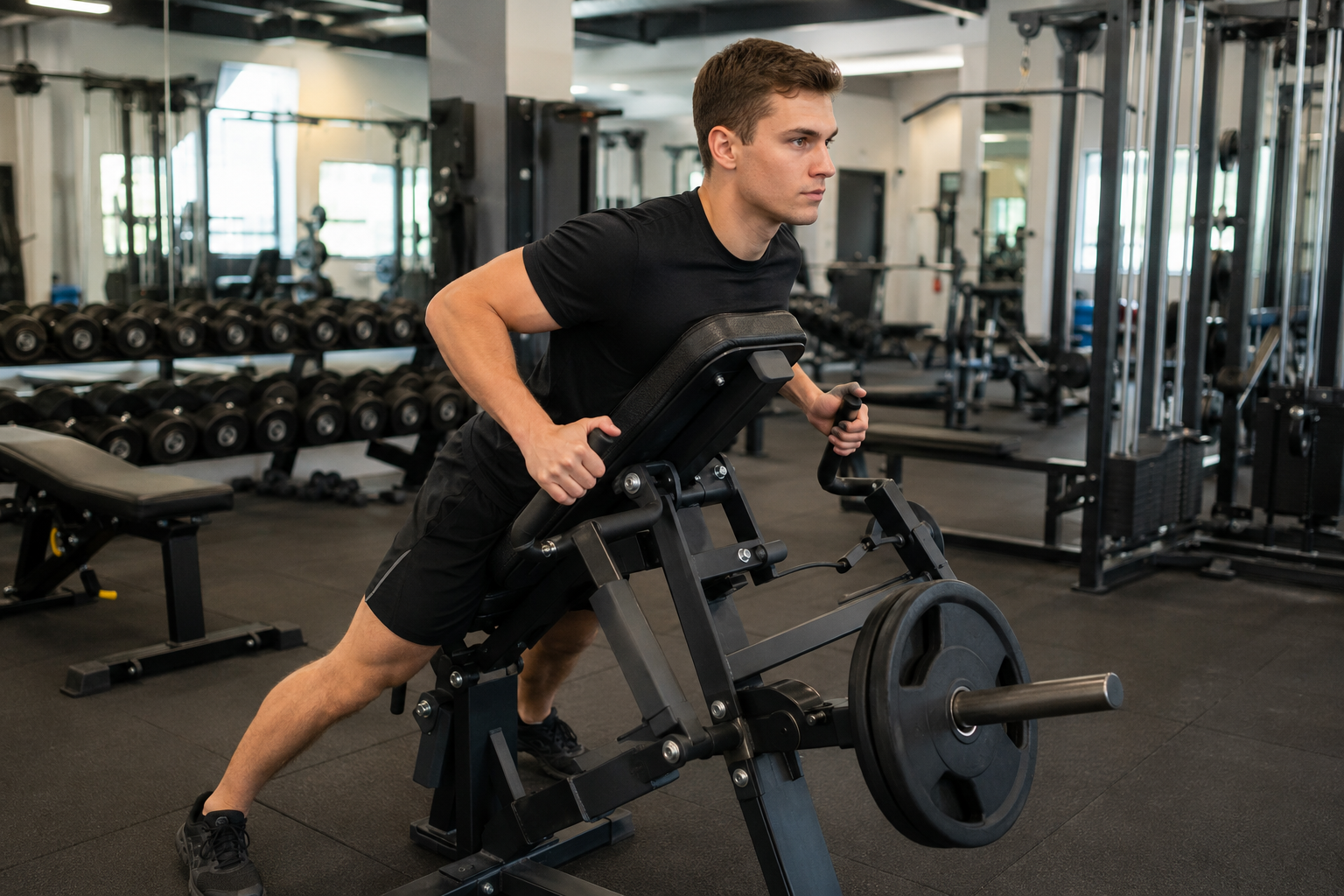
Machines can be especially useful for beginners because they often:
- Require less balance
- Are easier to set up
- Allow quick load adjustments
- Make it easier to focus on the target muscle
- Require fewer technical skills than some barbell lifts
That does not make machines automatically superior.
It simply makes them useful tools.
If you are unfamiliar with gym equipment, my Guide To Gym Machines For Beginners explains the basics in more detail.
3. Effort
Doing the exercises is not enough.
Your working sets eventually need to become challenging.
One useful way to measure that challenge is Reps in Reserve, or RIR.
RIR describes approximately how many technically acceptable repetitions you believe you could still perform before reaching muscular failure.
For example:
| RIR | Meaning |
|---|---|
| 4 RIR | About 4 good reps remained |
| 3 RIR | About 3 reps remained |
| 2 RIR | About 2 reps remained |
| 1 RIR | About 1 rep remained |
| 0 RIR | No additional complete rep was possible |
Another system you may see is RPE, or Rating of Perceived Exertion.
A rough relationship is:
- 3 RIR ≈ RPE 7
- 2 RIR ≈ RPE 8
- 1 RIR ≈ RPE 9
- 0 RIR ≈ RPE 10
Recent research suggests muscle growth generally increases as sets are taken closer to failure, but reaching absolute failure on every set is not required for hypertrophy.
For beginners, that makes 1–3 RIR a useful default.
You train hard enough for the set to matter while still leaving room to learn technique and manage fatigue.
4. Progressive Overload
Your muscles adapt to repeated stress.
That means the same challenge cannot remain equally challenging forever.
Progressive overload simply means that your training improves over time.
You might:
- Perform more repetitions with the same weight
- Lift slightly more weight
- Perform the same weight and reps with better control
- Use a larger comfortable range of motion
- Improve stability
- Complete the same workload at a more appropriate RIR
For beginners, the easiest form to track is usually double progression:
- Increase repetitions within a target range.
- Once you reach the top of that range across your working sets with good technique, increase the weight.
- Return toward the lower end of the rep range.
- Build upward again.
I will show you exactly how to do this later.
For a deeper explanation, see How To Implement Progressive Overload For Beginners.
5. Volume and Recovery
Volume describes how much training you perform.
In practical bodybuilding programming, one useful way to think about volume is the number of challenging working sets performed for a muscle each week.
More training is not automatically better.
Too little may provide an insufficient stimulus.
More productive sets can increase hypertrophy, but the benefit gradually diminishes while fatigue continues accumulating. Recent evidence continues to support a dose-response relationship between weekly resistance-training volume and muscle growth, while showing diminishing returns as volume becomes higher.
This program therefore starts conservatively.
A beginner does not need to immediately copy the volume of someone who has trained seriously for ten years.
You can build upward later if your progress and recovery justify it.
If you want to explore this topic separately, read Muscle Group Sets Per Week For Beginners.
Why This Plan Uses Three Full-Body Workouts
The weekly structure is:
- Monday — Full Body A
- Wednesday — Full Body B
- Friday — Full Body C
- Tuesday, Thursday, Saturday, Sunday — Rest or other appropriate activity
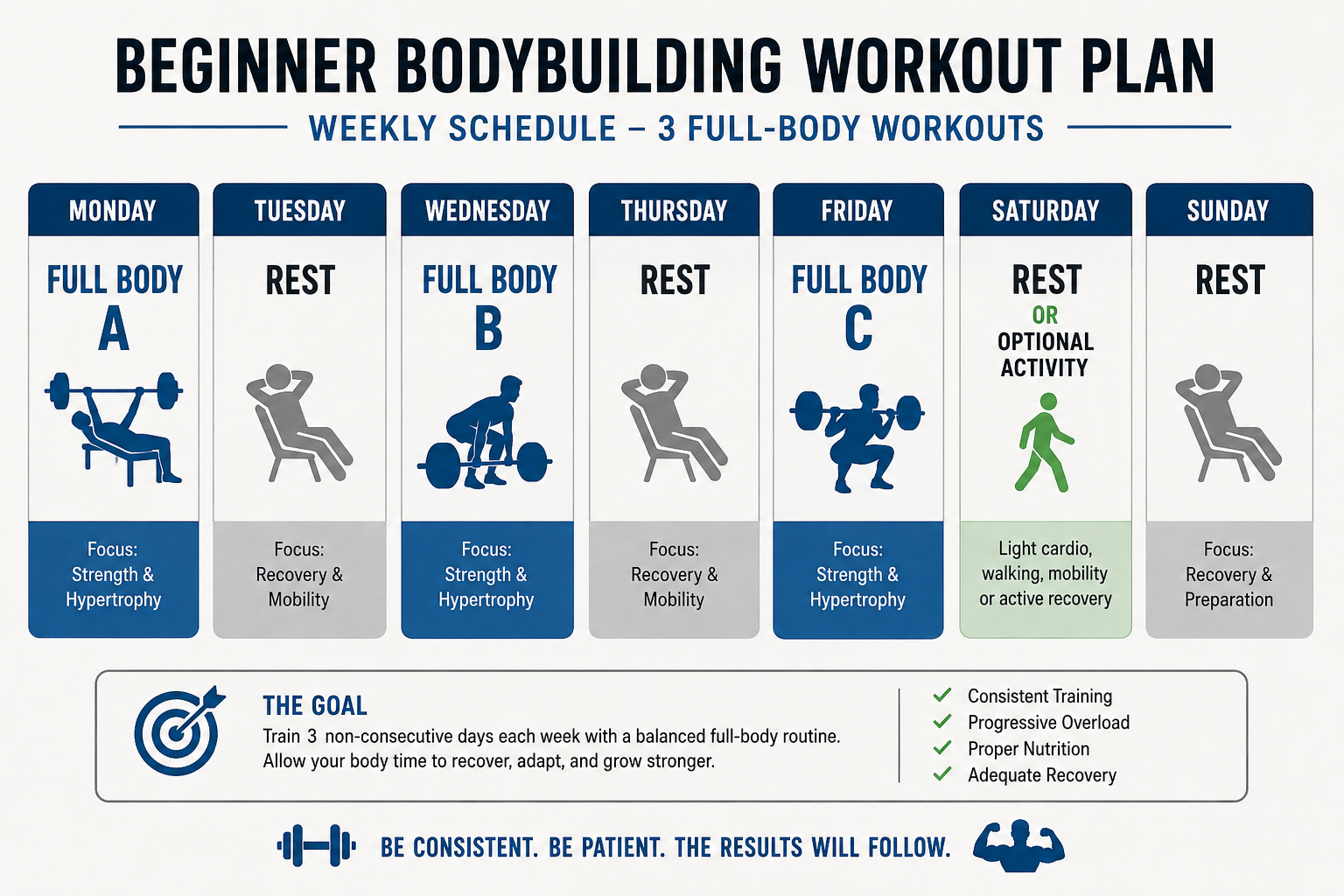
Those exact days are not mandatory.
You could instead use:
- Tuesday / Thursday / Saturday
- Sunday / Tuesday / Thursday
- Any arrangement that normally gives you a recovery day between resistance-training sessions
A three-day full-body structure is useful because it allows the week’s training to be spread across manageable sessions.
However, there is an important distinction:
Full-body training is not magically more hypertrophic than every split routine.
Research comparing full-body and split programs indicates that both can produce similar strength and muscle-growth outcomes when weekly volume is comparable.
Frequency appears to work largely as a tool for distributing volume. When weekly volume is controlled, simply increasing frequency does not consistently produce more hypertrophy.
So why choose full body here?
Because for a beginner it offers a practical combination of:
- Frequent practice of important movement patterns
- Manageable weekly scheduling
- Multiple opportunities to train each major muscle
- Rest days between sessions
- Easy adjustment if you miss a workout
- No need to dedicate an entire day to one body part
Later, if you prefer four training days, an upper/lower routine can work extremely well too.
See my 4 Day Workout Routine For Beginners and How To Choose A Workout Split For Beginners for those options.
12-Week Beginner Bodybuilding Workout Plan At a Glance
| Variable | Recommendation |
|---|---|
| Program length | 12 weeks |
| Training days | 3 days per week |
| Split | Full body |
| Main goal | Build a muscle-building foundation while improving strength and technique |
| Working sets | Usually 2–3 per exercise |
| Main rep ranges | Mostly 6–15 reps |
| Effort | Usually 1–3 RIR |
| Progression | Double progression |
| Compound rest | Usually 2–3+ minutes |
| Isolation rest | Usually 1–2+ minutes |
| Exercise changes | Keep exercises stable unless there is a reason to change |
| Advanced techniques | Not required |
| Nutrition | Calories appropriate for your goal + adequate protein |
| Recovery | Rest days, sleep, nutrition, hydration, fatigue management |
How to Read the Workout Tables
Each exercise includes several pieces of information.
Warm-Up Sets
These are lighter sets performed before your working sets.
They are not counted as working volume.
Their purpose is preparation.
Working Sets
These are the sets that actually count toward the program.
They should eventually become challenging enough to fall near the listed RIR target.
Repetition Range
If an exercise says 8–12 reps, you do not need to perform exactly 10.
Any number from 8 through 12 is acceptable if the set reaches approximately the intended effort level.
Early-Set and Last-Set RIR
The earlier sets are intentionally kept slightly farther from failure.
The final set may be somewhat harder.
For example:
2–3 RIR → 1–2 RIR
means:
- Early working sets: approximately 2–3 reps left
- Final working set: approximately 1–2 reps left
Rest Period
Rest long enough that your next set is limited mainly by the target muscles rather than by being out of breath.
The listed rest periods are starting points, not countdown clocks that force you to begin before you are ready.
Substitutions
You do not perform every exercise listed in the substitution column.
Choose the main exercise unless you have a reason to replace it.
Good reasons include:
- You do not have the equipment
- The movement consistently hurts despite reasonable technique adjustments
- The exercise does not fit your body well
- You strongly dislike it and another similar exercise improves adherence
- You have given the exercise a fair trial but cannot train the target muscle productively
Exercise video demonstrations: Each exercise and substitution marked with ▶ links to a demonstration showing how to perform the movement. If an exercise is unfamiliar to you, I recommend watching its demonstration before your warm-up sets so you can review the setup, range of motion, and basic execution. Use these videos as visual references alongside the technique notes in this program, and adjust exercises as needed for your anatomy, equipment, and comfort.
Warm-Up Protocol Before Each Workout
A warm-up should prepare you to train.
It should not become a workout before the workout.
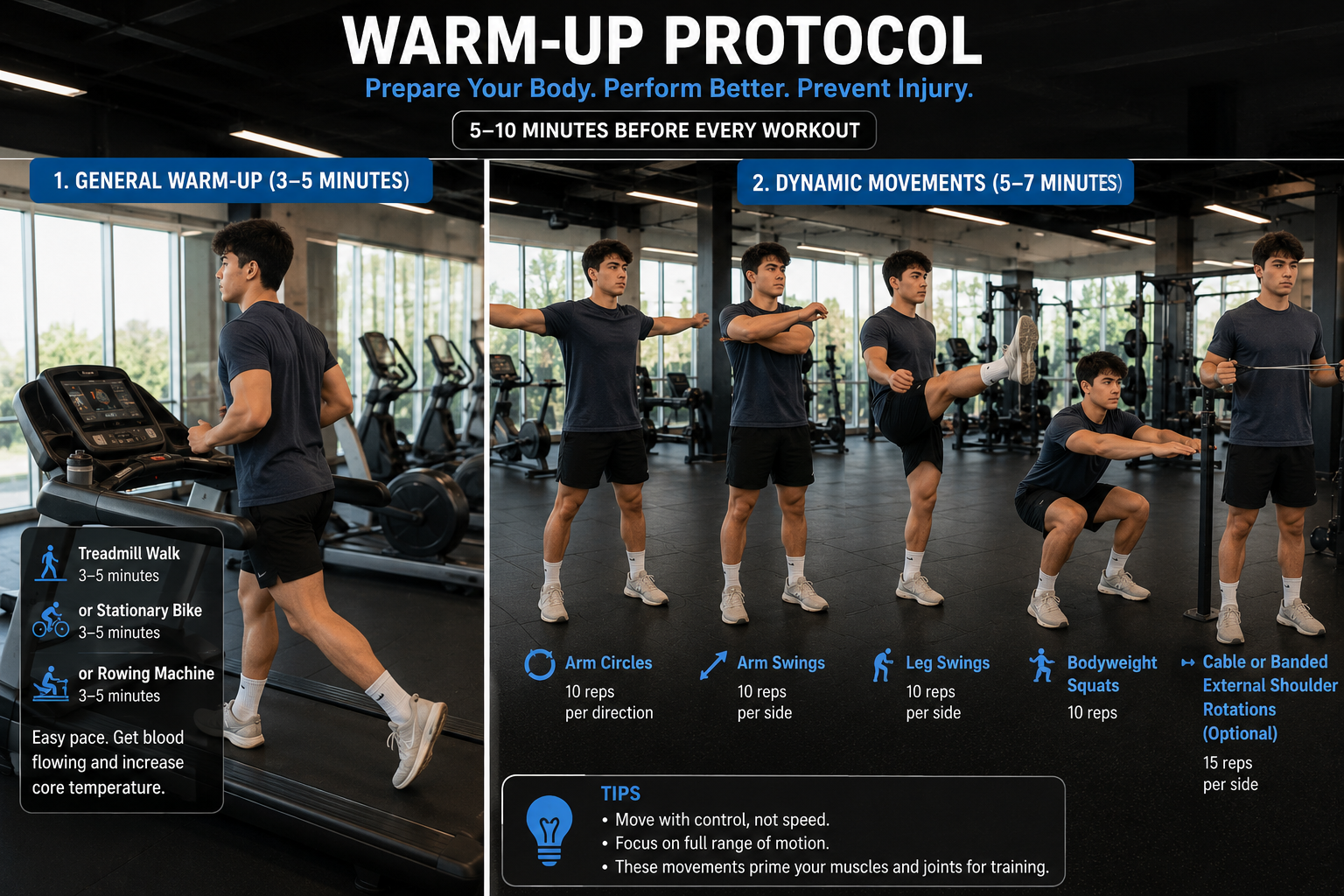
General Warm-Up
Spend roughly 5–10 minutes doing light activity such as:
- Treadmill walking
- Stationary cycling
- Elliptical
- Rowing
- Brisk walking
You can then use a few dynamic movements if they help you feel more prepared:
- Arm Circles ▶— 10 reps per side
- Arm swings ▶— 10 reps per side
- Front-to-Back Leg Swings ▶ — 10 reps per side
- Side-to-Side Leg Swings ▶— 10 reps per side
- Bodyweight Squats ▶— 10 reps
- Cable or Banded External Shoulder Rotations (optional) ▶ — 15 reps per side (optional)
Do not exhaust yourself.
You should feel warmer and more prepared — not fatigued.
For a complete breakdown, see How To Warm Up Before Lifting For Beginners.
Exercise-Specific Warm-Up Sets
A practical system is:
| Exercise Type | Warm-Up Approach |
|---|---|
| First heavy compound exercise | Usually 2–3 progressively heavier warm-up sets |
| Later compound exercise | Usually 1–2 warm-up sets |
| Familiar isolation exercise | Usually 0–1 warm-up set |
For example, if your planned working weight on the leg press is 200 pounds:
- Warm-up 1: about 100 pounds × 6–8 controlled reps
- Warm-up 2: about 140 pounds × 4–6 reps
- Warm-up 3: about 170 pounds × 2–4 reps if needed
- Working sets: 200 pounds
These percentages do not need to be perfect.
The important idea is:
As the weight gets heavier, the warm-up reps decrease.
You are preparing for the load without creating unnecessary fatigue.
Full Body Workout A
General warm-up: 5–10 minutes of light cardio and optional dynamic movement.
| Exercise | Warm-Up Sets | Working Sets | Reps | Early → Last Set RIR | Rest | Substitution Options |
|---|---|---|---|---|---|---|
| Leg Press ▶ | 2–3 | 3 | 6–10 | 2–3 → 1–2 | 2–3 min | Goblet Squat ▶/ Hack Squat ▶ |
| Machine Chest Press ▶ |
1–2 | 3 | 6–10 | 2–3 → 1–2 | 2–3 min | Dumbbell Bench Press ▶ / Barbell Bench Press ▶ |
| Chest-Supported Row ▶ | 1–2 | 3 | 8–12 | 2–3 → 1–2 | 2–3 min | Seated Cable Row ▶ / One-Arm Dumbbell Row ▶ |
| Seated Leg Curl ▶ | 1 | 2 | 10–15 | 2 → 1 | 1.5–2 min | Lying Leg Curl ▶ / Stability-Ball Leg Curl ▶ |
| Neutral/Close-Grip Lat Pulldown ▶ | 1 | 2 | 8–12 | 2 → 1 | 2 min | Assisted Pull-Up ▶ / Chin-Up ▶ |
| Dumbbell Lateral Raise ▶ | 0–1 | 2 | 12–20 | 2 → 1 | 1–2 min | Cable Lateral Raise ▶/ Machine Lateral Raise ▶ |
| Preacher Curl ▶ | 0–1 | 2 | 10–15 | 2 → 1 | 1–2 min | Dumbbell Curl ▶ / Cable Curl ▶ |
| Optional Standing Machine Calf Raise ▶ | 0–1 | 2 | 8–15 | 2 → 1 | 1–2 min | Leg-Press Calf Raise ▶ / Seated Calf Raise ▶ |
Workout A Technique Priorities
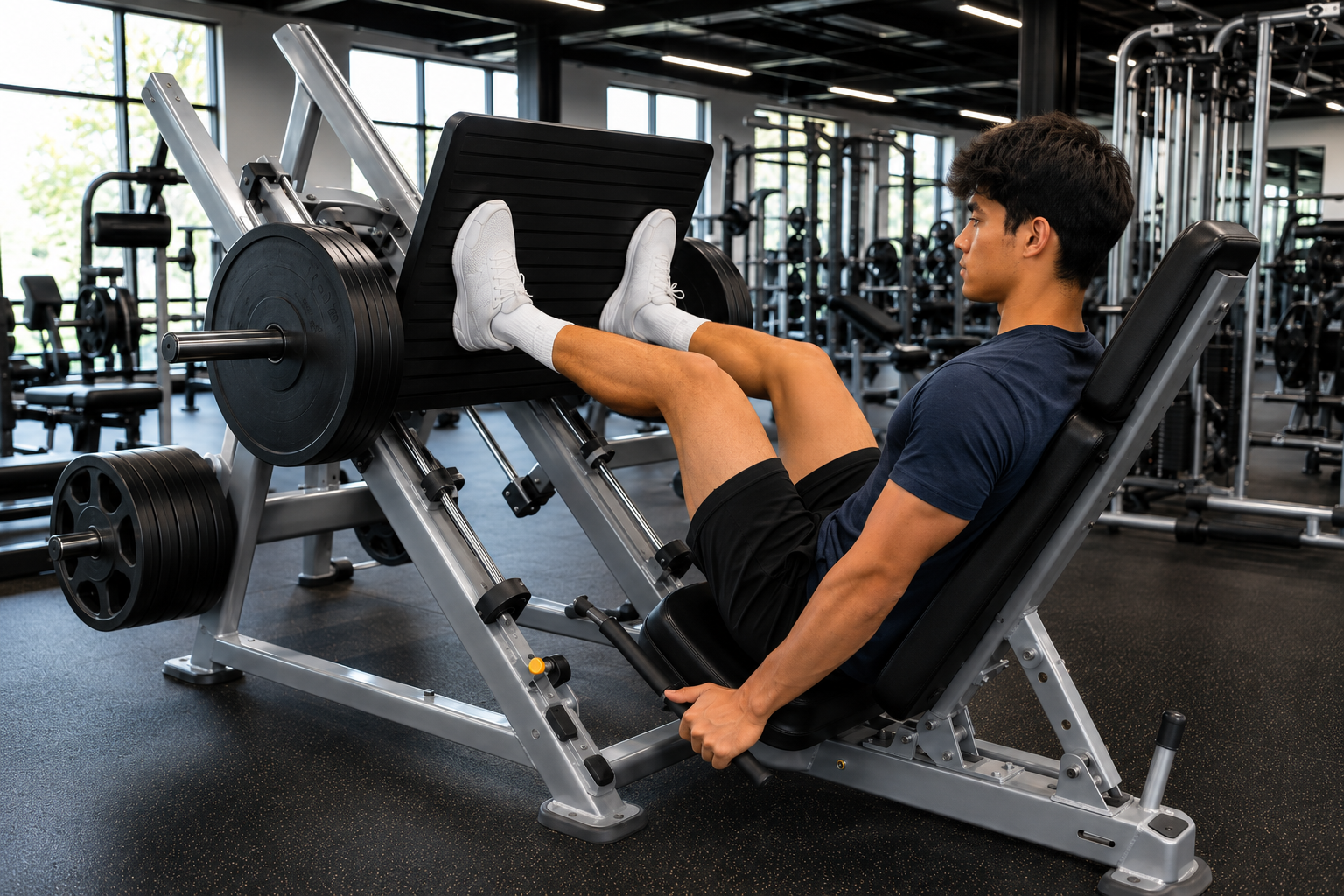
Leg Press: Set your feet where you can achieve a comfortable, controlled depth without your hips aggressively rolling off the pad. Lower the platform under control and push through the whole foot.
Machine Chest Press: Adjust the seat so the handles line up comfortably around mid-chest. Keep your shoulder blades stable against the pad and control the return.
Chest-Supported Row: Let your shoulder blades move naturally as you reach forward, then pull with your elbows while keeping your torso supported.
Seated Leg Curl: Control the stretch at the top and curl through the largest comfortable range you can maintain.
Lat Pulldown: Think about bringing your upper arms toward your sides rather than simply pulling the bar downward with your hands.
Lateral Raise: Use a weight light enough that your shoulders perform the work without excessive torso swinging.
Preacher Curl: Lower the weight under control and avoid aggressively bouncing out of the bottom position.
Full Body Workout B
General warm-up: 5–10 minutes of light cardio and optional dynamic movement.
| Exercise | Warm-Up Sets | Working Sets | Reps | Early → Last Set RIR | Rest | Substitution Options |
|---|---|---|---|---|---|---|
| Romanian Deadlift ▶ | 2–3 | 2 | 6–10 | 3 → 2 | 2–3+ min | Dumbbell Romanian Deadlift ▶ / Barbell Hip Thrust ▶ |
| Incline Dumbbell Press ▶ | 1–2 | 3 | 8–12 | 2–3 → 1–2 | 2–3 min | Incline Machine Press ▶ / Incline Barbell Press ▶ |
| Neutral/Close-Grip Lat Pulldown ▶ | 1 | 3 | 8–12 | 2–3 → 1–2 | 2–3 min | Assisted Pull-Up ▶ / Chin-Up ▶ |
| Leg Extension ▶ | 1 | 2 | 10–15 | 2 → 1 | 1.5–2 min | Leg Press ▶ / Goblet Squat ▶ |
| Machine Shoulder Press ▶ | 1 | 2 | 8–12 | 2 → 1 | 2 min | Seated Neutral-Grip Dumbbell Shoulder Press ▶ |
| Seated Cable Row ▶ | 1 | 2 | 8–12 | 2 → 1 | 2 min | Chest-Supported Row ▶ / Machine Row ▶ |
| Straight-Bar Cable Triceps Pressdown ▶ | 0–1 | 2 | 10–15 | 2 → 1 | 1–2 min | Dumbbell Skullcrusher ▶ / Cable Overhead Extension ▶ |
| Optional Cable Crunch ▶ | 0–1 | 2 | 10–15 | 2 → 1 | 1–2 min | Machine Crunch ▶ / Plank ▶ |
Workout B Technique Priorities
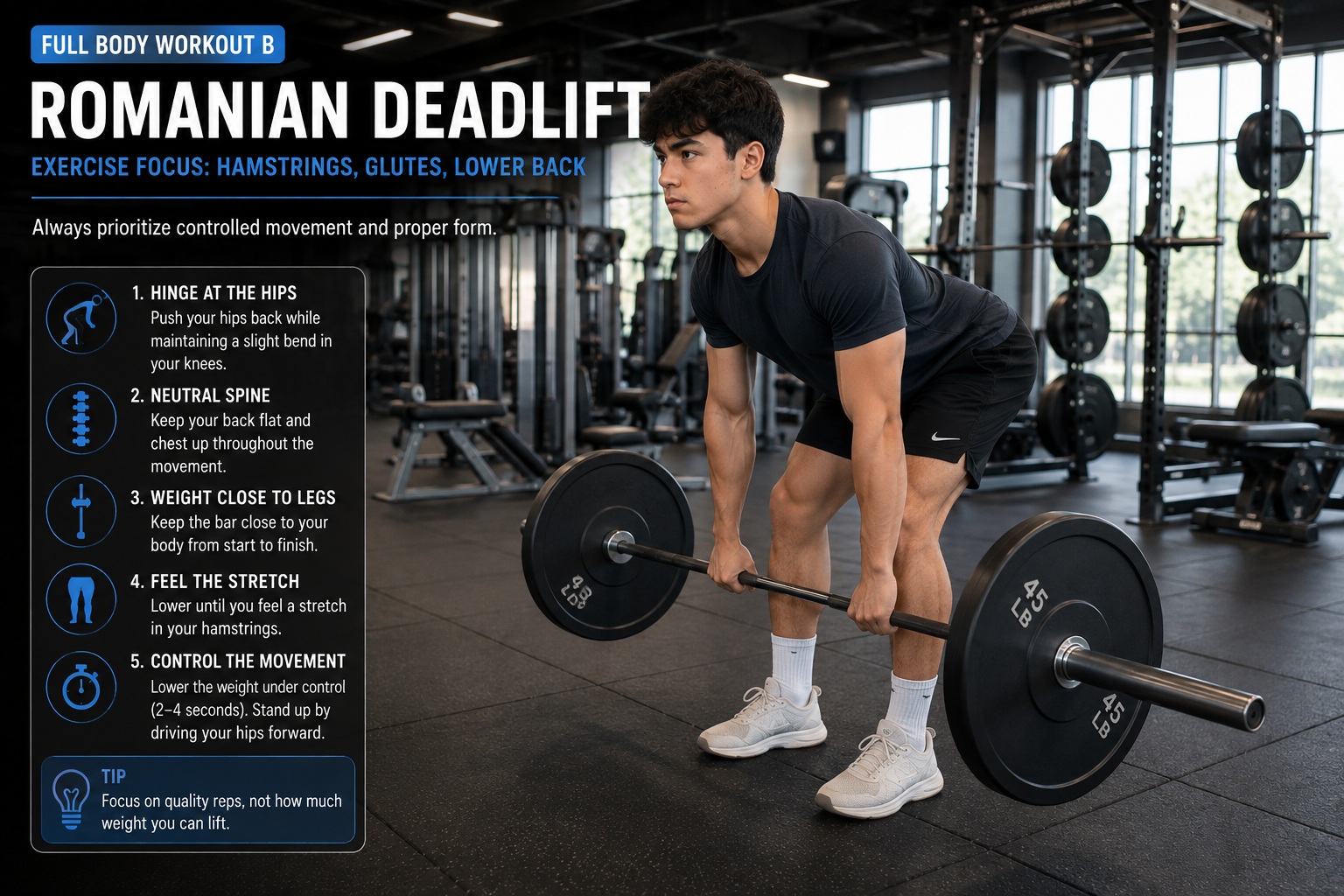
Romanian Deadlift: Keep the weight close to your legs, push your hips backward, and descend only as far as you can while maintaining control and a stable trunk. The goal is a strong hamstring stretch — not reaching the floor.
Because Romanian deadlifts can create substantial fatigue and soreness, they are intentionally kept farther from failure than small isolation movements.
Incline Dumbbell Press: Use a moderate incline rather than turning the exercise into a nearly vertical shoulder press. Lower the dumbbells under control.
Lat Pulldown: Use a grip that feels comfortable and allows a full, controlled repetition without excessive body swinging.
Leg Extension: Adjust the machine so your knee is aligned comfortably with its pivot. Lift and lower the weight deliberately rather than kicking it.
Machine Shoulder Press: Keep your torso supported and use a range of motion your shoulders tolerate comfortably.
Seated Cable Row: Avoid turning each repetition into a large torso swing. Let the back muscles lengthen and then pull deliberately.
Triceps Pressdown: Keep the upper arm relatively stable and focus on extending the elbow rather than throwing your body into the movement.
Full Body Workout C
General warm-up: 5–10 minutes of light cardio and optional dynamic movement.
| Exercise | Warm-Up Sets | Working Sets | Reps | Early → Last Set RIR | Rest | Substitution Options |
|---|---|---|---|---|---|---|
| Hack Squat ▶ | 2–3 | 3 | 6–10 | 2–3 → 1–2 | 2–3 min | Leg Press ▶ / Goblet Squat ▶ |
| Machine Chest Press ▶ | 1–2 | 3 | 8–12 | 2–3 → 1–2 | 2–3 min | Dumbbell Bench Press ▶ / Push-Up ▶ |
| Chest-Supported Row ▶ | 1 | 3 | 8–12 | 2–3 → 1–2 | 2–3 min | Machine Row ▶ / Cable Row ▶ |
| Seated Leg Curl ▶ | 1 | 2 | 10–15 | 2 → 1 | 1.5–2 min | Lying Leg Curl ▶/ Nordic Curl Regression ▶ / Stability-Ball Curl ▶ |
| Dumbbell Lateral Raise ▶ | 0–1 | 2 | 12–20 | 2 → 1 | 1–2 min | Cable Lateral Raise ▶/ Machine Lateral Raise ▶ |
| EZ-Bar Preacher Curl ▶ | 0–1 | 2 | 10–15 | 2 → 1 | 1–2 min | Cable Curl ▶ / Dumbbell Curl ▶ |
| Overhead Cable Triceps Extension ▶ | 0–1 | 2 | 10–15 | 2 → 1 | 1–2 min | Pressdown ▶ / Dumbbell Overhead Extension ▶ |
| Optional Seated Calf Raise ▶ | 0–1 | 2 | 10–15 | 2 → 1 | 1–2 min | Standing Machine Calf Raise▶ / Leg-Press Calf Raise ▶ |
Workout C Technique Priorities
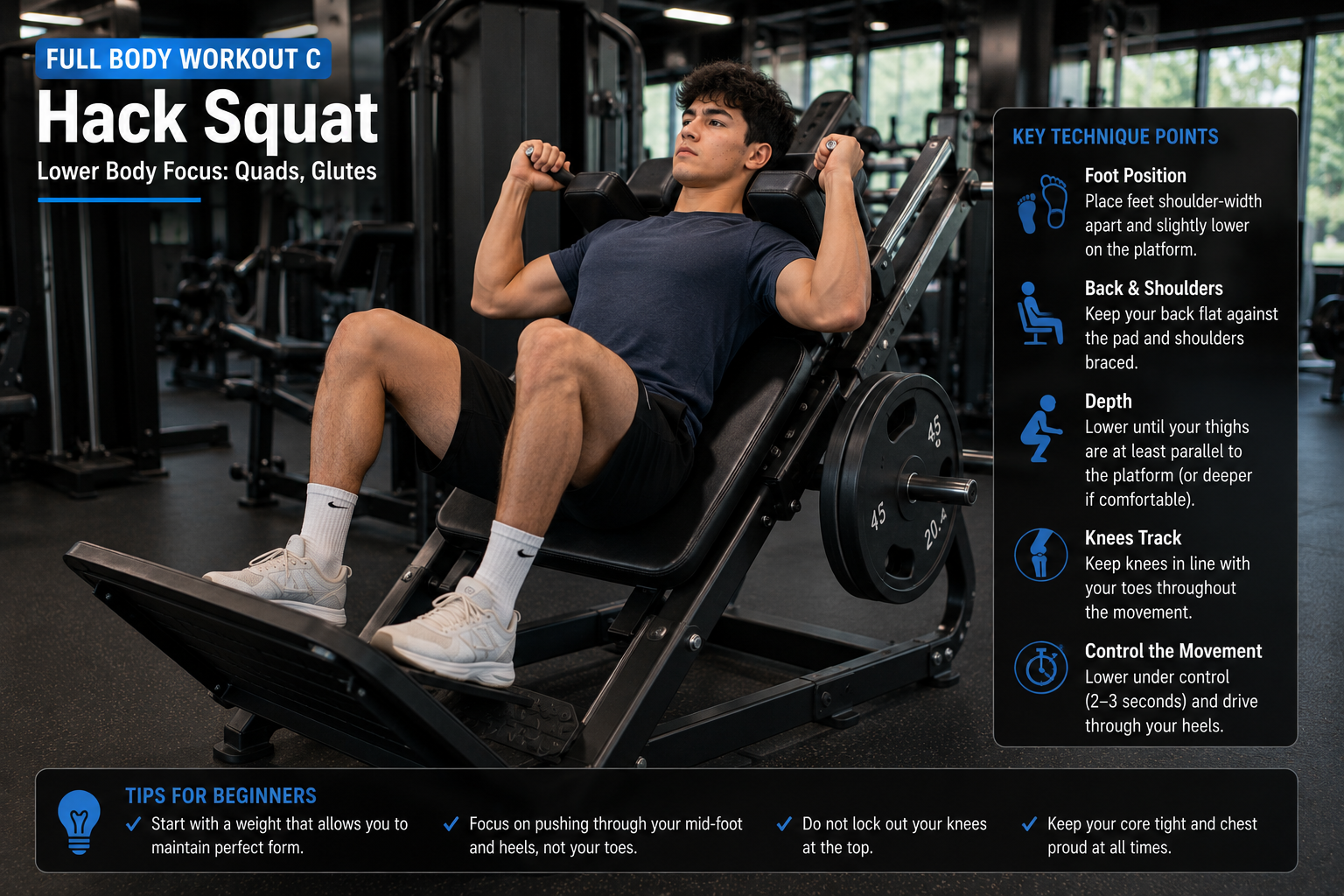
Hack Squat: Use the deepest range you can comfortably control while keeping your feet stable on the platform.
Machine Chest Press: Use the same setup from Workout A whenever possible. Consistency makes progression easier to measure.
Chest-Supported Row: Keep the movement repeatable. If you progressively shorten the range of motion every time you add weight, your logbook becomes misleading.
Leg Curl: Avoid rushing through the stretched position. Maintain tension through the repetition.
Lateral Raise: Think smooth and controlled rather than heavy.
Curl: Keep the shoulder and torso reasonably stable so the biceps remain responsible for most of the movement.
Overhead Triceps Extension: Use a comfortable shoulder position and allow the triceps to lengthen before extending the elbow.
What About Barbell Squats, Bench Presses, and Deadlifts?
You absolutely can use them.
They simply are not mandatory for bodybuilding.
If your main goal is gaining muscle, the exercise is a tool — not a test of whether you are a “real lifter.”
A barbell squat can build muscle.
A hack squat can build muscle.
A leg press can build muscle.
The best choice depends on:
- Your goals
- Your equipment
- Your anatomy
- Your technique
- Your comfort
- Your ability to progressively train the movement
If becoming stronger specifically at barbell squats, bench presses, or deadlifts matters to you, then practicing those movements becomes more important because strength adaptations are exercise-specific.
If muscle growth is the priority, you have much more flexibility.
For additional exercise options, see Beginner Bodybuilder Exercises: The Best Starter List For Muscle Growth.
How To Choose Your Starting Weight
Do not choose your starting weight based on what someone your size “should” lift.
Choose it based on the effort target.
Suppose the program says:
Machine Chest Press — 3 × 6–10 — 2–3 RIR → 1–2 RIR
Start conservatively.
If you perform:
- Set 1: 10 reps and could have done 8 more
- Set 2: 10 reps and could have done 7 more
- Set 3: 10 reps and could have done 6 more
the load is probably too light for a normal working set.
Increase it next time.
If instead you perform:
- Set 1: 7 reps and barely finish
- Set 2: 5 reps
- Set 3: 4 reps with deteriorating technique
the weight is too heavy.
Reduce it.
A useful beginner starting weight lets you enter the prescribed rep range while finishing with approximately the recommended RIR.
Do not worry if your estimate is imperfect.
RIR is a skill.
You become better at judging it with practice.
Your First Two Weeks Should Be Easier
The RIR targets in the workout tables are where the program eventually settles.
During Weeks 1–2, be more conservative.
Add roughly one extra repetition in reserve to most sets.
For example:
If the table says:
2–3 RIR → 1–2 RIR
use approximately:
3–4 RIR → 2–3 RIR
during the first week or two.
Why?
Because your first goal is not demonstrating how hard you can train.
It is learning:
- Exercise setup
- Technique
- Range of motion
- Appropriate load selection
- How different RIR levels feel
- How well you recover between workouts
You have eleven more weeks to train hard.
There is no prize for creating extreme soreness during Week 1.
Progressive Overload: Exactly How To Progress
The main progression system in this plan is double progression.
Suppose an exercise calls for:
3 sets × 8–12 reps
You select 50 pounds.
Your logbook might look like this:
| Workout | Weight | Set 1 | Set 2 | Set 3 |
|---|---|---|---|---|
| Week 1 | 50 lb | 9 | 8 | 8 |
| Week 2 | 50 lb | 10 | 9 | 8 |
| Week 3 | 50 lb | 11 | 10 | 9 |
| Week 4 | 50 lb | 12 | 11 | 10 |
| Week 5 | 50 lb | 12 | 12 | 11 |
| Week 6 | 50 lb | 12 | 12 | 12 |
| Next session | 55 lb | Return toward 8 reps |
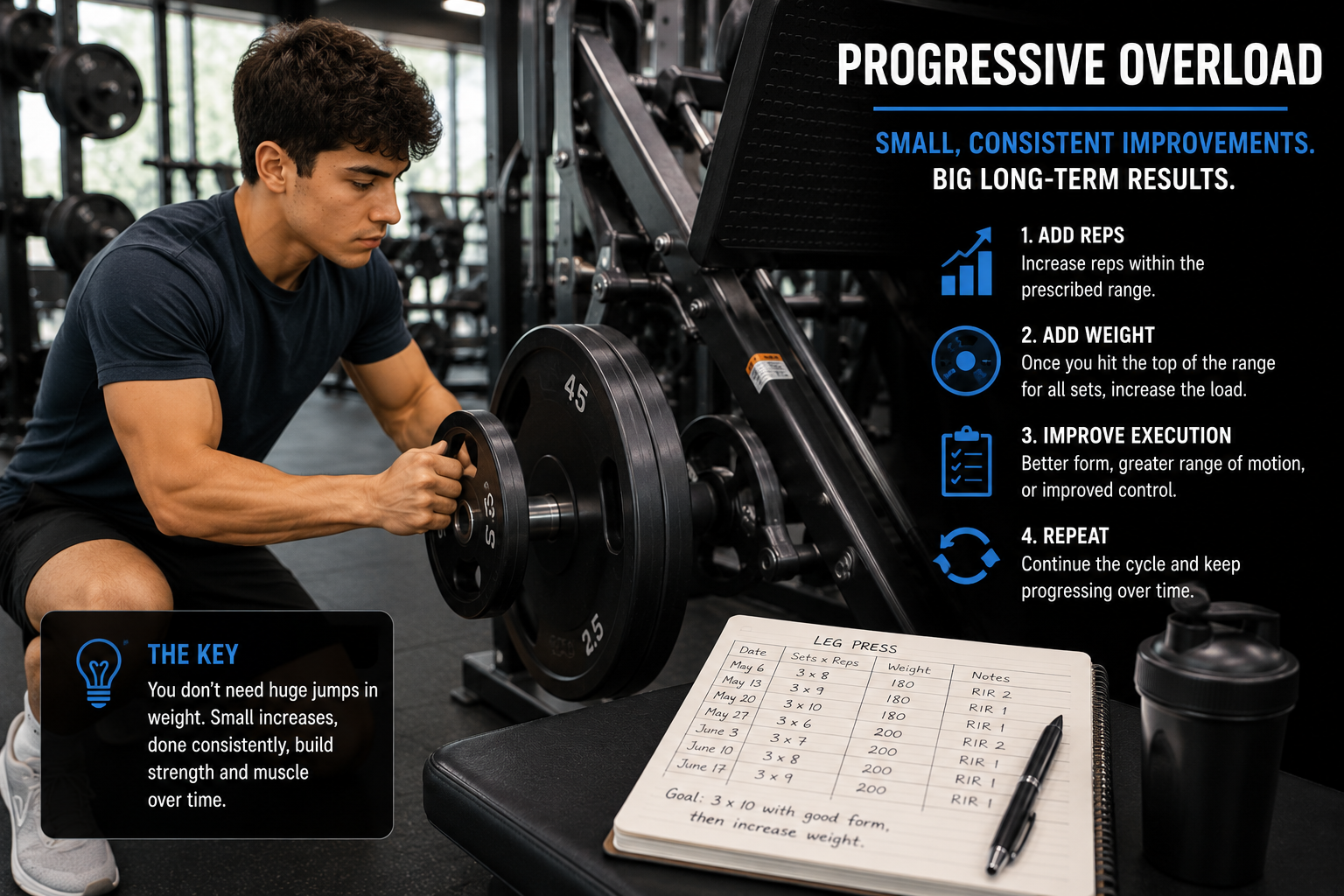
Once you can reach the top of the range across your working sets while still meeting the technique and RIR targets, increase the load by the smallest practical amount.
Then build back up.
Do Not Force Progress Every Workout
Progressive overload does not mean:
You must add weight every time you enter the gym.
Some weeks you may:
- Repeat the same performance
- Add one rep to one set
- Perform the same reps with better technique
- Achieve a better range of motion
- Make the same weight feel more controlled
All of those can represent progress.
Training performance also fluctuates because of:
- Sleep
- Stress
- Food intake
- Hydration
- Schedule changes
- Illness
- Normal day-to-day variation
Judge progress across several weeks rather than panicking after one ordinary workout.
The Complete 12-Week Progression
Weeks 1–2: Learn
Your priorities are:
- Learn the exercises
- Establish comfortable technique
- Find appropriate starting loads
- Begin recording workouts
- Stay farther from failure
- Avoid excessive soreness
Think:
Practice first. Performance second.
Weeks 3–4: Establish Your Baseline
Now begin using the regular RIR targets.
Your goal is to establish repeatable working numbers.
You should begin learning:
- What 3 RIR feels like
- What 2 RIR feels like
- Whether your chosen exercises fit you
- Which loads keep you inside the intended rep ranges
- How your body responds to the weekly volume
Weeks 5–8: Build Momentum
This is where the training becomes more productive.
Keep the exercises stable and focus on:
- Adding repetitions
- Adding load when appropriate
- Maintaining technique as loads increase
- Training consistently within approximately 1–3 RIR
- Recovering between sessions
You do not need:
- Drop sets
- Forced reps
- Myo-reps
- Rest-pause training
- Cheat reps
- Complex intensity techniques
Those strategies can have legitimate uses later.
Right now they would make a simple progression problem more complicated than necessary.
Weeks 9–11: Continue Progressing While Watching Fatigue
At this point, your technique should feel more automatic.
Continue progressing, but pay attention to recovery.
Good signs include:
- Reps or loads gradually increasing
- Stable or improving technique
- Normal motivation to train
- Soreness resolving before the next session
- Stable sleep
- No persistent joint pain
Potential fatigue warning signs include several of the following occurring together:
- Performance repeatedly declining
- Persistent soreness
- Unusual fatigue
- Joint aches that do not settle
- Sleep getting worse
- Low motivation
- Previously manageable weights suddenly feeling unusually difficult
One bad workout does not mean you need a deload.
Look for a pattern.
Week 12: Consolidate and Evaluate
Do not turn Week 12 into a reckless max-out week.
Your goal is to compare yourself with Week 1.
Ask:
- Am I using more weight?
- Am I performing more reps?
- Is my technique more consistent?
- Can I judge RIR more accurately?
- Do I understand gym equipment better?
- Have I trained consistently?
- Are my measurements or photos changing?
- Do I recover better?
- Have I built a routine I can continue?
That is a successful first 12 weeks.
Do Beginners Need To Train to Failure?
No.
Failure means attempting another repetition and being unable to complete it with acceptable technique.
You can build muscle without reaching that point on every set.
Research shows an important distinction:
Proximity to failure matters, but absolute failure is not automatically necessary.
Training closer to failure tends to support hypertrophy, but analyses directly comparing failure with non-failure training have not consistently shown that failure is superior.
That is why this program centers most sets around 1–3 RIR.
Later, once you have reliable technique, taking the occasional final set of a low-risk isolation movement to approximately 0–1 RIR can be reasonable.
Examples might include:
- Lateral raises
- Curls
- Triceps pressdowns
- Leg extensions
- Certain machine exercises
That is different from taking every Romanian deadlift, squat, or free-weight press to complete failure.
For a detailed explanation, see How Hard Should Beginners Train For Muscle Growth?.
Rep Ranges: Do You Have To Train in the 8–12 Rep “Hypertrophy Range”?
No.
Muscle can grow across a broad range of loads when sets are sufficiently challenging.
Research comparing different loading ranges shows similar hypertrophy can occur across light, moderate, and heavy resistance-training loads, although heavier loads have an advantage for maximizing one-repetition-maximum strength.
So why does this program mostly use 6–20 reps?
Because those ranges are practical.
Extremely heavy sets can require more preparation and place greater technical demands on beginners.
Extremely light sets may require very high repetitions and considerable discomfort before approaching failure.
Moderate rep ranges give you a useful middle ground.
This program generally uses:
- 6–10 reps: larger compound exercises
- 8–12 reps: many compound and machine exercises
- 10–15 reps: isolation work
- 12–20 reps: movements such as lateral raises
Those numbers are tools, not magical boundaries.
For more detail, see Beginner Weight Training Sets And Reps.
How Long Should You Rest Between Sets?
Do not rush your rest periods simply because short rest “feels more intense.”
The goal is not to become maximally tired.
The goal is to perform productive resistance-training sets.
A 2024 systematic review and Bayesian meta-analysis found a small potential hypertrophy advantage for resting longer than 60 seconds, while detecting little additional hypertrophy difference once rests were longer than roughly 90 seconds. Longer rests may also help preserve repetition performance across sets.
A practical starting point is:
Large Compound Exercises
Rest around 2–3 minutes, and longer when necessary.
Examples:
- Leg press
- Hack squat
- Romanian deadlift
- Chest press
- Heavy rows
- Heavy pulldowns
Smaller Isolation Exercises
Rest around 1–2 minutes.
Examples:
- Curls
- Triceps extensions
- Lateral raises
- Leg extensions
- Calf raises
If you still feel out of breath or clearly unable to repeat a high-quality effort, rest longer.
Your timer serves you.
You do not serve the timer.
For a full explanation, see How To Structure Workout Rest Periods.
How Fast Should You Perform Each Rep?
You do not need to turn every repetition into an exact four-second eccentric and one-second concentric.
Research has found hypertrophy across a fairly broad range of repetition durations, and the latest ACSM review did not find time under tension to consistently determine training outcomes.
For beginners, a better cue is:
Control the weight rather than intentionally moving it as slowly as possible.
A useful general approach is:
- Lower the weight deliberately
- Avoid uncontrolled dropping or bouncing
- Reach a comfortable range of motion
- Reverse direction under control
- Lift with strong intent while maintaining technique
On many exercises, roughly two seconds on the lowering phase will naturally accomplish this without needing a stopwatch.
Range of Motion: How Deep Should You Go?
Use the largest comfortable, controlled, repeatable range of motion appropriate for the exercise.
Full range of motion is a strong default, particularly while you are learning movement skills.
Research has generally supported full-range training over shortened partial ranges for lower-body hypertrophy, while newer research has also created interest in training muscles at longer lengths.
For a beginner, you do not need to turn that debate into another source of confusion.
Use a range where:
- The joint feels comfortable
- You maintain control
- The target muscle is meaningfully loaded
- Your technique remains repeatable
- You are not forcing range simply to reach an arbitrary depth
Do not sacrifice control to chase the deepest possible repetition.
How Much Weekly Volume Does This Program Provide?
The exact number depends on how you count indirect work.
For example:
A chest press directly trains the chest but also meaningfully involves the triceps and anterior deltoids.
A row directly trains the back while involving the biceps.
A leg press trains the quadriceps while also involving the glutes.
This program deliberately begins with moderate weekly volume rather than immediately forcing every muscle to receive enormous amounts of direct isolation work.
That gives you room to progress.
Recent evidence suggests hypertrophy generally benefits from more weekly training volume, with diminishing returns as more sets are added. The 2026 ACSM position stand reported greater hypertrophy with higher weekly volumes, including approximately 10 or more sets per muscle per week in the evidence they synthesized.
However, that does not mean every beginner should immediately perform 15–20 direct sets for every muscle.
Your compounds contribute work too.
The right starting dose is the amount from which you can:
- Recover
- Progress
- Maintain technique
- Remain consistent
After several weeks, additional volume can be added selectively if needed.
Do not add five new exercises because you had one disappointing session.
Should You Add Sets During the 12 Weeks?
Not automatically.
First, progress the program as written.
After roughly 4–6 weeks, consider adding one working set to one exercise for a priority muscle only if:
- You are recovering easily
- Soreness is manageable
- Performance is progressing
- Workouts are not becoming excessively long
- You want more emphasis on that muscle
For example, if your side delts are a major priority and two sets of lateral raises feel extremely manageable, you might eventually move one session from two sets to three.
Do not increase everything simultaneously.
More training only helps when you can recover from it.
When Should You Change an Exercise?
Exercise novelty is not progressive overload.
If an exercise:
- Feels comfortable
- Trains the intended muscles
- Is available consistently
- Allows measurable progression
- Does not create persistent pain
keep using it.
Eight to twelve weeks is perfectly reasonable for a beginner to retain the same core exercises.
Consider changing an exercise when:
- Equipment is unavailable long term
- The exercise repeatedly causes discomfort
- Your technique never feels stable despite practice
- You strongly dislike it and adherence is suffering
- A similar movement clearly fits you better
- Progress has genuinely stalled after reasonable troubleshooting
Do not replace an exercise simply because social media introduced a newer variation.
What If the Gym Is Busy?
You have several options:
- Wait briefly.
- Perform the next exercise and return later.
- Use one of the listed substitutions.
Your routine does not stop working because exercises appear in a slightly different order.
Exercise-order research suggests strength improvements tend to be greatest for exercises performed earlier in the workout, while hypertrophy appears less dependent on exercise order.
So place your highest-priority movements early when practical, but remain flexible enough to train in a real gym.
What If You Miss a Workout?
Do not restart the week.
Do not punish yourself with a double workout.
Continue the sequence.
Suppose your normal schedule is:
- Monday — A
- Wednesday — B
- Friday — C
You complete A on Monday but miss Wednesday.
If Friday is your next available day, perform B.
Then continue with C during your next session.
Think of the workouts as a repeating sequence:
A → B → C → A → B → C
rather than a test of whether every calendar week is perfect.
Consistency over months matters much more than one disrupted Wednesday.
Do You Need a Deload Every 6–8 Weeks?
Not necessarily.
This is another area where the old version of this article was too rigid.
A true beginner may progress for months without requiring a scheduled deload.
Instead, use fatigue as your guide.
Consider an easier week when several warning signs occur together and do not resolve after normal rest:
- Persistent performance decline
- Unusually high fatigue
- Persistent muscle soreness
- Joint aches
- Sleep disruption
- Loss of motivation to train
- Normal working weights feeling consistently abnormal
Simple Deload Option
For approximately one week:
- Reduce working sets by roughly 30–50%
- Use somewhat lighter weights if helpful
- Stay around 3–4+ RIR
- Avoid failure
- Focus on smooth technique
Then return to normal training.
A deload is not a punishment and it does not erase your progress.
It is simply one method of reducing accumulated fatigue.
How To Track Your Workouts
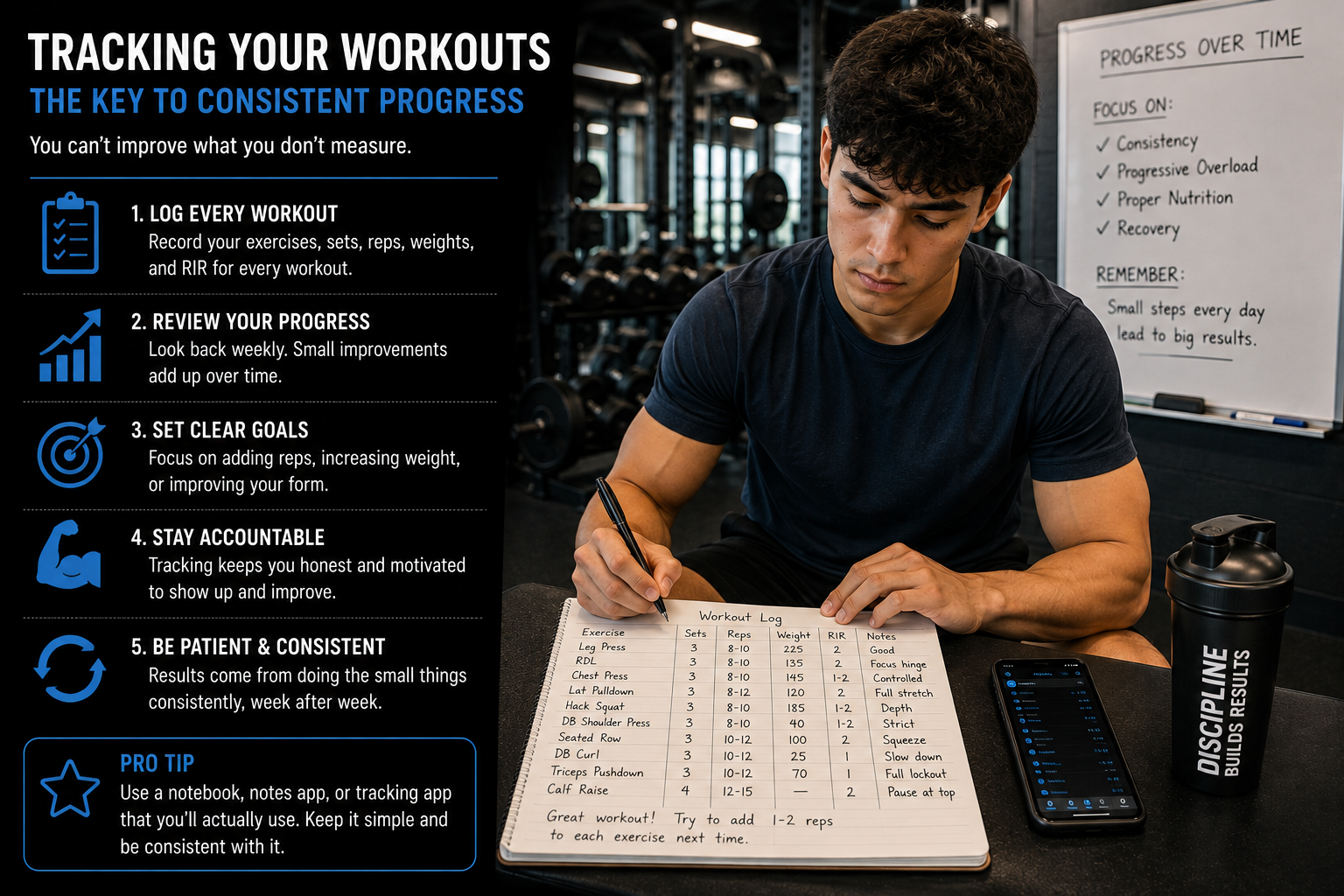
If you want to know whether progressive overload is happening, keep a logbook.
For every exercise, record:
- Weight
- Repetitions for each set
- Number of working sets
- Estimated RIR
- Any important technique note
- Exercise substitution if one was used
Example:
| Exercise | Weight | Set 1 | Set 2 | Set 3 | RIR | Notes |
|---|---|---|---|---|---|---|
| Leg Press | 180 lb | 10 | 9 | 8 | 2 / 2 / 1 | Good depth |
| Chest Press | 90 lb | 10 | 10 | 9 | 2 / 2 / 1 | Add reps next session |
| Row | 80 lb | 12 | 11 | 10 | 2 / 2 / 1 | Keep torso against pad |
Without a logbook, it is easy to feel as if you are progressing while repeatedly doing the same workload.
The numbers give you evidence.
How To Track Muscle-Building Progress Outside the Gym
Scale weight alone cannot tell you whether you gained muscle.
Bodyweight fluctuates because of:
- Water
- Carbohydrate intake
- Sodium
- Food volume
- Bathroom habits
- Menstrual-cycle changes
- Stress
- Hydration
Use several indicators together.
1. Training Performance
Are you gradually improving reps, load, or execution?
That is one of your most useful signals.
2. Bodyweight Trend
If you weigh yourself, compare weekly averages rather than reacting emotionally to individual days.
3. Progress Photos
Use:
- Similar lighting
- Similar distance
- Similar poses
- Similar time of day
Take them every few weeks rather than judging yourself in the mirror every day.
4. Measurements
Useful measurements may include:
- Waist
- Upper arm
- Chest
- Thigh
- Calf
Keep the measurement location consistent.
5. Clothing Fit
Changes in how shirts fit through the shoulders or how pants fit through the legs and waist can provide another clue.
No single measurement is perfect.
Look for trends across several indicators.
Nutrition for Beginner Bodybuilding
Training provides the stimulus.
Your diet provides the materials and energy needed to support adaptation.
Nutrition does not need to become a second full-time job.
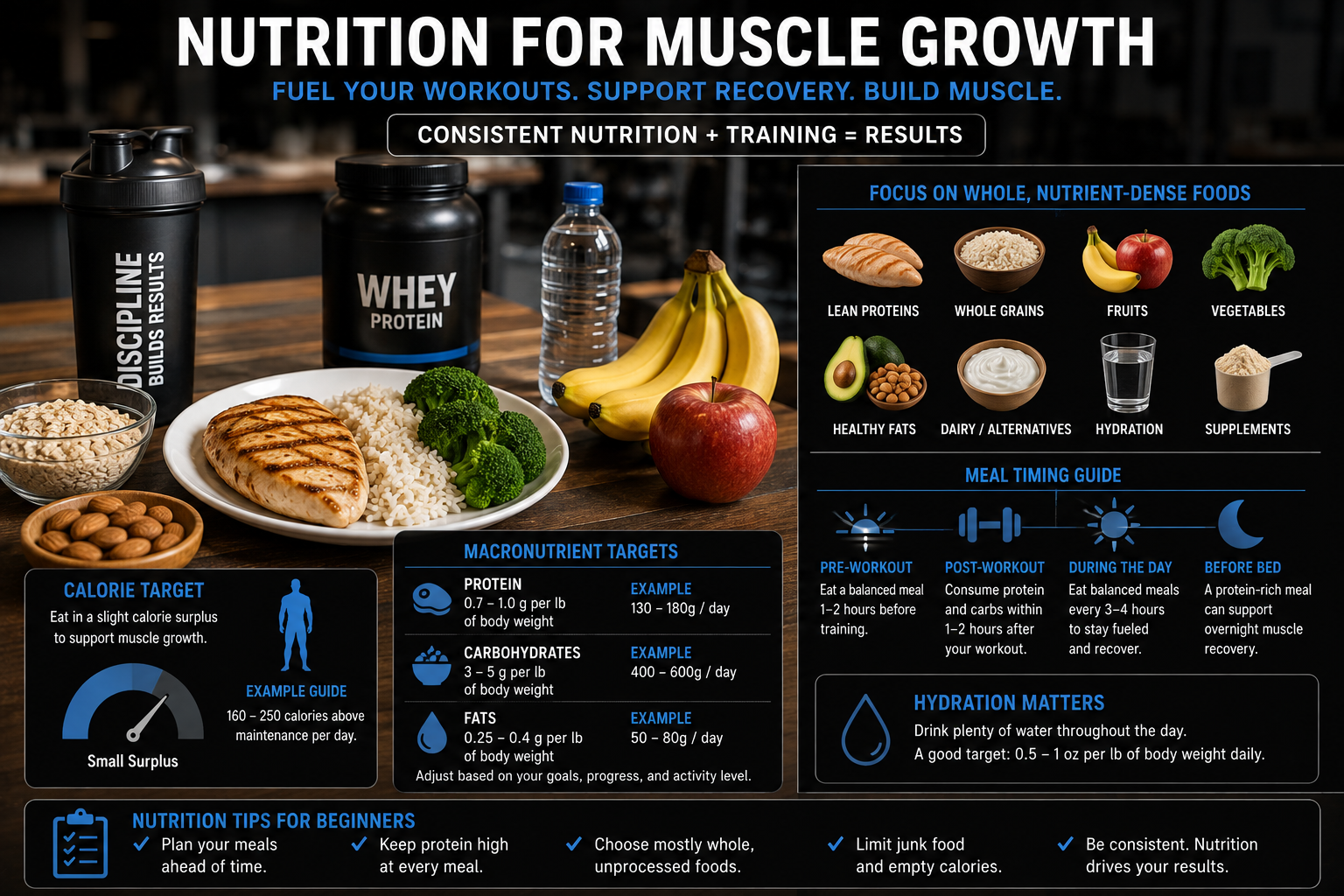
Your main priorities are:
- Appropriate calories
- Adequate protein
- Enough dietary fat
- Enough carbohydrate to support training and preference
- A generally nutritious diet you can maintain
For a complete nutrition breakdown, see my Muscle Building Nutrition Guide For Beginners.
Calories: Bulk, Maintain, Cut, or Recomp?
There is no single calorie target appropriate for every beginner.
Choose based on your starting point and goal.
If Your Main Goal Is Maximizing Muscle Gain
A small calorie surplus is more sensible than an aggressive bulk.
Evidence-based bodybuilding nutrition reviews have commonly recommended modest surpluses and relatively slow rates of weight gain to promote muscle growth while limiting unnecessary fat gain.
A practical starting point may be roughly 5–15% above maintenance, then adjust according to your weekly weight trend, waist measurement, performance, and appearance.
More calories do not automatically force muscle to grow faster.
Once energy needs are covered, increasingly large surpluses tend to produce increasingly unnecessary weight gain.
If You Want To Build Muscle While Losing Fat
Body recomposition is possible.
It is particularly realistic for:
- Beginners
- People returning after detraining
- People carrying more body fat
- People significantly improving previously poor training or nutrition
You may be able to train around maintenance calories or a modest deficit while gaining muscle and reducing fat.
A recent 2026 controlled study also found improvements in fat-free mass during both maintenance-calorie and moderate-deficit high-protein conditions combined with resistance training, illustrating that muscle gain and fat loss are not always mutually exclusive.
Do not assume you must bulk simply because you started lifting.
If Fat Loss Is the Main Goal
Use a controlled calorie deficit rather than a crash diet.
Continue resistance training and keep protein high.
The larger and more aggressive the deficit becomes, the harder it generally becomes to maintain training performance and lean tissue.
If you need help estimating intake, read How Many Calories Should Beginners Eat To Build Muscle?.
Protein: How Much Do Beginners Need?
A strong practical target is approximately:
0.7–1.0 grams of protein per pound of bodyweight per day
or:
1.6–2.2 grams per kilogram per day
A large meta-analysis found that gains from additional protein during resistance training tended to level off around an estimated intake of approximately 1.6 g/kg/day, although individual needs vary and somewhat higher targets provide a practical buffer.
If you are dieting in a calorie deficit, especially if you are already relatively lean, using the upper part of that range can be sensible.
You do not need to hit the exact same gram number every single day.
Consistency across your overall diet matters more.
For examples based on bodyweight, see How Much Protein Do Beginners Need To Build Muscle?.
Does Protein Timing Matter?
Daily protein intake is the first priority.
Once that is covered, distributing protein across several meals is a reasonable secondary strategy.
A simple approach is:
- Eat 3–5 meals during the day
- Include a meaningful protein source in each
- Have one of those meals within a few hours before or after training
You do not need to sprint toward a protein shake the second your workout ends.
The so-called anabolic window is much wider than a few minutes.
Carbohydrates and Fats
Once calories and protein are established, carbohydrates and fats can be adjusted according to preference.
Do not drive dietary fat extremely low.
A practical range for many people is approximately 20–30% of daily calories from fat, although individual diets can vary.
Then allow carbohydrates to fill much of the remaining calorie intake.
Carbohydrates are useful because resistance training depends heavily on stored carbohydrate energy, and carb-rich foods can support training performance.
Useful carbohydrate sources include:
- Rice
- Potatoes
- Oats
- Bread
- Pasta
- Fruit
- Beans
- Whole grains
Useful fat sources include:
- Olive oil
- Avocado
- Nuts
- Seeds
- Eggs
- Fatty fish
You do not need a “perfect bodybuilding food list.”
Your overall dietary pattern matters more than whether you eat chicken and rice at every meal.
Hydration
You do not need to obsess over a universal gallon-per-day rule.
Hydration needs change based on:
- Body size
- Temperature
- Activity
- Sweat rate
- Diet
Drink regularly throughout the day and have water available during training.
If you sweat heavily, your fluid needs will naturally increase.
Supplements: What Is Actually Worth Considering?
Supplements should sit on top of a good diet and training program.
They cannot rescue a poor foundation.
Creatine Monohydrate
Creatine is one of the most consistently supported resistance-training supplements.
A practical dose is:
3–5 grams daily
Timing is not particularly important.
A 2024 meta-analysis found that adding creatine to resistance training produced greater increases in lean body mass than resistance training alone.
You do not need a loading phase.
Protein Powder
Protein powder is food in a convenient form.
Use it if it helps you reach your protein target.
If you already meet your protein needs from your normal diet, protein powder is optional.
Caffeine
Caffeine may improve training performance for some people, but it is not required and should not interfere with sleep.
Do not use stimulant-heavy pre-workouts as a substitute for adequate rest.
What You Probably Do Not Need
Beginners generally do not need to spend significant money on:
- BCAAs when protein intake is already adequate
- “Testosterone boosters”
- Fat burners
- Complicated muscle-building stacks
Your training, calories, protein, sleep, and consistency matter far more.
Cardio: Will It Hurt Your Muscle Growth?
Cardio and bodybuilding can coexist.
The idea that doing any cardio will automatically “kill your gains” is exaggerated.
Recent research continues to show that concurrent resistance and endurance training can improve aerobic fitness while preserving substantial strength and hypertrophy adaptations. The interference effect appears to depend on factors such as the amount, modality, intensity, and organization of endurance work rather than simply whether cardio exists in your program.
For a beginner prioritizing muscle growth, a simple starting point might be:
- 2–3 cardio sessions per week
- Roughly 20–30 minutes
- Mostly low-to-moderate intensity
- Walking, incline treadmill, cycling, elliptical, swimming, or another activity you enjoy
If cardio and lifting happen in the same session and muscle growth is your priority, resistance training first is a sensible default.
Most importantly, monitor performance.
If your legs remain exhausted during every resistance workout because you added large amounts of running, your total training load may simply be too high.
The solution is not “cardio is bad.”
The solution is fatigue management.
Recovery: Muscle Growth Does Not End When the Workout Ends
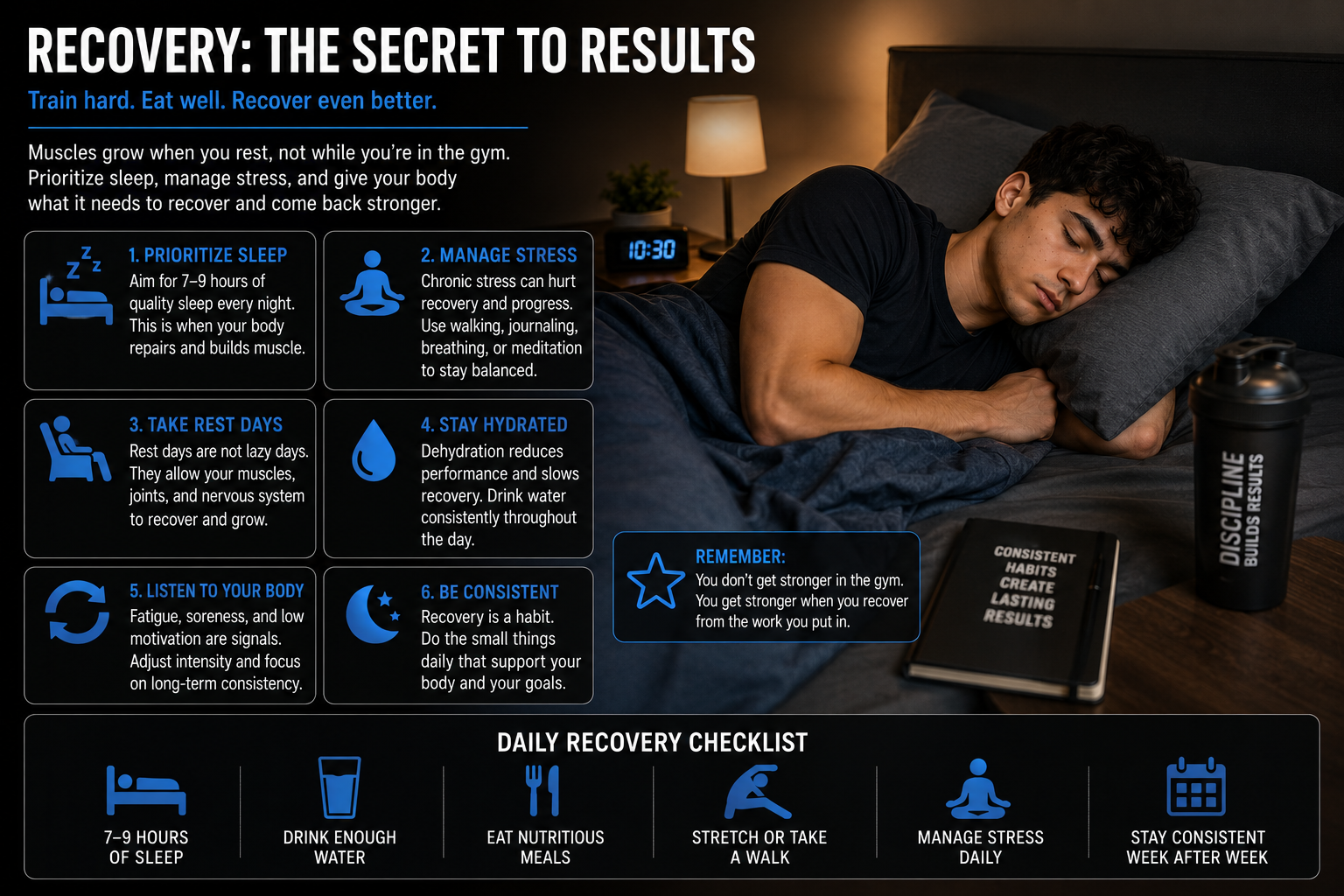
Your workout is the stimulus.
Adaptation occurs during the time between workouts.
That means recovery is part of the program.
For a dedicated guide, see Muscle Recovery Tips For Beginners.
Sleep
Most adults should aim for roughly 7–9 hours of sleep per night, with individual needs varying and younger trainees sometimes benefiting from more.
Sleep loss can negatively affect physical performance and muscle-recovery processes. Experimental research has also shown reductions in myofibrillar protein synthesis under severe sleep restriction.
Practical sleep habits include:
- Keep your sleep and wake times reasonably consistent
- Limit caffeine late in the day
- Reduce unnecessary bright-light exposure close to bedtime
- Keep your bedroom dark, comfortable, and relatively cool
- Avoid sacrificing sleep simply to squeeze in another activity
- Use naps when helpful without allowing them to destroy nighttime sleep
Perfect sleep is not required for progress.
But repeatedly treating sleep as optional makes the rest of your bodybuilding plan harder.
Stress
Your body does not separate training stress from the rest of your life as neatly as a spreadsheet does.
Recovery can also be affected by:
- School
- Work
- Relationships
- Illness
- Poor sleep
- Physically demanding jobs
- Major life events
During unusually stressful periods, maintaining your routine at a slightly reduced workload can be smarter than forcing personal records.
Consistency does not always mean pushing harder.
Sometimes it means keeping the habit alive until recovery improves.
Soreness: Is More Better?
No.
Muscle soreness is not a score for workout quality.
You can have a productive workout without becoming painfully sore.
Likewise, an extremely damaging workout can make you sore without being better for long-term growth.
Some soreness is normal when:
- Beginning training
- Returning after a long break
- Introducing a new exercise
- Increasing training volume
As you adapt, soreness often decreases.
That does not mean your workouts stopped working.
Common Beginner Bodybuilding Mistakes
1. Starting With Too Much Volume
You do not need twenty exercises per workout.
Start with enough to progress.
Add complexity when it becomes useful.
2. Changing the Program Every Week
If the exercises constantly change, it becomes harder to measure whether you are improving.
Consistency makes progression visible.
3. Training Too Far From Failure
A set that ends with another ten possible reps may be useful practice, but it is probably not a very stimulative hypertrophy set.
Eventually your working sets should become challenging.
4. Taking Every Set to Failure
The opposite extreme is unnecessary too.
Hard training does not require destroying yourself every set.
5. Sacrificing Technique for Weight
More weight only represents meaningful progression if the exercise remains reasonably comparable.
6. Resting Too Little
You are training muscles, not competing to see who can breathe hardest.
Take enough time to produce another high-quality set.
7. Ignoring Nutrition
You cannot consistently out-train an inadequate diet.
8. Ignoring Sleep
Recovery is not optional simply because it happens outside the gym.
9. Chasing Supplements
Creatine and protein powder can help.
They are still small pieces of the overall system.
10. Comparing Yourself With Advanced Lifters
Someone who has trained for ten years is playing a different game.
Your first goal is not to train like them.
Your first goal is to build the foundation that eventually allows you to become experienced.
For more examples, see Workout Mistakes For Beginners That Slow Muscle Growth.
What Results Can You Expect After 12 Weeks?
There is no scientifically honest way to promise that every beginner will gain a specific number of pounds of muscle in exactly 12 weeks.
Results vary based on:
- Genetics
- Sex
- Age
- Starting body composition
- Training history
- Previous muscle mass
- Diet
- Sleep
- Stress
- Program adherence
A beginner often experiences relatively fast improvements in strength because part of early progress comes from improved coordination, technique, confidence, and neurological adaptation.
Visible muscle growth usually takes longer and is more individual.
After 12 consistent weeks, realistic signs of success may include:
- Better exercise technique
- Higher training loads
- More repetitions
- Better understanding of RIR
- Greater gym confidence
- Improved work capacity
- Measurable changes in body measurements
- Visible physique changes
- More consistent nutrition
- A sustainable training habit
Do not judge the program only by whether your body looks dramatically different in a mirror after three months.
The greatest value of these first 12 weeks may be that you finally know how to train.
For a deeper discussion of timelines, read How Long Does It Take Beginners To Build Muscle?.
What Should You Do After Week 12?
You have three main options.
Option 1: Keep Running the Program
If you are:
- Progressing
- Enjoying the workouts
- Recovering well
- Not bored
- Training pain-free
you do not need to change simply because 12 weeks passed.
A good program does not expire at midnight after Week 12.
Option 2: Modify the Same Full-Body Structure
You can replace a few exercises while keeping the overall structure.
For example:
- Leg Press → Hack Squat
- Machine Chest Press → Dumbbell Press
- Lat Pulldown → Assisted Pull-Up
- Seated Row → Chest-Supported Dumbbell Row
Change strategically rather than randomly.
Option 3: Move to Another Split
If you want more training days or longer-term specialization, you might move to:
- A 4 Day Workout Routine For Beginners
- An upper/lower split
- A Push Pull Legs Workout For Beginners
The split should serve your schedule and training needs — not your ego.
Frequently Asked Questions About Beginner Bodybuilding
How many days per week should a beginner bodybuilder train?
Three resistance-training days per week is an excellent practical starting point, but it is not a universal physiological requirement.
Two days can work.
Four days can work.
The important variables are total training volume, exercise quality, effort, progression, recovery, and consistency.
This plan uses three days because it distributes a useful amount of full-body training across the week without requiring the gym nearly every day.
Is full-body training better than an upper/lower split?
Not inherently.
Research indicates full-body and split routines can produce similar hypertrophy when training volume is comparable.
Choose the structure you can perform consistently.
For many beginners, three-day full body is simply easier to organize.
Should beginners bulk?
Not automatically.
A lean beginner primarily focused on maximizing muscle gain may benefit from a small calorie surplus.
A beginner with more body fat may be able to gain muscle at maintenance or even while losing fat.
A returning lifter may also have good recomposition potential.
Match calories to your individual goal instead of assuming bodybuilding always means bulking.
Can beginners build muscle without supplements?
Absolutely.
Resistance training, sufficient calories, protein, sleep, and consistency produce the foundation.
Supplements are optional.
Should beginners use creatine?
Healthy adults who choose to supplement can consider creatine monohydrate because it has a strong evidence base and can support resistance-training adaptations.
A typical maintenance dose is 3–5 grams daily.
Anyone with medical concerns should discuss supplementation with an appropriate healthcare professional.
Should beginners train to failure?
Not on every set.
Most of this program uses approximately 1–3 RIR.
The occasional final set of a stable, lower-risk isolation exercise may eventually be taken closer to failure once technique is reliable, but failure is not a requirement for every exercise.
How long should a beginner bodybuilding workout take?
Roughly 60–90 minutes is a reasonable expectation for this program, but the clock is not a training variable you need to optimize.
Your workout may be shorter if:
- Equipment is available
- You use fewer optional exercises
- Your gym setup is efficient
It may take longer if:
- Equipment is busy
- You require additional warm-up sets
- You need longer rests
Quality matters more than finishing within an arbitrary time limit.
What if I can only train twice per week?
Train twice.
Two good workouts consistently are better than a theoretical three-day program you repeatedly miss.
You could alternate:
- Week 1: A / B
- Week 2: C / A
- Week 3: B / C
and continue the rotation.
Can I perform this workout at Planet Fitness or another commercial gym?
Yes.
The plan intentionally uses exercises commonly available at commercial gyms.
Machines, dumbbells, cables, and Smith-machine variations can all be used effectively for hypertrophy.
Can women use this beginner bodybuilding workout plan?
Yes.
The basic biological principles of resistance-training-induced hypertrophy apply to both men and women.
Individual goals, exercise preferences, body size, and recovery vary more meaningfully than the need for a completely different “women’s bodybuilding” system.
Can teenagers use this program?
Resistance training can be appropriate for younger trainees when exercises, loads, technique, supervision, and progression are appropriate.
However, younger athletes have different developmental and supervision needs. Minors should train with appropriate adult, coaching, and healthcare guidance where relevant rather than treating a general internet program as individualized instruction.
Is muscle soreness required after every workout?
No.
Soreness can happen, especially when training is new, but it is not required for muscle growth.
Track performance and progression rather than chasing soreness.
Do I need to eat immediately after training?
No.
Having protein and carbohydrate within a reasonable period around training is useful, but there is no tiny post-workout window that closes if you do not drink a shake immediately.
Total daily nutrition remains the priority.
How often should I change exercises?
Keep effective exercises stable for at least several weeks.
Change them when there is a reason — not because the calendar says you need “muscle confusion.”
What should I do if an exercise hurts?
Stop treating pain as something you must push through.
Check your setup and technique and consider an appropriate substitution.
If pain is significant, persistent, worsening, associated with an injury, or otherwise concerning, seek assessment from an appropriately qualified healthcare professional.
Beginner Bodybuilding Guides on Lift & Nurture
This article is the central blueprint.
If you want to go deeper into one individual part of the process, these guides break each topic down further:
- 3 Day Workout Schedule For Beginners — A dedicated three-day full-body training schedule.
- Full Body Workout Plan For Beginners — A simpler introduction to full-body workout structure.
- 4 Day Workout Routine For Beginners — An upper/lower option for beginners who prefer four training days.
- How To Choose A Workout Split For Beginners — Compare different weekly training structures.
- How To Implement Progressive Overload For Beginners — Learn how to progress reps and weight without forcing it.
- How Hard Should Beginners Train For Muscle Growth? — A full guide to RIR, effort, and proximity to failure.
- Beginner Weight Training Sets And Reps — Understand how to choose practical set and repetition ranges.
- Muscle Group Sets Per Week For Beginners — Understand weekly resistance-training volume.
- How To Structure Workout Rest Periods — Learn how long to rest between different types of sets.
- How To Warm Up Before Lifting For Beginners — Build an efficient warm-up.
- Beginner Bodybuilder Exercises — Explore beginner-friendly exercise selections.
- Guide To Gym Machines For Beginners — Learn how machines fit into a muscle-building program.
- Beginner Upper Body Workout At The Gym — A dedicated upper-body training guide.
- Simple Leg Day Workout Plan — A dedicated beginner lower-body session.
- Muscle Building Nutrition Guide For Beginners — A complete beginner nutrition foundation.
- How Much Protein Do Beginners Need To Build Muscle? — Practical daily protein targets.
- How Many Calories Should Beginners Eat To Build Muscle? — Understand maintenance calories and calorie surpluses.
- Muscle Recovery Tips For Beginners — Sleep, rest, soreness, and recovery.
- Workout Mistakes For Beginners — Common mistakes that can slow progress.
- How Long Does It Take To Build Muscle For Beginners? — Set realistic expectations for muscle-building progress.
- Beginner Fitness Plans After A Break — A useful starting point if you are returning after detraining.
If you train at home instead, Lift & Nurture also has:
- Beginner Bodyweight Workout Plan To Build Muscle At Home
- 3 Day At Home Workout Routine For Beginners
- No Equipment Full Body Workout For Beginners At Home
- Beginner Dumbbell Workout At Home
- Resistance Band Workout For Beginners At Home
Evidence and References
The training and nutrition recommendations in this guide were informed by evidence-based bodybuilding resources alongside primary and review research. Key scientific references include:
Currier BS, D’Souza AC, Fiatarone Singh MA, et al. American College of Sports Medicine Position Stand: Resistance Training Prescription for Muscle Function, Hypertrophy, and Physical Performance in Healthy Adults. Medicine & Science in Sports & Exercise. 2026. This overview synthesized 137 systematic reviews and more than 30,000 participants.
Pelland JC, Remmert JF, Robinson ZP, Hinson SR, Zourdos MC. The Resistance Training Dose Response: Meta-Regressions Exploring the Effects of Weekly Volume and Frequency on Muscle Hypertrophy and Strength Gains. Sports Medicine. 2026.
Robinson ZP, et al. Exploring the Dose-Response Relationship Between Estimated Resistance Training Proximity to Failure, Strength Gain, and Muscle Hypertrophy. Sports Medicine. 2024.
Refalo MC, et al. Influence of Resistance Training Proximity-to-Failure on Skeletal Muscle Hypertrophy: A Systematic Review With Meta-Analysis.
Ramos-Campo DJ, et al. Efficacy of Split Versus Full-Body Resistance Training on Strength and Muscle Growth: A Systematic Review With Meta-Analysis. 2024.
Haugen OC, et al. Effect of Free-Weight vs. Machine-Based Strength Training on Maximal Strength, Hypertrophy and Jump Performance: A Systematic Review and Meta-Analysis.
Singer A, et al. Give It a Rest: A Systematic Review With Bayesian Meta-Analysis on the Effect of Inter-Set Rest Interval Duration on Muscle Hypertrophy. 2024.
Morton RW, Murphy KT, McKellar SR, et al. A Systematic Review, Meta-Analysis and Meta-Regression of the Effect of Protein Supplementation on Resistance Training-Induced Gains in Muscle Mass and Strength in Healthy Adults. British Journal of Sports Medicine. 2018.
Iraki J, Fitschen P, Espinar S, Helms E. Nutrition Recommendations for Bodybuilders in the Off-Season: A Narrative Review. 2019.
Desai I, et al. The Effect of Creatine Supplementation on Resistance Training-Based Changes to Body Composition: A Systematic Review and Meta-Analysis. Journal of Strength and Conditioning Research. 2024.
Lundberg TR, et al. The Effects of Concurrent Aerobic and Strength Training on Muscle Fiber Hypertrophy: A Systematic Review and Meta-Analysis.
Saner NJ, et al. The Effect of Sleep Restriction, With or Without High-Intensity Interval Exercise, on Myofibrillar Protein Synthesis in Healthy Young Men. The Journal of Physiology. 2020.
Final Thoughts
A beginner bodybuilding workout plan does not need to look impressive on paper.
It needs to work in real life.
You need exercises you can learn.
You need enough hard training to create a reason for your muscles to adapt.
You need a progression system that tells you what to improve.
You need enough food and protein to support the process.
You need enough recovery to come back and do it again.
And you need enough patience to allow those pieces to compound.
That is the foundation.
You do not need to become obsessed with finding the perfect exercise.
You do not need to train six days per week.
You do not need to reach failure on everything.
You do not need advanced intensity techniques.
You do not need a cabinet full of supplements.
You need to become good at the fundamentals.
Train.
Record what you did.
Recover.
Come back.
Improve something when you can.
Then repeat.
After 12 weeks, the most important result will not simply be what the mirror shows.
It will be that you understand how to keep progressing after the 12 weeks are over.
That is the goal of this blueprint — not a temporary challenge, but a foundation you can continue building on.
Lift with intention. Nurture long-term growth.
— Angel
About the Author
I’m Angel Carcamo, founder of Lift & Nurture.
I created Lift & Nurture to make beginner bodybuilding easier to understand through clear, research-based guides on training, progressive overload, nutrition, and recovery.
I approach these topics from a beginner-focused perspective rather than pretending to have years of coaching or advanced bodybuilding experience that I do not have. My goal is to study evidence-backed training principles, organize the information carefully, and explain what I learn in a way that other beginners can put into practice.
My own earlier training was not based on the structured science-based approach explained throughout this website. Much of what I now study about bodybuilding came during my time away from consistent training, which is why I believe honesty about where I am in the process matters.
Lift & Nurture is about learning the fundamentals properly, applying them patiently, and building something sustainable over time.
If you are completely new to the site, start with the Beginner Bodybuilding Roadmap.
This is a great guideline for beginners starting out on their body building journey. It is, as you say, all about progression and getting gradually stronger. This also takes patience and consistency.
What I found interesting and I think that most people don’t know it, but muscles are built during the rest period, not the actual workout. Should you workout like this every day or should you take a couple of rest days a week?
Michel, that’s a great observation — and you’re absolutely right. Muscle growth happens during recovery, not during the workout itself.
For most beginners, training every day isn’t necessary and can actually slow progress if recovery isn’t managed properly.
That’s why I recommend 3 focused full-body sessions per week. It provides enough stimulus to grow while allowing 48 hours between sessions for recovery and adaptation.
Rest days aren’t “off days” — they’re growth days.
Light activity like walking or mobility work is fine, but structured resistance training should include planned recovery.
Recovery capacity determines progress just as much as training intensity.
Thanks for bringing that up — it’s one of the most misunderstood parts of muscle building.
As a single mom, finding a workout plan that actually focuses on building a solid foundation is such a relief compared to those “quick fix” trends that never stick. I love that this 12-week blueprint gives me a clear roadmap to follow during those early morning hours before the kids wake up, making my strength goals feel much more attainable. It’s empowering to invest in my own health this way, ensuring I have the energy and strength to keep up with my family every single day!
Thank you, Leah — I really appreciate you sharing that.
What you said about early mornings before the kids wake up is exactly the kind of real-life situation this plan is meant to support. A lot of beginner programs overlook that people have busy schedules, so having a clear structure you can rely on makes a huge difference.
I’m glad the 12-week blueprint gives you that sense of direction. That’s really the goal — not just workouts, but a system you can follow consistently without having to second-guess what to do each day.
You also touched on something important: building strength and energy for everyday life. For beginners, that’s one of the most valuable outcomes. It’s not just about muscle — it’s about feeling more capable, more consistent, and having the energy to show up for your day.
If you stay consistent with the plan, even small improvements week to week tend to add up more than most people expect. That’s really where the long-term results come from.
Thanks again for taking the time to share your experience — it genuinely means a lot.
— Angel