

Learning how to implement progressive overload for beginners can sound simple at first: do more over time.
But that short definition leaves out the part that causes most of the confusion.
Should you add weight every workout? Do you need another rep every week? Should you add more sets when progress slows? Does better technique count? What happens when the next dumbbell is too heavy? And if you repeat the same performance for two workouts, does that mean you have already hit a plateau?
The answer is more practical than “just keep adding weight.”
Progressive overload is about making sure your training continues to provide an appropriate challenge as your body adapts. Sometimes that means adding a repetition. Sometimes it means increasing the load. Sometimes the best decision is to repeat the exact same workout because you are not ready to progress yet.
The goal is not to force progression onto your body. The goal is to train effectively enough that adaptation occurs, then adjust your training as your ability improves.
That distinction matters especially for beginners, because the fastest-looking progression on paper is not always the best progression in the gym.
A heavier lift performed with half the range of motion, more momentum, worse technique, and zero control is not necessarily an improvement over the lighter version you performed last week.
In this guide, you’ll learn how progressive overload actually works, how to use double progression, when to increase weight, how hard to train, how to track your workouts, what to do when equipment jumps are too large, how to progress at home, and how to troubleshoot a real plateau without randomly changing your entire program.
A Quick Note About My Perspective
I’m Angel Carcamo, founder of Lift & Nurture, and I still consider myself a beginner.
I started lifting when I was younger, but my training was not structured around the evidence-based principles I study today. At 16, I pushed my training beyond what I could recover from, needed physical therapy for lower-body issues, and eventually spent an extended period away from consistent lifting.
During that time away, I began studying resistance-training research and learning from science-based bodybuilding educators much more seriously. I’m now 19, and I have not yet returned to consistent training and personally applied every method explained in this guide.
So this article is not written from the perspective of a veteran coach, competitive bodybuilder, or someone claiming decades of personal experience.
It is an educational beginner guide built from current resistance-training evidence and established evidence-based training frameworks, translated into practical steps that beginners can understand and apply.
That distinction is important to me because Lift & Nurture is built around clarity, evidence, and honesty rather than pretending to have experience I do not have.
If you are returning after an injury, significant pain, surgery, rehabilitation, or a long medically advised break from training, individual guidance from an appropriate qualified healthcare professional may be more important than any general progression rule in this article.
Table of Contents
- How to Implement Progressive Overload for Beginners: Quick Answer
- What Is Progressive Overload?Progressive Overload vs. Progression: An Important Difference
- Progressive Overload Does Not Mean Doing More Every Workout
- What Actually Counts as Progress?
- The Best Simple Progression Method for Beginners
- How Double Progression Works Step by Step
- A Realistic Double-Progression Example
- How Hard Should Beginners Train?
- Understanding RIR
- When Should You Increase the Weight?
- How Much Weight Should You Add?
- What If the Next Weight Is Too Heavy?
- How to Progress With Different Types of Equipment
- Should You Add More Sets?
- Technique, Range of Motion, Tempo, and Rest
- How to Track Progressive Overload
- What a Beginner Training Log Can Look Like
- Do You Need to Progress Every Workout?
- How to Know If You Have Actually Hit a Plateau
- How to Troubleshoot a Progressive Overload PlateauWhen to Deload, Reduce Weight, or Change an Exercise
- Progressive Overload for Muscle Growth vs. Strength
- How Progression Changes as You Become More Experienced
- Common Progressive Overload Mistakes
- Progressive Overload Checklist
- Frequently Asked Questions
- Your Next Workout: Beginner Action Plan
- Key Takeaways
- Final Thoughts
- Related Beginner Bodybuilding Guides
- References
- About the Author
How to Implement Progressive Overload for Beginners: Quick Answer
For most beginners focused on building muscle, one of the simplest ways to implement progressive overload is to use a rep range plus a consistent effort target, gradually add repetitions as performance improves, and then increase the weight when the current load has become appropriately manageable.
For example, imagine your program calls for:
Machine Chest Press — 3 sets of 8–12 reps
You might begin with a weight that allows you to perform all three working sets inside that range while finishing most sets with roughly 1–3 reps in reserve, depending on the exercise and program.
Over future workouts, you try to perform more good-quality repetitions with the same weight.
Once you can reach the top of the rep range with the intended technique, range of motion, and effort, increase the resistance by the smallest practical amount.
Your reps will probably drop again.
Then you build them back up.
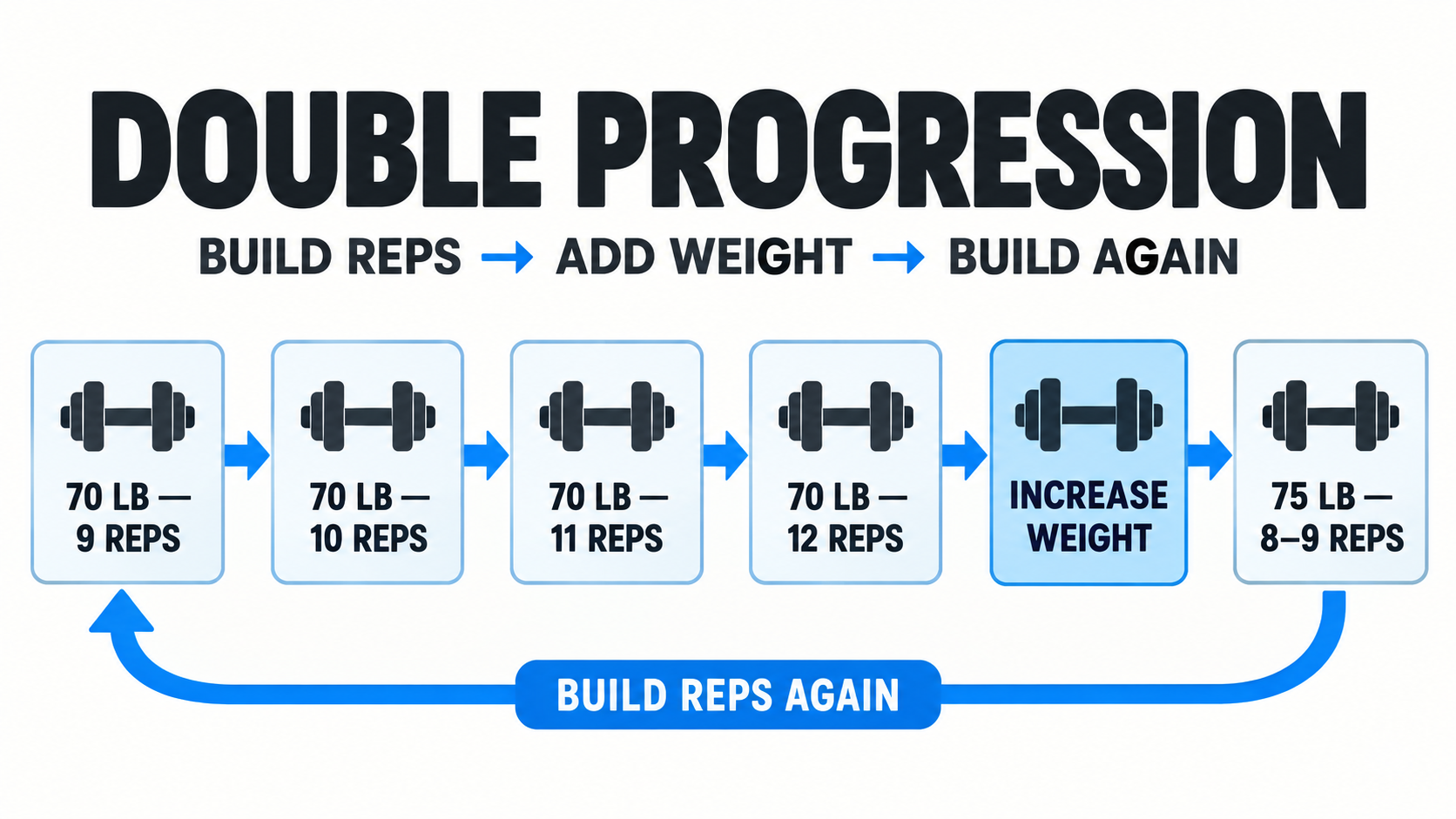
That process is commonly called double progression because you progress repetitions first and resistance second.
Research has directly compared increasing repetitions with increasing load and found that both can produce muscular adaptations. That includes research in resistance-trained participants as well as research in young adults in the early stages of training. [2,3]
A simple beginner progression cycle might look like this:
Add quality reps → reach the top of the range → add a small amount of weight → let reps decrease → build them back up → repeat.
But there is one critical rule:
Do not sacrifice your technique, range of motion, or the intended difficulty of the set just to make the number in your logbook go up.
Progressive overload works best when you compare reasonably similar performances.
What Is Progressive Overload?
Progressive overload is the principle that your training stimulus must remain sufficiently challenging as you adapt if you want to keep improving.
When you first begin resistance training, relatively modest training can represent a substantial challenge because your body has not yet adapted to it.
Over time, that same workout may become easier.
A weight that once allowed only 10 difficult repetitions might eventually allow 12, 15, or more.
The weight did not become lighter.
You became more capable.
At that point, continuing to perform the exact same easy workload forever may no longer provide the same training stimulus it once did.
That is where progression becomes useful.
You might:
perform additional repetitions,
increase the resistance,
use a harder bodyweight variation,
or, when programming circumstances justify it, adjust training volume.
The 2026 American College of Sports Medicine Position Stand synthesized a large body of resistance-training evidence and concluded that healthy adults should perform progressive resistance training to improve muscle function, muscle size, and physical performance. [1]
But there is an important detail that often gets lost when progressive overload is explained online.
Progressive Overload vs. Progression: An Important Difference
Progressive overload and progression are closely related, but they are not exactly the same thing.
Think of overload as providing a training stimulus that is challenging enough to encourage adaptation.
Think of progression as adjusting what you do as your ability changes.
That means progression should not simply become:
“I did 10 reps last time, so I am required to do 11 today.”
Your muscles do not know what your spreadsheet says.
They respond to the training stimulus you provide.
Suppose you perform 10 challenging repetitions of an exercise today.
After several weeks of effective training and recovery, you may become strong enough that the exact same 10 repetitions feel considerably easier. If your goal is hypertrophy, performing another repetition or increasing the load can help keep the set within an appropriate level of effort.
But the original workout did not stop working immediately after one session.
Your body needed time to adapt.
That leads to one of the most useful ways to think about progressive overload:
You do not need to force your body to adapt by winning the logbook every workout. You train productively, allow adaptation to occur, and then let improved performance show you when progression is appropriate.
That mindset prevents a lot of unnecessary beginner mistakes.
Video: Progressive Overload Is More Than Adding Weight
The short video below is a useful visual recap of an important distinction in this guide: progressive overload does not mean blindly forcing more weight onto an exercise every workout. Your training should create an appropriate stimulus first; increases in reps or resistance should follow as your ability improves.
Beginner Tip: Use the video as a concept refresher, not as a rule that you must increase something every session. The next section explains why normal performance fluctuations mean repeating the same load or reps can sometimes be exactly the right decision.
Progressive Overload Does Not Mean Doing More Every Workout
This deserves its own section because it is probably the most common misunderstanding.
You do not have to:
add weight every workout,
add repetitions every workout,
add another set every week,
train closer to failure every session,
shorten your rest periods,
slow every repetition down more and more,
or turn every gym visit into a personal-record attempt.
Human performance fluctuates.
You might sleep poorly.
You might be more stressed.
You may have eaten differently.
Your hydration may be different.
Another exercise earlier in the workout may have tired you out more than usual.
Sometimes you simply have an average day.
A productive training program should be able to survive those normal fluctuations without making you think something has gone wrong.
Progression should be judged as a trend over time, not as a requirement to improve every number during every workout.
What Actually Counts as Progress?
This is where beginners can benefit from being more precise.
Suppose last week you performed a dumbbell press with 30-pound dumbbells for 10 repetitions.
This week you perform 11.
That looks like progress.
But what if last week’s repetitions used a controlled range of motion and this week you shortened the bottom half of every repetition?
The number improved, but the performances are no longer directly comparable.
For logbook progression to mean something, try to keep the important conditions reasonably consistent.
| Variable | Try to Keep It Consistent Because… |
|---|---|
| Exercise | Different exercises cannot be directly compared |
| Machine or equipment | Resistance can vary between machines |
| Seat and pad settings | Setup changes can alter leverage |
| Range of motion | Partial and full repetitions are different tasks |
| Technique | Added momentum can artificially increase reps or load |
| Exercise order | Exercises usually perform differently when done fresh vs. fatigued |
| Rest periods | More or less recovery can change performance |
| Rep range | A 5-rep performance and 15-rep performance reflect different loading demands |
| Effort/RIR | 10 reps at 4 RIR is not the same challenge as 10 reps at 1 RIR |
You do not need laboratory-level precision.
You simply want enough consistency that you can look back at the log and make a useful comparison.
Better Technique Is Still Progress
Improving your technique is extremely valuable.
If you learn to control a movement better, reduce unnecessary momentum, use a more appropriate range of motion, and direct the exercise toward the intended muscles more effectively, your training may become better even if the weight stays unchanged.
But it is useful to distinguish technical improvement from automatically calling every technical change progressive overload.
Technique is what makes your performance measurable and repeatable.
A heavier weight achieved by degrading technique may be fake logbook progress.
A weight you already use performed with substantially better execution may be a meaningful improvement even if the load did not change.
For beginners, establishing good execution should often come before obsessing over adding weight.

The Best Simple Progression Method for Beginners
There are many ways to structure progression, but beginners do not need nine complicated overload strategies running at the same time.
For a muscle-building program, a simple variation of double progression is hard to beat.
It is:
easy to understand,
easy to track,
flexible across machines, barbells, dumbbells, and cables,
compatible with different rep ranges,
and forgiving when strength does not improve perfectly from session to session.
Research supports the basic idea that either increasing repetitions or increasing resistance can be used as a viable progression strategy over time. [2,3]
The exact system does not need to be identical for every exercise.
But the general principle is simple.
How Double Progression Works Step by Step
Step 1: Use a Defined Rep Range
Suppose your program says:
Lat Pulldown — 3 × 8–12
That means each working set should generally fall somewhere between 8 and 12 repetitions.
A rep range gives you room to progress before needing a heavier weight.
It is often more practical than demanding exactly 10 repetitions forever.
Step 2: Choose a Load That Fits the Range
Select a weight that allows you to enter the prescribed rep range with good technique and an appropriate level of effort.
If you are supposed to perform 8–12 repetitions, choosing a load you can barely perform for 5 repetitions is too heavy.
Choosing a load you could easily perform for 25 repetitions is probably too light for that particular prescription.
Step 3: Keep the Load the Same While Reps Improve
Maybe your first workout looks like:
100 lb — 10, 9, 8 reps
That is fine.
Next time, perhaps you get:
100 lb — 10, 10, 9
The total improvement is small.
That is still progress.
You do not need to add a repetition to every set simultaneously.
Step 4: Continue Until You Reach the Progression Threshold
A simple beginner rule is to wait until you can reach or closely approach the top of the prescribed range across your sets while maintaining the intended technique and effort.
For example:
100 lb — 12, 12, 12
If those repetitions are still performed properly and the set is no longer excessively difficult, you have a good reason to increase the resistance.
A slightly more autoregulated approach can use the first working set as the main progression marker.
For example, if your first set reaches the top of the range while still leaving the intended number of repetitions in reserve, and your remaining sets stay acceptably close to the target range, that can also be a reasonable signal that you are ready for a small increase.
Beginners do not need to obsess over which version is theoretically perfect.
Choose a clear rule and use it consistently.
Step 5: Increase the Resistance by the Smallest Practical Amount
Maybe the next available weight is 105 pounds.
After increasing it, your workout might become:
105 lb — 9, 9, 8
That is not regression.
You deliberately made the exercise harder.
Now you begin progressing through the rep range again.
Step 6: Repeat the Process
Over time:
Reps rise → weight rises → reps fall → reps rise again.
That is the basic cycle.
You do not need to continuously invent new exercises or new intensity techniques to keep progressing.
A Realistic Double-Progression Example
Real training rarely progresses as neatly as an example on paper.
So instead of pretending you will add one repetition to every set every week, here is a more realistic example.
Imagine your machine chest press prescription is:
3 sets of 8–12 reps, generally around 1–3 RIR
| Session | Weight | Reps | What Happened |
|---|---|---|---|
| 1 | 70 lb | 10 / 9 / 8 | Good starting point |
| 2 | 70 lb | 10 / 10 / 9 | Small improvement |
| 3 | 70 lb | 11 / 10 / 10 | Progress continues |
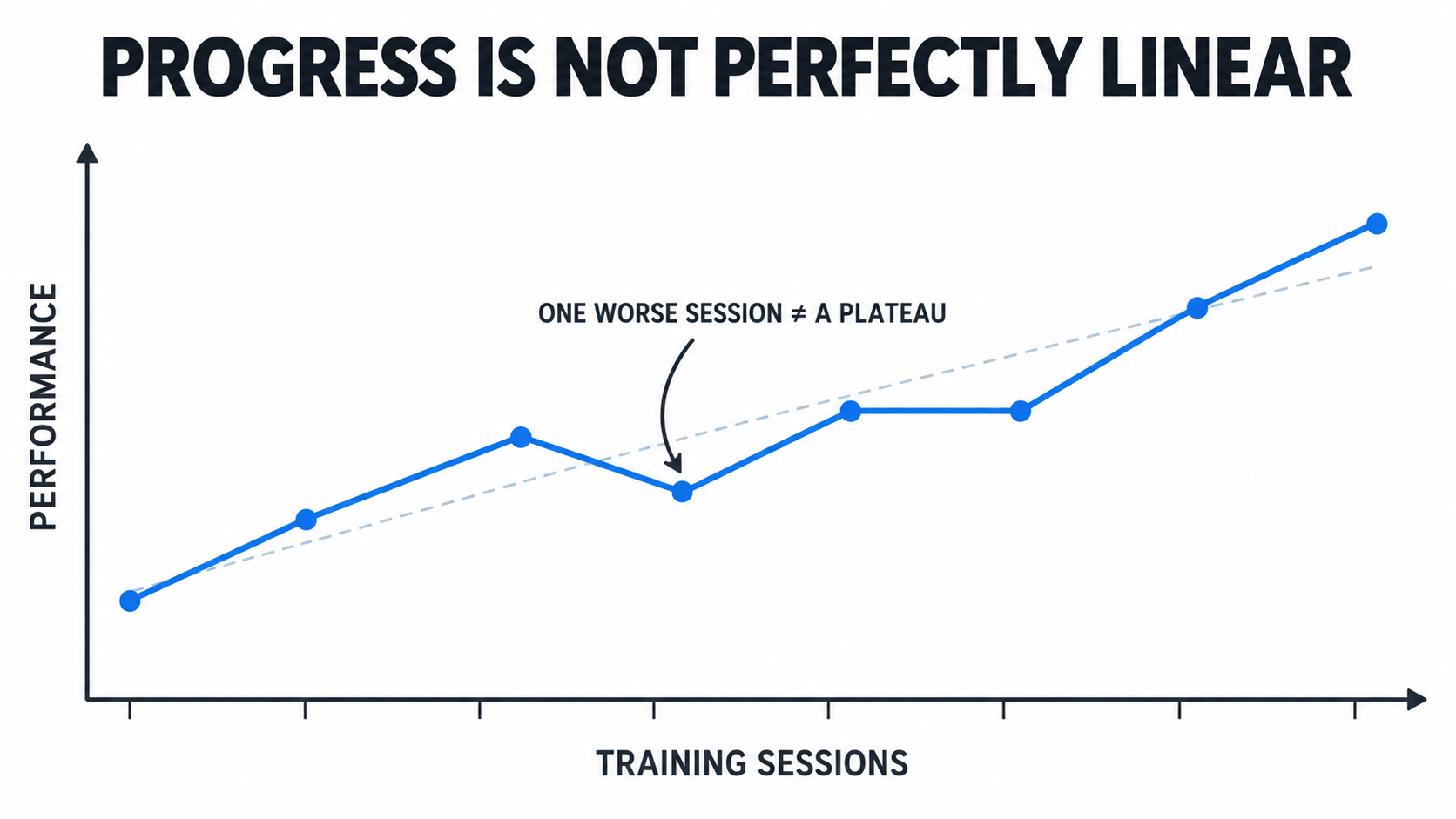
| 4 | 70 lb | 10 / 10 / 9 | Slightly worse day — no change needed |
| 5 | 70 lb | 12 / 11 / 10 | Strong session |
| 6 | 70 lb | 12 / 12 / 11 | Near the top |
| 7 | 70 lb | 12 / 12 / 12 | Ready for a sensible increase |
| 8 | 75 lb | 9 / 8 / 8 | Heavier load; cycle begins again |
Notice Session 4.
Performance temporarily went backward.
Nothing dramatic happened.
There was no emergency deload.
No exercise was replaced.
No extra set was added.
The trainee simply continued.
That is much closer to how real progression works.
How Hard Should Beginners Train?
Progressive overload only makes sense if your working sets are challenging enough to be productive in the first place.
If you perform 10 repetitions with a weight you could have lifted another 15 times, adding one repetition next week may make the spreadsheet look better without meaningfully changing the training stimulus.
At the other extreme, taking every set to absolute failure can create unnecessary fatigue and make subsequent training harder to recover from.
For hypertrophy, current evidence suggests that muscle growth tends to increase as sets are terminated closer to failure, although the exact dose-response relationship is not perfectly established. Reaching absolute momentary muscular failure on every set is not required for productive training. [1,4]
That is where RIR, or reps in reserve, becomes useful.
Understanding RIR
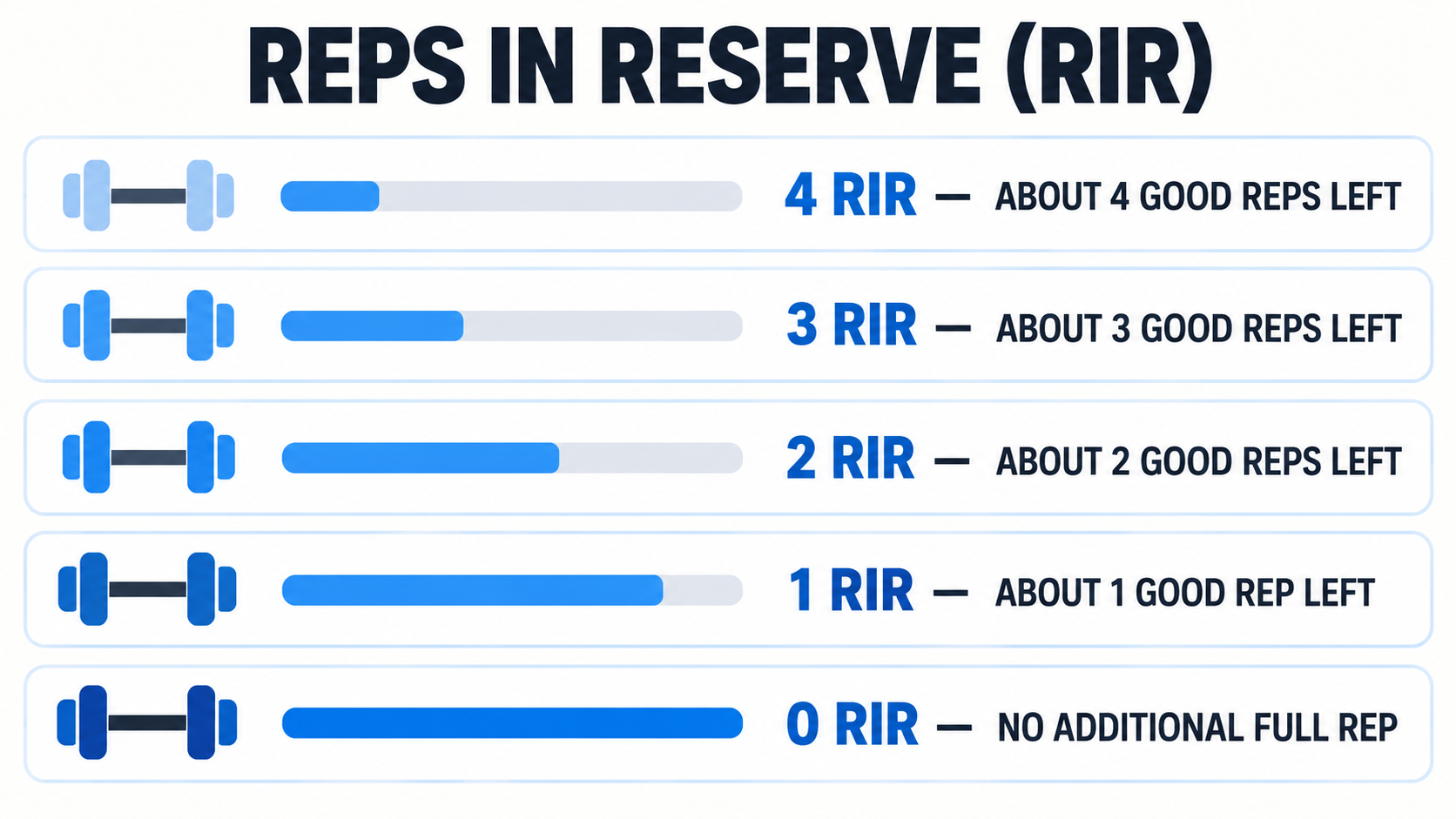
RIR estimates how many additional good repetitions you probably could have completed before reaching momentary muscular failure.
A simple interpretation is:
| RIR | Meaning |
|---|---|
| 4 RIR | You probably had about 4 more good reps |
| 3 RIR | About 3 reps remained |
| 2 RIR | About 2 reps remained |
| 1 RIR | Probably 1 good rep remained |
| 0 RIR | No additional full repetition was possible |
For many beginner hypertrophy workouts, spending a large portion of your working sets somewhere around 1–3 RIR can be a useful practical starting range.
That is not a universal law.
Some exercises, phases, and programs may use different targets. Isolation movements can often be taken closer to failure with a relatively manageable recovery cost, while demanding compound movements may be kept slightly farther from failure.
And beginners should remember that estimating RIR is a learned skill.
When you are new, what feels like “1 RIR” might actually be 4 RIR.
You get better at judging effort with experience.
The important lesson is not to become obsessed with perfectly rating every set.
Use RIR as a practical way to ask:
Was that set actually challenging, and was it roughly as hard as the performance I am comparing it with?
For a deeper explanation of training effort, read How Hard Should Beginners Train For Muscle Growth?.
Video: How Accurate Is Reps in Reserve?
RIR is useful because it gives you a practical way to describe how close a set was to failure, but it is still an estimate—not a laboratory measurement. The discussion below with Eric Helms takes a deeper look at how lifters judge reps in reserve, what the research says about RIR accuracy, and how RIR can be used when managing progression.
Beginner Tip: You do not need to identify your RIR perfectly. Use it as an approximate training tool. As you gain experience performing genuinely challenging sets, you can gradually become more familiar with what having several repetitions left—or almost none—actually feels like.
Do Beginners Need to Train to Failure?
No.
You can build muscle without taking every set to the point where another full repetition is impossible.
The 2026 ACSM evidence review found that training to momentary muscle fatigue did not consistently improve resistance-training outcomes, while separate proximity-to-failure research suggests that hypertrophy can benefit from training sufficiently close to failure without requiring every set to reach failure. [1,4]
That does not mean failure training is useless.
It means:
Failure is a tool, not a requirement.
Occasional failure may be more practical on stable, lower-risk exercises such as certain machine or isolation movements than on technically demanding lifts where fatigue can quickly affect execution.
For a beginner, learning good technique, understanding what a hard set feels like, and recovering consistently usually matter more than proving how hard you can grind every set.
When Should You Increase the Weight?
Do not increase weight just because Monday became Monday again.
Increase it because your performance suggests that the current resistance is ready to move forward.
Before increasing the load, ask:
| Question | Good Sign |
|---|---|
| Am I reaching the progression target? | Yes |
| Is my range of motion still consistent? | Yes |
| Is my technique still controlled? | Yes |
| Am I reaching those reps without excessive momentum? | Yes |
| Is the set still within the intended RIR range? | Yes |
| Am I using the same basic setup? | Yes |
| Can I make a reasonably small weight increase? | Yes |
If the answers are mostly yes, increasing the resistance is reasonable.
If you reached the number only because you shortened your ROM, bounced the weight, changed your body position, or turned a controlled repetition into a full-body swing, stay at the current load.
The logbook number is only useful when the performance behind it is useful.
How Much Weight Should You Add?
There is no universal rule that every upper-body lift should increase by exactly 5 pounds and every lower-body lift by exactly 10.
What matters is the size of the increase relative to the resistance you are already using.
Consider two examples.
Going from:
100 lb → 105 lb
is only a 5% increase.
But going from:
15 lb → 20 lb
is a 33% increase.
Both increased by 5 pounds.
They are obviously not equivalent.
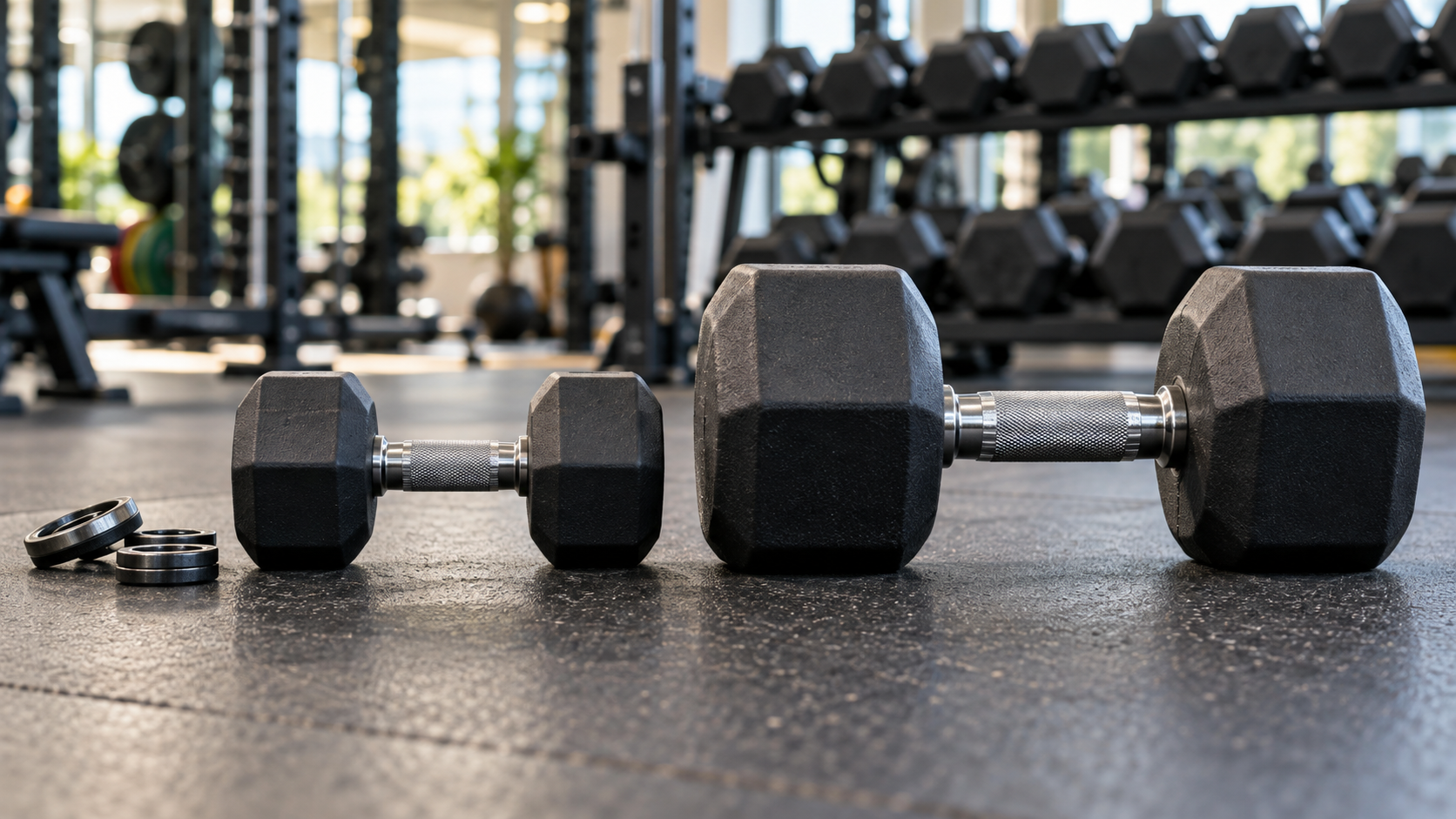
This is why smaller muscles and isolation exercises can be frustrating with fixed dumbbells.
For most exercises, use the smallest practical increase available that allows you to stay reasonably close to the intended rep range while preserving technique.
Barbell Exercises
Small plates can make progression relatively easy.
Depending on the exercise and your current strength, adding a small amount to the entire bar may be sufficient.
Microplates can provide even smaller jumps when useful, although beginners do not need to turn loading into an accounting exercise.
Dumbbell Exercises
Dumbbells can create much larger percentage jumps.
If moving to the next pair destroys your rep range or technique, you do not have to force the increase.
Build more repetitions first.
Machines and Cables
Use the smallest available weight-stack or plate increment.
Always record the specific machine and setup when possible because “100 pounds” on one machine may feel completely different from 100 pounds on another.
What If the Next Weight Is Too Heavy?
This is one of the most useful beginner problems to understand.
Suppose you perform dumbbell lateral raises with 15-pound dumbbells.
You eventually reach your progression target.
But your gym’s next option is 20 pounds.
That is a massive relative increase.
When you try 20 pounds:
your repetitions crash,
you have to swing,
your range of motion changes,
and the exercise suddenly feels worse.
Do not force it simply because your progression rule says “add weight.”
You have several options.
Option 1: Use a Wider Rep Range
Instead of progressing from 10 to 12 repetitions, you might use something like 10–15 or another sensible range supported by your program.
That gives you more room to become stronger before making the larger jump.
Option 2: Stay With the Current Weight Longer
There is nothing wrong with spending more time at the lighter load.
You could improve repetitions, consistency, control, or how comfortably you stay within the prescribed effort range.
Option 3: Use Smaller Increments If Available
Some gyms have:
fractional plates,
magnetic add-on weights,
smaller cable-stack plates,
or dumbbells in 2.5-pound increments.
These can make progression smoother.
Option 4: Use Another Suitable Exercise With Better Load Progression
If progression is repeatedly awkward and another exercise trains the same target muscle effectively while offering easier resistance adjustments, switching can eventually make sense.
But do not turn that into exercise hopping.
First make sure the loading increment is genuinely the problem.
How to Progress With Different Types of Equipment
The same principle can be applied differently depending on what you use.
| Equipment | Practical Ways to Progress |
|---|---|
| Barbells | Add reps, then use small load increases; microloading is optional |
| Dumbbells | Add reps through a wider range before moving to the next pair |
| Machines | Add reps, then move the pin or add plates; keep machine settings consistent |
| Cables | Add reps, then use the smallest stack increment available |
| Bodyweight | Add reps, improve ROM, use harder leverage/variations, or add external resistance |
| Resistance bands | Add reps, increase band tension, change starting length, or use a stronger band |
Progressive Overload With Bodyweight Exercises
If you can perform only 6 good push-ups, building toward 10, 12, or 15 is progression.
Eventually, simply adding repetitions may become impractical.
At that point, you might progress to:
a more difficult variation,
greater usable range of motion,
additional external resistance,
or another movement that allows better long-term loading.
The goal is not to perform 150 push-ups just because “more reps equals overload.”
Progress within a range appropriate for your goal.
For practical examples, see my Beginner Bodyweight Workout Plan and No Equipment Full Body Workout For Beginners.
Progressive Overload With Resistance Bands
Bands are useful, but progression can be harder to standardize because resistance depends on how much the band is stretched.
If possible, keep the setup consistent:
use the same band,
the same anchor point,
the same starting position,
and approximately the same band length.
Then progress repetitions before increasing band tension.
My Resistance Band Workout For Beginners At Home goes deeper into structuring band-based training.

Should You Add More Sets to Progress?
Adding sets increases training volume, so it can increase the training stimulus.
But that does not mean beginners should automatically add another set whenever an exercise stops improving.
Think of reps and load as exercise-level progression tools.
Think of adding sets as more of a programming decision.
Recent dose-response research indicates that greater weekly resistance-training volume is associated with greater hypertrophy on average, while the estimated benefit becomes progressively smaller as more volume is added. In other words, the relationship shows diminishing returns rather than “more is always better.” [6]
Going from very little productive training to an appropriate amount can make a major difference.
Going from an already effective amount to dramatically more work may provide a much smaller benefit while increasing:
training time,
fatigue,
soreness,
recovery demands,
and the chance that later sets become low quality.
So do not run a progression system like this:
Week 1: 3 sets
Week 4: 4 sets
Week 8: 5 sets
Week 12: 6 sets
Week 16: 7 sets
Eventually your entire day would become one exercise.
Instead, adjust volume when there is a programming reason to do it.
Before adding sets because progress has stalled, check whether:
your current sets are actually hard enough,
your technique is consistent,
you are recovering,
your load is appropriate,
and you have truly stalled rather than simply having an average week.
For a full breakdown, see Muscle Group Sets Per Week For Beginners.
Do Not Treat “Sets × Reps × Weight” as a Muscle-Growth Score
You may see training volume calculated as:
Sets × Reps × Load
For example:
3 sets × 10 reps × 100 lb = 3,000 lb of “volume load.”
Then someone may assume that if they reach 3,500 pounds next month, they must have stimulated 16.7% more muscle growth.
It does not work that cleanly.
A 2024 paper specifically cautioned against treating increases in total training volume load—often calculated as sets × reps × load—as though they directly explain muscle growth. Performing more total work can reflect improved training capacity, but a larger increase in tonnage does not automatically produce a proportionally larger increase in muscle size. [8]
The logbook is a tool.
It is not the muscle-growth mechanism itself.
Focus on productive, progressively challenging training rather than trying to maximize a tonnage number.
Technique, Range of Motion, Tempo, and Rest Should Make Progress Measurable
Progressive overload becomes much easier to interpret when your repetitions are performed under reasonably stable conditions.
Four variables deserve special attention.
Technique
Your technique does not need to look mechanically identical down to the millimeter.
But it should be consistent enough that adding 10 pounds actually reflects greater performance rather than a completely different movement.
For example, if a biceps curl becomes:
more hip drive,
more back extension,
less elbow flexion,
and half the previous range of motion,
the heavier dumbbell is not a clean comparison.
For beginners, improving technique can temporarily make the same load feel harder.
That is not failure.
You may actually be making the exercise more demanding for the intended muscles.
Range of Motion
Use the range of motion appropriate for the exercise, your anatomy, your goals, and your individual comfort.
Evidence generally supports using substantial ranges of motion, while research also suggests that training a muscle at longer muscle lengths—whether through full ROM or appropriately selected partial ROM—may provide a hypertrophy advantage for certain muscles and exercises. [9]
For progression purposes, the most important point is consistency.
If you squat to one depth during Week 1 and a dramatically shallower depth in Week 4, the load comparison becomes less meaningful.
Tempo
You do not need to make every repetition slower each week.
Current evidence suggests that, across the repetition tempos commonly studied in resistance training, deliberately using slower rather than faster repetitions has little overall effect on muscle hypertrophy when the other important training variables are controlled. [7]
For most beginners:
Control the weight, avoid recklessly dropping it, and use a repeatable tempo.
The purpose of tempo in a progression system is partly to keep repetitions comparable.
Turning a two-second lowering phase into a six-second lowering phase changes the exercise enough that the raw rep count becomes harder to compare.
Rest Periods
Reducing rest time makes a workout feel harder.
That does not automatically make it better progressive overload for muscle growth.
If you rested three minutes last week and only one minute today, your next set may contain fewer repetitions simply because you did not recover sufficiently.
A 2024 systematic review and Bayesian meta-analysis found that the central estimates tended to favor rest intervals longer than 60 seconds for hypertrophy, although there was substantial uncertainty and no appreciable difference was detected once rest intervals exceeded roughly 90 seconds. [5]
The practical message is simple:
Rest long enough that inadequate recovery is not unnecessarily limiting your next set.
You can learn more in How To Structure Workout Rest Periods.
How to Track Progressive Overload
If you do not remember what you did last time, progression quickly turns into guesswork.
You do not need a complicated spreadsheet.
A notebook, Notes app, or training app can work.
At minimum, record:
Exercise
Load
Repetitions for each working set
Number of working sets
Approximate RIR when useful
For machines, also record settings that meaningfully change the movement.
For example:
Machine Chest Press
Seat: 4
Weight: 70 lb
Set 1: 11 reps — ~2 RIR
Set 2: 10 reps
Set 3: 9 reps
That gives you useful information next time.

Useful Optional Notes
You can also record unusual circumstances such as:
much less sleep than normal,
unexpectedly high fatigue,
changed equipment,
pain or discomfort,
different exercise order,
or a particularly strong session.
Do not turn your logbook into a medical chart.
Record only what helps you interpret training.
What a Beginner Training Log Can Look Like
Here is a simple example:
| Date | Exercise | Load | Sets | RIR/Notes |
|---|---|---|---|---|
| Sept. 1 | Leg Press | 180 lb | 12 / 11 / 10 | ~2 RIR first set |
| Sept. 5 | Leg Press | 180 lb | 12 / 12 / 11 | Similar setup |
| Sept. 9 | Leg Press | 180 lb | 11 / 11 / 10 | Slept poorly |
| Sept. 13 | Leg Press | 180 lb | 13 / 12 / 12 | Strong session |
| Sept. 17 | Leg Press | 190 lb | 10 / 9 / 9 | Load increased |
This is useful because the September 9 workout does not automatically look like a plateau once you see the broader trend.
Performance recovered and continued upward.
Without the logbook, the trainee might have panicked after one bad session and changed the program unnecessarily.
Is Getting Stronger Proof That You Are Building Muscle?
Not automatically.
Muscle growth contributes to strength, but strength also improves through:
better technique,
coordination,
confidence,
neural adaptations,
familiarity with an exercise,
and greater skill at expressing force.
That is especially important for beginners, who can gain strength rapidly as they simply become better at performing a movement.
However, if your technique is stable and your performance in muscle-building rep ranges improves substantially over months while your training, nutrition, bodyweight, and recovery are appropriate, that is useful evidence that your program is moving in the right direction.
Use multiple signals rather than one.
For more on that distinction, see How To Know If You Are Building Muscle.
Do You Need to Progress Every Workout?
No.
And this might be the single most important mental shift in the article.
A beginner may often progress quickly.
Some true novices can add repetitions or resistance from one exposure to the next.
But even beginners are not robots.
Progress can look like:
Up → up → same → up → down slightly → up → same → up
rather than:
Up → up → up → up → up forever
Your training status influences how quickly progress can generally occur.
Beginners tend to progress faster because they are farther from their eventual potential. As you become increasingly trained, measurable improvements usually occur more slowly.
But these are trends, not deadlines.
You do not lose beginner status because you repeated a weight for two weeks.
A Simple Traffic-Light System for Progression
Use this when you are unsure what to do at the next workout.
| Status | What Happened? | What Should You Do? |
|---|---|---|
| 🟢 Progress | More good reps at similar effort | Continue |
| 🟢 Ready to Load | Top of rep range reached with consistent execution and appropriate RIR | Increase resistance slightly |
| 🟡 Hold | Performance roughly matched last time | Repeat the plan |
| 🟡 Off Day | One session was slightly worse | Keep training and watch the trend |
| 🔴 Do Not Add Weight | ROM or technique deteriorated | Maintain or reduce the load |
| 🔴 Investigate | Several comparable sessions are declining or stalled | Troubleshoot before changing everything |
The yellow category is important.
Maintaining performance is not automatically failure.
Sometimes the correct training decision is doing the same thing again.
How to Know If You Have Actually Hit a Plateau
A plateau is not:
“I did 10 reps last Monday and only 9 today.”
A meaningful plateau is better thought of as a persistent lack of expected progress across enough comparable training opportunities to justify investigation.
How long that takes depends on your:
training status,
exercise,
rep range,
strength level,
equipment increments,
nutrition,
recovery,
and individual rate of adaptation.
A beginner may normally progress relatively quickly on some exercises.
An experienced lifter may be doing well to add one repetition after several weeks.
A lateral raise may progress much more slowly in absolute load than a leg press.
So instead of declaring a plateau based on a fixed calendar, ask:
Is my performance trend actually worse than what would reasonably be expected for me and this exercise?
Why You Can Be Getting Fitter While Temporarily Performing Worse
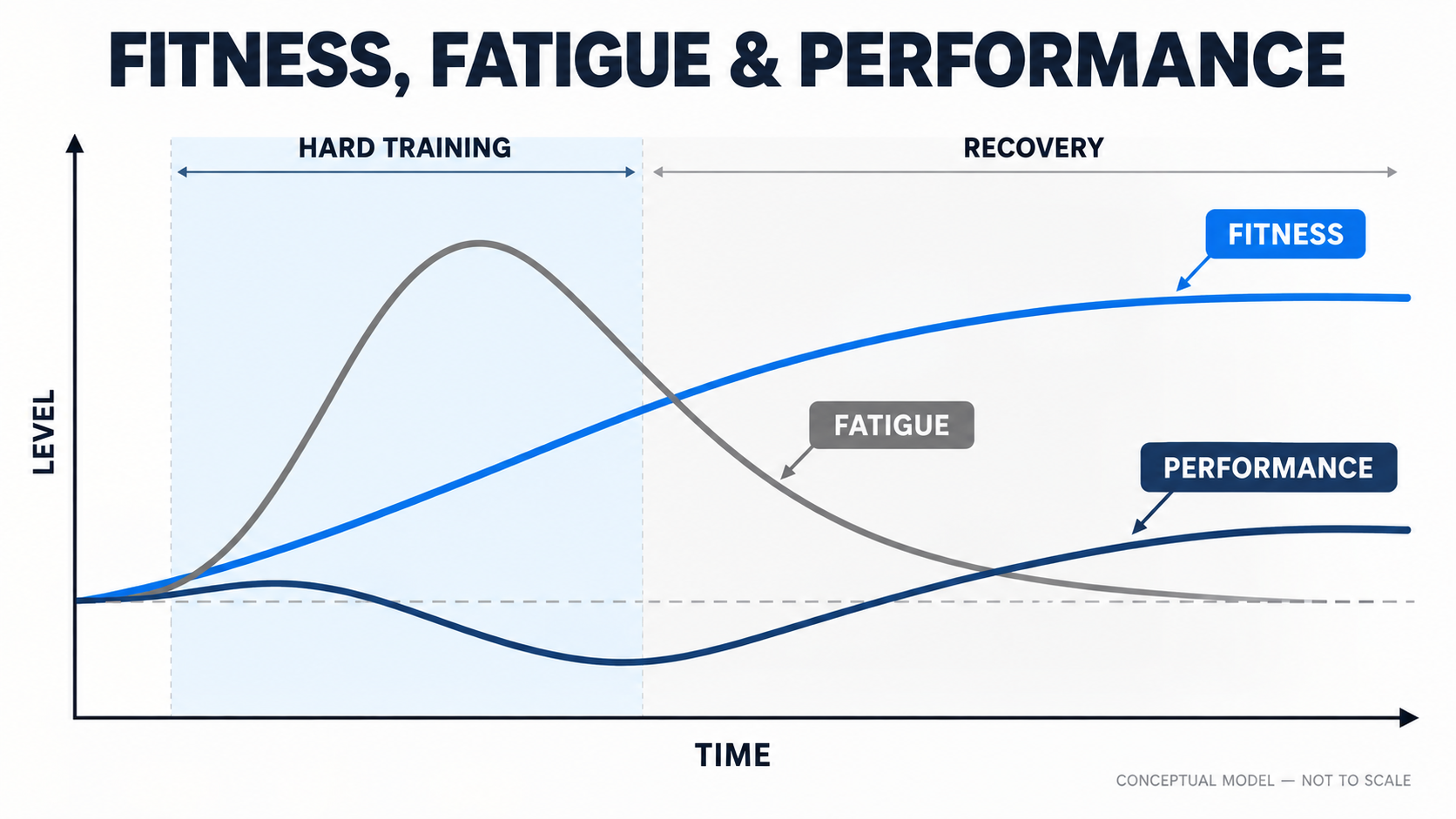
This is where the fitness-fatigue model becomes useful.
Training produces two broad things at the same time:
Fitness — the adaptations you want.
Fatigue — the temporary cost of producing those adaptations.
Your gym performance reflects both.
You can think of it conceptually as:
Performance ≈ Fitness − Fatigue
That is not a literal equation you need to calculate from your workouts. The fitness-fatigue model is a conceptual performance model, and researchers have cautioned against treating its estimated components as perfectly measured biological quantities. For a beginner, its practical value is simply understanding that fatigue can temporarily mask improvements in underlying fitness. [14]
Suppose your training has been productive, but you have also accumulated:
poor sleep,
muscular soreness,
stress,
unusually high training volume,
and several hard sessions.
Your new fitness may be partially hidden underneath fatigue.
That is why randomly adding more training whenever progress slows can sometimes make the situation worse.
How to Troubleshoot a Progressive Overload Plateau
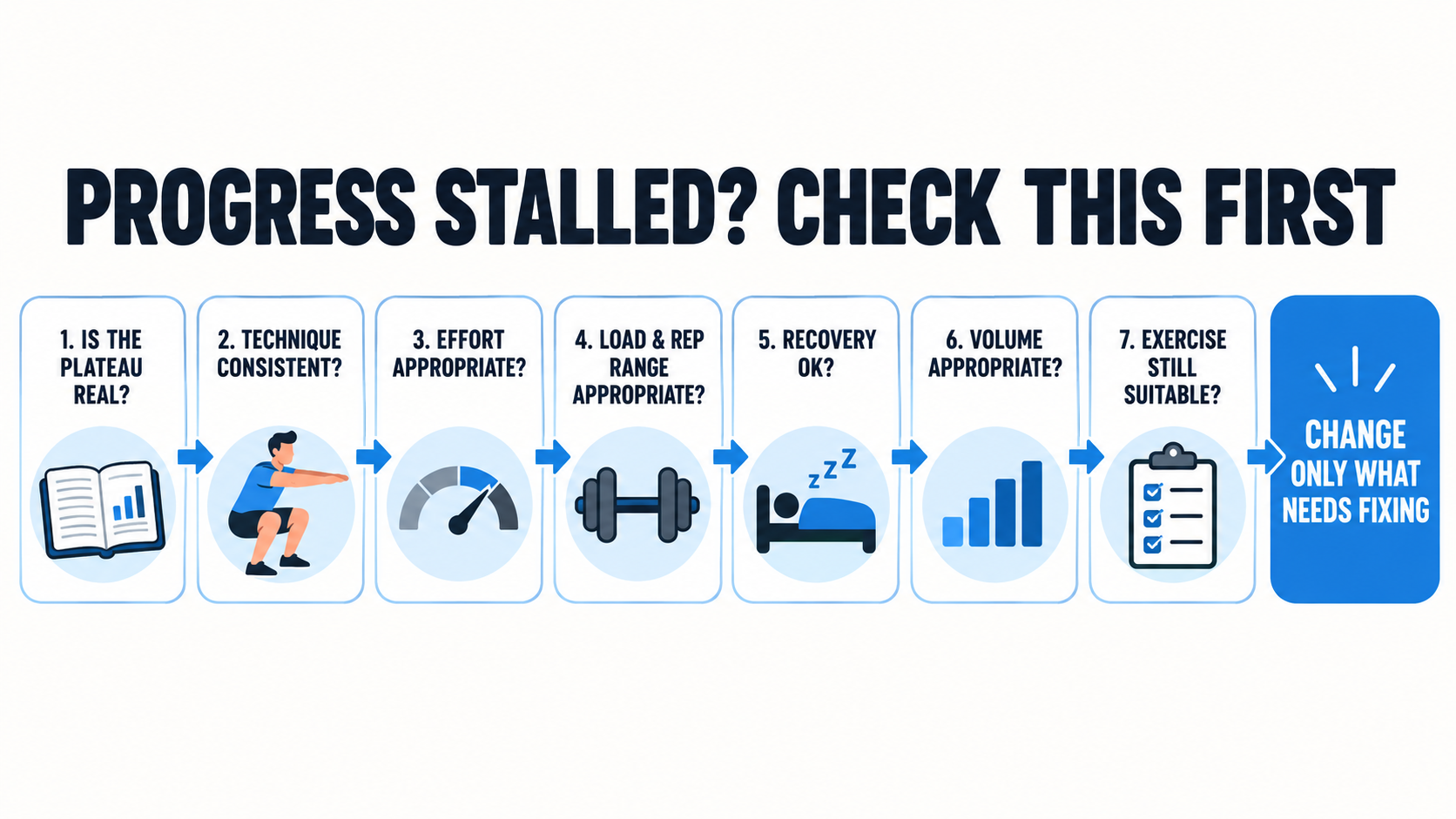
If progression really has stalled, do not immediately jump to:
“I need a new program.”
Use a sequence.
Step 1: Make Sure the Plateau Is Real
Compare several training exposures.
Check whether:
the same exercise was used,
the setup was similar,
range of motion was comparable,
rest periods were similar,
and the same progression target was used.
If not, you may have a measurement problem rather than a training problem.
Step 2: Check Your Technique
Has your execution actually improved?
Sometimes beginners become stricter with an exercise and temporarily perform fewer repetitions.
That can be a positive development.
If your old “12 reps” involved momentum and your new 10 reps are controlled through a better range of motion, the lower number may not represent regression.
Step 3: Check Your Effort
Are your working sets challenging enough?
If every set ends with 6–8 repetitions still available, your progression problem may simply be inadequate effort for the intended hypertrophy stimulus.
But also check the opposite problem.
If every set of every exercise is being pushed to absolute failure, you may be creating more fatigue than necessary.
Step 4: Check the Load and Rep Range
Maybe the next weight jump is simply too large.
Use:
a wider rep range,
smaller increments,
or more time at the current load.
Do not interpret equipment limitations as a failure of your body.
Step 5: Check Recovery
Ask whether anything has changed with:
sleep,
total calorie intake,
protein,
life stress,
illness,
sports,
cardio,
work or school demands,
or training outside your lifting program.
Training does not occur in isolation.
For recovery fundamentals, read Muscle Recovery Tips For Beginners.
Step 6: Check Your Training Volume
Volume can be too low.
It can also be unnecessarily high.
Do not automatically assume that stalled progress means you need more sets.
If several lifts are declining, you feel unusually fatigued, and recovery is deteriorating, reducing training stress temporarily may make more sense than adding work.
If recovery is excellent, training quality is high, effort is appropriate, and a persistent plateau remains despite sufficient time, then a programming adjustment may be justified.
Step 7: Evaluate the Exercise Itself
Ask:
Does this exercise fit me well?
Can I perform it comfortably?
Can I progress it in sensible increments?
Can I train the intended muscle effectively?
Is the equipment consistently available?
Do I actually enjoy it enough to keep performing it?
If the exercise repeatedly fails those tests, replacing it with an appropriate alternative can make sense.
When Should You Deload?
A deload is a temporary reduction in training stress designed to help fatigue dissipate.
Beginners do not automatically need a deload every fourth, sixth, or eighth week simply because the calendar says so.
Some programs intentionally schedule them.
Other lifters use them reactively.
A deload may become worth considering when several signs occur together, such as:
performance declining across multiple workouts,
unusual fatigue persisting,
motivation dropping sharply,
aches becoming more noticeable,
workouts feeling harder than normal,
and normal recovery habits no longer restoring performance.
A light week is not magic.
It simply reduces the training demand temporarily.
If performance rebounds afterward, accumulated fatigue may have been part of the problem.
If you repeatedly recover after a light week and then immediately become exhausted again, the larger issue may be that your normal training dose is more than you can currently recover from.
When Should You Reduce the Weight?
Reducing weight is not “going backward” when it solves a real problem.
Consider using less resistance when:
your technique is breaking down,
you cannot reach the lower end of your rep range,
your range of motion has substantially shortened,
a recent increase was clearly too large,
you are returning after time away,
or your program intentionally calls for reduced loading.
Your muscles do not know whether you feel emotionally attached to a number.
The goal is productive training.
When Should You Change an Exercise?
Beginners benefit from keeping exercises reasonably stable because repeated exposure helps you:
practice technique,
build skill,
establish a baseline,
and measure progress.
But there is no universal law requiring every beginner to change an exercise exactly after 8, 10, or 12 weeks.
Keep an exercise while it continues to be:
productive, tolerable, trackable, available, and appropriate for your goals.
Consider replacing it if:
it repeatedly causes significant discomfort,
another movement clearly fits you better,
equipment availability makes consistency impossible,
progression increments are consistently impractical,
motivation and adherence are suffering,
or the exercise remains genuinely stalled after the relevant variables have been addressed.
Variety can be useful.
Randomness is not the same thing as variety.
Progressive Overload for Muscle Growth vs. Strength
Progressive overload matters for both hypertrophy and strength, but the way you evaluate progression can differ because the goals differ.
For Maximum Strength
Strength is highly specific to:
the exercise,
the load,
the skill,
and the rep range.
Heavier resistance generally produces greater improvements in maximal strength than lighter resistance, particularly when strength is assessed with a heavy 1RM test. [10]
Someone trying to maximize a one-repetition maximum therefore needs meaningful exposure to heavier loading and the specific lifts they want to improve.
For Muscle Growth
Hypertrophy can occur across a wider range of loads when sets are sufficiently challenging.
Meta-analytic evidence suggests that muscle hypertrophy can be achieved across a fairly broad range of resistance-training loads when sets are performed with sufficient effort, while heavier loading generally provides a clearer advantage for improving maximal strength. [10]
That means a bodybuilding-focused beginner does not need to turn every exercise into heavy strength testing.
Moderate rep ranges are often practical because they balance:
loading,
technique,
fatigue,
comfort,
and ease of progression.
For example, a program might use lower-to-moderate reps on some compounds and moderate-to-higher reps on isolation exercises.
There is no single magical muscle-building rep number.
How Progression Changes as You Become More Experienced
The closer someone gets to their current potential, the slower improvements generally become.
A true beginner may sometimes add reps or load almost every time an exercise repeats.
An intermediate trainee may need several sessions.
An advanced trainee may work weeks or months for a small measurable improvement.
That does not mean the advanced lifter’s training stopped working.
The size of the available adaptation has become smaller.
This matters because social media can create unrealistic expectations.
You may see someone add:
20 pounds to a lift,
several repetitions,
or obvious muscle mass
and assume your training is failing because your improvement is smaller.
But training status, genetics, body size, exercise selection, experience, recovery environment, and starting point all influence the rate of progress.
Compare your training primarily with your own appropriately standardized past performance.
Why Beginners Should Not Copy Advanced Progression Methods
Advanced lifters sometimes use:
specialized volume phases,
complex periodization,
intensity techniques,
specialization blocks,
drop sets,
rest-pause methods,
partial repetitions,
or highly individualized fatigue management.
These can have a place.
But a beginner who has not yet learned to perform consistent working sets does not need to start with the most complicated tools available.
A beginner’s progression system can usually be:
Pick appropriate exercises → train them consistently → use appropriate effort → add reps when performance allows → add load when ready → recover → repeat.
That simplicity is a feature.
Not a limitation.
Common Progressive Overload Mistakes Beginners Make
1. Adding Weight at Any Cost
More weight is not meaningful progress if you shorten your range of motion, use substantially more momentum, or change the exercise just to move the load.
Keep the movement comparable enough that your logbook reflects genuine improvement.
2. Treating Every Workout Like a Test
Training is where you build capacity—not where you have to prove it every session.
You will not set a personal record every workout, and you do not need to.
3. Changing Too Many Variables at Once
If you simultaneously add weight, add sets, shorten rest periods, increase frequency, and train closer to failure, it becomes difficult to tell what helped and what created unnecessary fatigue.
Change what actually needs changing.
4. Automatically Adding More Sets When Progress Slows
More weekly volume can support additional muscle growth, but its benefits show diminishing returns and additional sets also increase training and recovery demands. [6]
Before adding volume, make sure your existing sets are productive and that you have actually stalled.
5. Using Shorter Rest Periods as Your Main Form of Progression
Completing the same workout faster can improve time efficiency or conditioning, but shorter rest is not automatically better for hypertrophy. Rest long enough to perform your next set effectively. [5]
6. Changing Exercises Too Often
Constant exercise switching makes it harder to develop technique and compare your performance over time.
Keep useful exercises reasonably stable while they remain productive and comfortable.
7. Expecting Perfectly Linear Progress
Some workouts will improve, some will stay the same, and some may temporarily be worse.
Judge the trend rather than demanding a personal record every session.
8. Not Tracking Your Training
You do not need to record every possible detail, but you should know your exercises, loads, repetitions, and working sets well enough to compare sessions.
9. Using Soreness or Failure as Proof of Progress
More soreness and more exhaustion do not automatically mean more muscle growth. Likewise, every set does not need to reach momentary muscular failure to be productive. [1,4]
10. Ignoring Recovery
Training performance is affected by more than the workout itself. Sleep, nutrition, stress, illness, other physical activity, and accumulated fatigue can all influence what you are able to do in the gym.
Progressive Overload Myths Beginners Can Ignore
“You Must Add Weight Every Week”
No. Increase resistance when your performance shows that you are ready—not because another week has passed.
“If the Weight Stayed the Same, You Did Not Progress”
You may have performed more repetitions, improved your execution, or completed the same performance with a more appropriate level of effort. Load is important, but it is not the only useful sign of progression.
“More Sets Always Mean More Growth”
Higher training volumes can support greater hypertrophy on average, but the relationship has diminishing returns. More work is not automatically better work. [6]
“You Need to Train to Failure for Progressive Overload”
No. Training sufficiently close to failure can be useful for hypertrophy, but reaching failure on every set is not required. [1,4]
“Slower Reps or Shorter Rest Automatically Mean More Overload”
Neither should be your default progression strategy. Repetition tempo appears to have a relatively small overall effect on hypertrophy across commonly studied tempos, while overly short rest periods can make subsequent sets harder to perform effectively. [5,7]
“More Tonnage Means More Muscle”
Sets × reps × load can describe work performed, but it is not a direct muscle-growth score. Larger increases in total volume load do not automatically produce proportionally greater hypertrophy. [8]
Progressive Overload Checklist for Beginners
Before increasing an exercise, check:
Am I following a structured program?
Is my exercise setup consistent?
Am I using a repeatable range of motion?
Is my technique still good?
Am I training hard enough for the goal?
Am I staying around my intended RIR?
Have my repetitions actually improved?
Have I reached my progression threshold?
Is the next load increase reasonable?
Am I recovering from my current training?
Am I judging a trend rather than one workout?
Am I changing only what needs to change?
If most of those pieces are in place, progressive overload becomes much less confusing.
Frequently Asked Questions About Progressive Overload
How Often Should Beginners Increase Weight?
There is no required schedule. Increase resistance when you reach your program’s progression target with appropriate technique, range of motion, and effort.
Some exercises may progress quickly, while others may remain at the same load for several sessions.
Can You Progress Without Adding Weight?
Yes. Adding repetitions with the same resistance is a valid progression strategy, and research has found that both repetition progression and load progression can produce muscular adaptations. [2,3]
Bodyweight exercises can also be progressed with harder variations or external resistance when appropriate.
What If I Cannot Add Another Rep?
Repeat the exercise as programmed.
One session without improvement is not a plateau. If performance remains genuinely stalled across multiple comparable workouts, begin troubleshooting.
Should I Increase Weight Once I Reach the Top of the Rep Range?
Usually, yes—provided your technique and range of motion remain consistent, the set is within the intended effort range, and the next weight increase is practical.
If the next jump is too large, stay at the current load longer, use a wider rep range when appropriate, or use a smaller increment if available.
Should Beginners Train to Failure?
Not on every set. Training close enough to failure matters for hypertrophy, but reaching momentary failure on every working set is not necessary. [1,4]
Is Better Form Progressive Overload?
Better technique is valuable progress, but it is more useful to think of technique as something that makes your performances comparable.
Once your execution improves, keep it reasonably consistent so future changes in repetitions and load actually mean something.
Can Machines Be Used for Progressive Overload?
Yes. Machines can be especially convenient because resistance is easy to adjust and performance is straightforward to track.
When possible, use the same machine and settings from one workout to the next.
How Long Should I Keep the Same Exercise?
There is no mandatory 8- or 12-week expiration date.
Keep an exercise while it remains productive, comfortable, practical, and appropriate for your goal.
Is Progressive Overload Necessary for Muscle Growth?
Long-term training needs to remain sufficiently challenging as your body adapts, but that does not mean you must increase something every workout.
Progression is how you adjust the training stimulus as your capabilities improve.
What If My Strength Goes Down for One Workout?
Usually, nothing needs to change based on one session alone.
Watch the trend and consider normal factors such as sleep, nutrition, stress, exercise order, and fatigue.
What If I Have Been Stuck for Several Weeks?
First make sure the performances are actually comparable. Then review your technique, effort, recovery, load selection, nutrition, training volume, and exercise choice before making a larger programming change.
Your Next Workout: A Beginner Progressive Overload Action Plan
If all of this information feels like a lot, use this simple process during your next training phase.
Step 1: Follow a Structured Program
Do not build progression on top of random workouts.
If you need a complete starting structure, begin with my Beginner Bodybuilding Workout Plan or 3 Day Workout Schedule For Beginners.
Step 2: Give Each Exercise a Rep Range
Example:
Machine Chest Press — 3 × 8–12
Step 3: Choose a Manageable Starting Load
Use a weight that lets you perform the movement correctly inside the rep range with the intended effort.
You do not need to begin at the heaviest load you can survive.
Step 4: Record the Workout
Write down:
weight + repetitions for every working set
Add RIR when useful.
Step 5: Try to Improve Performance Over Time
That might mean one additional repetition somewhere in the exercise.
It does not need to happen every workout.
Step 6: Increase the Resistance When You Are Ready
Once you reach your progression threshold with solid execution and appropriate effort, make the smallest sensible increase.
Step 7: Let Reps Fall and Build Them Back Up
Do not panic when the heavier resistance puts you near the lower end of the range.
That is the point.
Step 8: Watch the Trend
One bad workout means very little.
Several weeks of genuinely stalled or declining performance deserve investigation.
Step 9: Troubleshoot Before Adding More Work
Do not automatically add sets.
Check:
technique → effort → load → recovery → nutrition → volume → exercise selection
Step 10: Stay Patient
Progressive overload is a long-term training principle.
It is not a challenge to see how fast you can turn every set into a maximum-effort test.

Progressive Overload Key Takeaways
- Progressive overload means keeping your training stimulus appropriately challenging as your body adapts.
- You do not need to improve every workout. Judge progress across multiple comparable sessions.
- Double progression is a simple beginner method: build repetitions within a range, increase the resistance when ready, then build the repetitions back up.
- Keep technique, range of motion, exercise setup, and rest conditions reasonably consistent so your logbook comparisons mean something.
- Train with sufficient effort, but do not assume every working set must reach absolute failure.
- Increase resistance by the smallest practical amount when your performance supports it.
- Adding sets is a programming decision, not the automatic solution to every plateau.
- Track your workouts and distinguish one off day from a persistent stall.
- If progress genuinely stalls, troubleshoot technique, effort, loading, recovery, nutrition, volume, and exercise selection before changing everything.
- As you become more experienced, expect measurable progression to occur more slowly.
Final Thoughts
Progressive overload does not need to be complicated, but it does need to be understood correctly.
The goal is not to walk into every workout thinking:
“I have to do more today no matter what.”
A better approach is to train productively, keep your important variables reasonably consistent, record your performance, recover, and let improved ability tell you when it is time to progress.
That means the number in your logbook is feedback, not a command.
Sometimes progress means another repetition. Sometimes it means a small increase in resistance. Sometimes it means performing the same workout again because nothing needs to change yet.
For beginners, the overall process can stay simple:
Learn the exercise. Train it hard enough. Track it. Build quality repetitions. Increase resistance when appropriate. Recover. Repeat.
Over time, that turns progressive overload from a confusing fitness buzzword into what it should be: a practical way to keep your training matched to your improving ability.
Beginner Bodybuilding Guides on Lift & Nurture
If you want to build the rest of your training around the progression system explained here, these guides are useful next steps:
Beginner Bodybuilding Workout Plan (12-Week Foundation Blueprint) — A structured beginner foundation for applying progressive resistance training.
3 Day Workout Schedule For Beginners — A manageable full-body schedule for beginners.
4 Day Workout Routine For Beginners — An upper/lower option for beginners who prefer four weekly training days.
Beginner Weight Training Sets And Reps — Learn how to choose workable set and rep targets.
Muscle Group Sets Per Week For Beginners — Understand weekly volume before deciding to add more sets.
How Hard Should Beginners Train For Muscle Growth? — A deeper guide to RIR, effort, and proximity to failure.
How To Structure Workout Rest Periods — Learn how long to recover between working sets.
Muscle Recovery Tips For Beginners — Sleep, fatigue, rest days, and recovery fundamentals.
Beginner Bodybuilder Exercises — Beginner-friendly exercise-selection guidance.
Beginner Fitness Plans After A Break — A more conservative approach for returning after time away.
References
Currier BS, et al. American College of Sports Medicine Position Stand. Resistance Training Prescription for Muscle Function, Hypertrophy, and Physical Performance in Healthy Adults: An Overview of Reviews. Medicine & Science in Sports & Exercise. 2026. This updated ACSM position stand synthesized 137 systematic reviews involving more than 30,000 participants.
Plotkin D, et al. Progressive overload without progressing load? The effects of load or repetition progression on muscular adaptations. PeerJ. 2022. Both increasing repetitions and increasing resistance produced muscular adaptations across the eight-week intervention.
Kassiano W, et al. Effects of Resistance Training Overload Progression Protocols on Strength and Muscle Mass. 2024. This randomized study in previously untrained young adults directly compared load progression with repetition progression over 10 weeks.
Robinson ZP, et al. Exploring the Dose-Response Relationship Between Estimated Resistance Training Proximity to Failure, Strength Gain, and Muscle Hypertrophy: A Series of Meta-Regressions. Sports Medicine. 2024.
Singer A, et al. Give it a rest: a systematic review with Bayesian meta-analysis on the effect of inter-set rest interval duration on muscle hypertrophy. 2024.
Pelland JC, Remmert JF, Robinson ZP, Hinson SR, Zourdos MC. The Resistance Training Dose Response: Meta-Regressions Exploring the Effects of Weekly Volume and Frequency on Muscle Hypertrophy and Strength Gains. Sports Medicine. 2026.
Enes A, et al. How Slow Should You Go? A Systematic Review With Meta-Analysis of the Effect of Resistance Training Repetition Tempo on Muscle Hypertrophy. Journal of Strength and Conditioning Research. 2025.
Hammert WB, et al. Progression of total training volume in resistance training studies and its application to skeletal muscle growth. Physiological Measurement. 2024.
Kassiano W, et al. Which ROMs Lead to Rome? A Systematic Review of the Effects of Range of Motion on Muscle Hypertrophy. Journal of Strength and Conditioning Research. 2023.
Lopez P, et al. Resistance Training Load Effects on Muscle Hypertrophy and Strength Gain: Systematic Review and Network Meta-analysis. Medicine & Science in Sports & Exercise. 2021.
Refalo MC, et al. Influence of resistance training load on measures of skeletal muscle hypertrophy and improvements in maximal strength and neuromuscular task performance: A systematic review and meta-analysis. 2021.
Helms E, Morgan A, Valdez A. The Muscle & Strength Pyramid: Training, 3rd Edition. 2025.
Nippard J. The Muscle Ladder. 2024.
- Vermeire K, Ghijs M, Bourgois JG, Boone J. The Fitness-Fatigue Model: What’s in the Numbers? International Journal of Sports Physiology and Performance. 2022;17(5):810–813.
About the Author
Angel Carcamo is the founder of Lift & Nurture, a beginner bodybuilding website focused on making evidence-based training, nutrition, and muscle-building fundamentals easier to understand.
Angel is 19 and still considers himself a beginner. His earlier training was not structured around the evidence-based principles he studies today, and after pushing his training beyond what he could recover from as a teenager, he spent an extended period away from consistent lifting.
During that time, he began studying resistance-training research and science-based bodybuilding more seriously.
Lift & Nurture does not present Angel as a veteran coach or advanced bodybuilder. Instead, the goal is to research established training principles carefully, explain what the evidence actually supports, acknowledge uncertainty where it exists, and turn complicated fitness information into practical beginner guidance.
Start here: Beginner Bodybuilding Roadmap
Foundation program: Beginner Bodybuilding Workout Plan (12-Week Foundation Blueprint)
This article is for educational purposes and is not a substitute for individualized medical care, rehabilitation, or professional coaching.
Great guide! I like how clearly you explained progressive overload, especially for beginners who can easily feel overwhelmed when starting strength training. The step-by-step examples and the double progression method make the concept much easier to understand and apply. Tracking workouts and focusing on small improvements really does make a big difference over time. Do you find that most beginners struggle more with tracking their progress or with knowing when to increase the weight?
Thank you so much, Monica — I’m really happy the step-by-step examples helped.
And yes — most beginners struggle with tracking at first, and a lot of them also get stuck on when to increase weight because they think it has to happen every workout. What I see most often is:
They don’t write down sets/reps, so they’re guessing week to week
Or they jump weight too soon and form breaks down
A simple beginner rule that helps a lot is: earn the weight increase.
If your rep range is 8–12, stay at the same weight until you can hit the top end of the range across all sets with solid form, then increase by the smallest jump.
Example:
3×8–12 → once you hit 3×12 clean, go up in weight → you’ll probably be back near 3×8 and repeat.
If someone hates tracking, the “minimum effective” version is just writing exercise + weight + reps in your phone notes. That alone makes progress way easier to see.
Also, recovery matters a ton here — if protein and sleep are off, progression feels way harder than it needs to. My protein guide for beginners can help with that side too.
I agree that it is better to increase repetitions first before increasing the load. Once the repetitions get easy then you know your are ready for a heavier weight.
It is also no good doing the exercise with the incorrect form, as you could do more damage than good. Take care as you get fatigued that the form does not go, as then you are not doing yourself any favors.
Do you recommend that beginners should get either a workout buddy or coach to help them do the exercises correctly rather than just winging it or following You Tube?
Great points, Michel — you’re absolutely right.
For beginners, improving repetitions first while maintaining solid form is one of the safest and most effective ways to progress. Once the reps feel controlled and consistent, increasing the weight makes much more sense. Trying to jump weight too early often leads to sloppy technique or stalled progress.
Form is especially important because it determines whether the target muscles are actually being trained and helps reduce injury risk. If form breaks down as fatigue builds, that’s usually a sign to stop the set rather than push through.
Regarding your question: a workout buddy or coach can be extremely helpful, especially in the early stages. A knowledgeable partner can provide real-time feedback, encouragement, and safety during heavier lifts. A qualified coach is even better if someone wants personalized guidance and faster skill development.
That said, many beginners can still make excellent progress on their own by focusing on fundamentals — using reputable instructional sources, recording their lifts to check technique, progressing gradually, and prioritizing consistency over intensity.
The most important factor isn’t whether you train alone or with someone — it’s whether you follow a structured plan, apply progressive overload patiently, and recover properly.
Thanks for sharing your insights and asking such a thoughtful question.