 Learning how to apply progressive overload is one of the most important skills for beginners who want to build strength and muscle consistently. Progressive overload is the core driver behind the Beginner Bodybuilding Workout Plan (12-Week Foundation Blueprint), where it is applied through a structured full-body program. If you’re new to lifting or returning after time away, progressive overload can feel confusing at first — but learning this skill early can prevent years of stalled progress.
If you’re just starting strength training or bodybuilding, you may have heard trainers or online guides talk about “progressive overload.” Many beginners hear that they need to challenge themselves to see results, but the process of doing that safely and effectively is often unclear. Understanding and applying progressive overload can help break plateaus and continue improving, even when results begin to slow down.
This step-by-step guide explains progressive overload in the simplest way possible for beginners. Since most beginners apply these methods in commercial gyms, it’s also helpful to understand basic gym etiquette so you can train effectively while respecting shared equipment and other lifters. This isn’t just about theory; it’s a practical approach for beginners following a 3-day full body routine or a starter muscle-building plan. By the end, you’ll have a clear checklist and tips you can use every week to keep moving forward, avoid injuries, and stay motivated for the long haul.
Let’s get into everything you need to know about progressive overload for beginners.
Muscle growth for beginners depends on three key factors: structured training, proper nutrition, and consistent recovery
This guide is for educational purposes only and does not replace individualized coaching or medical advice.
Table of Contents
- Quick Answer: How to Implement Progressive Overload
- What Is Progressive Overload?
- Why Progressive Overload Confuses Beginners
- 4 Practical Ways to Apply Progressive Overload
- How Double Progression Works (With Example)
- Tracking Lifts to Monitor Progress
- When to Increase Weight
- When NOT to Increase Weight
- Using RIR to Manage Progression Safely
- How Long to Stick With the Same Exercises
- Realistic Timeline for Strength and Muscle Gains
- Common Beginner Mistakes That Cause Plateaus
- Progressive Overload Checklist for Beginners
- Frequently Asked Questions (Progressive Overload)
- Key Takeaways
- Your Next Steps
- Final Thoughts
- Beginner Bodybuilding Guides on Lift & Nurture
- References
- About the Author
How to Implement Progressive Overload for Beginners (Quick Answer)
Beginners can implement progressive overload by gradually making workouts more challenging over time within a structured training program.
The most effective methods include:
- Increasing the weight used in an exercise
- Performing more repetitions with the same weight
- Adding additional sets to a workout
- Improving exercise control and technique
- Reducing rest time between sets
Most beginners should focus on improving repetitions first, then increase weight once the top of the rep range is reached. Small improvements each week lead to steady strength and muscle gains.
What is Progressive Overload? (Beginner-Friendly Definition)
Progressive overload means gradually increasing the challenge of your workouts through sets, reps, weight, and training volume. If you’re unsure how much total training volume beginners actually need, see my guide on Muscle Group Sets Per Week For Beginners. You can do this by slowly making an exercise harder, either by lifting heavier, doing more reps, adding an extra set, or making your form more controlled and precise. Progressive overload is widely considered a foundational principle of strength training and muscle development.
If you don’t change anything in your routine, your muscles quickly adapt. That means they simply stop responding and you’ll find you aren’t getting stronger, building muscle, or seeing any change in how you look or feel. Progressive overload keeps your body challenged in a safe and steady way, so results keep coming. Research on progressive overload in resistance training shows that gradually increasing training demands is essential for continued muscle and strength gains. Even small changes each week “signal” your body to keep adapting.
Why Progressive Overload Confuses New Lifters
Many beginners make common mistakes when first learning about progressive overload, often assuming weight must increase every workout or that “more is always better.” Sometimes lifters chase heavier numbers without focusing on proper form, while others repeat the exact same reps and sets for months and wonder why nothing changes.
Here are common beginner confusions:
- Thinking progressive overload is only about lifting more weight.
- Trying to increase everything (weight, reps, sets) at once, leading to burnout.
- Neglecting good exercise form just to “progress.”
- Not tracking workouts, so it’s unclear if any real progress is happening over time — especially when following a beginner workout program.
Patience goes a long way. Progress happens with small, regular steps. Setting a game plan right away helps you avoid frustration and early plateaus.
4 Practical Ways to Apply Progressive Overload
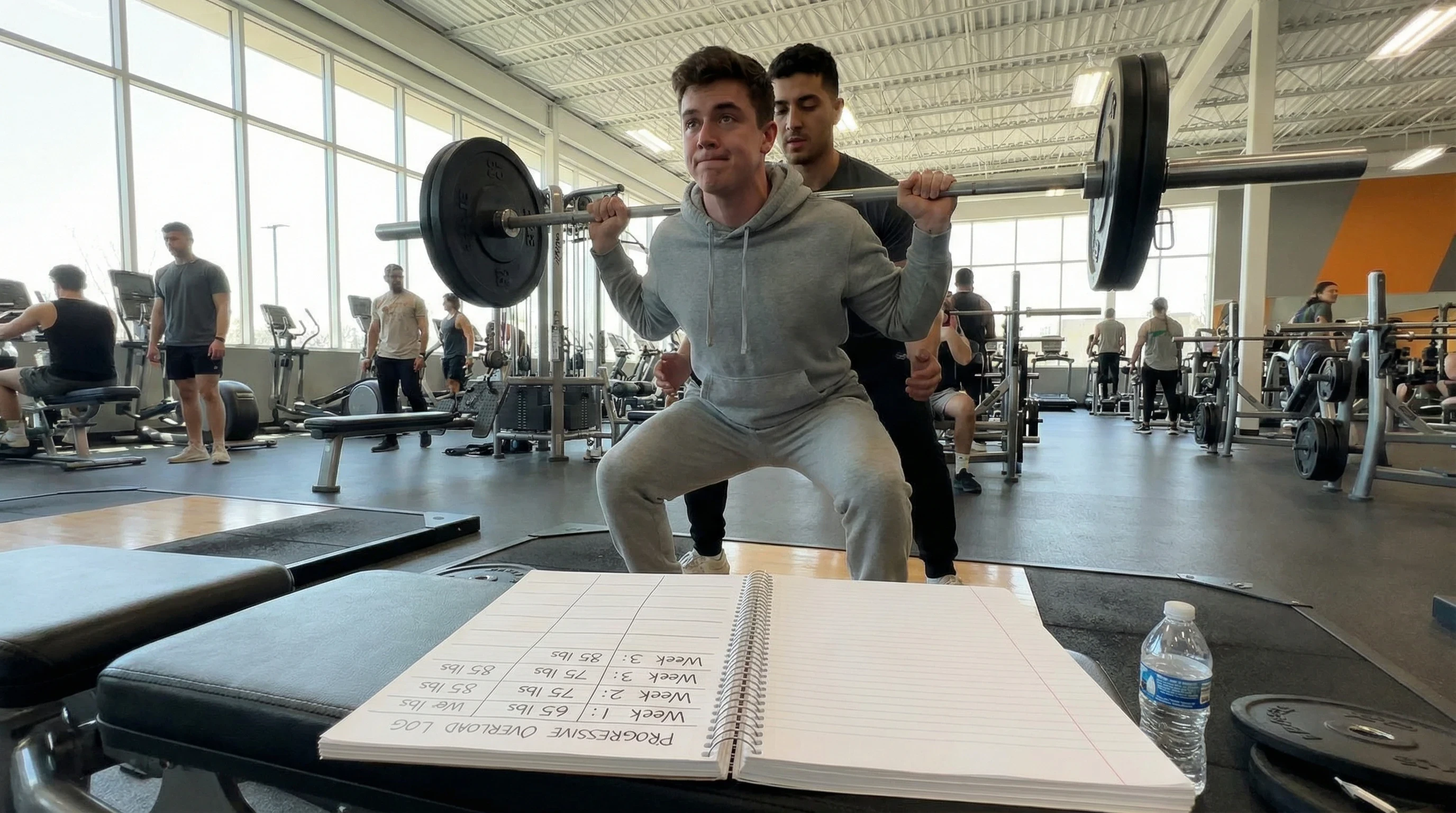
Four simple methods work especially well for beginners and are widely recommended in strength training programs:
- Increase Reps: Do more repetitions with the same weight (for example, taking your squat from 2 sets of 8 reps to 2 sets of 10 reps).
- Increase Weight: Use the same number of reps and sets, but go up in weight (like moving from 20 lbs to 22.5 lbs on your dumbbell press).
- Increase Sets: Add an extra set with the same weight and reps (such as moving from 2 sets of 10 reps to 3 sets of 10 reps). This increases your total weekly training volume, which should stay within a manageable range for beginners—explained further in my guide on Muscle Group Sets Per Week For Beginners.
- Improve Form or Control (Tempo), especially when performing foundational movements from a beginner exercise list: Make each rep slower and more controlled, or shorten rest periods. If you are unsure how to adjust rest safely, this guide on how to structure workout rest periods explains beginner-friendly rest ranges for different exercises.
You don’t need to adjust all four at once. Usually, it’s easiest for beginners to work on one aspect, see progress, and then switch focus once things get tougher. Changing just one factor at a time is safer and gives clear results.
Before increasing difficulty on major lifts like the squat, it’s important to make sure your technique is solid. This step-by-step barbell squat tutorial explains how beginners can perform the movement safely and efficiently from the start.
How Double Progression Keeps You Improving (With a Real Example)
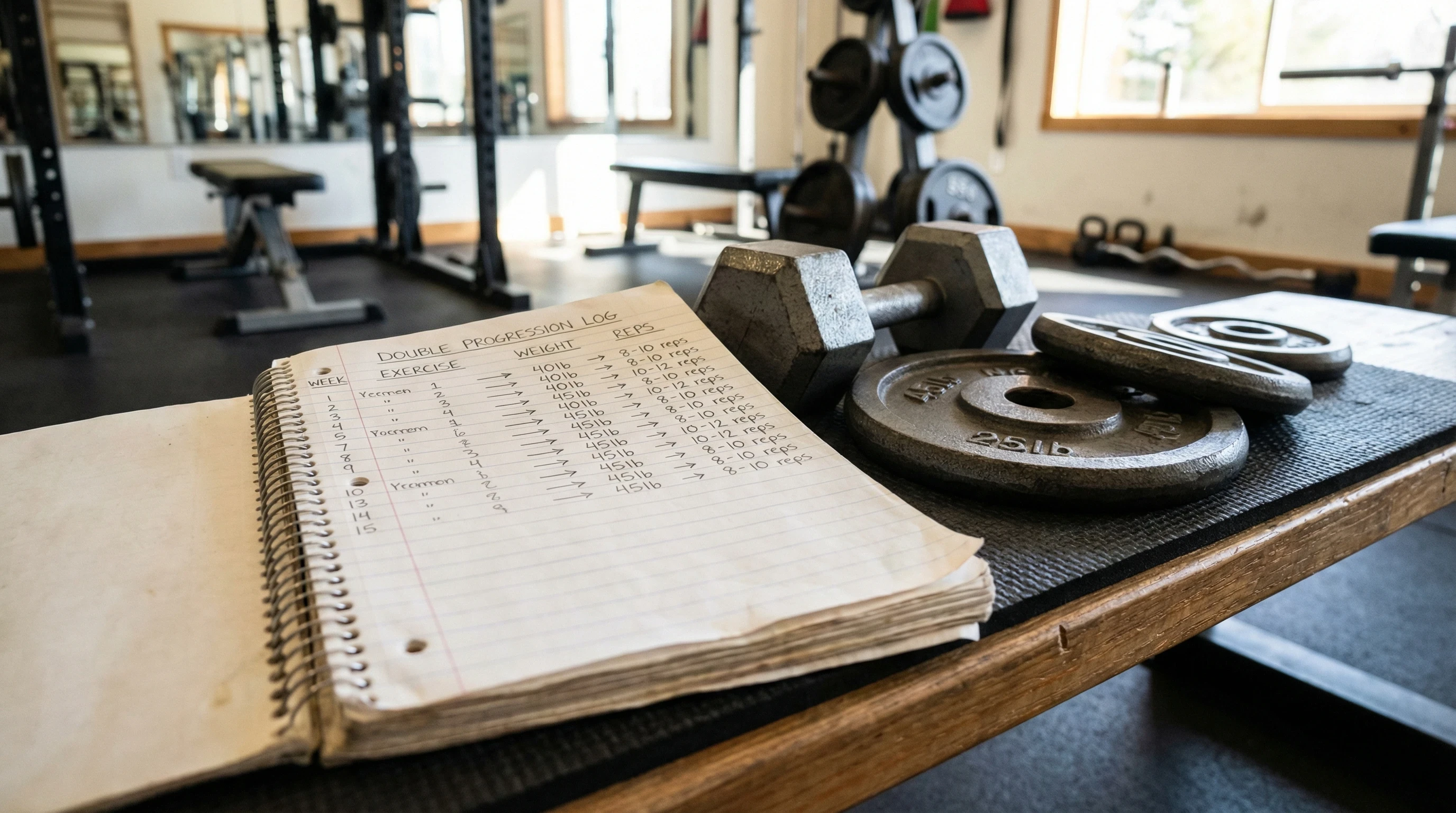
One effective strategy used in many beginner programs is the double progression method.
Here’s how it works:
- Pick a set and rep range. For example, 3 sets of 8-12 reps for barbell rows. If you need help choosing the right training volume, see my guide on Beginner Weight Training Sets and Reps, along with my guide on Muscle Group Sets Per Week For Beginners.
- Stick with the same weight, working to boost your reps each workout until you reach the top of the rep range in all your sets.
- Once you can do 12 reps for all three sets (using solid form), increase the weight by the smallest jump possible, usually 2.5 to 5 lbs per side. If you’re unsure how many sets and reps beginners should start with before progressing, read Beginner Weight Training Sets and Reps.
- With the new heavier weight, you’ll likely be back to 8 reps again. The cycle repeats. Over weeks, your strength and muscle build steadily.
Example:
- Week 1: 3 x 8 x 40 lbs
- Week 2: 3 x 10 x 40 lbs
- Week 3: 3 x 12 x 40 lbs
- Week 4: 3 x 8 x 45 lbs (next jump up in weight, back at lower reps)
This is slower than adding weight every session, but it keeps you safe and reduces frustration from hitting a wall. It also stops you from cheating or using momentum just to move more weight. Over time, these incremental improvements really stack up.
Step-by-Step: Tracking Lifts to Monitor Progress Weekly
Tracking workouts is essential when applying progressive overload in a structured routine.
Step 1: Use a tracking method
Use a notebook or training app to record exercises, weights, sets, and reps.
Step 2: Record every workout
After each set, write down the number of reps performed. For example:
Squat – 65 lbs: 3 sets (10 / 9 / 7 reps)
Step 3: Look for weekly improvements
The goal is not necessarily beating every number every session, but seeing gradual improvements such as one extra rep, improved control, or a small weight increase.
Step 4: Review progress monthly
Every 4–6 weeks, review trends in performance. If progress stalls for multiple weeks, recovery factors like sleep, nutrition, or program design may need adjustment.
How to Know When It’s Time to Add Weight
Weight should generally increase once the top of the rep range can be reached across all sets while maintaining good form.
For example, if the overhead press rep range is 3 sets of 8–12, weight can increase once 3 sets of 12 reps are achieved.
Small weight jumps work best for beginners:
Upper body exercises: 2.5–5 lbs
Lower body exercises: 5–10 lbs
Increasing weight too quickly can lead to missed reps or poor technique. Slow and consistent progression leads to safer and more sustainable results.
When NOT to Increase Weight
Weight increases should be avoided when:
- Form begins to break down (such as rounding during deadlifts)
- The last sets fall far below the target rep range
- The movement suddenly feels much harder than the previous week
- Fatigue, illness, or poor sleep affects performance and recovery capacity
Sometimes a lighter training week (often called a deload week) helps restore progress and reduce injury risk.
Using RIR (Reps in Reserve) to Manage Progression Safely
RIR stands for “reps in reserve”—how many reps you could do before failure. Beginners should aim for 1-3 RIR during most working sets to balance training intensity and recovery. That means after completing your set, you feel like you could do one to three perfect reps more, but you stop there. Progressive overload only works if you can actually recover from the training. For a beginner-friendly breakdown of sleep, rest days, and the biggest recovery mistakes that stall progress, see Muscle Recovery Tips for Beginners.
Training this way means you’re working hard, but not so hard that you risk burning out or getting injured. Many lifters track their RIR in a training log (“Bench Press: 3 x 8, 2 RIR”) to check if things are getting easier over the weeks. This clear feedback helps prevent pushing too hard and keeps gains steady.
How Long to Stick With the Same Exercises
Choosing the right movements in the first place is just as important. This guide to beginner bodybuilder exercises explains which foundational lifts respond best to progressive overload.
Beginners should generally stick with foundational exercises like squats, bench presses, rows, and deadlifts for at least 12 weeks.
This allows muscles and joints to adapt while providing enough time to see measurable strength improvements. Changing exercises too frequently slows progress because form must constantly be relearned.
Exercise changes usually become necessary only after long plateaus or when motivation significantly drops.
Realistic Timeline: What to Expect With Strength and Muscle Gains
Many beginners expect dramatic results within the first few weeks, but real progress typically takes time.
Most beginners experience noticeable strength increases within 4–6 weeks, particularly on major compound lifts.
Visible muscle growth often begins appearing after 8–12 weeks, provided training consistency, sufficient protein intake, and good sleep habits are maintained.
Progress rarely occurs in a perfectly straight line. Periods of rapid improvement are often followed by slower phases. Staying focused on small weekly improvements leads to significant long-term results.
For a deeper breakdown of muscle-building timelines and what beginners should realistically expect over months and years of training, see my guide on How Long It Takes Beginners to Build Muscle.
Common Beginner Mistakes That Cause Training Plateaus
- Not tracking sets, reps, and weights, so it’s hard to spot real improvement.
- Jumping to heavier weights before you’re ready, which can hurt form and risk injury.
- Switching exercises too often before mastering the basics.
- Not eating enough or getting quality sleep, which slows or stalls recovery.
Eating enough calories is just as important as training progression. If you’re unsure how much to eat, read my guide on how many calories beginners should eat to build muscle.
- Going to muscular failure every set, causing excessive soreness or burn out.
- Not resting enough between tough sets — or not understanding proper rest periods between sets, or stacking lots of cardio right after lifting.
Many of these issues appear alongside other beginner training errors, which are covered in this guide on workout mistakes for beginners that slow muscle growth.
Avoiding these mistakes makes training more productive and sustainable.
Progressive Overload Checklist for Beginners
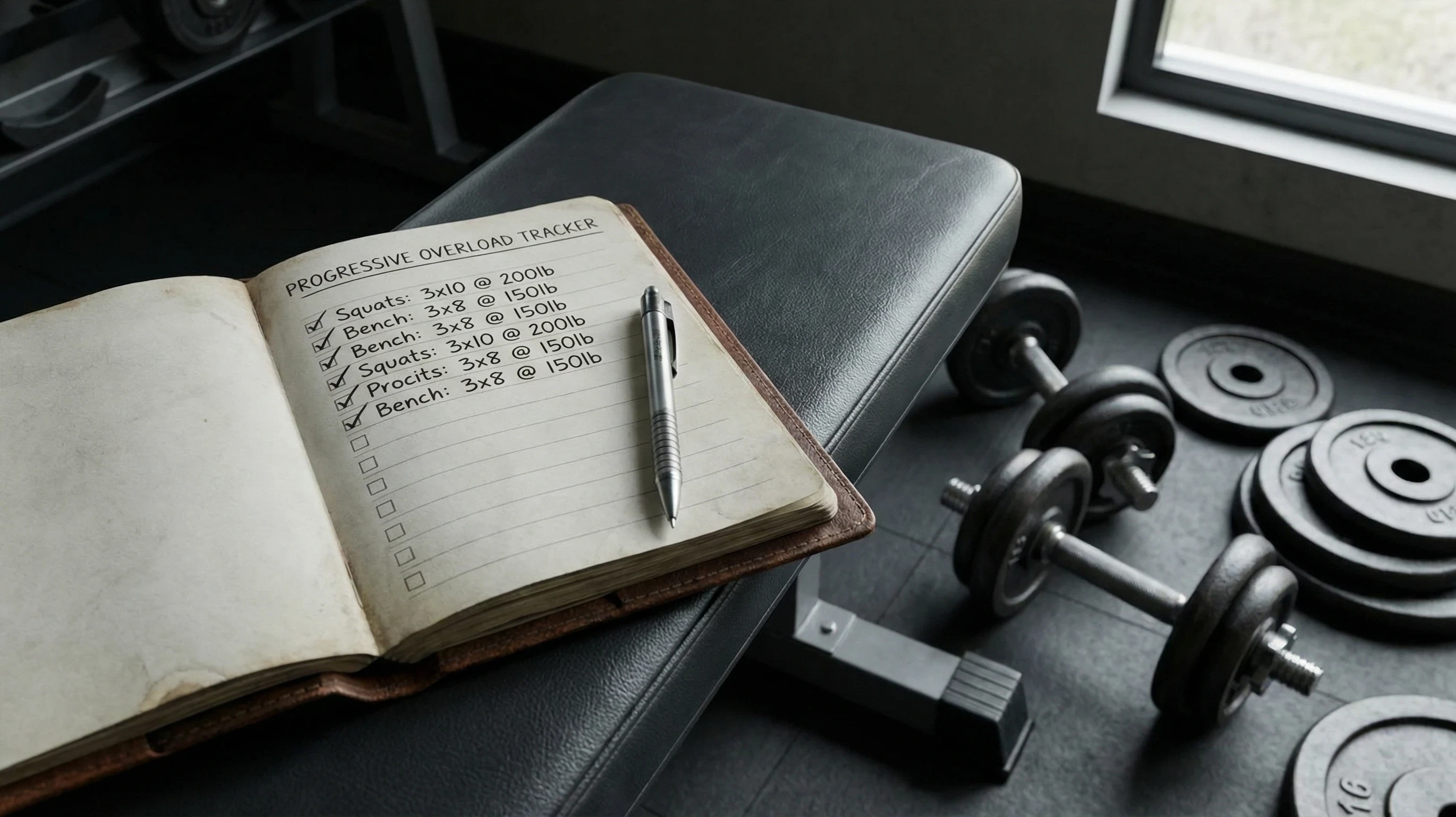
- Write down every set, rep, and weight for each session.
- Stick with your primary exercises for at least 8-12 weeks.
- Build up to the top of your rep range before bumping up the weight.
- Keep form tight, even when things get heavy.
- Training with 1-3 reps in reserve on most sets is a safe bet.
- Eat plenty of protein (see this guide on how much protein beginners need to build muscle) plus solid sleep each night and recovery habits.
- Adjust only one variable (weight, reps, sets, tempo) at a time in your workouts.
Frequently Asked Questions (Progressive Overload)
How often should I increase the weight?
For beginners, aim to add a small amount of weight every 1-3 weeks, depending on the exercise and how quickly you hit the top of your target rep range. Don’t worry if things slow down after the first month—expect steady, not constant, progress.
Can I use progressive overload without adding weight?
Yes! Adding reps, sets, improving your technique, slowing your tempo, or reducing rest breaks are all valid ways to push your muscles, especially for bodyweight or dumbbell movements where weight jumps might be large.
What if I don’t increase weight every week?
That’s totally normal. Early in your program, progress will feel quick, but later it slows. Improving your form, squeezing out an extra rep, or repeating a strong performance still count as progress.
Should beginners train to failure?
No. Leaving 1-3 reps in reserve gives you enough intensity without burning out. Training to failure every set can slow recovery and progress in the long run. Save failure for advanced lifters or occasional finishers.
How do I know if I’m progressing too fast?
If you notice sore joints, nagging pains, or decreasing form quality, it’s a sign to pull back. Listen to your body and focus on good technique plus steady gains, not just racking up numbers.
How long should I keep the same exercises?
Stick with foundational movements for 8-12 weeks. To make those 8–12 weeks productive, it also helps to understand beginner sets and reps for weight training. This helps you build both skill and muscle. Switch things up only after hitting a real plateau, growing bored, or finishing a phase, like moving from a 3 Day Full Body Workout Schedule to something more advanced.
Is progressive overload necessary for muscle growth?
Yes. Muscle growth stops if you’re not making your workouts harder over time. Even small gradual increases—more reps, better control, tougher sets—send the signal for new muscle to grow.
Progressive Overload Key Takeaways
- Progressive overload means gradually increasing workout difficulty
- Beginners should prioritize repetitions before increasing weight
- Tracking workouts is essential for consistent progress
- Small weekly improvements lead to long-term muscle growth
- Recovery and good form are critical for safe training
Your Next Steps With Progressive Overload
- Pick one way to push yourself further this month (either reps, weight, sets, or cleaning up form).
- Track every workout in a simple logbook or app—consistency is everything.
- Stay patient. Steady progress stacks up more reliably than constantly chasing huge leaps.
- Keep your beginner or full body routine steady, especially if you’re following a 3 day workout schedule for beginners.
Tweaking just one thing at a time, and tracking your sessions, pays off fast for new and returning lifters. Don’t sweat slow weeks. Every bit of effort you put in stacks up—over weeks and months, you’ll be amazed at your progress. Got more questions? Drop them in the comments or look through my other guides for beginner lifters looking for clear answers.
Final Thoughts
Progressive overload is not about doing more for the sake of doing more. It’s about applying small, consistent improvements over time while maintaining good form and recovery.
Beginners who focus on steady progression, track their workouts, and stay patient will build strength and muscle far more effectively than those chasing rapid increases.
Mastering progressive overload early gives you a long-term advantage. It turns training from guesswork into a structured process you can rely on for years of consistent progress.
Beginner Bodybuilding Guides on Lift & Nurture
If you’re building a beginner strength program, these guides can help you apply the principles explained in this article:
•Beginner Bodybuilding Workout Plan (12-Week Foundation Blueprint) – A 12-week foundation plan covering training structure, recovery, nutrition, and progressive overload.
• 3 Day Workout Schedule for Beginners – A simple beginner routine designed to help you apply progressive overload consistently while balancing training and recovery.
• Muscle Building Nutrition Guide for Beginners – A simple beginner meal plan and nutrition strategy to support muscle growth and recovery.
• How Many Calories Should Beginners Eat to Build Muscle? – Learn how to calculate maintenance calories and create a small calorie surplus for steady muscle growth without unnecessary fat gain.
• Beginner Weight Training Sets and Reps – Learn how many sets and repetitions beginners should perform to build muscle, improve strength, and structure effective workouts.
• Muscle Group Sets Per Week For Beginners – Learn how many sets each muscle group needs per week and how to structure your total training volume for consistent muscle growth.
References
Schoenfeld BJ. The mechanisms of muscle hypertrophy and their application to resistance training. Journal of Strength and Conditioning Research. Available via PubMed: https://pubmed.ncbi.nlm.nih.gov/20847704/
About the Author
Angel Carcamo is the founder of Lift & Nurture, a beginner bodybuilding platform focused on structured training, muscle growth fundamentals, and long-term progress.
As a beginner himself, Angel creates content based on evidence-backed principles commonly recommended in strength training, breaking them down into clear, simple steps for new lifters.
His guides focus on key fundamentals like progressive overload, recovery, and nutrition — helping beginners build muscle without confusion, shortcuts, or unrealistic expectations.
Start here: Beginner Bodybuilding Roadmap
Foundation guide: Beginner Bodybuilding Workout Plan (12-Week Foundation Blueprint)
Great guide! I like how clearly you explained progressive overload, especially for beginners who can easily feel overwhelmed when starting strength training. The step-by-step examples and the double progression method make the concept much easier to understand and apply. Tracking workouts and focusing on small improvements really does make a big difference over time. Do you find that most beginners struggle more with tracking their progress or with knowing when to increase the weight?
Thank you so much, Monica — I’m really happy the step-by-step examples helped.
And yes — most beginners struggle with tracking at first, and a lot of them also get stuck on when to increase weight because they think it has to happen every workout. What I see most often is:
They don’t write down sets/reps, so they’re guessing week to week
Or they jump weight too soon and form breaks down
A simple beginner rule that helps a lot is: earn the weight increase.
If your rep range is 8–12, stay at the same weight until you can hit the top end of the range across all sets with solid form, then increase by the smallest jump.
Example:
3×8–12 → once you hit 3×12 clean, go up in weight → you’ll probably be back near 3×8 and repeat.
If someone hates tracking, the “minimum effective” version is just writing exercise + weight + reps in your phone notes. That alone makes progress way easier to see.
Also, recovery matters a ton here — if protein and sleep are off, progression feels way harder than it needs to. My protein guide for beginners can help with that side too.
I agree that it is better to increase repetitions first before increasing the load. Once the repetitions get easy then you know your are ready for a heavier weight.
It is also no good doing the exercise with the incorrect form, as you could do more damage than good. Take care as you get fatigued that the form does not go, as then you are not doing yourself any favors.
Do you recommend that beginners should get either a workout buddy or coach to help them do the exercises correctly rather than just winging it or following You Tube?
Great points, Michel — you’re absolutely right.
For beginners, improving repetitions first while maintaining solid form is one of the safest and most effective ways to progress. Once the reps feel controlled and consistent, increasing the weight makes much more sense. Trying to jump weight too early often leads to sloppy technique or stalled progress.
Form is especially important because it determines whether the target muscles are actually being trained and helps reduce injury risk. If form breaks down as fatigue builds, that’s usually a sign to stop the set rather than push through.
Regarding your question: a workout buddy or coach can be extremely helpful, especially in the early stages. A knowledgeable partner can provide real-time feedback, encouragement, and safety during heavier lifts. A qualified coach is even better if someone wants personalized guidance and faster skill development.
That said, many beginners can still make excellent progress on their own by focusing on fundamentals — using reputable instructional sources, recording their lifts to check technique, progressing gradually, and prioritizing consistency over intensity.
The most important factor isn’t whether you train alone or with someone — it’s whether you follow a structured plan, apply progressive overload patiently, and recover properly.
Thanks for sharing your insights and asking such a thoughtful question.