

Most lifters who ask about cardio for fat loss while lifting are really asking whether they need it. The answer depends on what else is already in place. Cardio is a support tool for a cut. The main lever is how much you eat, and most of the fat loss comes from the size of the calorie deficit, not from the treadmill.
This article gives you a way to decide how much cardio to add, if any. It covers how many calories cardio burns, why the number on the machine is too high, how the body offsets some of what you burn, and how cardio can interfere with your lifting. At the end you get a decision order you can follow whether you are a beginner on your first cut or a competitor in contest prep.
Cardio supports a cut, it should not lead it
A cut works when you eat less energy than you spend, and your lifting tells your body to keep muscle while that happens. Food intake is the easiest part of that equation to control precisely. You can set it, measure it and change it by any amount in a single day. Cardio is harder to measure and costs you recovery as well as time.
That points to an order of operations:
- Diet first. Set a deficit you can sustain. How big it should be, and what happens to your metabolism as a cut drags on, is covered in the energy balance guide linked at the end of this article, so this piece does not repeat it.
- Steps second. Daily walking is cheap, low in fatigue and easy to scale up or down.
- A small dose of structured cardio third. Low-impact or moderate sessions, added only if steps and diet are not enough.
- HIIT last, and only if it earns its place. High-intensity intervals cost the most recovery for the calories they burn.
The reasons for this order come from three separate problems: the calories are smaller than they look, the body compensates for some of them, and cardio can get in the way of lifting. The next sections take them one at a time.
Estimating cardio calories with RPE: light, moderate and vigorous per 10 minutes per pound
Cardio equipment gives you a calorie number, but its accuracy is poor, so a simple estimate you can calculate yourself is more useful. The approach here pairs your perceived effort (RPE) with a calorie cost per pound of body weight, based on the MET values in the Compendium of Physical Activities (Ainsworth 1993). A MET is a multiple of resting energy expenditure, so 1 MET is what you burn sitting still.
Three effort bands cover most cardio:
- Light (about RPE 3 to 4): you can hold a full conversation without effort. Easy walking and easy cycling fit here.
- Moderate (about RPE 5 to 6): you can talk in short sentences, and breathing is clearly elevated. Brisk incline walking and steady cycling fit here.
- Vigorous (about RPE 7 to 8): you can say a few words at a time. Hard intervals and hard continuous efforts fit here.
For the calculations in this article, I use the per-pound values from the MSP3, which are based on the Compendium. After subtracting the energy you would burn at rest anyway, the net cost per 10 minutes per pound of body weight is roughly:
- Light: 0.2 kcal
- Moderate: 0.45 kcal
- Vigorous: 0.7 kcal
The formula is:
net kcal = factor × body weight in lb × (minutes ÷ 10)
These are population-level approximations, not measurements of you. Fitness level, efficiency, terrain and how honestly you rate your own effort all move the real figure. They are still much closer to the truth for planning purposes than a screen showing gross calories.
Gross versus net: why the treadmill screen overstates what you burn
Cardio machines usually report gross calories. That figure includes the energy you would have used during those minutes whether or not you were on the machine, because your body burns energy at rest all day. What matters for a cut is the net figure, the extra energy burned above what a normal stretch of that time would have cost.

Here is an example. A machine reports 400 kcal for a session. Subtract the resting energy you would have burned over the same period, and the net is about 300 kcal. In this example, a quarter of the reported number was never extra.
This matters for two practical reasons. First, if you eat back the machine’s number, you eat back calories you never burned, and a planned deficit shrinks without you noticing. Second, when you compare cardio with other options such as steps, the comparison only makes sense on net figures.
Treat any gross number on a screen as an upper bound. If you want to account for cardio in your calorie plan at all, use a net estimate like the one above, and treat even that as approximate.
What the numbers look like: a table at 120, 160 and 200 lb
Using the working values above, here is the estimated net calorie cost of a 30 minute session by body weight and effort. These are rounded figures.
| Body weight | Light (30 min) | Moderate (30 min) | Vigorous (30 min) |
| 120 lb | about 72 kcal | about 162 kcal | about 252 kcal |
| 160 lb | about 96 kcal | about 222 kcal | about 336 kcal |
| 200 lb | about 120 kcal | about 270 kcal | about 420 kcal |
Take a 160 lb lifter doing three moderate 30 minute sessions a week. That is about 666 kcal of net expenditure across the week, or about 95 kcal a day. Trimming a small snack from the day’s food would produce the same effect with no time spent and no fatigue.
Vigorous sessions burn more per minute, but they cost more in recovery, and you cannot repeat them as often. A lifter who wants cardio to make a real dent in the deficit needs a large weekly dose, and that dose has costs for lifting performance, appetite and recovery. This is why the order of operations puts diet first.
Exercise energy compensation: additive versus constrained models
Even the net numbers overestimate the benefit, because the body responds to extra exercise by spending less energy elsewhere. This is called exercise energy compensation.
Two models describe how total daily energy expenditure responds to exercise:
- The additive model says that if you burn 300 extra kcal through exercise, your total daily expenditure rises by 300 kcal. Everything else stays the same.
- The constrained model says your body keeps total daily expenditure within a limited range. When you add exercise, it reduces energy spent on other things, so the total rises by less than the exercise cost.
Research on the constrained model (Pontzer 2016, Thurber 2019, Willis 2022) supports at least partial compensation. A meta-analytic estimate (Careau 2021) found that people end up with about 30% fewer calories burned than the additive model predicts. Across individuals, the amount of compensation ranged from about 10% to about 50%.
Return to the 160 lb lifter with 666 net kcal a week from cardio. At 30% compensation, about 466 kcal remain. At the low end of the range (10%), roughly 599 kcal remain, and at the high end (50%), roughly 333 kcal remain. You cannot know where you fall in that range without tracking your own results.
Compensation shows up in several forms, such as moving less for the rest of the day, feeling hungrier, or recovering more slowly. The practical lesson is to plan with the lower figure. If a session is estimated to burn 150 kcal net, count on roughly 100 to 110 kcal.
Steps first: the 7,000 step floor
Daily steps are the first form of activity worth adding, because they are low in intensity, easy to scale and cause little fatigue that carries into lifting.
A reasonable first target is a floor of about 7,000 steps a day. If you are below it, getting there is the first priority, and it is worth doing before you add any structured cardio. Past the floor, extra walking has a modest but real energy cost. A study of step counts (Nielson 2011) puts it at about 100 kcal for each additional 2,500 steps. This is an approximate figure and it varies with body size and pace.

For a 160 lb lifter, 4,000 extra steps a day comes to roughly 160 kcal by that estimate. After typical compensation, around 110 kcal would remain. That is about half of one moderate 30 minute session (about 222 kcal for this lifter), but you can do it every day without feeling it in your next squat session.
Steps are also useful when a cut stalls. Suppose your weight has stopped moving despite accurate tracking. You have two options: lower calories further or raise activity. Raising daily steps first delays the next cut in food. Food is a limited resource on a cut, since you can only reduce it so far before hunger, performance and adherence suffer. Activity is a more flexible resource.
Setting a step target you will hit
A step target only helps if you reach it consistently. A target that is too ambitious will be skipped for weeks.
Start by measuring your baseline. Track your steps for a typical week without trying to change anything, and take the average. Then build up gradually:
- Increase your daily average by a modest amount for a week or two before raising it again.
- Cap the total increase at 50% above your baseline, unless you are already above 15,000 steps a day.
- If your baseline is below 7,000, work toward the floor first within that cap.
For example, with a baseline of 8,000 steps, the cap would be 12,000. With a baseline of 5,000, the cap would be 7,500, which is close to the floor. The cap exists because a large sudden jump adds time, fatigue and sore feet, and the target tends to collapse.
Pick the version you can repeat. A 20 minute walk after a meal, a walk during phone calls or parking farther from the door all count. The best step plan is the one that fits your day without needing willpower each time. This follows from the adherence principle behind any good training plan: a program has to be realistic, enjoyable and flexible enough to last. If you want a fuller treatment of that idea, see training adherence.
The interference effect: how cardio can affect lifting
Concurrent training means doing cardio and resistance training in the same program. The interference effect is the finding that doing both can produce smaller strength gains than lifting alone.
The most recent large analysis (Huiberts 2024) pooled 59 studies with 1,346 participants. Its main results fit a pattern that is useful for lifters:
- Muscle growth is largely unaffected by adding cardio.
- Strength and power are affected more, and lower-body strength is where interference tends to show up most clearly.
There are two broad families of explanations. Physiological explanations propose that the signaling from endurance work interferes with the signaling for muscle adaptation. Practical explanations propose that cardio leaves you tired, so your lifting sessions are of lower quality. Evidence on the physiological route is mixed, and the practical route is easy to understand: if your legs are fatigued from a hard bike session, your squats suffer.

You can reduce interference in several ways:
- Separate the sessions. Put cardio and lifting on different days where you can (Schumann 2022). If you have to train both in one day, a gap of about 3 hours is a sensible rule of thumb.
- Choose low-impact modes. Cycling and incline walking create less muscle damage than running.
- Keep sessions short and controlled. Aim for 20 to 30 minutes if the effort is high, and under an hour otherwise.
- Protect leg day. If you must do cardio on or near a lower-body day, make it light.
For a lifter who cares mostly about muscle size, interference is a minor concern at modest doses. For one who cares about maximal strength, or for a competitor with limited recovery capacity, it deserves more attention.
HIIT versus steady cardio
High-intensity interval training (HIIT) alternates hard efforts with recovery periods. It is popular because a session takes less time than steady cardio, and some people enjoy the intensity. For a lifter, the question is whether it costs more in recovery than it returns.
A meta-analysis of HIIT and concurrent training (Sabag 2018) found the same kind of interference seen with other cardio. Its authors considered fatigue the likely cause. That fits the practical explanation: intervals are hard on the legs and nervous system, and the tiredness carries over into your next lifting session.
If you include HIIT, set limits:
- Frequency: 1 to 3 sessions per week.
- Duration: 30 minutes or less per session, including warm-up where practical.
- Placement: away from your hardest lower-body lifting, ideally on a separate day.
HIIT earns its place in specific cases. You may be short on time, you may enjoy it more than steady work, or you may be in a phase where you need extra output and can recover from it. If none of these apply, moderate steady cardio gives a similar calorie return for less fatigue.
Low-impact choices and timing
When you have chosen to add structured cardio, the mode matters for recovery.
- Cycling is easy on the joints and produces little muscle soreness. A stationary bike also lets you control the intensity precisely.
- Incline walking raises the energy cost without the impact of running. It also overlaps with your step target.
- Rowing, swimming and the elliptical are alternatives if you prefer them or are working around a niggle.
Running is not off limits. It carries more impact and tends to cause more muscle soreness, especially in the legs, which is the main reason it interferes more with lower-body training.
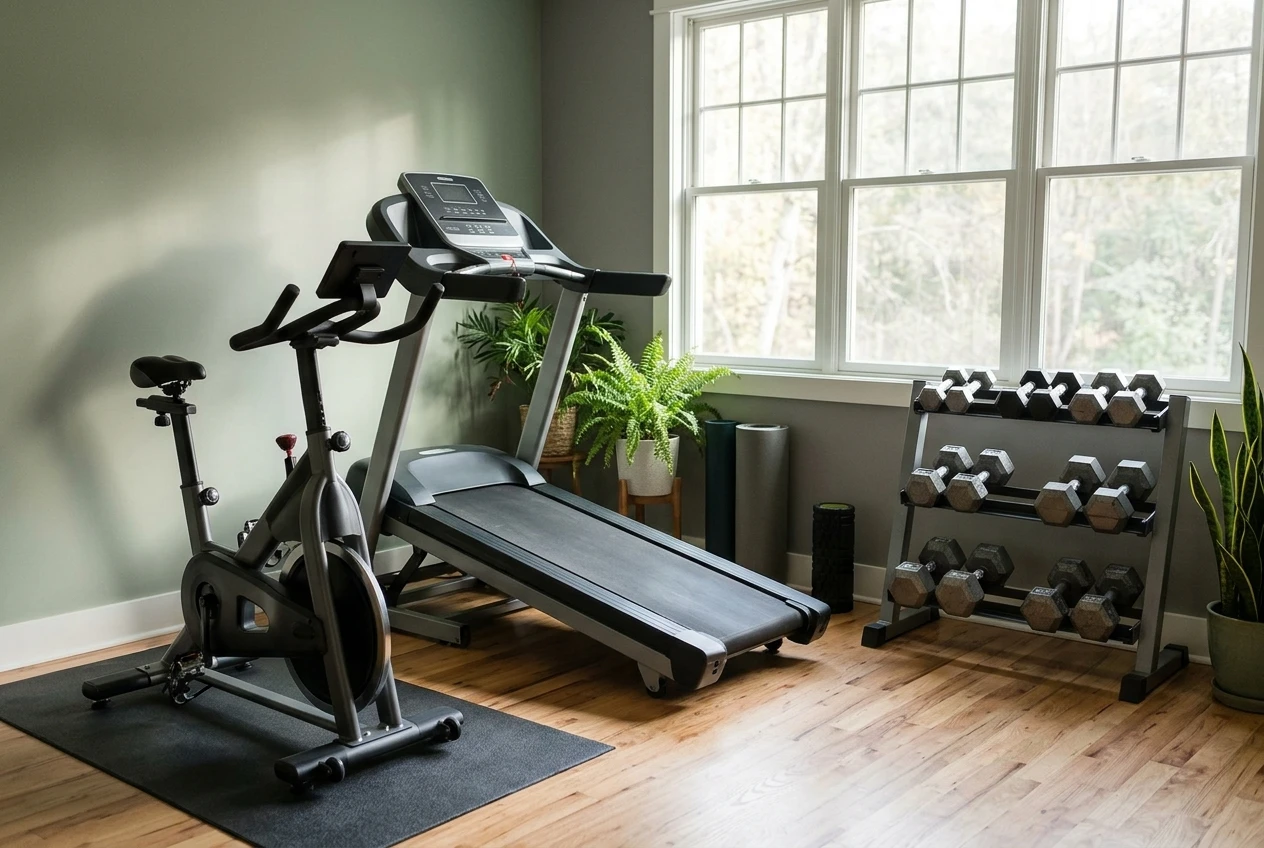
For timing, the simplest option is to keep cardio and lifting on separate days. If your schedule does not allow that, leave about 3 hours between sessions, and lift first when strength is the priority. If your main goal is to preserve muscle and strength on a cut, it makes sense to keep lifting performance as the priority and to schedule cardio around it. When one activity leads, the other becomes the add-on, and lifting should be the one that leads. For help fitting sessions into your week, the guide on how to build a bodybuilding program shows how to lay out a schedule.
A decision order for adding cardio on a cut
Use this sequence each time progress slows or you want to speed up a cut.
- Check diet accuracy. Confirm that your tracked intake matches reality, including weekends, oils, drinks and portion sizes. Many stalls come from small errors here.
- Raise steps. First reach the 7,000 floor, then add gradually within the cap of 50% above baseline, unless you already average more than 15,000.
- Add a small dose of low-impact or moderate cardio. Start with one or two sessions of 20 to 30 minutes, kept away from hard lower-body days.
- Consider HIIT only if it earns its place. Limit it to 1 to 3 sessions per week of 30 minutes or less.
- Adjust food last. If the previous steps are in place and progress is still too slow, a small reduction in calories is the next lever.
Know when to stop adding. If you see signs of under-recovery, such as dreading the gym, worse sleep, dropping loads or reps, or rising aches and pains, stop adding cardio and consider reducing it. Because of compensation, extra cardio on top of a tired body may deliver less than predicted while costing you more in training quality.
Competitors in contest prep face the tightest version of this trade-off. They have less room in food and recovery, so every addition needs a clear reason. Tracking weight trend, gym performance and sleep together will tell you whether the current dose is working.
Key takeaways
- Diet leads a cut. Cardio is a support tool, and steps come before structured sessions.
- Machine calorie counts are gross. Net expenditure is lower, for example about 300 kcal net from a 400 kcal reading.
- Estimate net cost with the per-pound figures: about 0.2, 0.45 and 0.7 kcal per pound per 10 minutes for light, moderate and vigorous effort.
- The body compensates for part of what you burn. Careau 2021 found about 30% on average, with a range from about 10% to about 50%.
- Aim for at least 7,000 steps a day. Each extra 2,500 steps is worth about 100 kcal (Nielson 2011).
- Raise steps gradually, and cap the increase at 50% above baseline unless you already average more than 15,000.
- Interference affects strength, especially lower-body strength, more than muscle growth (Huiberts 2024). Separate cardio from lifting by day where you can, or by about 3 hours, and favor low-impact modes
- HIIT does not escape interference (Sabag 2018). Limit it to 1 to 3 sessions per week of 30 minutes or less.
- Stop adding cardio when recovery or lifting performance drops.
Set your cutting rate first: read Energy Balance for Lifters, then come back and pick the smallest cardio dose that keeps the cut on track.
References
- Ainsworth 1993
- Huiberts 2024
- Schumann 2022
- Nielson 2011
- Sabag 2018
- Pontzer 2016
- Thurber 2019
- Willis 2022
- Careau 2021