

Drop sets get marketed as a shortcut: take a set to failure, strip weight, keep going, and squeeze a week’s worth of stimulus into half the time. That pitch is half right. Drop sets can be genuinely efficient, but the question that actually matters for someone running a structured program isn’t whether they work in isolation. It’s whether you can add them to a split you’re already following without quietly inflating your weekly set count past what your recovery can absorb.
This is a Level 5 tool in the Muscle & Strength Pyramid, sitting alongside rest period manipulation and techniques like rest-pause and supersets. That placement matters. Volume, intensity, and progression (Levels 2 and 3) do most of the work in a hypertrophy program. Drop sets don’t replace any of that. They’re a way to apply the volume and intensity you’ve already decided on more efficiently, not a separate growth mechanism layered on top.
What A Drop Set Actually Is (And What It Isn’t)
A drop set is one continuous unit: you load a weight, take it to or near failure, strip a percentage of the load with minimal rest (often none beyond re-racking and re-gripping), and continue for more reps. You can repeat that strip-and-continue process multiple times within the same set. The whole sequence, start to finish, is what the research and this article mean by “a drop set.”
It’s not the same thing as a superset, where you alternate between two different exercises. It’s not rest-pause training either, where you take short, deliberate rest periods (10 to 20 seconds) between mini-sets at the same weight rather than reducing the load. Drop sets specifically combine a weight reduction with the absence of a real rest interval, and that combination is what makes them effective and what makes them expensive to recover from.
The confusion matters because people often use “drop set” loosely to describe any high-intensity finisher, then wonder why their results don’t match the studies. The research below is specific to the strip-the-weight, keep-going format, and the dosing guidance only holds if you’re doing that version.
Does The Research Support Drop Sets For Hypertrophy?
Short rest intervals are the mechanism that makes a drop set a drop set, so it’s worth starting there. Senna et al. found that reducing rest between sets increases perceived effort and reduces the total volume a lifter can complete, which is exactly the tradeoff a drop set is built around: you accept less total work per unit of time in exchange for reaching comparable fatigue and metabolic stress faster. Singer’s 2024 meta-analysis put a number on where that tradeoff tips over, identifying roughly 90 seconds as the threshold below which rest intervals start meaningfully compromising performance on subsequent sets. Drop sets live well under that threshold by design, which is the entire point: you’re deliberately sacrificing full recovery between efforts to compress the time cost.
Grgic’s 2018 review looked at drop sets directly against traditional straight sets for hypertrophy outcomes and found them comparable per unit of time invested. That’s an important qualifier. Drop sets haven’t shown themselves to be superior to straight sets for muscle growth when you equate total volume. Their advantage is efficiency, not some unique stimulus straight sets can’t provide.
Sodal’s 2023 review pushed this further by quantifying the volume relationship: across the trials examined, something like 13 drop sets produced muscle growth comparable to 10 straight sets taken to or near failure. That’s the key finding for program design. Drop sets aren’t volume for free. You need more of them than you’d need straight sets to get an equivalent training effect, because each individual “set” inside a drop set sequence is doing less full work than a complete straight set would.
Longo’s 2022 training-dose study reinforces the same theme from a different angle: when total training volume is matched across methods, the growth response tends to converge. The advantage of drop sets isn’t that they beat equivalent volume, it’s that they let you approach that volume in less clock time and with less total load handled, which matters for joint stress and session length but not for the growth signal itself.
Put together, this research says drop sets are a legitimate, evidence-backed method for building muscle, but they are not more potent per set than straight sets, and treating them as such is how people end up overshooting their recovery capacity while thinking they’re being efficient.
Where Drop Sets Fit In The Muscle & Strength Pyramid
Drop sets sit at Level 5, Rest Periods, not at Level 2, Volume and Intensity. That ordering isn’t cosmetic. It means your weekly set targets and RIR targets, decided at Level 2, come first. Drop sets are a method for executing some of those sets, not a reason to add sets you weren’t already planning to do.
This is also why drop sets don’t belong in every session or every week of a program. Level 3, Progression, and Level 4, Exercise Selection, both sit below Level 5 in priority, which means a lifter who hasn’t nailed down a sensible progression scheme or appropriate exercise choices for their structure gets very little benefit from adding drop sets on top. Fix the lower levels first. Drop sets are a refinement for someone whose volume, intensity, and exercise selection are already dialed in and who wants a more time-efficient way to execute part of that plan, not a fix for a program that isn’t working.
Which Exercises Work Best For Drop Sets (And Which Don’t)
Drop sets work best on machines, cables, and isolation movements where the weight change is quick and the setup doesn’t demand much technical precision under fatigue. Leg press, leg extension, leg curl, lat pulldown, cable rows, triceps pushdowns, and pec deck are all good candidates: you can drop a pin or swap a plate in a few seconds and the movement pattern stays stable even as your form starts to degrade near failure.
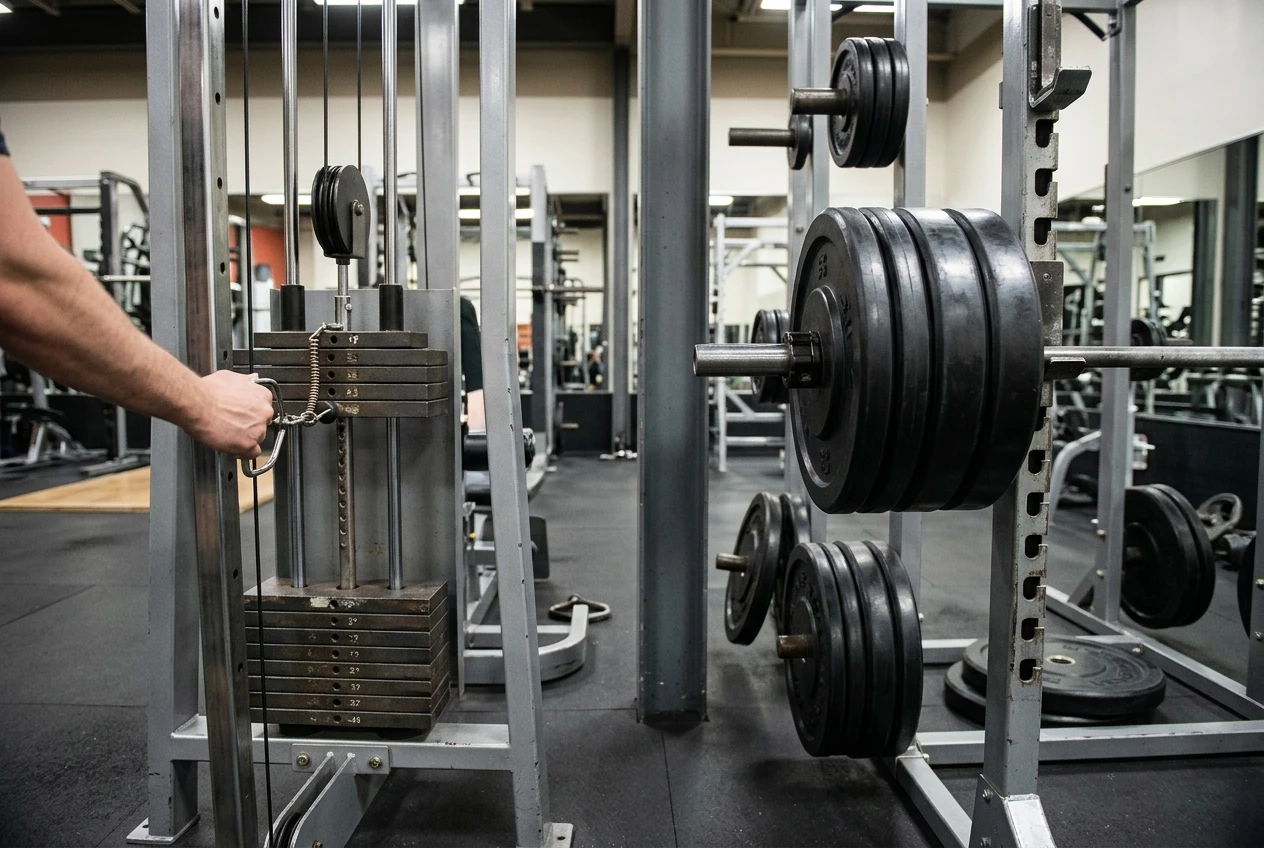
Free weight compounds are a poor fit. Dropping weight on a barbell squat or deadlift mid-set means stripping plates, which takes too long to preserve the short-rest mechanism that makes a drop set work, and doing a heavy compound to failure repeatedly carries more joint and spinal loading risk than the stimulus justifies. Dumbbell exercises sit in between: a dumbbell drop set is workable if you have a rack of graduated weights within reach, but it’s clumsier than a machine or cable version and rarely worth the setup cost unless that’s genuinely the most available equipment.
The practical rule: save drop sets for the last exercise in a muscle group’s rotation, on equipment that lets you change load in under five seconds, and on movements where losing some technical precision near failure doesn’t put you at meaningful injury risk.
How Many Drops, How Much Weight To Cut, And How Long To Rest Between Them: The 75% Rule
Most of the research supporting drop sets uses two to three drops per set, cutting roughly 20 to 25 percent of the load at each strip. A typical sequence looks like: work set to failure, drop 20 to 25 percent, continue to failure, drop another 20 to 25 percent, continue to failure, done. Going beyond three drops adds fatigue faster than it adds growth stimulus, since each subsequent drop is working with an already-exhausted muscle and diminishing mechanical tension.
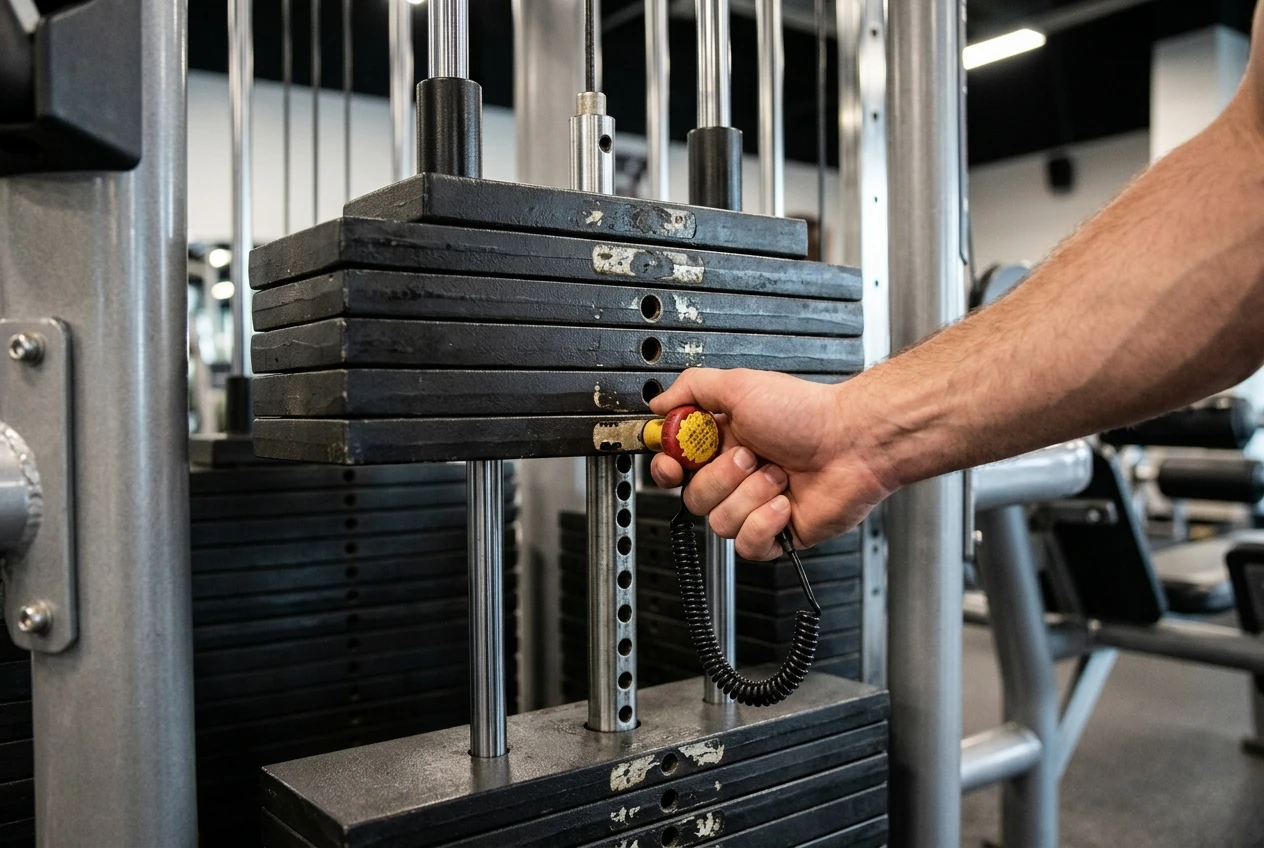
Rest between the drops should be as short as practically possible, generally under 15 seconds, just long enough to change the load and reposition. This is the part that actually defines a drop set as distinct from rest-pause training, and it’s also the part that makes drop sets more fatiguing per set than straight sets.
For counting purposes, use a 75 percent rule of thumb: treat one full drop-set sequence (the initial set plus its drops) as equivalent to roughly 0.75 of a straight set when you’re tallying your weekly volume for a muscle group. This isn’t an arbitrary number. It lines up with Sodal’s finding that around 13 drop sets matched the output of 10 straight sets, which works out to each drop set contributing a bit over three-quarters of a full set’s worth of stimulus. Using 0.75 as your conversion factor keeps your fractional set counting honest instead of either double-counting the drops as separate full sets or ignoring them entirely.
Converting A Straight-Set Prescription To Drop Sets: An RIR-Matched Example
Say your program calls for 3 sets of leg extensions at 0 to 1 RIR. Using the 75 percent rule, 3 straight sets would need roughly 4 drop-set sequences to deliver equivalent volume (3 divided by 0.75). In practice, that’s too many drop sets to tolerate well in one session, so the more realistic application is swapping one or two of those straight sets for a single drop-set sequence, not replacing the whole prescription.
A workable conversion: keep 2 of the 3 sets as straight sets at your prescribed RIR, then turn the third into one drop-set sequence (initial set to failure, two drops of about 20 to 25 percent each). That gives you roughly 2 + 0.75 = 2.75 fractional sets, close enough to your original 3-set target that you haven’t meaningfully shorted the muscle group, while cutting several minutes off the exercise.
Adding Drop Sets To A Program You’re Already Running Without Overshooting Your Weekly Sets
The failure mode to avoid is adding drop sets on top of your existing sets rather than converting some of those sets into drop-set form. If your program has you at 14 weekly sets for a muscle group and you tack on 3 drop-set sequences without removing anything, you’re not at 14 anymore, you’re closer to 16 or 17 once you fractional-count them, and that can push you past the 11-set-per-session threshold where splitting the work across more frequency starts to matter.
The fix is substitution, not addition. Pick one exercise, usually the last one in that muscle group’s rotation for the session, and convert its final set or two into a drop-set sequence using the 75 percent conversion. Leave every other set in your program untouched. This keeps your weekly fractional set count essentially where it was while changing how a small slice of that volume gets executed.
Recovery Cost: How To Tell When Drop Sets Are Doing More Harm Than Good
Drop sets generate disproportionate fatigue relative to their fractional set value, largely because the short rest intervals push metabolic stress and perceived effort higher than an equivalent straight set would produce (consistent with Senna’s findings on rest interval reduction). That means the usual under-recovery signals, worse sleep, rising joint aches, flat or declining loads on your main lifts, dreading a particular session, show up faster when drop sets are involved than when they aren’t.

If you notice those signals appearing after adding drop sets to a lift, the first move is cutting back to one drop per sequence instead of two or three, or limiting drop sets to a single exercise per session instead of several. If the signals persist, pull drop sets out entirely for a week or two and reassess. They’re not an essential piece of any program, which means the system loses nothing by dropping them when recovery isn’t keeping up.
Common Mistakes That Turn Drop Sets Into Junk Volume
A few patterns consistently waste the time investment drop sets are supposed to save:
- Stacking too many drops. Four or five strips past failure mostly add fatigue, not stimulus, since the muscle is already too depleted to produce meaningful tension on the later drops.
- Cutting too little weight. A 10 percent reduction often isn’t enough to allow more than a rep or two, which defeats the purpose; stick closer to the 20 to 25 percent range.
- Resting too long between drops. Anything approaching 30 to 45 seconds starts to behave like a separate set rather than a continuation, which changes the stimulus and breaks the research’s dosing assumptions.
- Using them on every exercise, every session. Drop sets are a tool for the last exercise in a rotation, applied selectively, not a default setting for an entire workout.
- Forgetting the conversion math. Treating each drop-set sequence as a full extra set rather than roughly 0.75 of one is the single most common way lifters silently overshoot their weekly volume and then can’t figure out why recovery slipped.
Drop sets earn their place in a program when they’re substituted in deliberately, counted honestly, and reserved for the exercises and situations where the short setup time actually pays off. Try adding drop sets to one lift for 3 to 4 weeks, then use how to know if you are building muscle to check whether they’re actually moving the needle before making them a permanent part of your split.