Lift & Nurture is a bodybuilding education site covering training, nutrition, lifestyle, and competition. It is written for people at every stage: someone building a first routine, an intermediate lifter whose progress has slowed, and a competitor counting weeks to a show. Bodybuilders of all genders are the audience, and the advice is meant to work for all of them.
Competition is a full pillar here, with the same standing as training. Many bodybuilding sites treat the stage as an afterthought or a niche for a few readers. Here it gets its own coverage, because contest prep, posing, and judging criteria are skills that can be taught and explained like any other part of the sport.
Who this site is for
A beginner needs a plan they can follow and an explanation of why it works. A competitor needs detail: how to set up a specialization cycle, how to manage a long prep, how to handle the demands of stage preparation. These readers usually get separate resources, and the beginner’s version is often oversimplified while the competitor’s version assumes years of background.
Lift & Nurture is built to serve both without talking down to one or burying the other. Beginners get plain explanations that do not assume prior knowledge. Competitors get depth and specifics, with the reasoning kept visible so they can judge it for themselves.
Every post is meant to be easy to read and simple to follow, whatever your experience level. Accurate advice you cannot understand or apply does not help anyone.
The four pillars
Training
Training is the largest part of the site, and it is organized around a framework called the Muscle & Strength Pyramid, or MSP3. It is a six-level hierarchy of priorities. The bottom levels drive roughly 80% of results, so they get attention first.
The six levels, from the base up:
- Adherence
- Volume and intensity
- Progression
- Exercise selection
- Rest periods
- Lifting tempo
Most lifters work in the reverse order. They argue about tempo and exercise variations while skipping the questions that matter more, such as whether they can sustain the plan and whether they are doing enough hard sets. The pyramid puts those questions first.
Nutrition
The nutrition pillar covers evidence-based eating for muscle gain, fat loss, and contest preparation. Beginners will find practical material on what to eat, how to shop, and how to prepare meals. Competitors will find coverage of the diet side of a show prep, where the margin for error is smaller and the stakes are higher.

Protein targets, energy balance, and meal timing appear throughout. They are tied to the training they support, because food and training only work as a pair.
Lifestyle
Results are made in the gym and kept or lost everywhere else. The lifestyle pillar covers recovery, daily habits, and mindset: sleep, stress, and the mental side of staying with a demanding sport for years.
These topics get the same evidence standard as the rest of the site. Sleeping 7 or more hours is a training variable, not a wellness slogan, and the site treats it that way.
Competition
The competition pillar covers preparation, posing, and judging criteria. It is meant for anyone considering a first show and for experienced competitors refining their approach. Understanding how judges evaluate a physique changes how you prepare, so that material sits next to the training and nutrition guidance rather than apart from it.
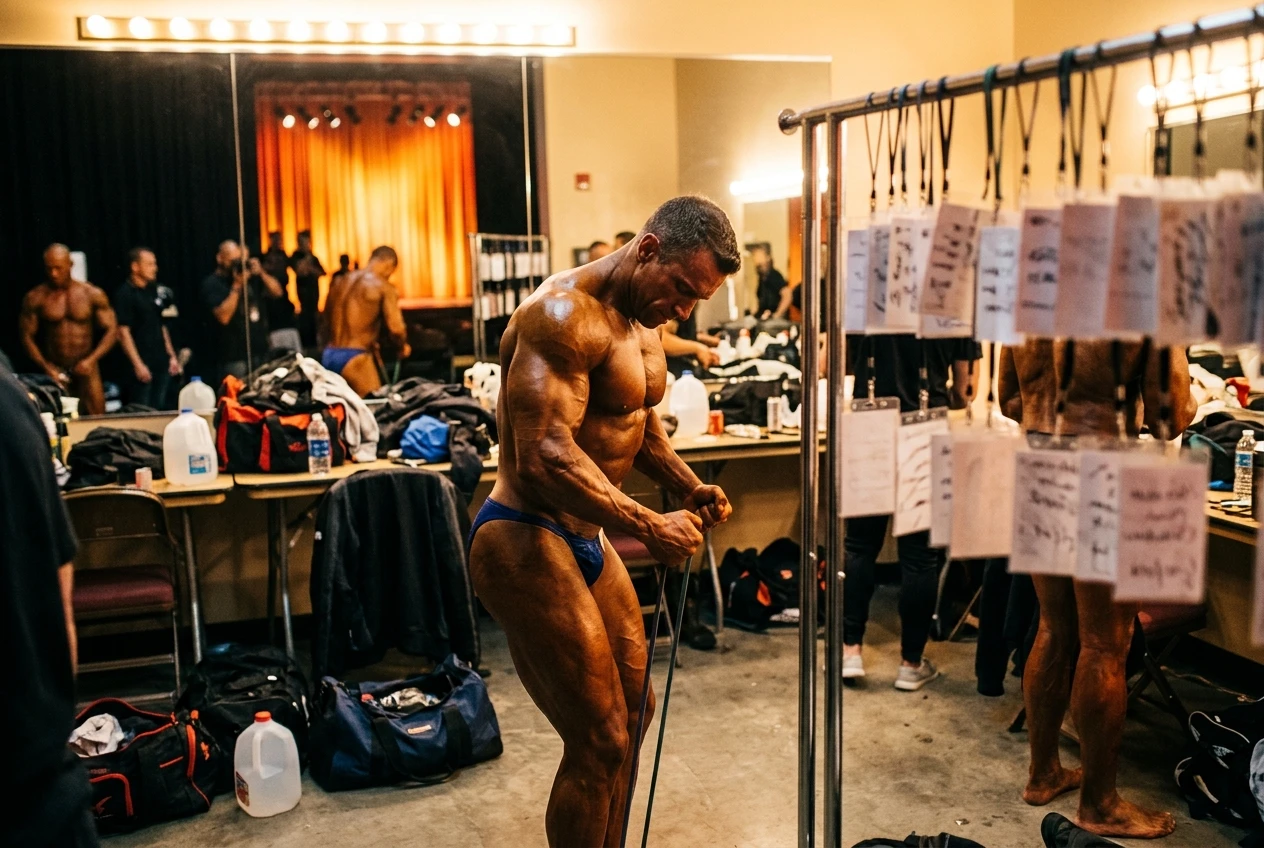
Training for the stage also has its own requirements. The programs include specialization cycles for advanced and competitive lifters, so a competitor is not forced to adapt a beginner template.
How the training framework works in practice
The first level of the pyramid is adherence, and it is the one that decides whether the others matter. A plan only works if you keep doing it for years, not weeks. The site breaks adherence into three qualities, abbreviated REF: realistic, enjoyable, and flexible.
Realistic means separating the time you have available from the schedule you actually follow. A plan sized to your true weekly capacity beats one sized to an idealized week that rarely happens.
Enjoyable draws on research by Fishbach and Choi. Exercisers who focused on the process outlasted outcome-focused exercisers and exceeded their own predictions. A plan has to be something you want to keep doing, not just the best one on paper.
Flexible means leaving room to adjust training to stress, energy, and life circumstances. Research on auto-regulated and self-selected session order shows better adherence and strength gains than fixed schedules. “Optimal” is better understood as a moving target than a fixed destination.
Adherence also covers the situations that interrupt real training:
- A missed workout: resume where you left off, skip low-stakes sessions, and when consecutive hard days are unavoidable, adjust the load rather than force the plan.
- Several sports or activities: one activity leads and the other becomes the add-on, using periodization logic borrowed from team-sport athletes.
- Cardio and lifting together: the interference effect largely spares hypertrophy but affects strength and power more. Separate the two by 3 or more hours or put them on different days, favor low-impact options, and keep sessions to 20 to 30 minutes at higher intensity or under an hour otherwise.
- Injury and pain: lifting injury rates are lower than in most non-contact team sports and endurance training. Pain is a signal with adjustable sensitivity, not a perfect indicator of tissue damage. Persistent or red-flag pain goes to a specialist, and minor niggles can be worked around with exercise substitution, load changes, or blood flow restriction training.
Volume, intensity, and frequency
Level 2 is the foundation of any program. It covers how many sets count, how to measure intensity (percentage of 1RM, RPE or RIR, proximity to failure), and how often to train, with strength and hypertrophy goals treated separately.
Frequency distributes weekly volume rather than adding to it. Once a muscle group passes roughly 11 fractional sets in a single session, it is time to spread the work across more days. As a general guide, 4 to 10 weekly sets per muscle suit 1 to 2 sessions a week, 11 to 20 sets suit 2 to 3, and 21 to 30 sets suit 3 or more. For strength, aim for at least two weekly exposures per lift, even if one is light.
Volume and RIR interact rather than stack. Both show diminishing returns, so chasing maximum sets and maximum proximity to failure together backfires. High-volume protocols often push lifters further from failure just to survive the workload, which cancels the benefit they were after.
These numbers are averages over a training block for most beginner to intermediate lifters. They are not fixed targets for one person on one day, and the right mix shifts across a lifting career. Fractional set counting, such as a bench press counting as half a triceps set, is a useful approximation and not a literal truth, so exercise selection still matters.
When progress stalls
The site gives a diagnostic order for stalled progress. Fix the basics before touching volume:

- Sleep 7 or more hours.
- Be out of an energy deficit.
- Eat 0.7 g per pound of bodyweight or more of protein.
- Rate your effort accurately with RPE.
- Train each muscle or lift at least twice a week for strength goals.
- Keep exercise selection, range of motion, and tempo consistent.
If those are solid, check for under-recovery: dreading the gym, worse sleep quality, dropping loads or reps, rising aches and pains, or higher life stress. If you are recovering well, it may be time to raise your training dose. If not, take a light week and reassess before deciding whether to reduce or reorganize volume permanently.
Programs for every level and schedule
The program library runs from 2-day to 6-day splits and runs week by week for up to 52 weeks. Each program lists the exercises, sets, reps, and RIR targets, along with substitution options and notes on supersets and drop sets. Beginners get a clear, followable structure, while advanced and competitive lifters get specialization cycles.
Programs are meant to be adapted. The Level 1 principle of flexibility applies to every one of them, so substitution options and auto-regulation guidance come with the plan rather than as an afterthought.
How the site treats evidence
Every training, nutrition, and competition recommendation is meant to trace back to real research. Fad claims do not belong on the site, however popular they are. Where the evidence is limited or the guidance is an approximation, the posts say so.
Each post also explains the research behind its advice in plain terms. That serves beginners, who deserve to know why they are doing something, and competitors, who need enough reasoning to judge whether it fits their situation.
The site also tries to be engaging as well as correct. A resource nobody wants to read does not change how anyone trains, so posts are written to be practical and easy to follow, and worth returning to.
Where to start
If you are not sure which path fits you, the Start Here page sorts readers into two routes: beginner foundations, or intermediate and competition prep.
Beginners will find material on building a first routine, training at home or in a gym, warming up, eating for muscle gain, and checking whether you are actually growing. Intermediate lifters and competitors will find the deeper material on progression, periodization, and show preparation.
Whichever route you take, begin with the first level of the pyramid: build a plan you can sustain, and the rest of the framework has something to work on.

Angel Carcamo
Founder of LiftandNurture.com