Building muscle isn’t just about lifting weights. It also depends on fueling your body properly so you can recover, adapt, and grow stronger over time. Calories play a major role in that process because they provide the energy your body needs not only for training, but also for recovery and muscle repair afterward.
When training in a gym environment, pairing proper nutrition with good gym etiquette helps support a positive and consistent training experience. For beginners, learning how calorie intake supports muscle growth makes it much easier to build muscle in a structured and sustainable way.

When you train, the goal is to challenge your muscles enough to create an adaptive response. After the workout, your body repairs and strengthens muscle tissue during recovery. To support that process effectively, you need enough calories to provide the energy required for recovery and growth—especially as your weekly training volume increases, such as when following a 4 day workout routine for beginners. If you’re unsure how training volume is structured for beginners, see this guide on Muscle Group Sets Per Week For Beginners.
Calories do more than provide energy; the foods that contain them also supply the nutrients your muscles need for recovery and growth. If you’re skimping on calories, you’ll struggle to supply your body with the vitamins, minerals, and other building blocks it needs for growth.
Balancing calorie intake is important—it’s about providing enough energy to support muscle growth without gaining unnecessary body fat too quickly. This is often referred to as a caloric surplus, which simply means consuming more calories than you burn over time. While some beginners may still build muscle around maintenance calories under certain conditions, a small surplus is often the most practical starting point when muscle gain is the main goal.
Calories support muscle growth, but they only work when paired with progressive overload.
Muscle growth for beginners depends on three key factors: structured training, proper nutrition, and consistent recovery.
Quick Answer: Calories for Muscle Growth
Most beginners should start by estimating their maintenance calories, then add a small calorie surplus of around 5–10% to support muscle growth. From there, monitor weekly body weight, gym performance, recovery, and consistency, then adjust calorie intake gradually if needed.
Table of Contents
- Quick Answer: Calories for Muscle Growth
- Understanding Calories In vs. Calories Out
- How to Estimate Your Maintenance Calories
- How to Build a Calorie Surplus for Muscle Growth
- Nutrition Essentials Beyond Muscle Growth
- How to Monitor Progress and Adjust Calories
- Common Beginner Mistakes
- Frequently Asked Questions
- Key Takeaways
- Final Thoughts
- Beginner Bodybuilding Guides on Lift & Nurture
- References
- About the Author
Understanding Calories In vs. Calories Out for Muscle Growth
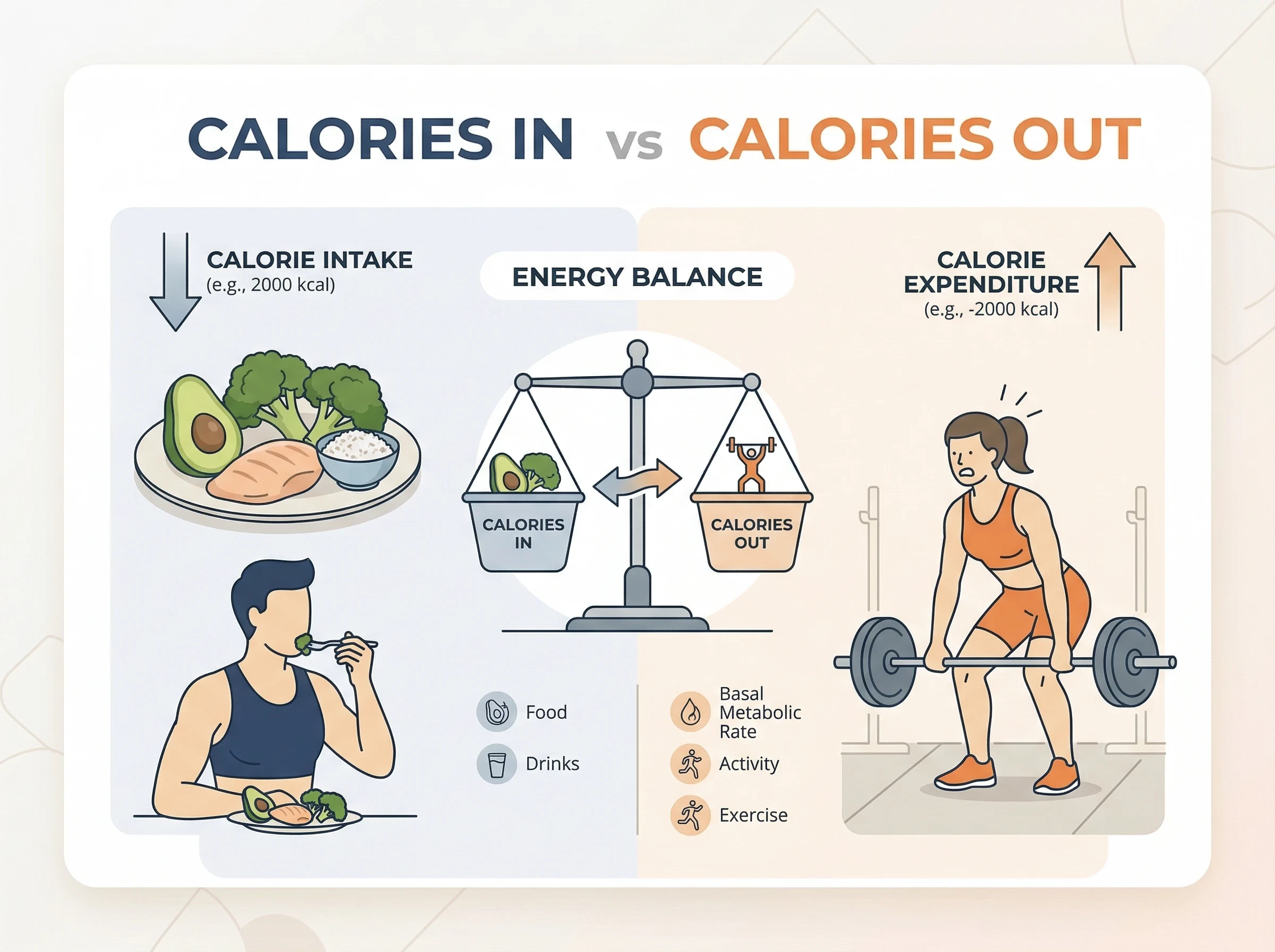
Everyone’s heard the phrase ‘calories in vs. calories out,’ but what does it really mean when building muscle? Essentially, it’s about energy balance—how many calories you consume compared to how many you burn. For muscle growth, you want to tip the scale towards consuming more than you burn, creating a calorie surplus.
An energy surplus gives your body the resources it needs to grow muscle, but it’s important to know what that surplus should look like. Too much and you’re setting yourself up for gaining unnecessary body fat; too little, and you’re likely not giving your body enough fuel to maximize muscle development.
Maintenance calories, on the other hand, are what you need to keep your current weight steady. This is a balance point where the calories you eat equal those you expend. Understanding this is crucial in deciding how much extra you should aim for in your diet to encourage growth without tipping the scales towards too much fat gain.
Everyone’s calorie needs are different and depend on factors like body size, age, sex, activity level, training volume, and daily movement outside the gym. If you’re unsure how much training volume beginners actually need, see this guide on Muscle Group Sets Per Week For Beginners. To estimate maintenance calories, you can start with a rough method like multiplying your body weight by 15 or use an online calorie calculator for a more tailored estimate. Either way, this is only a starting point. Once you know where you stand, you can adjust based on your actual body-weight trends and training progress.
Remember, muscle building is as much about calories as it is about how you balance those calories with expenditure. Keeping track can help you adjust food intake to line up with your body’s needs as you grow and change.
Calories create the environment for muscle growth, but training provides the stimulus.
How to Estimate Your Maintenance Calories

Getting a handle on your maintenance calories is key to planning a muscle-building diet. It’s like finding your starting point before charting a course. A lot of people use the simple method of multiplying their body weight by 15 as a rough estimate of how many calories they may need each day to maintain their current weight.
This rough estimate is a good jumping-off point, but remember, it’s not set in stone. Everyone’s unique, and a more personalized approach might suit you better. Many folks find online calorie calculators helpful because they factor in other details like age, sex, and activity level to give a more tailored calorie count.
Another practical way to estimate your maintenance calories is to track your food intake and body weight for about two weeks. Log everything you eat and drink, note the calorie count as accurately as possible, and weigh yourself consistently under similar conditions. If your average body weight stays relatively stable over that period, you likely have a decent estimate of your maintenance intake.
This process is not exact, but it helps you establish a more useful starting point. Once you’ve got a handle on your maintenance needs, you’ll be better equipped to decide how much of a surplus you need to start building muscle effectively.
For example, if a beginner maintains their weight at around 2400 calories per day, a 5–10% surplus would place them at roughly 2520 to 2640 calories per day. That gives them a practical starting range they can test and adjust based on weekly progress.
How to Build the Right Calorie Surplus for Muscle Growth

So, you’ve figured out your maintenance calories and now you’re wondering how many extra calories you should eat to build muscle without gaining unnecessary fat too quickly. A modest calorie surplus of around 5 to 10% above maintenance is often a practical starting point for beginners. A calorie surplus can help support muscle growth by increasing the energy available for recovery and adaptation, although the exact amount needed varies from person to person.
For instance, if your maintenance level is about 2500 calories a day, a small surplus might place you somewhere around 2625 to 2750 calories per day. This gradual approach is less likely to lead to excess fat gain than jumping straight to a high surplus.
Larger surpluses are not automatically better. Some beginners assume eating far more will speed up muscle growth, but this often increases fat gain faster than it improves muscle-building results. For most beginners, a controlled surplus is the more strategic option because it supports progress while keeping unnecessary fat gain more manageable.
If your body weight is not increasing after a few consistent weeks, you may need to raise your calorie intake slightly. But remember, scaling up slowly is usually the wiser choice. More doesn’t always mean better when it comes to calorie surpluses, especially for those just starting out with muscle building.
Nutrition Essentials Beyond Calories

While calories are key to muscle growth, the quality of what you eat matters just as much. Protein intake is especially important because it directly supports muscle repair and growth. If you’re unsure how much protein beginners should eat, see my guide on How Much Protein Beginners Need to Build Muscle. A common evidence-based target for muscle growth is around 1.6 to 2.2 grams of protein per kilogram of body weight per day. Protein provides the raw material your body uses to repair and build muscle tissue after training.
Meal frequency also plays a role. Eating every few hours helps maintain energy levels and supplies your muscles with protein they need throughout the day. Whether it’s three meals or five, consistency is the name of the game.
Hydration might not seem like a big deal, but it sure is. Water supports everything from nutrient transportation to muscle contraction during workouts. Dehydration can zap your strength and focus, which isn’t ideal when you’re trying to lift heavier and grow muscle.
Alcohol is another sneaky factor in recovery. While the occasional drink probably won’t derail your progress, regularly going overboard can impede muscle recovery and increase fat storage.
Focusing on nutrient-dense whole foods over processed snacks helps ensure you give your body the vitamins and minerals it needs. Think colorful veggies, whole grains, lean proteins, and healthy fats.
By diversifying your diet, you arm your body with the resources to not only grow muscle but also to keep your energy up and support your overall health. It all ties back to providing enough fuel and recovery support for the muscle-building journey.
A common beginner mistake is focusing only on eating more while ignoring food quality, protein intake, or training consistency. More calories can help, but they work best when paired with a structured program, such as a 4 day workout routine for beginners, along with enough protein and recovery habits that support performance in the gym.
How to Monitor Progress and Adjust Calories
Keeping tabs on your progress is as important as the calorie intake itself. Weighing yourself weekly and noting the average can offer insights into how your plan is working. If you’re not seeing the scale go up after a few weeks of consistent effort, it might be time to tweak those calories up a notch.
Progressive overload in your workouts is the cornerstone of muscle building. If you’re new to this concept, read my guide on How to Implement Progressive Overload for Beginners. At the same time, without enough calories and protein, the progress you want may stall. Your diet supports recovery and growth, allowing you to lift heavier over time, which promotes more muscle growth.
If adjustments are needed, make them gradually—usually by about 100 to 200 calories at a time. This makes it easier to monitor how your body responds and helps reduce the chance of pushing calories up faster than necessary.
Monitoring isn’t just about watching the number on the scale. It also means paying attention to gym performance, recovery, how your clothes fit, and whether your body weight is increasing at a reasonable pace. This becomes even more important when following a 4 day workout routine for beginners, where higher training frequency increases overall energy demands. Recovery plays a huge role in muscle growth because muscles repair and adapt during rest, not during the workout itself. The amount of recovery you need is also influenced by your total weekly training volume. If you’re unsure how to structure that, see this guide on Muscle group sets per week for beginners. Proper rest between sets also affects performance and fatigue. This guide on how to structure workout rest periods explains how rest timing influences strength output and muscle growth.
Using these tactics helps align your dietary efforts with your fitness goals, allowing for continual adjustments as you grow stronger.
Calories alone won’t build muscle without proper training. Pairing adequate nutrition with the right movements is essential. These beginner bodybuilder exercises provide the primary stimulus for muscle growth. Training provides the stimulus, while calories provide the energy to recover and grow. If you’re new to resistance training, start with a structured program like my Beginner Bodybuilding Workout Plan (12-Week Foundation Blueprint), which explains how to combine training, nutrition, and recovery for consistent muscle growth.
Common Beginner Mistakes
Common mistakes can slow muscle-building progress even when motivation is high. One of the biggest beginner nutrition mistakes is eating too few calories while expecting muscle gain to happen efficiently. In other cases, beginners may increase calories too aggressively and gain more body fat than needed. Nutrition mistakes are only one side of the equation. Many beginners also make training mistakes that reduce the quality of the stimulus needed for muscle growth. Another common issue is increasing training volume too quickly without increasing calorie intake to support recovery. If you’re unsure how much volume beginners should actually use, see this guide on Muscle Group Sets Per Week For Beginners.
Some beginners go too far in the opposite direction and assume a huge calorie surplus will speed up muscle gain. In practice, this usually leads to more unnecessary fat gain without proportionally better muscle-building results.
Protein intake often gets overlooked too, with some focusing solely on calories. Remember, protein is key in rebuilding and strengthening those muscle fibers you’ve worked hard on. Without it, the gains just won’t come as effectively.
A well-rounded diet needs proper training to truly make an impact. Simply eating more calories without the right kind of exercise won’t result in the muscle growth you’re aiming for. It’s the combination of both that drives results.
Frequently Asked Questions:
1. How many calories should beginners eat to build muscle? Most beginners should start by estimating maintenance calories and then adding a small surplus of around 5–10%, adjusting based on weekly progress.
2. Should beginners bulk or recomp? For beginners whose main goal is building muscle as efficiently as possible, a controlled calorie surplus is often the simplest and most reliable approach. In some cases, body recomposition may also happen, especially in true beginners or people returning to training.
3. Can beginners build muscle without a surplus? Yes, in some situations. However, a small calorie surplus is often the more practical option when the goal is maximizing muscle gain.
4. How fast should beginners gain weight? A slow and controlled rate of weight gain is usually best if you want to support muscle growth while limiting unnecessary fat gain.
5. How do I calculate my maintenance calories? Use the bodyweight × 15 method or an online calorie calculator as a rough starting point, then adjust based on your actual body-weight trends over time.
Key Takeaways
Building muscle is not just about lifting heavier weights. Nutrition plays a major role in how well your body can recover, adapt, and build new muscle tissue over time.
For beginners, the best approach is simple:
– Estimate your maintenance calories
– Add a small surplus
– Prioritize enough protein
– Follow a structured training program
– Stay consistent with recovery habits
When calorie intake is paired with progressive overload, structured training, and proper recovery, muscle growth becomes much more predictable and sustainable.
Focus on consistency rather than perfection. Over time, these habits will support long-term muscle growth, better training performance, and lasting results.
Example Beginner Calorie Setup
If you weigh 160 lbs:
- Maintenance ≈ 160 × 15 = ~2400 calories
- Add 5–10% surplus → ~2500–2650 calories
Start at:
~2550 calories per day
Then:
- If weight isn’t increasing → add 100–150 calories
- If gaining too fast → reduce slightly
Final Thoughts
Building muscle is not just about lifting heavier weights. Nutrition plays a major role in how well your body can recover, adapt, and build new muscle tissue over time.
For beginners, the best approach is usually simple: estimate your maintenance calories, add a small surplus, prioritize enough protein, and monitor your progress consistently. Small, steady adjustments are far more effective than extreme bulking strategies or constantly changing your diet.
When proper calorie intake is paired with structured strength training, progressive overload, and good recovery habits, beginners can build muscle steadily without making the process more complicated than it needs to be.
Focus on consistency rather than perfection. Over time, these habits can support long-term muscle growth, better training performance, and more sustainable progress.
Beginner Bodybuilding Guides on Lift & Nurture
If you want to understand how calorie intake fits into the full muscle-building process, these guides will help:
- Beginner Bodybuilding Workout Plan (12-Week Foundation Blueprint)
- 3 Day Workout Schedule for Beginners
- 4 Day Workout Routine For Beginners
- How to Implement Progressive Overload for Beginners
- How Much Protein Beginners Need to Build Muscle
- Muscle Recovery Tips for Beginners
- Workout Mistakes Beginners Should Avoid
- Beginner Weight Training Sets and Reps
- Muscle Group Sets Per Week For Beginners
- Muscle Building Nutrition Guide for Beginners
References
Iraki, J., Fitschen, P., Espinar, S., & Helms, E. (2019). Nutrition Recommendations for Bodybuilders in the Off-Season: A Narrative Review. Sports (Basel). Available at: https://pmc.ncbi.nlm.nih.gov/articles/PMC6710320/
About the Author
Angel Carcamo is the founder of Lift & Nurture, a beginner bodybuilding platform focused on structured training, muscle growth fundamentals, and long-term progress.
As a beginner himself, Angel creates content based on evidence-backed principles commonly recommended in strength training, breaking them down into clear, simple steps for new lifters.
His guides focus on key fundamentals like progressive overload, recovery, and nutrition — helping beginners build muscle without confusion, shortcuts, or unrealistic expectations.
Start here: Beginner Bodybuilding Roadmap
Foundation guide: Beginner Bodybuilding Workout Plan (12-Week Foundation Blueprint)
Hello Angel,
This article was really helpful because calorie advice for muscle building can get confusing fast. I like how you explained that beginners don’t need to jump into some massive “bulk,” but instead focus on eating slightly above maintenance and adjusting based on results. That idea alone probably clears up a lot of frustration for people who are training hard but not seeing much change.
The part that stood out to me most was the reminder that calories need to support the work you’re doing in the gym. Building muscle takes energy, so eating just a little more than your body burns each day helps fuel recovery and growth. A lot of guidance suggests beginners start with a modest surplus of around 250 to 500 extra calories per day so they can gain muscle without putting on unnecessary fat.
I also appreciate how you emphasized consistency over perfection. It feels like a lot of beginners think they need the exact “perfect” calorie number, when in reality it seems more like something you dial in over time based on strength progress and how your body responds.
Do you find that most beginners struggle more with figuring out their calorie target, or with actually eating enough consistently to support muscle growth? I’d be curious what you see most often.
Angela M 🙂
Hi Angela — thank you for the thoughtful comment. I’m really glad the article helped clarify things.
From what most beginner guidance and research suggest, the bigger challenge usually isn’t calculating a calorie target — it’s consistently eating enough day after day to support training and recovery.
Many beginners unintentionally undereat due to low appetite, busy schedules, or concern about gaining fat. So even if they know roughly how much they should eat, actually hitting that intake consistently can be difficult.
That’s why a modest surplus combined with simple, repeatable habits tends to work best. Muscle growth is driven by consistent adequate fueling over time, not by finding a single “perfect” number.
Tracking strength progress, recovery, and body-weight trends can help guide adjustments. If those are improving gradually, intake is likely appropriate. If progress stalls, small increases usually work better than drastic changes.
Great question — consistency is often the factor that makes the biggest difference for beginners.
— Angel
Great article and you are keeping it healthy with a choice of delicious foods. Is it a good idea to have a protein shake as part of the mix, or is it better to get all your calories from your food intake? I just feel that a shake fills me up as well as gives me a great dose of protein, as I don’t tend to love eating protein much. Also is it better to limit carbs or do you need these for energy when you are working to gain more muscle?
Great questions, Michel — you’re thinking about this the right way.
1. Protein shakes vs whole food
You don’t need protein shakes, but they’re a very useful tool. Whole foods should be your foundation because they provide more nutrients and tend to keep you fuller.
That said, protein shakes are perfectly fine if:
– You struggle to hit your daily protein target
– You don’t enjoy eating a lot of high-protein foods
– You need something quick and convenient
A simple way to think about it:
Use whole foods first, and use protein shakes to fill the gaps when needed.
2. Should you limit carbs when building muscle?
No — carbs are actually very important for muscle growth.
Carbohydrates:
– Fuel your workouts (better performance = better muscle stimulus)
– Help replenish glycogen (your muscles’ energy storage)
– Support recovery and training consistency
If carbs are too low, you’ll usually feel:
– Lower energy in workouts
– Reduced strength output
– Slower overall progress
So instead of limiting carbs, it’s better to balance them properly alongside protein and fats.
3. Simple beginner approach (what I recommend)
– Hit your daily protein target consistently (this is priority #1)
– Keep carbs moderate to high to support training
– Include healthy fats, but don’t overdo them
If you prefer shakes because you don’t enjoy protein-rich foods much, that’s completely fine — just make sure your overall daily intake is dialed in.
— Angel