Picking exercises is the part of a program most lifters enjoy and the part most often done by habit. The result is a routine full of lifts that feel hard but leave the target muscle under-trained, or lifts that train it well but that you cannot perform safely or consistently. This page gives you one framework for exercise selection for muscle growth and one template for ordering the lifts you pick, so you can build or audit a program for muscle growth today.
The framework is Level 4 of the MSP3 Pyramid, restated here in our own words with credit to its authors and to the studies it draws on. The Pyramid ranks training priorities from the most to the least important. Adherence, volume, intensity and progression sit below exercise selection, so settle those first. If you have not, start with the guide on how many sets per muscle group per week and come back. Once those are in place, exercise selection decides where the work you are already doing gets applied.
Where exercise selection sits and why it matters for muscle growth
Muscle grows when a muscle is trained close to failure with enough weekly volume and progressively more demand. Exercise selection decides which muscle receives that stimulus, how much of it, and whether you can repeat the work week after week. Two lifters can run the same sets, reps and effort and get different results because one chose exercises that load the target muscle directly and the other did not.
MSP3 reduces the decision to three principles for hypertrophy:
- The exercise must train the target muscle.
- The muscle should be challenged at long lengths.
- The exercise must be feasible for you.
An exercise that fails any one of these is a poor pick for that muscle, however popular it is. The rest of this page expands each principle, converts them into a template of six movement patterns, and shows how to order and schedule the result.
Principle 1: The exercise must train the target muscle
Choosing an exercise because it uses a muscle is different from choosing it because it trains that muscle well. A muscle can be active in a lift without being the thing that ends your set. If another muscle gives out first, the one you care about never gets close to its own limit.
Three questions help you judge any exercise:
- Does the target muscle produce the movement through a meaningful range?
- Is the target muscle the part that makes the set hard, or does another muscle or joint cut it short?
- Does the exercise load the muscle across its whole structure, including the regions you want to grow?
The next three sections work through these questions: joint action, muscle regions, and what ends the set.
Single-joint and multi-joint lifts: why biarticular muscles need isolation
Some muscles cross two joints and are called biarticular. The quadriceps’ rectus femoris crosses the hip and knee. The hamstrings cross the hip and knee. The long head of the triceps and the biceps both cross the shoulder and elbow. In a multi-joint lift, these muscles are asked to do opposite things at the two joints at once.
Take the squat. At the knee, the quads shorten as you stand up. At the hip, the rectus femoris is being lengthened as the hip extends. The two actions partly cancel, and the muscle stays near the same length through the rep instead of working across a big change in length. The hamstrings have a similar problem: they lengthen at the hip while shortening at the knee, so they do much less than their size suggests.
Single-joint exercises avoid the conflict. A leg extension trains the quads at the knee alone, and the rectus femoris is not being pulled in the opposite direction at the hip. A leg curl trains the hamstrings at the knee, and sitting upright for it puts the hip in flexion, which stretches the hamstrings.
Two studies show how much the details matter:
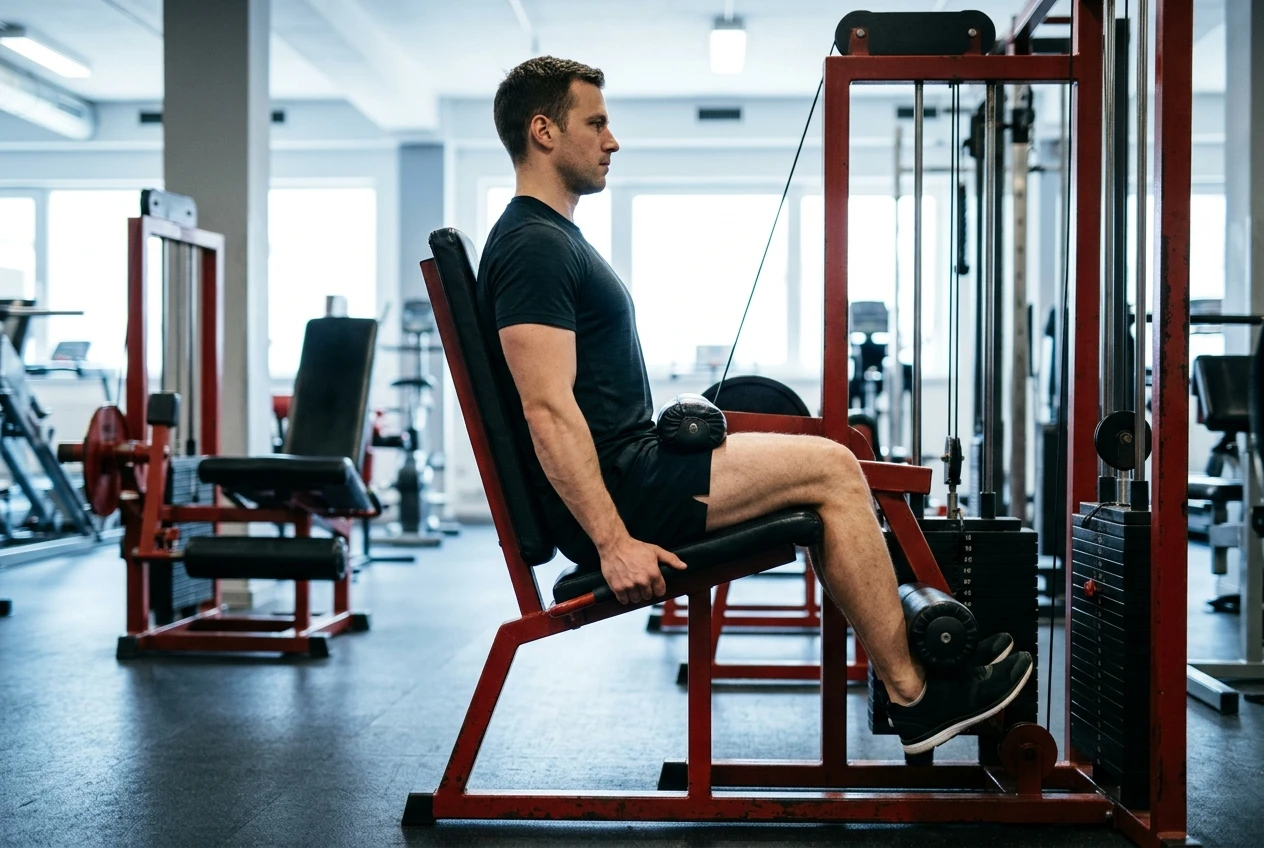
- Maeo and colleagues (2021) compared hamstring training in a seated leg curl, where the hip is flexed and the hamstrings are lengthened, with a prone leg curl. The seated version produced more hamstring growth.
- Maeo and colleagues (2023)compared triceps training with the arm overhead, which stretches the long head, with the arm at the side. Overhead extensions produced substantially more triceps growth.
For these four muscles the practical rule is simple. Multi-joint lifts are good tools and should stay in your program, but add direct isolation work for quads, hamstrings, triceps and biceps rather than hoping presses, squats and rows cover them. Isolation is also easy to push close to failure, because the movement is simple and your lower back, grip and balance rarely become the limit.
Muscle regions: why incline pressing and multi-plane pulling matter
Large muscles are not uniform. The chest has an upper (clavicular) portion and a lower (sternal) portion whose fibers run at different angles. The back has fibers that run in different directions across the lats, mid-back, lower traps and rear delts. A movement at one angle loads some fibers more than others.
Regional growth research is still developing, and the differences between regions are generally modest. It is still a cheap decision to act on, because covering more angles costs nothing in effort:
- For the chest, include an incline press or incline fly alongside a flat or declined press. This makes sure the upper fibers get direct work.
- For the back, mix vertical pulling (pulldowns, pull-ups) with horizontal pulling (rows). Within rows, vary the elbow path between a close, tucked path that emphasizes the lats and a wider, flared path that emphasizes the upper back and rear delts.
- For the shoulders, use overhead pressing for the front and side delts, and add lateral raises and a rear delt movement, because pressing alone leaves the side and rear heads under-trained.
Think of it as sampling more than one line of pull or push per muscle across the week, rather than repeating the same angle every session.
Effective means limiting: the hip thrust vs squat study
A muscle is stimulated best when it is the one that limits the set. In a squat, the set can end because the quads fatigue, because the glutes fatigue, because your lower back rounds, or because your balance wobbles. Which one stops you differs between lifters and with stance, depth and bar position. If the muscle you are trying to grow is not the limiter, the final reps of the set stress something else.
A trial by Plotkin and colleagues (2023) is a useful example. It compared back squat and hip thrust training and found that both produced similar gluteus muscle growth in the trained participants. The squat is a thigh and hip exercise that happens to load the glutes, and the hip thrust is an exercise built around hip extension against a fixed position, so the study shows that very different lifts can both work when the glutes are limiting enough in each.
Take two practical points from it:
- A lift does not need to look like a glute exercise to train the glutes. The test is whether your glutes are what end the set, which you can judge by where you feel the effort and what fails first.
- If the squat leaves you limited by your back or breathing instead of the muscles you want to grow, add a lift that removes the weak link. A leg press, hack squat or hip thrust can let the target muscle be the limiter.
One trial in one population is not a final answer, so treat the result as support for the logic rather than as a ranking of lifts.
Quick reference: movement patterns and the muscles they train
Use this as a lookup when you are filling gaps in a program. Primary muscles are listed first, with secondary involvement after them.
| Movement pattern | Example exercises | Primary muscles | Also involved |
|---|---|---|---|
| Squat (knee dominant) | Squat, hack squat, leg press | Quads, glutes | Adductors, spinal erectors |
| Hinge (hip dominant) | Romanian deadlift, hip thrust, back extension | Glutes, hamstrings | Spinal erectors, adductors |
| Horizontal push | Bench press, dumbbell press, push-up | Chest, front delts | Triceps |
| Vertical push | Overhead press, machine shoulder press | Front and side delts | Triceps, upper chest |
| Horizontal pull | Chest-supported row, cable row | Mid-back, lats | Rear delts, biceps |
| Vertical pull | Pulldown, pull-up | Lats | Biceps, lower traps |
| Elbow extension (isolation) | Overhead triceps extension, pushdown | Triceps | None |
| Elbow flexion (isolation) | Incline curl, preacher curl | Biceps, brachialis | Forearms |
| Knee extension (isolation) | Leg extension | Quads (rectus femoris) | None |
| Knee flexion (isolation) | Seated leg curl | Hamstrings | Calves |
| Shoulder abduction (isolation) | Lateral raise | Side delts | None |
| Plantar flexion (isolation) | Standing or seated calf raise | Calves | None |
Principle 2: Challenge the muscle at long lengths
Principle 2 is about where in the range of motion the muscle is hardest. Muscles tend to grow well when they are loaded while stretched. Bottom-of-the-lift positions, such as the bottom of a dumbbell press, a Romanian deadlift or an incline curl, load the muscle in a lengthened state. Exercises that get easy at the stretched position and hardest where the muscle is shortened, like a standard dumbbell lateral raise at the top, put much of their demand where the muscle is shortest.
This is why the earlier examples line up. The seated leg curl and the overhead triceps extension both place the target muscle in a stretched position under load, and both beat their shortened-position alternatives in the studies above. To apply the principle:

- Choose variations that load the muscle at its longest point: incline curls over standing curls, overhead extensions over pushdowns, seated curls over prone curls, Romanian deadlifts over hip-focused finishers for the hamstrings.
- Use the full range you can control, and do not bounce out of the stretched position.
- Prefer equipment that keeps tension at the stretch, such as cables and machines with a cam, when free weights go slack there. A dumbbell lateral raise has little tension at the bottom, while a cable lateral raise from behind the body keeps tension there.
Lengthened partials vs full range of motion: what the evidence actually says
Full range of motion is a sensible default, because it loads the muscle at long lengths and through the rest of the range. The open question is whether a lengthened partial, which uses only the stretched portion of the range, can do as well or better. This is an emerging area, and the findings are not settled.
What the research shows so far:
- Several trials, including Pedrosa and colleagues (2022) and Kassiano and colleagues (2023, on the calf), found that partial reps at long muscle lengths grew muscle as well as or better than full range of motion.
- Partials done at short muscle lengths, where the muscle is already contracted, did not show the same advantage.
- A 2023 meta-analysis by Wolf and colleagues did not show partial range beating full range overall. The pattern in individual trials depended on which part of the range was trained.
Many of these trials are small, short and use one exercise per muscle, so the findings should not be stretched beyond what they tested. A reasonable way to use them today:
- Keep full range of motion as your default on most lifts.
- Use lengthened partials as an option at the end of a set on a muscle and exercise where the stretched position is the hard part, such as the bottom half of a calf raise or a leg extension from the stretched side.
- Do not turn your whole program into half reps. If a lengthened partial feels better for a given muscle and does not make you cut your range sloppily, it is a reasonable experiment.
Treat any recommendation beyond these as a hypothesis until more studies replicate it.
Principle 3: Exercises must be feasible (the PLATE checklist)
A perfect exercise you cannot do, cannot do safely, or cannot repeat does nothing. Feasibility is Principle 3, and the PLATE checklist is a quick way to apply it. Run each exercise through five questions:
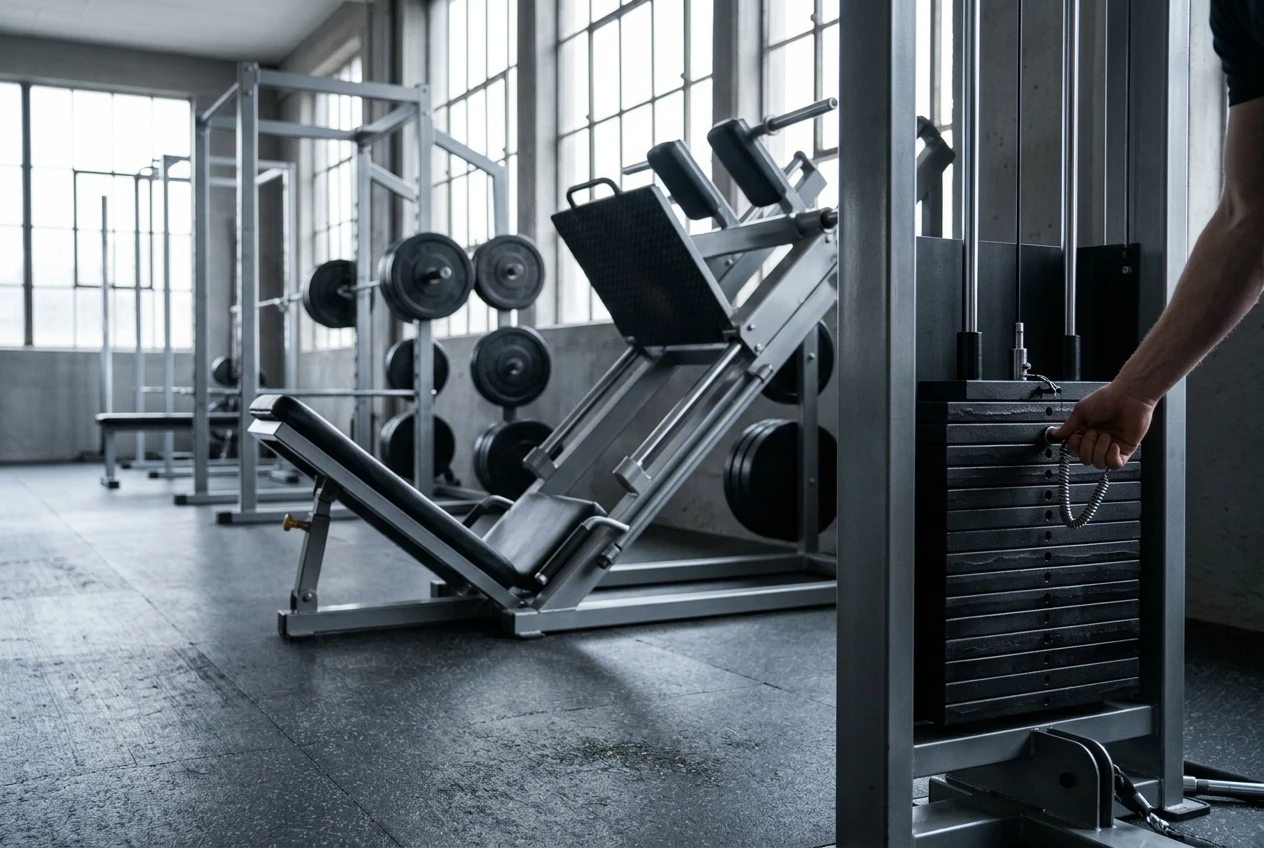
- P, Painful: Does the exercise cause you consistent pain in your joints during or after training? Sharp or persistent pain means swap the exercise or change the angle, grip or stance.
- A, Available: Can you get to the equipment within the time and travel you have? A lift that needs a rack you wait 20 minutes for, or a gym across town, will get skipped.
- T, Time-efficient: Does the setup fit inside your session? A lift that needs 20 minutes of building a bench and bar rig loses to a close variation, such as a cable row.
- E, Enjoyable: Do you look forward to doing it? A lift you dread will cost you effort, so pick the version you will train hard and keep doing.
Fit matters too. Bone lengths, joint structure and muscle attachments differ between people, so a lift that feels natural to one lifter feels awkward to another. If an exercise fails PLATE for you, swap to a variation that targets the same muscle, such as a hack squat for a back squat or a dumbbell press for a barbell press, rather than forcing the original.
Why “muscle confusion” is a myth: unfamiliar lifts grow less
The idea that you must constantly rotate exercises to keep muscles guessing has little research behind it. A systematic review by Kassiano and colleagues (2022) looked at studies of varying exercises and found no clear advantage over keeping the same ones. Some variation can still be useful, for example to cover different muscle regions, but there is no need to change for the sake of change.
There is also a practical cost to switching often. An unfamiliar lift makes it hard to judge how close you are to failure, and it makes your numbers unreliable, since part of any early improvement is learning the movement. The first weeks on a new exercise therefore tend to produce less stimulus per set than the same exercise once you are practiced at it. A stable list of exercises also lets you see progress clearly, which matters for how to progress in bodybuilding.
A sensible approach is to keep core lifts for a full block of 8 to 12 weeks, then change one or two exercises if you have a reason: an injury, a plateau on one lift, a new piece of equipment, or boredom that threatens consistency. Enjoyment counts, and a small amount of variety that keeps you training is worth more than a perfect list you abandon.
Build your selection: the six core movements and extra guidelines
The six core movements give you complete coverage of the major muscles with a small number of exercises. For each one, pick one exercise that passes the PLATE checklist and run it as your main lift for that pattern.
- Squat pattern: a squat, hack squat or leg press. Trains the quads and glutes.
- Hinge pattern: a Romanian deadlift, hip thrust or back extension. Trains the glutes and hamstrings.
- Horizontal push: a bench press, dumbbell press or machine press. Trains the chest, front delts and triceps.
- Vertical push: an overhead press or machine shoulder press. Trains the delts and triceps.
- Horizontal pull: a chest-supported or cable row. Trains the mid-back and lats.
- Vertical pull: a pulldown or pull-up. Trains the lats and biceps.
Then add the isolation work that the multi-joint lifts leave short, using the earlier principles:
- Quads: leg extension, because the rectus femoris is under-worked by squats.
- Hamstrings: seated leg curl, for the lengthened position.
- Triceps: an overhead extension, so the long head is stretched.
- Biceps: an incline curl or similar stretched-position curl.
- Side and rear delts: lateral raises and a rear delt movement.
- Calves: a standing or seated calf raise with a full stretch at the bottom.
Extra guidelines for the selection:
- Use the PLATE check on every pick. A swap that fits you beats a better-on-paper lift that fails it.
- Cover chest and back angles. One incline and one flat press, and both a vertical and a horizontal pull, across the week.
- Prefer stable exercises for the last sets. Machines and supported rows let you reach failure without form breaking down.
- Match exercises to your weak points. If a muscle lags, give it a second, different exercise per week rather than only adding sets to the first one.
- Keep the list short. Six patterns plus a handful of isolation lifts is plenty. A longer list spreads effort thinly and makes progress harder to track.
Weekly set counts per muscle come from your volume plan, not from this page.
Exercise order: what goes first and the weak-point exception
Within a session, you perform better and push harder on the first exercises than on the last ones, because fatigue builds. That makes order a decision about where to spend your freshest effort. Use these rules:
- Start with the multi-joint lift for your highest-priority muscle. It is the most demanding exercise and benefits most from freshness.
- Do other multi-joint lifts next, in order of how much you want to grow the muscles they train.
- Finish with isolation work. These lifts are less technical and less limited by overall fatigue, so they hold up better late in a session.
- Put the exercises that train the same muscle apart. Do not run two lifts that exhaust the same muscle back to back unless that is your aim, since the second will be compromised.
The weak-point exception
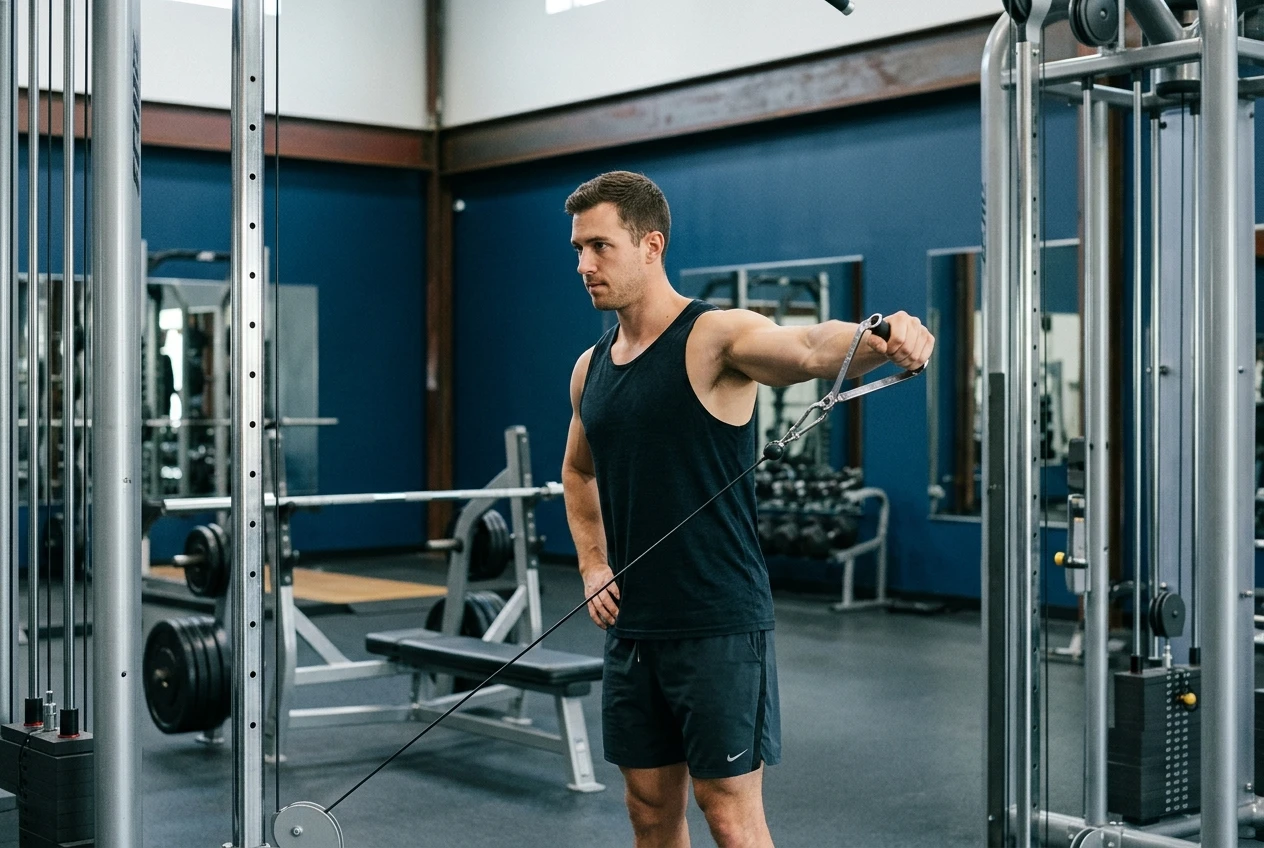
If one muscle is lagging, break the rules and train it first. Whatever comes first in the session gets the most effort, the highest-quality reps and the closest approach to failure with good technique. If your side delts are the weak point, lateral raises can open an upper-body day, ahead of presses. If your hamstrings lag, open a lower day with the seated leg curl, then move on to squats.
Use the exception for one or two muscles at a time, and rotate them if your priorities change. Putting everything first means nothing is first. It also costs something: whatever you move down loses some of its freshness, so choose the muscle you are willing to give that up for.
Sample weekly template: a 4-day upper/lower split built from the six patterns
This template uses all six patterns twice per week, with isolation work added for the muscles the multi-joint lifts leave short. Train Monday, Tuesday, Thursday and Friday, or any arrangement that puts a rest day between the two lower and upper pairs.
Treat the sets and reps as a starting point. Take multi-joint lifts to roughly 1 to 3 reps in reserve and isolation work to 0 to 2 reps in reserve, and adjust the number of sets using your volume plan. Rep ranges are suggestions, since muscle can grow across a wide range of reps as long as sets are taken close to failure.
Day 1: Upper A
- Incline dumbbell press (horizontal push, upper chest): 3 sets of 6 to 10
- Chest-supported row (horizontal pull): 3 sets of 8 to 12
- Lat pulldown (vertical pull): 3 sets of 8 to 12
- Seated dumbbell overhead press (vertical push): 2 sets of 8 to 12
- Overhead triceps extension: 3 sets of 10 to 15
- Incline dumbbell curl: 3 sets of 10 to 15
- Cable lateral raise: 3 sets of 12 to 20
Day 2: Lower A
- Hack squat or squat (squat pattern): 3 sets of 6 to 10
- Romanian deadlift (hinge): 3 sets of 8 to 10
- Leg extension: 3 sets of 10 to 15
- Seated leg curl: 3 sets of 10 to 15
- Standing calf raise: 3 sets of 8 to 12
- Cable crunch: 2 sets of 10 to 15
Day 3: Upper B
- Machine or flat dumbbell press (horizontal push): 3 sets of 8 to 12
- Pull-up or neutral-grip pulldown (vertical pull): 3 sets of 6 to 10
- Cable row with a wide elbow path (horizontal pull, upper back): 3 sets of 10 to 12
- Machine shoulder press (vertical push): 3 sets of 8 to 12
- Cable pushdown or overhead extension: 2 sets of 10 to 15
- Preacher or bayesian cable curl: 3 sets of 10 to 15
- Rear delt fly: 3 sets of 12 to 20
Day 4: Lower B
- Leg press (squat pattern): 3 sets of 8 to 12
- Hip thrust or back extension (hinge): 3 sets of 8 to 12
- Seated leg curl: 3 sets of 10 to 15
- Leg extension: 2 sets of 10 to 15
- Seated calf raise: 3 sets of 10 to 15
- Hanging leg raise or similar: 2 sets of 10 to 15
If you need to apply the weak-point exception, move that muscle’s exercise to the top of the relevant day. For progression within this template, the guide on how to progress in bodybuilding covers adding reps and load over time.
Summary table: hypertrophy exercise selection recommendations
| Decision | Recommendation | Why |
|---|---|---|
| Overall approach | Choose exercises that train the target muscle, challenge it at long lengths, and are feasible for you | These are the three principles of Level 4 for hypertrophy |
| Quads, hamstrings, triceps, biceps | Add direct single-joint work to multi-joint lifts | Biarticular muscles are not fully trained in lifts where they work against themselves across two joints |
| Hamstrings | Seated leg curl over prone | Greater growth in the lengthened position (Maeo et al., 2021) |
| Triceps | Overhead extension over arm-at-side variations | Greater growth with the long head stretched (Maeo et al., 2023) |
| Chest | Include an incline movement and a flat movement | Covers upper and lower fibers |
| Back | Use both vertical and horizontal pulls, with varied elbow paths | Covers different fiber directions |
| Limiting muscle | Pick lifts where the target muscle ends the set | A lift stimulates a muscle best when that muscle is the limiter |
| Range of motion | Full range by default | Loads the muscle at long lengths and through the whole range |
| Lengthened partials | Optional, at the end of a set, labelled emerging | Early trials are promising, but the evidence is not settled |
| Feasibility | Run each lift through PLATE: painful, loadable, available, time-efficient, enjoyable | A lift you cannot do or repeat produces nothing |
| Variation | Keep core lifts for 8 to 12 weeks | Frequent change gives no clear advantage and hides progress |
| Core selection | One exercise for each of six patterns plus isolation | Covers every major muscle with a short list |
| Order | Priority multi-joint lift first, isolation last | Early exercises get your best effort |
| Weak point | Train the lagging muscle first in the session | The first exercise gets the most effort and freshness |
Frequently asked questions
How many exercises should I do per session?
Most sessions work well with five to seven exercises, as in the template above. The number matters less than the quality of the sets, so if the later exercises are being done with low effort, cut one.
Do I need barbell squats and deadlifts to build muscle?
No. The pattern matters more than the specific lift. A leg press, hack squat or hip thrust can replace a barbell lift when it fits you better under the PLATE checklist, provided the target muscles are what ends your sets.
Should I always take lengthened partials to failure?
Lengthened partials are an emerging option, not a rule. If you try them, use them at the end of a set on exercises where the stretched position is the hardest part, and keep full range for the rest of the work.
How often should I change my exercises?
Keep your core lifts for 8 to 12 weeks. Change an exercise earlier only for pain, a clear plateau on that lift, equipment changes, or boredom severe enough to put your attendance at risk. The guide on training adherence covers how to build a program you will keep following.
Is isolation work really necessary?
For quads, hamstrings, triceps and biceps, yes, in most programs. Those muscles cross two joints and are only partly trained by presses, squats and rows. Isolation lifts also let those muscles be the limiter on the set.
What if I only train three days a week?
Keep the six patterns and spread them across the three sessions, for example a full body split where each session has one lift from each pattern and the isolation work rotates. Volume per muscle matters more than the number of days.
Do I need different exercises for men and women?
No. The principles apply to everyone. Preferences differ, and some lifters want extra glute or shoulder work, so use the weak-point exception to give any muscle you want to prioritize the first slot in a session.
What if an exercise fails the PLATE check?
Change the variation rather than skipping the muscle. Swap a barbell for dumbbells, a free weight for a machine, or a standing lift for a seated one, and keep the same pattern.
Sources and studies referenced
This page restates Level 4 (Exercise Selection, hypertrophy) of the MSP3 Pyramid framework in our own words. The framework and its reasoning belong to its authors, and the PLATE checklist and the sample template are our own application of it. Where a study is named above, the details are summarized from its published findings, and readers who want the full methods should consult the original papers.
- MSP3 Pyramid framework, Level 4: Exercise Selection, hypertrophy section.
- Maeo et al. (2021): hamstring hypertrophy after training at long versus short muscle lengths, seated versus prone leg curl.
- Maeo et al. (2023): triceps hypertrophy after elbow extension training performed overhead versus with the arm at the side.
- Plotkin et al. (2023): gluteus muscle hypertrophy after hip thrust training versus back squat training.
- Pedrosa et al. (2022): partial range of motion training at long muscle lengths compared with full range of motion.
- Kassiano et al. (2023): gastrocnemius hypertrophy after partial range of motion training at long muscle lengths.
- Wolf et al. (2023): systematic review and meta-analysis of partial versus full range of motion resistance training.
- Kassiano et al. (2022): systematic review of whether varying resistance exercises promotes greater muscle hypertrophy.
Pick one exercise per core movement pattern from this page, add the isolation work it lists, and run it for 8 to 12 weeks before changing anything.